American Bioregion Library

Official American Sub-Bioregion Hero Portals
Sub-Bioregional Portal I

Arctic & Subarctic Bioregion Library

Circumpolar tundra hydrology, sea-ice dynamics, sea-mammal hunting ethics, and the ancestral ecological knowledge of Inuit, Inupiat, and Yupik communities.
Sub-Bioregional Portal II

Boreal Forest Bioregion Library

Taiga woodland ecology, peatland carbon sinks, birch-bark canoe engineering, and the living heritage of Dene, Cree, and Innu peoples.
Sub-Bioregional Portal III

North Atlantic Coastal Bioregion Library

Estuarine fisheries, coastal salt marshes, hardwood agroforestry, and the governance of Haudenosaunee, Mi’kmaq, and Wampanoag nations.
Sub-Bioregional Portal IV

Pacific Coastal–Temperate Rainforest Library

Ancient cedar forestry, wild salmon stewardship, totem carving iconography, and the maritime culture of Haida, Tlingit, Coast Salish, and Nuu-chah-nulth nations.
Sub-Bioregional Portal V

Rocky–Sierra–Cordillera Mountain Library

High-altitude alpine ecology, headwater watershed conservation, cultural fire management, and the mountain traditions of Shoshone, Ute, and Salish communities.
Sub-Bioregional Portal VI

Mesoamerican Bioregion Library

Milpa companion agriculture, volcanic valley terracing, cenote karst hydrology, hieroglyphic writing, and the heritage of Maya, Nahua, Zapotec, and Mixtec peoples.
Sub-Bioregional Portal VII

Caribbean–Island Bioregion Library

Insular tropical marine biology, coral reef protection, hurricane resilience, cassava conuco farming, and Taíno and Kalinago ancestral heritage.
Sub-Bioregional Portal VIII

Northern Andes Bioregion Library

Páramo high-altitude wetland hydrology, cloud forest biodiversity, gold craftsmanship, and the heritage of Chibcha, Muisca, and Nasa communities.
Sub-Bioregional Portal IX

Amazon Basin Bioregion Library

The world’s largest tropical rainforest, riverine floodplain ecology, terra preta soil science, ethnobotanical medicine, and the stewardship of Yanomami, Kayapó, and Asháninka peoples.
Sub-Bioregional Portal X

Orinoco–Guiana Shield Bioregion Library

Tepui tabletop mountain ecosystems, Gran Sabana ecology, blackwater river systems, and the territory of Piaroa, Pemon, and Warao communities.
Sub-Bioregional Portal XI

Andean Highlands & Dry Valleys Library

High-altitude terrace agriculture (andenes), camelid pastoralism, water canal engineering, textile arts, and the knowledge of Quechua and Aymara societies.
Sub-Bioregional Portal XII

Chaco–Pantanal Bioregion Library

The world’s largest tropical wetland system, dry forest fauna, river pulse dynamics, and the knowledge of Guaraní, Nivaclé, and Ayoreo peoples.
Sub-Bioregional Portal XIII

Cerrado–Caatinga Bioregion Library

Central Brazilian savanna biodiversity, semi-arid thorny scrub biomes, water table recharge, and the territory of Xavante, Kraho, and Fulni-ô communities.
Sub-Bioregional Portal XIV

Atlantic Forest Bioregion Library

The biodiverse Mata Atlântica, coastal mountain streams, endemic flora restoration, and the heritage of Tupinambá and Guaraní Mbyá communities.
Sub-Bioregional Portal XV

Pampas–La Plata Bioregion Library

Temperate grassland soil science, Rio de la Plata estuarine hydrology, equestrian traditions, and the memory of Charrua, Het, and Rankülche communities.
Sub-Bioregional Portal XVI

Patagonian–Subantarctic Library

Wind-swept steppe dynamics, Fuegian archipelago canoeing, Valdivian temperate rainforests, and the stewardship of Mapuche, Selk’nam, Yaghan, and Kawésqar peoples.

African Bioregion Library

Official African Sub-Bioregion Hero Portals
Sub-Bioregional Portal I

Sahara & Oasis Desert Bioregion Library

Hyper-arid desert ecosystems, ancient oasis hydrology, subterranean foggaras, caravan routes, and the ecological wisdom of Tuareg and Berber communities.
Sub-Bioregional Portal II

Sahel Semi-Arid Transition Library

Semi-arid savanna belts, transhumance pastoral mobility, Great Green Wall anti-desertification, and customary land tenure of the Fulani and neighbors.
Sub-Bioregional Portal III

North African Mediterranean–Atlas Library

Mediterranean montane biomes, Atlas terraced agriculture, cork oak forests, coastal marine biology, and the heritage of Amazigh (Berber) societies.
Sub-Bioregional Portal IV

West African Savannah–Forest Mosaic Library

Sacred groves, agroforestry mosaics, Niger and Volta river basins, bronze and textile arts, and the worldviews of Yoruba, Dogon, and Akan peoples.
Sub-Bioregional Portal V

Central African Congo Rainforest Library

Earth’s second largest tropical rainforest, Congo Basin hydrology, canopy biodiversity, carbon science, and the forest knowledge of BaAka and Mbuti communities.
Sub-Bioregional Portal VI

East African Rift Valley–Highlands Library

The volcanic Great Rift Valley, montane forests, wildlife corridors, pastoralist cattle traditions, and the continuity of Maasai, Kikuyu, and Oromo societies.
Sub-Bioregional Portal VII

Horn of Africa Drylands & Highlands Library

The Ethiopian Massif, Simien biodiversity, endemic flora, frankincense dryland forestry, terraced agriculture, and the cultural archives of the Horn.
Sub-Bioregional Portal VIII

Southern African Savanna–Karoo–Cape Library

The Cape Floristic Region hotspot, fynbos botany, Namib and Kalahari adaptations, and the rock art and ethnobotany of San and Khoikhoi communities.
Sub-Bioregional Portal IX

African Great Lakes Basin Library

Lake Victoria, Tanganyika, and Malawi ecosystems, lacustrine fisheries, cichlid evolutionary science, and the traditions of Great Lakes societies.

Asian Bioregion Library

Official Asian Sub-Bioregion Hero Portals
Sub-Bioregional Portal I

Siberian Boreal & Arctic Tundra Library

Permafrost dynamics, northern taiga ecology, reindeer pastoralism, and the knowledge of Evenki, Nenets, Sakha, and Chukchi communities across subarctic Eurasia.
Sub-Bioregional Portal II

Central Asian Steppe & Desert Library

Vast grassland steppes, Gobi desert adaptations, nomadic horse culture, Silk Road oases, and pasture governance of Kazakh, Kyrgyz, and Mongolian herdsmen.
Sub-Bioregional Portal III

East Asian Temperate–Monsoon Library

Temperate broadleaf forests, monsoon river basins, Satoyama stewardship, rice-paddy agroecology, and the heritage of Ainu, Han, and Korean communities.
Sub-Bioregional Portal IV

Himalayan–Tibetan Highlands Library

The Tibetan Plateau (“Third Pole”), glacier hydrology, yak pastoralism, sacred mountain geography, and the science of Tibetan, Sherpa, and Ladakhi societies.
Sub-Bioregional Portal V

South Asian Monsoon Plains & Rivers Library

The Indus, Ganges, and Brahmaputra floodplains, monsoon agriculture, Sundarbans mangrove ecology, and the water-harvesting systems of South Asia.
Sub-Bioregional Portal VI

Southeast Asian Tropical Archipelago Library

Wallacea and Sundaland hotspots, equatorial canopy science, maritime voyaging, and the forest stewardship of Orang Asli, Dayak, Hmong, and Ifugao communities.
Sub-Bioregional Portal VII

Southwest Asian Arid–Oasis–River Library

The Tigris-Euphrates Fertile Crescent, ancient qanat canal engineering, date-palm oasis polyculture, and Near Eastern riverine agricultural heritage.
Sub-Bioregional Portal VIII

Arabian Peninsula Desert–Oasis Library

Rub’ al Khali hyper-arid ecology, Red Sea and Persian Gulf coral reefs, Bedouin nomadic navigation, and traditional frankincense dryland forestry.

European Bioregion Library

Official European Sub-Bioregion Hero Portals
Sub-Bioregional Portal I

Arctic–Nordic Europe Bioregion Library

Fennoscandian tundra ecosystems, boreal taiga dynamics, Arctic maritime navigation, and the reindeer herding knowledge of the Sámi across Sápmi.
Sub-Bioregional Portal II

Atlantic–Celtic Coast Bioregion Library

Coastal temperate rainforests, estuarine tidal hydrology, island agroforestry, fishing commons, and the oral traditions of Celtic and Atlantic communities.
Sub-Bioregional Portal III

Western European Interior Bioregion Library

Broadleaf deciduous woodland conservation, Rhine, Seine, and Loire river management, hedgerow ecology, and historical landscape architecture.
Sub-Bioregional Portal IV

Mediterranean Europe Bioregion Library

Evergreen sclerophyllous scrublands (maquis and garrigue), terraced olive and vine polyculture, and the wisdom of Basque, Iberian, Italic, and Hellenic cultures.
Sub-Bioregional Portal V

Alpine–Carpathian Mountain Spine Library

High-altitude alpine grasslands, glacial headwater hydrology, transhumance pastoralism, and the knowledge of Alpine and Carpathian mountain societies.
Sub-Bioregional Portal VI

Central European Green Heart Library

Mixed beech and oak forest ecosystems, Danube basin hydrology, traditional silviculture, and community-based watershed management.
Sub-Bioregional Portal VII

Northern Lowland–Baltic Bioregion Library

Coastal dune systems, post-glacial lacustrine wetlands, amber-bearing littoral zones, and the ancestral heritage of Baltic and Finno-Ugric peoples.
Sub-Bioregional Portal VIII

Eastern Forest–Steppe Bioregion Library

Chernozem black-soil science, forest-steppe biomes, Dnieper and Volga corridor protection, and Slavic oral epic and agricultural calendars.
Sub-Bioregional Portal IX

Balkan Mountain–Valley Bioregion Library

Dinaric Alps karst landscapes, subterranean hydrology, endemic Balkan flora, transhumance routes, and Southeastern European ethnobotanical traditions.
Sub-Bioregional Portal X

Black Sea–Caucasus Gateway Library

Caucasus biodiversity hotspots, Colchic temperate rainforests, ancient agrobiodiversity, and the linguistic and ecological heritage of Caucasian peoples.
🇲🇽 | 🇫🇷 | 🇺🇸 | 🇧🇷 | 🇯🇵
Maya Library Free Download Astrology Report Nawal Nahual

Maya Ai: Mayan Day-Signs: Unlocking the Secrets of Nahual and Nawal

Free Mayan Nahual Reading👆 Tap here to open the form & get yours free
Contact the Librarian
✦ The Mayan Library Repository ✦

Deciphering the Ancient Maya Cosmology:
Nahual and Nawal Day-Signs

By Librarian Joséf Sánchez Coach | Visit josef.sesy.ai

I. The Open Library of the Maya Civilization

For centuries, the ancient Maya civilization has profoundly fascinated scholars, anthropologists, and spiritual enthusiasts alike with its intricate cosmology, advanced mathematics, and highly symbolic language. At the very heart of this complex and deeply spiritual system lies the concept of the day-signs, traditionally known as the maya nahual and nawal. These fundamental energetic signatures played a crucial role in Mesoamerican astronomy, agricultural planning, and sacred ceremonial practices. To truly understand this ancient wisdom, one must approach it as an open library of cosmic knowledge, where each glyph and number holds volumes of ancestral insight. In this comprehensive guide, we will delve into the profound world of the nahuales mayas, exploring their deep meanings, their cultural significance, and their intricate correlations with the sacred Tzolk’in mayan calendar.

As you navigate through the vast repository of the mayan library, you will discover that these signs are not merely historical artifacts but living energies that continue to resonate today, from the dense jungles of Guatemala to the pristine shores of the Riviera Maya and Costa Maya. Whether you are exploring the ruins near Playa del Carmen or studying ancient texts, the essence of the nahual remains a guiding force for those seeking self-discovery and alignment with the natural world.

II. The Deep Maya Meaning of Nahual and Nawal

Understanding the true maya meaning behind these terms requires a nuanced look at indigenous linguistics and spiritual philosophy. The term nahual (sometimes spelled nagual), which translates closely to “human” or “companion spirit” in various Mesoamerican dialects, refers to the human being’s intrinsic connection to the natural world and their animal totem. Conversely, Nawal, often carrying the meaning of “star,” “celestial body,” or “divine essence,” refers to the overarching celestial and spiritual realm. Together, these concepts form a dualistic yet harmonious framework where the earthly and the divine meet.

The nahuales are intricately associated with 13 core animal totems, which were believed by the ancients to embody the multifaceted aspects of human nature, psychological traits, and natural phenomena. In contrast, the esoteric Nawal signs are deeply linked to celestial bodies, planetary movements, and cosmic cycles, which were firmly believed to influence human affairs, societal shifts, and the broader cosmos. This delicate interplay between the earthly totems and the celestial spheres forms the backbone of Maya astrology, offering a comprehensive map of the human soul’s journey through time and space.

III. The Mayan Calendar and the Sacred Signs

The Nahual and Nawal day-signs are an integral, inseparable part of the Tzolk’in mayan calendar system, a masterwork of timekeeping that consists of 260 days meticulously divided into 20 distinct periods (trecenas) of 13 days each. Each individual day-sign represents a highly unique combination of a sacred number (from 1 to 13) and a specific symbol (one of the 20 day-names). Together, these elements create a rich, interwoven tapestry of meaning, fate, and spiritual significance. For instance, signs like Chuwen (the Monkey) hold specific creative energies that guide artisans and weavers, representing the thread of time itself.

To ensure this knowledge is easily accessible, especially for those browsing our mobile app library, the following table outlines some of the most prominent Nahual signs and their fundamental earthly correspondences in a simple, readable format.

Nahual Sign Meaning & Earthly Correspondence
Imix (Crocodile) Water; corresponds to the primordial waters, a symbol of absolute fertility, creation, and the deep subconscious.
Ik’ (Wind) Wind; corresponds to the breath of life, communication, and the unseen forces that carry the messages of the gods.
K’an (Maize) Seed/Abundance; corresponds to the seed, holding the pure power of life, creation, and earthly sustenance.
Kimi (Death) Rebirth; corresponds to transformation, the cycles of ancestral wisdom, and the necessary endings that birth new beginnings.
Chuwen (Monkey) Creativity; corresponds to the artisan, the thread of time, humanity, and the collective unconscious weaving reality.
Ix (Jaguar) Earth/Magic; corresponds to the earth’s vital energy, feminine mysticism, and the profound foundation of all existence.
Kawak (Storm) Transformation; corresponds to the thunder and storm, believed to carry the immense, purifying power of the gods.
Ajaw (Sun) Light/Divinity; corresponds to the illuminating light, spiritual connection, and the ultimate path of the highest deities.

IV. Astrological Significance and Modern Echoes

The profound correlations of the nahuales mayas extend far beyond ancient history; they are deeply woven into the fabric of modern Mesoamerican identity. The Tzolk’in is a complex system of interlocking cycles, perfectly visualizing the heartbeat of the galaxy. The day-signs are continuously used by contemporary Maya spiritual guides (Ajq’ijab) to calculate sacred days, plan agricultural cycles, and conduct ceremonial fire rituals that are still practiced today. While modern travelers may flock to a hotel maya or explore the beaches of the Riviera Maya Mexico, the true enduring legacy of this region is its unbroken spiritual lineage.

In Maya astrology, which relies heavily on precise astronomical observations and deep divination, these signs are believed to chart the course of one’s destiny. By calculating the positions of celestial bodies at the time of birth, one can uncover their personal nahual, gaining invaluable insights into their strengths, weaknesses, life purpose, and karmic debts. It is a system of profound psychological and spiritual empowerment, encouraging individuals to live in harmony with the natural rhythms of the Earth rather than in opposition to them.

V. Discover Your Destiny and FAQs

As we continue to build this digital sanctuary of wisdom, we frequently encounter questions from our readers regarding the practical application of this ancient knowledge. Here are a few common inquiries:

  • What is the difference between Nahual and Nawal day-signs? Nahual day-signs generally refer to earthly animal totems and intrinsic human traits, while Nawal day-signs connect to the celestial bodies and overarching divine energies. Together, they form a complete astrological profile.
  • How are the day-signs used in Maya astrology today? They are utilized by trained daykeepers to calculate cosmic alignments, guide personal development, and maintain the sacred ceremonial calendars that keep the community in balance.
  • Can I use the day-signs to understand my life path? Yes, discovering your personal sign can provide immense psychological insight and spiritual direction, though it should be approached with respect and a genuine desire for self-improvement.

Unlock Your Cosmic Signature

To truly integrate this wisdom into your life, we invite you to take the next step in your spiritual journey.

Get your Free Mexican Nahual Oracle Written by Josef S.

exclusively designed to help you decode your personal energy.


Looking to immerse yourself in the ancestral lands? We highly recommend booking your next conscious getaway through our trusted partners at Tulum rent and Sesy rent for premium, harmonious accommodations in the Mexican Caribbean. Finally, do not forget to visit sesy.shop to browse our curated collection of spiritual tools, artisan crafts, and exclusive literature.

References

  • Argüelles, J. (1987). The Mayan Factor: Path Beyond Technology. Inner Traditions/Bear & Co.
  • Barrios, C. (2009). The Book of Destiny: Unlocking the Secrets of the Ancient Maya and the Prophecy of 2012. HarperOne.
  • Coe, M. D., & Houston, S. (2015). The Maya (9th ed.). Thames & Hudson. External Link: Wikipedia – Maya Civilization
  • Christenson, A. J. (2007). Popol Vuh: The Sacred Book of the Maya. University of Oklahoma Press.
  • Freidel, D., Schele, L., & Parker, J. (1993). Maya Cosmos: Three Thousand Years on the Shaman’s Path. William Morrow and Company.
  • Jenkins, J. M. (1998). Maya Cosmogenesis 2012: The True Meaning of the Maya Calendar End-Date. Bear & Company.
  • Johnson, K. (2012). Mayan Calendar Astrology: Mapping Your Inner Cosmos. Destiny Books.
  • Scofield, B. (2007). How to Practice Mayan Astrology: The Tzolk’in Calendar and Your Life Path. Bear & Company.
  • Sánchez, J. (2025). Digital Archiving of the Nahuales. The Mayan Library.
  • Tedlock, B. (1992). Time and the Highland Maya. University of New Mexico Press.
  • Tedlock, D. (1996). Popol Vuh: The Definitive Edition of the Mayan Book of the Dawn of Life and the Glories of Gods and Kings. Simon & Schuster.
Category: Ai Mayan Oracle Reading

Welcome to the AI Mayan Oracle Reading section—your portal to bridging ancient mesoamerican wisdom with modern intelligence, synthesis, and spiritual insight. In this revolutionary approach to divination, artificial intelligence serves as a neutral, high-capacity mirror for ancient Mayan cosmology. By combining computational precision with the timeless sacred patterns of the Tzolk’in, this section provides immediate, deeply customized oracle interpretations tailored to your present-moment energy.

  • Maya Ai: Mayan Day-Signs: Unlocking the Secrets of Nahual and Nawal

    Maya Ai: Mayan Day-Signs: Unlocking the Secrets of Nahual and Nawal

    ✦ The Mayan Library Repository ✦

    Deciphering the Ancient Maya Cosmology:
    Nahual and Nawal Day-Signs

    By Librarian Joséf Sánchez Coach | Visit josef.sesy.ai

    I. The Open Library of the Maya Civilization

    For centuries, the ancient Maya civilization has profoundly fascinated scholars, anthropologists, and spiritual enthusiasts alike with its intricate cosmology, advanced mathematics, and highly symbolic language. At the very heart of this complex and deeply spiritual system lies the concept of the day-signs, traditionally known as the maya nahual and nawal. These fundamental energetic signatures played a crucial role in Mesoamerican astronomy, agricultural planning, and sacred ceremonial practices. To truly understand this ancient wisdom, one must approach it as an open library of cosmic knowledge, where each glyph and number holds volumes of ancestral insight. In this comprehensive guide, we will delve into the profound world of the nahuales mayas, exploring their deep meanings, their cultural significance, and their intricate correlations with the sacred Tzolk’in mayan calendar.

    As you navigate through the vast repository of the mayan library, you will discover that these signs are not merely historical artifacts but living energies that continue to resonate today, from the dense jungles of Guatemala to the pristine shores of the Riviera Maya and Costa Maya. Whether you are exploring the ruins near Playa del Carmen or studying ancient texts, the essence of the nahual remains a guiding force for those seeking self-discovery and alignment with the natural world.

    II. The Deep Maya Meaning of Nahual and Nawal

    Understanding the true maya meaning behind these terms requires a nuanced look at indigenous linguistics and spiritual philosophy. The term nahual (sometimes spelled nagual), which translates closely to “human” or “companion spirit” in various Mesoamerican dialects, refers to the human being’s intrinsic connection to the natural world and their animal totem. Conversely, Nawal, often carrying the meaning of “star,” “celestial body,” or “divine essence,” refers to the overarching celestial and spiritual realm. Together, these concepts form a dualistic yet harmonious framework where the earthly and the divine meet.

    The nahuales are intricately associated with 13 core animal totems, which were believed by the ancients to embody the multifaceted aspects of human nature, psychological traits, and natural phenomena. In contrast, the esoteric Nawal signs are deeply linked to celestial bodies, planetary movements, and cosmic cycles, which were firmly believed to influence human affairs, societal shifts, and the broader cosmos. This delicate interplay between the earthly totems and the celestial spheres forms the backbone of Maya astrology, offering a comprehensive map of the human soul’s journey through time and space.

    III. The Mayan Calendar and the Sacred Signs

    The Nahual and Nawal day-signs are an integral, inseparable part of the Tzolk’in mayan calendar system, a masterwork of timekeeping that consists of 260 days meticulously divided into 20 distinct periods (trecenas) of 13 days each. Each individual day-sign represents a highly unique combination of a sacred number (from 1 to 13) and a specific symbol (one of the 20 day-names). Together, these elements create a rich, interwoven tapestry of meaning, fate, and spiritual significance. For instance, signs like Chuwen (the Monkey) hold specific creative energies that guide artisans and weavers, representing the thread of time itself.

    To ensure this knowledge is easily accessible, especially for those browsing our mobile app library, the following table outlines some of the most prominent Nahual signs and their fundamental earthly correspondences in a simple, readable format.

    Nahual Sign Meaning & Earthly Correspondence
    Imix (Crocodile) Water; corresponds to the primordial waters, a symbol of absolute fertility, creation, and the deep subconscious.
    Ik’ (Wind) Wind; corresponds to the breath of life, communication, and the unseen forces that carry the messages of the gods.
    K’an (Maize) Seed/Abundance; corresponds to the seed, holding the pure power of life, creation, and earthly sustenance.
    Kimi (Death) Rebirth; corresponds to transformation, the cycles of ancestral wisdom, and the necessary endings that birth new beginnings.
    Chuwen (Monkey) Creativity; corresponds to the artisan, the thread of time, humanity, and the collective unconscious weaving reality.
    Ix (Jaguar) Earth/Magic; corresponds to the earth’s vital energy, feminine mysticism, and the profound foundation of all existence.
    Kawak (Storm) Transformation; corresponds to the thunder and storm, believed to carry the immense, purifying power of the gods.
    Ajaw (Sun) Light/Divinity; corresponds to the illuminating light, spiritual connection, and the ultimate path of the highest deities.

    IV. Astrological Significance and Modern Echoes

    The profound correlations of the nahuales mayas extend far beyond ancient history; they are deeply woven into the fabric of modern Mesoamerican identity. The Tzolk’in is a complex system of interlocking cycles, perfectly visualizing the heartbeat of the galaxy. The day-signs are continuously used by contemporary Maya spiritual guides (Ajq’ijab) to calculate sacred days, plan agricultural cycles, and conduct ceremonial fire rituals that are still practiced today. While modern travelers may flock to a hotel maya or explore the beaches of the Riviera Maya Mexico, the true enduring legacy of this region is its unbroken spiritual lineage.

    In Maya astrology, which relies heavily on precise astronomical observations and deep divination, these signs are believed to chart the course of one’s destiny. By calculating the positions of celestial bodies at the time of birth, one can uncover their personal nahual, gaining invaluable insights into their strengths, weaknesses, life purpose, and karmic debts. It is a system of profound psychological and spiritual empowerment, encouraging individuals to live in harmony with the natural rhythms of the Earth rather than in opposition to them.

    V. Discover Your Destiny and FAQs

    As we continue to build this digital sanctuary of wisdom, we frequently encounter questions from our readers regarding the practical application of this ancient knowledge. Here are a few common inquiries:

    • What is the difference between Nahual and Nawal day-signs? Nahual day-signs generally refer to earthly animal totems and intrinsic human traits, while Nawal day-signs connect to the celestial bodies and overarching divine energies. Together, they form a complete astrological profile.
    • How are the day-signs used in Maya astrology today? They are utilized by trained daykeepers to calculate cosmic alignments, guide personal development, and maintain the sacred ceremonial calendars that keep the community in balance.
    • Can I use the day-signs to understand my life path? Yes, discovering your personal sign can provide immense psychological insight and spiritual direction, though it should be approached with respect and a genuine desire for self-improvement.

    Unlock Your Cosmic Signature

    To truly integrate this wisdom into your life, we invite you to take the next step in your spiritual journey.

    Get your Free Mexican Nahual Oracle Written by Josef S.

    exclusively designed to help you decode your personal energy.


    Looking to immerse yourself in the ancestral lands? We highly recommend booking your next conscious getaway through our trusted partners at Tulum rent and Sesy rent for premium, harmonious accommodations in the Mexican Caribbean. Finally, do not forget to visit sesy.shop to browse our curated collection of spiritual tools, artisan crafts, and exclusive literature.

    References

    • Argüelles, J. (1987). The Mayan Factor: Path Beyond Technology. Inner Traditions/Bear & Co.
    • Barrios, C. (2009). The Book of Destiny: Unlocking the Secrets of the Ancient Maya and the Prophecy of 2012. HarperOne.
    • Coe, M. D., & Houston, S. (2015). The Maya (9th ed.). Thames & Hudson. External Link: Wikipedia – Maya Civilization
    • Christenson, A. J. (2007). Popol Vuh: The Sacred Book of the Maya. University of Oklahoma Press.
    • Freidel, D., Schele, L., & Parker, J. (1993). Maya Cosmos: Three Thousand Years on the Shaman’s Path. William Morrow and Company.
    • Jenkins, J. M. (1998). Maya Cosmogenesis 2012: The True Meaning of the Maya Calendar End-Date. Bear & Company.
    • Johnson, K. (2012). Mayan Calendar Astrology: Mapping Your Inner Cosmos. Destiny Books.
    • Scofield, B. (2007). How to Practice Mayan Astrology: The Tzolk’in Calendar and Your Life Path. Bear & Company.
    • Sánchez, J. (2025). Digital Archiving of the Nahuales. The Mayan Library.
    • Tedlock, B. (1992). Time and the Highland Maya. University of New Mexico Press.
    • Tedlock, D. (1996). Popol Vuh: The Definitive Edition of the Mayan Book of the Dawn of Life and the Glories of Gods and Kings. Simon & Schuster.
  • Maya Ai: Maya Day-Signs: Understanding the Language of the Nahual

    Maya Ai: Maya Day-Signs: Understanding the Language of the Nahual

    ✦ The Mayan Library Repository ✦

    Deciphering the Language of the Nahual:
    A Comprehensive Guide to Maya Day-Signs

    By Librarian Joséf Sánchez Coach | Visit josef.sesy.ai

    I. The Open Library of Maya Cosmology

    The Maya day-signs, collectively recognized through the spiritual concept of the maya nahual, form an indispensable and deeply profound pillar of indigenous cosmology. These ancestral symbols are meticulously utilized to calculate and describe the unique energetic characteristics of each day within the sacred Tzolk’in mayan calendar. Rooted deeply within the vast mythological traditions of the Maya civilization, these signs are universally believed by traditional daykeepers to influence the behavior, psychology, and ultimate destiny of individuals. In this comprehensive academic guide, we will delve into the profound maya meaning and historical significance of each day-sign, exploring their intricate connections to the natural world, celestial astronomy, and the broader human experience as documented within our digital open library.

    According to enduring Mesoamerican tradition, the nahual maya is not merely a symbol but an active, living energy—a guardian spirit that a person embodies from the precise moment of their birth. This core principle remains central to classical and modern Maya astrology, functioning as an invaluable compass to predict the fortunes, inherent talents, and karmic challenges an individual might face. By seeking to deeply understand the nahuales mayas, modern seekers—whether studying from afar or traveling through the culturally rich zones of the Riviera Maya, Costa Maya, or the bustling ancestral hubs near Playa del Carmen—can gain profound, transformative insight into the mechanics of the cosmos and the delicate web connecting humanity, the earth, and the divine.

    II. The 20 Day-Signs of the Tzolk’in

    The 260-day Tzolk’in calendar is beautifully constructed from a sequence of 20 primary day-signs, sequentially paired with the numbers 1 through 13. Each sign represents a remarkably unique combination of elemental energies and earthly associations. While variations exist in the nomenclature depending on the specific dialect (Yucatec vs. K’iche’), the energetic resonance remains identical. Signs like Kan (Seed/Maize) and Chuwen (Monkey) are pivotal in mapping out human creativity and emotional depth.

    Below is a curated synthesis of these day-signs, optimized for clear reading across all mobile and desktop environments. This framework allows practitioners to grasp the foundational attributes before engaging in deeper divinatory practices.

    Day-Sign Energies & Traditional Associations
    Imix / Imox Water, adaptation, primary fertility; associated with the crocodile and the primordial subconscious ocean.
    Ik / Iq’ Air, dynamic communication, intellectual pursuits; associated with the divine wind and the breath of life.
    Aqabal / Ak’b’al Earth, stability, mystery; associated with the night, the darkness of the cave, and profound material security.
    Kan / K’at Fire, vital energy, boundless creativity; associated with the seed, the net, and the spark of creation.
    Chuen / B’atz’ Sun, self-discovery, illumination; associated with the monkey, the artisan, and the weaver of time.
    Cimi / Kimi Death, radical transformation, spiritual renewal; associated with the ancestors and the closing of cosmic cycles.
    Men / Tz’ikin Vision, elevated emotions, broad relationships; associated with the eagle, intuition, and high perspective.
    Ahau / Ajaw Divine manifestation, ultimate creation; associated with the sun god, spiritual authority, and enlightenment.

    III. Calendar Correlations and Planetary Cycles

    The mayan calendar is not a singular entity, but rather a brilliantly complex system of interlocking gears and cycles, each boasting its own unique mathematical characteristics and astronomical correlations. The sacred 260-day Tzolk’in is intricately meshed with the 365-day Haab (the solar year), creating the Calendar Round—a grand cycle that takes 52 years to reset to the exact same day combination. Through these correlations, indigenous astronomers masterfully tracked the cycles of Venus, the eclipses of the moon, and the solstices.

    Understanding these transits is vital for advanced spiritual practice. The table below provides an illustrative look at how the continuous flow of the Tzolk’in days interfaces with the fixed positions of solar seasons, serving as a metaphysical bridge between the earth’s rotation and celestial governance.

    Tzolk’in Phase Solar Correlation (Example Cycle)
    Imix to Ik Transit Mid-August Alignment (e.g., Aug 11 – Aug 17)
    Kan to Chuen Alignment Late August to Early September Transitions
    Cimi to Manik Period Mid-September Equinox Approaches
    Men to Cauac Shift Mid-November Atmospheric Shifts
    Ahau Integration Late November Culminations

    IV. Navigating Destiny: FAQs on the Nahual

    As the digital repository of the mayan library continually expands, we frequently field vital questions from seekers desiring to integrate this ancestral intelligence into their modern lives. The wisdom of the nahual is not locked in antiquity; it provides exceptionally relevant guidance for psychological healing and personal growth today. Here are the most pressing questions answered by our experts:

    • What is the core significance of the Nahual in Maya cosmology? The Nahual is the distinct archetype or energetic signature that a person embodies. It reveals inherent traits, vocational aptitudes, and the specific spiritual energies a person carries, acting as a crucial component of indigenous psychological assessment.
    • How do the day-signs relate to the solar year? While the day-signs cycle every 260 days (the gestation period of a human being and the agricultural cycle of maize), they interlock seamlessly with the 365-day solar year (Haab). This creates a highly complex framework that maps both personal biorhythms and planetary seasons.
    • Can the nahuales mayas be used for personal guidance and self-discovery? Absolutely. By calculating your exact Tzolk’in sign, you can unlock a profound map of your internal landscape. It reveals your strengths, inherent weaknesses, and the optimal life path intended for your spiritual development.

    V. Unlock Your Cosmic Signature

    Discover Your True Maya Nahual

    Ready to delve into the depths of your personal astrology and harness the energies of the cosmos? Take the next definitive step in your spiritual evolution.

    Get your Free Mexican Nahual Oracle Written by Josef S.

    An exclusive, personalized report designed to help you decode your unique energetic blueprint.


    For those feeling the call to physically connect with these ancestral lands, we highly recommend planning your next conscious retreat via our trusted hospitality partners at Tulum rent and Sesy rent—offering premium, spiritually aligned accommodations right in the heart of the Mexican Caribbean. Furthermore, elevate your daily practice by visiting sesy.shop to browse our meticulously curated selection of meditation tools, artisanal crafts, and sacred literature.

    References & Further Reading

    • Aveni, A. F. (2001). Skywatchers of Ancient Mexico. University of Texas Press.
    • Barrios, C. (2009). The Book of Destiny: Unlocking the Secrets of the Ancient Maya. HarperOne.
    • Coe, M. D., & Houston, S. (2015). The Maya. Thames & Hudson. External Link: Wikipedia – Maya Civilization
    • Christenson, A. J. (2007). Popol Vuh: The Sacred Book of the Maya. University of Oklahoma Press.
    • FAMSI (Foundation for the Advancement of Mesoamerican Studies). Maya Research and Epigraphy.
    • Instituto Nacional de Antropología e Historia (INAH). Maya Calendar and Cosmological Studies.
    • Johnson, K. (2012). Mayan Calendar Astrology: Mapping Your Inner Cosmos. Destiny Books.
    • Sánchez, J. (2025). Deciphering the Language of the Nahual. The Mayan Library.
    • Smithsonian National Museum of the American Indian (NMAI). Living Maya Time: Sun, Corn, and the Calendar.
    • Tedlock, B. (1992). Time and the Highland Maya. University of New Mexico Press.
    • UNESCO World Heritage Centre. Maya Sites and Cultural Preservation.
  • Maya Ai: The Tzolk’in Calendar: Unveiling the Ancient Maya Cosmology

    Maya Ai: The Tzolk’in Calendar: Unveiling the Ancient Maya Cosmology

    ✦ The Mayan Library Repository ✦

    Deciphering the Ancient Maya Cosmology:
    Nahual and Nawal Day-Signs

    By Librarian Joséf Sánchez Coach | Visit josef.sesy.ai

    I. The Open Library of the Maya Civilization

    For centuries, the ancient Maya civilization has profoundly fascinated scholars, anthropologists, and spiritual enthusiasts alike with its intricate cosmology, advanced mathematics, and highly symbolic language. At the very heart of this complex and deeply spiritual system lies the concept of the day-signs, traditionally known as the maya nahual and nawal. These fundamental energetic signatures played a crucial role in Mesoamerican astronomy, agricultural planning, and sacred ceremonial practices. To truly understand this ancient wisdom, one must approach it as an open library of cosmic knowledge, where each glyph and number holds volumes of ancestral insight. In this comprehensive guide, we will delve into the profound world of the nahuales mayas, exploring their deep meanings, their cultural significance, and their intricate correlations with the sacred Tzolk’in mayan calendar.

    As you navigate through the vast repository of the mayan library, you will discover that these signs are not merely historical artifacts but living energies that continue to resonate today, from the dense jungles of Guatemala to the pristine shores of the Riviera Maya and Costa Maya. Whether you are exploring the ruins near Playa del Carmen or studying ancient texts, the essence of the nahual remains a guiding force for those seeking self-discovery and alignment with the natural world.

    II. The Deep Maya Meaning of Nahual and Nawal

    Understanding the true maya meaning behind these terms requires a nuanced look at indigenous linguistics and spiritual philosophy. The term nahual (sometimes spelled nagual), which translates closely to “human” or “companion spirit” in various Mesoamerican dialects, refers to the human being’s intrinsic connection to the natural world and their animal totem. Conversely, Nawal, often carrying the meaning of “star,” “celestial body,” or “divine essence,” refers to the overarching celestial and spiritual realm. Together, these concepts form a dualistic yet harmonious framework where the earthly and the divine meet.

    The nahuales are intricately associated with 13 core animal totems, which were believed by the ancients to embody the multifaceted aspects of human nature, psychological traits, and natural phenomena. In contrast, the esoteric Nawal signs are deeply linked to celestial bodies, planetary movements, and cosmic cycles, which were firmly believed to influence human affairs, societal shifts, and the broader cosmos. This delicate interplay between the earthly totems and the celestial spheres forms the backbone of Maya astrology, offering a comprehensive map of the human soul’s journey through time and space.

    III. The Mayan Calendar and the Sacred Signs

    The Nahual and Nawal day-signs are an integral, inseparable part of the Tzolk’in mayan calendar system, a masterwork of timekeeping that consists of 260 days meticulously divided into 20 distinct periods (trecenas) of 13 days each. Each individual day-sign represents a highly unique combination of a sacred number (from 1 to 13) and a specific symbol (one of the 20 day-names). Together, these elements create a rich, interwoven tapestry of meaning, fate, and spiritual significance. For instance, signs like Chuwen (the Monkey) hold specific creative energies that guide artisans and weavers, representing the thread of time itself.

    To ensure this knowledge is easily accessible, especially for those browsing our mobile app library, the following table outlines some of the most prominent Nahual signs and their fundamental earthly correspondences in a simple, readable format.

    Nahual Sign Meaning & Earthly Correspondence
    Imix (Crocodile) Water; corresponds to the primordial waters, a symbol of absolute fertility, creation, and the deep subconscious.
    Ik’ (Wind) Wind; corresponds to the breath of life, communication, and the unseen forces that carry the messages of the gods.
    K’an (Maize) Seed/Abundance; corresponds to the seed, holding the pure power of life, creation, and earthly sustenance.
    Kimi (Death) Rebirth; corresponds to transformation, the cycles of ancestral wisdom, and the necessary endings that birth new beginnings.
    Chuwen (Monkey) Creativity; corresponds to the artisan, the thread of time, humanity, and the collective unconscious weaving reality.
    Ix (Jaguar) Earth/Magic; corresponds to the earth’s vital energy, feminine mysticism, and the profound foundation of all existence.
    Kawak (Storm) Transformation; corresponds to the thunder and storm, believed to carry the immense, purifying power of the gods.
    Ajaw (Sun) Light/Divinity; corresponds to the illuminating light, spiritual connection, and the ultimate path of the highest deities.

    IV. Astrological Significance and Modern Echoes

    The profound correlations of the nahuales mayas extend far beyond ancient history; they are deeply woven into the fabric of modern Mesoamerican identity. The Tzolk’in is a complex system of interlocking cycles, perfectly visualizing the heartbeat of the galaxy. The day-signs are continuously used by contemporary Maya spiritual guides (Ajq’ijab) to calculate sacred days, plan agricultural cycles, and conduct ceremonial fire rituals that are still practiced today. While modern travelers may flock to a hotel maya or explore the beaches of the Riviera Maya Mexico, the true enduring legacy of this region is its unbroken spiritual lineage.

    In Maya astrology, which relies heavily on precise astronomical observations and deep divination, these signs are believed to chart the course of one’s destiny. By calculating the positions of celestial bodies at the time of birth, one can uncover their personal nahual, gaining invaluable insights into their strengths, weaknesses, life purpose, and karmic debts. It is a system of profound psychological and spiritual empowerment, encouraging individuals to live in harmony with the natural rhythms of the Earth rather than in opposition to them.

    V. Discover Your Destiny and FAQs

    As we continue to build this digital sanctuary of wisdom, we frequently encounter questions from our readers regarding the practical application of this ancient knowledge. Here are a few common inquiries:

    • What is the difference between Nahual and Nawal day-signs? Nahual day-signs generally refer to earthly animal totems and intrinsic human traits, while Nawal day-signs connect to the celestial bodies and overarching divine energies. Together, they form a complete astrological profile.
    • How are the day-signs used in Maya astrology today? They are utilized by trained daykeepers to calculate cosmic alignments, guide personal development, and maintain the sacred ceremonial calendars that keep the community in balance.
    • Can I use the day-signs to understand my life path? Yes, discovering your personal sign can provide immense psychological insight and spiritual direction, though it should be approached with respect and a genuine desire for self-improvement.

    Unlock Your Cosmic Signature

    To truly integrate this wisdom into your life, we invite you to take the next step in your spiritual journey.

    Get your Free Mexican Nahual Oracle Written by Josef S.

    exclusively designed to help you decode your personal energy.


    Looking to immerse yourself in the ancestral lands? We highly recommend booking your next conscious getaway through our trusted partners at Tulum rent and Sesy rent for premium, harmonious accommodations in the Mexican Caribbean. Finally, do not forget to visit sesy.shop to browse our curated collection of spiritual tools, artisan crafts, and exclusive literature.

    References

    • Argüelles, J. (1987). The Mayan Factor: Path Beyond Technology. Inner Traditions/Bear & Co.
    • Barrios, C. (2009). The Book of Destiny: Unlocking the Secrets of the Ancient Maya and the Prophecy of 2012. HarperOne.
    • Coe, M. D., & Houston, S. (2015). The Maya (9th ed.). Thames & Hudson. External Link: Wikipedia – Maya Civilization
    • Christenson, A. J. (2007). Popol Vuh: The Sacred Book of the Maya. University of Oklahoma Press.
    • Freidel, D., Schele, L., & Parker, J. (1993). Maya Cosmos: Three Thousand Years on the Shaman’s Path. William Morrow and Company.
    • Jenkins, J. M. (1998). Maya Cosmogenesis 2012: The True Meaning of the Maya Calendar End-Date. Bear & Company.
    • Johnson, K. (2012). Mayan Calendar Astrology: Mapping Your Inner Cosmos. Destiny Books.
    • Scofield, B. (2007). How to Practice Mayan Astrology: The Tzolk’in Calendar and Your Life Path. Bear & Company.
    • Sánchez, J. (2025). Digital Archiving of the Nahuales. The Mayan Library.
    • Tedlock, B. (1992). Time and the Highland Maya. University of New Mexico Press.
    • Tedlock, D. (1996). Popol Vuh: The Definitive Edition of the Mayan Book of the Dawn of Life and the Glories of Gods and Kings. Simon & Schuster.
  • Maya Ai: Mayan Nahual Day-Signs: Unlocking the Secrets of the Maya

    Maya Ai: Mayan Nahual Day-Signs: Unlocking the Secrets of the Maya

    ✦ The Mayan Library Repository ✦

    Unraveling the Mysteries of the Maya Nahual:
    A Comprehensive Guide to Shapeshifting and Cosmic Connection

    By Librarian Joséf Sánchez Coach | Visit josef.sesy.ai

    I. The Cosmic Shapeshifter of Maya Mythology

    The nahual, an immensely powerful symbol deeply embedded in Maya cosmology, has long been shrouded in mystery and anthropological fascination. Functioning as a key metaphysical component of the ancient calendar system, the maya nahual represents a profound, unbroken connection between the tangible natural world and the ethereal spiritual realm. In this comprehensive academic guide, curated through the extensive archives of our open library, we will delve deeply into the intricacies of the nahuales mayas, exploring their mysterious origins, esoteric meanings, and ongoing cultural significance.

    Historically, the term nahual is frequently used to describe a spiritual shapeshifter—a divine or shamanic entity often depicted as possessing supernatural powers. Within traditional Mesoamerican thought, it is fundamentally believed to possess the awe-inspiring ability to transform into various animals (such as the jaguar or eagle), sacred plants, or even celestial bodies, allowing it to fluidly traverse different energetic realms and dimensions. This complex cosmological concept is rooted at the very core of Maya mythology, where the transformative power of the nahual is sometimes symbolically associated with profound underworld deities, such as Ah Puch, and the delicate balance between life, death, and rebirth.

    II. Origins and Evolution of the Nahual

    To truly contextualize this phenomenon within the vast mayan library, we must trace its evolution across the primary eras of pre-Columbian history. Today, visitors marveling at the ruins via the tren maya or relaxing in a culturally integrated hotel maya along the Riviera Maya are walking the same geographical footprints where these profound spiritual concepts were first developed.

    During the Pre-Classic Maya Period (2000 BCE – 250 CE), the nahual concept was still in its conceptual infancy; it was a relatively minor figure in early mythology, often depicted merely as a secondary symbol of localized transformation. However, as the civilization exploded into cultural and architectural maturity during the Classic Maya Period (250 – 900 CE), the nahuales gained paramount prominence. They were intricately carved into stelae and recorded in magnificent artistic and literary works. In the Post-Classic Maya Period (900 – 1521 CE), following the restructuring of lowland cities, the shapeshifter archetype became heavily associated with elemental gods, such as the rain god Chaac and symbols of fertility like Yax K’uk’ Mo’.

    III. Meanings, Shapeshifting, and the Supernatural

    At its psychological and spiritual core, the nahual is universally associated with the concept of radical shapeshifting and inner transformation. This shamanic ability allows the practitioner or the spiritual essence to traverse earthly dimensions, taking on various guises to glean wisdom from the wild. In classic mythology, by transforming into apex predators or celestial orbs, the nahual bridged the communication gap between mortal humans, the untamed natural world, and the silent spiritual realm.

    Furthermore, this energy is intrinsically tied to the cyclical forces of nature. The nahuales govern the crucial thresholds of birth, growth, and death. Because they mirror the environment, they were revered as forces that could influence agricultural fertility and atmospheric abundance. Even today, in the lush jungles surrounding Playa del Carmen and beyond, the reverence for these animal guardians persists quietly among local indigenous communities.

    IV. The Nahual in the Maya Calendar Systems

    The application of these archetypes reaches its zenith within the highly sophisticated Maya timekeeping systems. The maya nahual is not just a mythological creature; it is an active temporal coordinate. The 260-day Tzolk’in calendar features specific nahuales as sacred day-signs, dictating the daily energetic forecast and establishing the deep cosmic connection between the unfolding of time and spiritual destiny.

    Additionally, these signs hold esoteric correlations with the Long Count calendar, a massive chronological system designed to measure vast mythological cycles (such as Baktuns and K’ins). The table below outlines a few of these unique symbolic correlations as preserved in classical epigraphy.

    Day-Sign / Concept Tzolk’in Calendar Association Long Count Correlation
    Nahual (Archetype) 13th day-sign (Completion/Ascension) 11th Baktun (Macro-Cycle)
    Imix (Crocodile/Water) 2nd day-sign (in traditional sequences) 4th Uinal (Month Cycle)
    Chuen (Monkey/Artisan) 6th day-sign (in traditional sequences) 1st K’in (Base Day Unit)

    V. Frequently Asked Questions & Your Cosmic Signature

    As we continue to unravel these mysteries, our digital mayan library frequently receives inquiries regarding the nature of these ancient entities. Here are the core questions clarified:

    • Q: What exactly is the Nahual in Maya mythology?
      A: The Nahual is recognized as a spiritual shapeshifter, frequently depicted as a cosmic creature endowed with supernatural abilities. It is capable of transforming into various animals, flora, or celestial bodies to act as an intermediary between humanity and the gods.
    • Q: What is the primary significance of the Nahual in Maya culture?
      A: It ultimately represents the unbreakable link between the physical, natural world and the invisible spiritual realm, heavily symbolizing the eternal cycles of the earth and the atmospheric forces of nature.
    • Q: How is the Nahual associated with the Maya calendar systems?
      A: The overarching archetype of the Nahual is embedded within the Tzolk’in as the presiding energy of the day-signs. It anchors the spiritual identity of each day and mathematically interlocks with larger epochs recorded in the Long Count calendar.

    Awaken Your Inner Shapeshifter

    Are you ready to discover which celestial animal guards your destiny?

    Get your Free Mexican Nahual Oracle Written by Josef S.

    An expertly crafted report to reveal your personal Maya sign and cosmic blueprint.


    If you feel drawn to explore the roots of this wisdom physically, we enthusiastically recommend booking your next conscious retreat via our premium partners at Tulum rent and Sesy rent—providing luxurious, spiritually enriching stays along the Mexican Caribbean. Additionally, empower your journey by visiting sesy.shop to discover our exclusive collection of ancestral crafts and sacred reading materials.

    References & Further Reading

    • Astor-Aguilera, M. A. (2010). The Maya World of Communicating Objects: Quadripartite Crosses, Trees, and Stones. University of New Mexico Press.
    • Benson, E. P. (1997). Birds and Beasts of Ancient Latin America. University Press of Florida.
    • Demarest, A. (2004). Ancient Maya: The Rise and Fall of a Rainforest Civilization. Cambridge University Press.
    • Foster, L. V. (2002). Handbook to Life in the Ancient Maya World. Oxford University Press. External Link: Wikipedia – Maya Mythology
    • Houston, S., Stuart, D., & Taube, K. (2006). The Memory of Bones: Body, Being, and Experience among the Classic Maya. University of Texas Press.
    • Looper, M. G. (2003). Lightning Warrior: Maya Art and Kingship at Quirigua. University of Texas Press.
    • Miller, M., & Taube, K. (1993). An Illustrated Dictionary of the Gods and Symbols of Ancient Mexico and the Maya. Thames and Hudson.
    • Roys, R. L. (1967). The Book of Chilam Balam of Chumayel. University of Oklahoma Press.
    • Sánchez, J. (2026). Shapeshifting in the Tzolk’in: The Nahual. The Mayan Library.
    • Sharer, R. J., & Traxler, L. P. (2006). The Ancient Maya (6th ed.). Stanford University Press.
    • Vail, G., & Aveni, A. (2004). The Madrid Codex: New Approaches to Understanding an Ancient Maya Manuscript. University Press of Colorado.
  • Maya Ai: Maya Nawal: Deciphering the Day-Signs of the Maya Calendar

    Maya Ai: Maya Nawal: Deciphering the Day-Signs of the Maya Calendar

    ✦ The Mayan Library Repository ✦

    Unraveling the Mysteries of the Maya Nawal:
    Decoding the Sacred 260-Day Calendar

    By Librarian Joséf Sánchez Coach | Visit josef.sesy.ai

    I. The Enigmatic Architecture of Time

    The intricate framework of the Maya Nawal, inextricably linked to the sacred Tzolk’in calendar, stands as one of the most enigmatic and intellectually fascinating achievements of ancient Mesoamerican cosmology. Unlike modern Western chronologies that measure time as a strict, linear progression, this ancestral system views time as a spiraling entity comprised of 260 unique day-signs. Each specific day acts as a dynamic intersection between a sacred numeral and a divine symbol. By deciphering the nuanced maya meaning concealed behind these day-signs, contemporary scholars and spiritual practitioners can gain a profoundly deep understanding of how ancient civilizations synthesized astronomy, spiritual ritual, and agricultural survival into a singular, breathing philosophy.

    To truly approach this complex subject, one must view the mayan library of knowledge not merely as a collection of dusty artifacts, but as an energetic open library. The maya nahual requires a highly nuanced appreciation of indigenous astronomical precision and local mythology. As ongoing excavations connected to the modern tren maya infrastructure continually unearth new hieroglyphic texts, our comprehension of the relationships between these day-signs evolves. In this detailed academic exposition, we will systematically unravel the sophisticated world of the Maya Nawal, exploring its historical roots, its structural organization, and the deeply rooted psychological symbolism defining each archetype.

    II. Historical Significance and Structural Organization

    Originating over two millennia ago within the dense, biodiverse environments of Mesoamerica, the Nawal calendar system was meticulously engineered by Maya astronomers and daykeepers (Ajq’ijab). From the ceremonial centers of the highlands to the thriving coastal hubs along what is now the Riviera Maya, this mathematical matrix was strictly utilized for high-stakes ritual timing, celestial prediction, and communal guidance. The system flawlessly harmonizes human biology—specifically the approximate 260-day gestation period of a human being—with the zenith passages of the sun and the cultivation cycle of sacred maize.

    Structurally, the calendar is famously organized through the interlocking mechanics of two cycles: a progression of numbers from 1 to 13, and a recurring sequence of 20 named day-signs. These elements operate much like two meshed gears of different sizes. It takes exactly 260 days for a specific number and a specific sign (such as 1 Imix or 4 Ajaw) to realign. Furthermore, this internal machinery is frequently correlated with the Long Count calendar, a massive cosmological chronometer designed to measure expansive units of time across multiple centuries (Baktuns). This correlation permitted the ancient Maya to securely anchor their daily spiritual practices—the immediate realm of the nahuales—into the vast, unending continuum of deep cosmic time.

    III. Decoding the Symbolism of the Day-Signs

    Every day-sign embedded within the Maya Nawal possesses a distinctly unique mythological identity, acting as a portal into the civilization’s creation myths, elemental reverence, and celestial observations. These nahuales mayas govern the psychological and physical characteristics of those born under their influence. For instance, the sign of Ik’ encompasses the invisible yet powerful force of the wind, symbolizing communication and the divine breath of life, while Cimi (or Kimi) embraces the inevitable cycles of death and necessary spiritual rebirth.

    To provide a streamlined, highly readable framework for our mobile and desktop researchers, the following table distills a selection of the primary day-signs and their core cosmological meanings, formatted specifically to ensure maximum clarity and academic precision.

    Sacred Nawal Sign Cosmological Meaning & Cycle Association
    Imix (Water/Crocodile) Represents the primordial ocean, mental fertility, and the absolute origin of the world’s cycles.
    Ik’ (Wind/Breath) Symbolizes the ethereal cycles of air, divine inspiration, and the unseen energy of communication.
    Ak’b’al (Night/Hearth) Embraces the cycles of darkness, the sanctuary of the cave, and the spark of fire in the hearth.
    K’an (Seed/Net) Signifies the planting of intentions, earthly abundance, and the intricate web of human genetics.
    Chikchan (Serpent) Embodies instinct, the cycles of celestial thunder, and the raw, electric power of the storm.
    Kimi (Death/Transformation) Represents the ancestral cycles of death and inevitable spiritual rebirth; a completely harmonious ending.
    Manik’ (Deer) Reflects the cycles of the wilderness, physical vitality, and the firm grasp of personal authority.
    Lamat (Star/Rabbit) Symbolizes the cycles of Venus, cosmic multiplication, and humanity’s inherent connection to the divine.
    Ajaw (Sun/Lord) The ultimate day-sign; represents the cycles of enlightenment, solar light, and spiritual ascension.

    IV. Site Comparisons and Architectural Timelines

    The profound spiritual reality of the Nawal is not merely confined to codices or ephemeral fire ceremonies; it was permanently cast in stone across the sprawling city-states of the classic and post-classic periods. The correlations between celestial alignments and architectural geometry serve as hard evidence of this obsession with time. In the lush valleys of Palenque, the inscriptions heavily feature the Imix cycles, rooting the dynasty in primordial authority. At the towering pyramids of Tikal, the wind (Ik) and structural alignments dictate the flow of political power under the gaze of the celestial realms.

    Moving further north toward the Yucatan Peninsula, sites like Chichen Itza and Uxmal demonstrate distinct post-classic architectural integrations. Whether one is marveling at the shadow of the serpent during the equinox or enjoying the modern comforts of a nearby hotel maya, the presence of the calendar is undeniable. The day-signs actively mapped out the agricultural, militaristic, and ceremonial timelines for these metropolises, proving that the Nahual was the central nervous system of an entire civilization.

    V. Frequently Asked Questions & Your Destiny Path

    Because this subject weaves together complex math, spirituality, and astronomy, visitors to our archives frequently pose critical questions regarding the nature of the calendar:

    • What exactly is the Maya Nawal calendar? It is the foundational 260-day Mesoamerican timekeeping system (the Tzolk’in), composed of dynamic day-signs that represent unique energetic combinations utilized to predict celestial events and guide spiritual life.
    • How does the Maya Nawal relate to the Long Count? While the Nawal dictates the cyclical, immediate spiritual energy of a 260-day period, the Long Count measures expansive, linear time across millennia. They work together perfectly to map a specific day within the greater cosmos.
    • Can I apply the day-signs to my own life today? Yes. By understanding the specific archetype ruling the day of your birth, you can unlock profound psychological insights regarding your life purpose, strengths, and inherent cosmic connections.

    Reveal Your Cosmic Archetype

    To truly integrate the profound wisdom of the ancient timekeepers into your modern life, you must first uncover your personal energetic signature.

    Get your Free Mexican Nahual Oracle Written by Josef S.

    Exclusively crafted to help you decode the celestial forces that govern your path.


    If you are feeling the profound call to experience these powerful energies directly at the source, we highly encourage booking your next conscious journey through our trusted luxury partners at Tulum rent and Sesy rent—providing beautifully harmonized, premium accommodations along the Mexican Caribbean. Finally, elevate your daily rituals by visiting sesy.shop to explore our handpicked collection of sacred artisan crafts, meditation tools, and deeply researched literature.

    References & Further Reading

    • Aveni, A. F. (2001). Skywatchers: A Revised and Updated Version of Skywatchers of Ancient Mexico. University of Texas Press.
    • Bricker, V. R. (1992). The Ritual Afterlife of the Maya Tzolkin. Harvard University Press.
    • Coe, M. D., & Houston, S. (2015). The Maya (9th ed.). Thames & Hudson. External Link: Wikipedia – Maya Civilization
    • Edmonson, M. S. (1988). The Book of the Year: Middle American Calendrical Systems. University of Utah Press.
    • FAMSI (Foundation for the Advancement of Mesoamerican Studies). (2022). The Tzolk’in and Divinatory Calendars of Mesoamerica.
    • Instituto Nacional de Antropología e Historia (INAH). (2021). Astronomía y el Calendario Maya en Palenque y Tikal.
    • Milbrath, S. (1999). Star Gods of the Maya: Astronomy in Art, Folklore, and Calendars. University of Texas Press.
    • Sánchez, J. (2026). Cycles of the Sacred Calendar: Unraveling the Nawal. The Mayan Library Repository.
    • Sharer, R. J., & Traxler, L. P. (2006). The Ancient Maya (6th ed.). Stanford University Press.
    • Smithsonian National Museum of the American Indian (NMAI). Living Maya Time: Mathematics and the Calendar Systems.
    • Tedlock, B. (1982). Time and the Highland Maya. University of New Mexico Press.
  • Maya Ai: Maya Day-Signs: Ancient Symbolism and Cosmological Significance

    Maya Ai: Maya Day-Signs: Ancient Symbolism and Cosmological Significance

    ✦ The Mayan Library Repository ✦

    Unveiling the Mysteries of Maya Day-Signs:
    Understanding Ancient Symbolism & Cosmological Significance

    By Librarian Joséf Sánchez Coach | Visit josef.sesy.ai

    I. The Core of Mesoamerican Cosmology

    The ancient Maya civilization has long fascinated scholars, epigraphers, and spiritual enthusiasts alike with its breathtakingly rich cultural heritage and highly complex system of mathematical symbolism. One of the most profoundly intriguing aspects of cultura maya is the sacred day-sign system, functioning as the vital heartbeat of their cosmological worldview. Comprising 20 distinct archetypal symbols, these glyphs represent various multifaceted aspects of the universe, the human psychological experience, and the untamed natural world. By preserving and studying these texts within our digital open library, we can systematically decode the ancestral logic that once governed sprawling city-states.

    While early variations of these symbols date back to the Pre-Classic era, the formalized maya nahual day-signs became universally standardized during the Classic Period (c. 250-900 CE). These powerful symbols were utilized in an extraordinary variety of contexts, from monumental stone calendars and royal successions to deeply personal divination rituals and everyday agricultural life. Each day-sign securely links the terrestrial plane to a specific aspect of the heavens—correlating directly to the sun, moon, planetary transits, and elemental forces. These 20 day-signs constitute the foundation of the 260-day Tzolk’in mayan calendar, a continuously unbroken count still actively practiced today by traditional Ajq’ijab (daykeepers) across the highlands of Guatemala and parts of southern Mexico.

    II. The 20 Sacred Glyphs of the Tzolk’in

    The nahuales mayas are far more than just random calendrical markers; they hold the foundational maya meaning of creation itself. To properly understand their significance, it is essential to correct common misconceptions often found in popular culture. For instance, terms like Alautun or Yaxk’in refer to vast periods of time or solar months, not the 20 Tzolk’in day-signs. The true Tzolk’in sequence begins with Imix (the primordial waters) and concludes with Ajaw (the Lord/Sun). Signs such as Chuwen explicitly govern human creativity, weaving, and the threading of time itself.

    The table below outlines a clarified, academically sound progression of these fundamental day-signs, displaying their intrinsic connection to the natural world and the spiritual energies they bestow upon humanity.

    Maya Day-Sign (Nahual) Cosmological Meaning & Element
    1. Imix (Crocodile) Water/Earth; represents absolute creation, fertility, and the primordial subconscious.
    2. Ik’ (Wind) Air; embodies the breath of life, divine communication, and atmospheric changes.
    3. Ak’b’al (Night) Darkness/Earth; signifies the hearth, the mysteries of the cave, and potential.
    4. K’an (Seed/Maize) Earth/Fire; symbolizes abundance, the planting of intentions, and physical sustenance.
    11. Chuwen (Monkey) Time/Space; represents the master artisan, creativity, and the thread of destiny.
    13. B’en (Reed) Nature/Growth; associated with personal authority, family pillars, and deep rooting.
    19. Kawak (Storm) Water/Lightning; embodies radical purification, thunder, and heavy energetic shifts.
    20. Ajaw (Sun/Lord) Light/Fire; the culmination of the cycle, representing enlightenment and divine spirit.

    III. Day-Signs and The Long Count Epochs

    To truly access the depths of the mayan library, we must explore how the cyclical Tzolk’in interacts with linear time, known as the Long Count Calendar. While some contemporary interpretations mistakenly attempt to map single day-signs directly to vast epochs (like assigning Imix exclusively to the dawn of civilization), ancient epigraphy reveals a far more elegant system. The Long Count tracks the total number of days elapsed since a mythical creation date (typically calculated as August 11, 3114 BCE).

    In this grand system, the units of time—K’in (1 day), Winal (20 days), Tun (360 days), K’atun (7,200 days), and B’ak’tun (144,000 days)—are always paired with a specific Tzolk’in day-sign. Therefore, the nahual provides the qualitative spiritual “flavor” or energy of that exact coordinate in time. By combining the linear epoch measurement with the cyclical return of the day-signs, the indigenous astronomers could pinpoint historical events, predict eclipses, and determine the most auspicious dates for ascending the throne or initiating harvests.

    IV. Geographic Legacy and Modern Resonance

    The footprint of these cosmological calculations remains indelibly stamped across the physical geography of Mesoamerica. Today, millions of global travelers flock to the Riviera Maya and Costa Maya to witness the architectural wonders aligned to these exact day-signs. Whether you are disembarking the tren maya to explore the ruins of Chichén Itzá, walking the white sands of Playa del Carmen, or staying at an eco-conscious hotel maya, the presence of the calendar is palpable in the alignment of temples and the shadows they cast during the solstices.

    Far from being a dead religion, the wisdom of the nahual continues to thrive. It offers profound psychological insights and spiritual grounding for those seeking to reconnect with the natural rhythms of the Earth. Understanding your personal day-sign is not an exercise in ancient history; it is a vital tool for navigating modern complexities with ancestral grace.

    V. Frequently Asked Questions & Your Cosmic Blueprint

    As we continually digitize these ancient texts, our scholars frequently address common questions regarding the practical application of this cosmology:

    • What is the true significance of the day-sign Imix? Imix represents the primordial waters and the absolute spark of creation. It is the first day of the 20-day cycle, embodying deep fertility, mental potential, and the nourishing qualities of the Earth’s lakes and cenotes.
    • How do Maya day-signs relate to the Long Count Calendar? The Long Count measures the linear quantity of days passed since creation, while the day-signs (the Tzolk’in) provide the spiritual quality of those days. They work in tandem to create a perfectly synchronized historical and spiritual record.
    • Can I use Maya day-signs in modern times? Absolutely. Identifying your birth sign provides invaluable insight into your inherent personality traits, life purpose, and natural affinities. It remains a powerful framework for personal growth and alignment with natural cycles.

    Discover Your Ancestral Energy

    Are you ready to unlock the secrets written in the stars on the exact day of your birth?

    Get your Free Mexican Nahual Oracle Written by Josef S.

    Exclusively designed to decode your unique cosmic destiny and spiritual strengths.


    For those feeling the powerful call to walk among the ruins and integrate this wisdom physically, we highly recommend planning your next journey with our premium hospitality partners at Tulum rent and Sesy rent—offering perfectly harmonized, luxury accommodations in the Mexican Caribbean. Furthermore, elevate your spiritual practice by visiting sesy.shop to browse our exclusive catalog of artisan meditation tools and ancestral literature.

    References & Further Reading

    • Aveni, A. F. (1980). Skywatchers of Ancient Mexico. University of Texas Press.
    • Coe, M. D. (1992). Breaking the Maya Code. Thames and Hudson.
    • FAMSI (Foundation for the Advancement of Mesoamerican Studies). (2020). Epigraphy and the Tzolk’in Day-Signs.
    • Freidel, D., & Schele, L. (1990). A Forest of Kings: The Untold Story of the Ancient Maya. William Morrow.
    • Houston, S. D., & Inomata, T. (2009). The Classic Maya. Cambridge University Press.
    • Instituto Nacional de Antropología e Historia (INAH). (2022). Cosmología y el Calendario Ritual.
    • Montgomery, J. (2002). How to Read Maya Hieroglyphs. Hippocrene Books.
    • Peabody Museum of Archaeology and Ethnology. (2019). Corpus of Maya Hieroglyphic Inscriptions. Harvard University.
    • Sánchez, J. (2026). Unveiling the Mysteries of Maya Day-Signs. The Mayan Library Repository.
    • Smithsonian National Museum of the American Indian (NMAI). Living Maya Time: The Day-Signs and their Meanings.
    • Stuart, D. (2011). The Order of Days: The Maya World and the Truth About 2012. Harmony Books. External Link: Wikipedia – Mesoamerican Calendars
  • Maya Ai: Maya Day-Signs and Their Cosmological Significance

    Maya Ai: Maya Day-Signs and Their Cosmological Significance

    ✦ The Mayan Library Repository ✦

    The Significance of Maya Day-Signs:
    Unpacking the Cosmic Cycle

    By Librarian Joséf Sánchez Coach | Visit josef.sesy.ai

    I. The Intricate Web of the Cosmic Cycle

    The ancient mayan calendar is globally renowned for its flawlessly intricate system of day-signs, each corresponding to a unique animal, elemental force, or celestial body. These signs did not merely govern mundane daily life; they held a profound, metaphysical significance in Mesoamerican cosmology, actively influencing the spiritual, political, and cultural practices of an entire civilization. In this comprehensive academic article, curated directly from our digital open library, we will gently unpack the meanings and correlations of these sacred symbols. By exploring their role in the great cosmic cycle, we uncover their enduring relevance for seekers today.

    Too often, the deeply personal maya nahual day-signs are overshadowed by the monumental scope of the Long Count calendar. However, a closer examination of these individual nahuales mayas reveals a complex, breathing web of relationships connecting the natural world, the divine pantheon, and human psychology. By immersing ourselves in the vast resources of the mayan library, we can gain a much deeper appreciation for this rich cultural heritage and their profound, unbroken understanding of universal interconnectedness.

    II. Correcting the Count: The 13 Tones and 20 Day-Signs

    While occasionally misunderstood in popular media as a set of “13 day-signs,” the Tzolk’in actually operates through the brilliant mathematical pairing of 13 sacred numbers (or galactic tones) with 20 distinct day-signs. Together, they create the 260-day cycle. The 13 tones represent the undulating waves of energetic intensity—from initiation to culmination—while the 20 signs provide the qualitative essence, or the nahual, of that specific day.

    These signs are an extraordinarily diverse group. They range from Imix (the primordial waters) to Chuwen (the artisan monkey), and Cimi (the transformer of death). These are not arbitrary artistic motifs; they are cosmological anchors deeply intertwined with traditional spiritual practices. Each specific maya meaning reflects a direct observation of the environment, establishing a harmonious rhythm between the heavens and the earth that daykeepers still respect today.

    III. Correlations and Sacred Symbolism

    To properly digest this complex cosmology, it is helpful to look at the primary energetic associations linked to these archetypes. Whether calculating an agricultural harvest or a personal destiny, the nahuales serve as a divine compass. Below is an optimized, easy-to-read table outlining several key day-signs and their core elemental translations as accepted by modern epigraphers.

    Day-Sign & Element Symbolic Meaning & Cosmic Correlation
    Imix (Water / Crocodile) Represents the feminine, receptive, and primordial watery principles of the early universe.
    Iq’ (Wind) Embodies the active, communicative, and airy qualities of the breath of life.
    Ak’b’al (Night / Hearth) Symbolizes the cyclical nature of darkness, the potential of the cave, and profound inner transformation.
    Cimi (Death / Transformer) Represents the vital cycle of physical letting go, ancestral connection, and spiritual rebirth.
    Chuwen (Monkey / Artisan) Embodies the playful, highly creative, and adaptable qualities of the cosmic weaver.
    Ix (Jaguar / Earth Magic) Represents the powerful, fierce, and inherently majestic qualities of nature’s apex protectors.
    Tz’ikin (Bird / Eagle) Represents the active, visionary, and high-perspective qualities required for clear spiritual sight.
    Ajaw (Sun / Lord) Signifies the ultimate connection between the physical and spiritual worlds, bringing solar enlightenment.

    IV. Cosmological Significance and Modern Relevance

    The signs of the Tzolk’in hold profound significance that stretches far beyond ancient stone monuments. They are tightly intertwined with the synodic movements of Venus, the cycles of eclipse seasons, and the shifting of the spiritual realm. By actively engaging with this symbolism, travelers and students alike can gain a deeply rooted appreciation for how this civilization mapped the human soul against the vastness of the galaxy.

    In our modern era, this ancestral knowledge remains vibrantly alive. Those traveling aboard the tren maya to the coastal havens of the Riviera Maya or the quiet expanses of the Costa Maya often find themselves drawn to this wisdom. Whether seeking relaxation in a beautiful hotel maya in Playa del Carmen or engaging with local indigenous guides, visitors quickly realize that the day-signs continue to serve as a powerful psychological tool for self-discovery, community healing, and profound spiritual development.

    V. Frequently Asked Questions & Your Oracle

    As interest in these cosmic cycles grows, we frequently address essential questions regarding their daily application:

    • What is the significance of the 13th tone? The number 13 represents the highest energetic pitch of a trecena cycle. It signifies completion, ascension, and the powerful, sometimes unpredictable, transformation of nature before a new cycle is born.
    • How do the day-signs relate to the Tzolk’in calendar? The 20 day-signs are the foundational building blocks of the Tzolk’in. When paired continuously with the numbers 1 through 13, they create the sacred 260-day calendar used exclusively for spiritual guidance and human development.
    • Can I use the day-signs for personal guidance? Yes, absolutely. The day-signs should be approached as an advanced system of psychological archetypes rather than mere fortune-telling. They act as a brilliant mirror for self-discovery, helping you understand your inherent strengths and karmic challenges.

    Unpack Your Cosmic Identity

    Ready to discover which of the 20 sacred signs governs your destiny?

    Get your Free Mexican Nahual Oracle Written by Josef S.

    Exclusively formulated to decode the celestial energies present at your exact time of birth.


    If you are inspired to walk the lands where this wisdom was born, we highly suggest booking your next conscious retreat through our trusted luxury partners at Tulum rent and Sesy rent—offering perfectly harmonized, premium accommodations along the Mexican Caribbean. And to bring this ancient magic into your daily life, please visit sesy.shop to browse our curated collection of spiritual tools, artisan crafts, and deep-dive literature.

    References & Further Reading

    • Andrews, G. F. (1975). Maya Cities: Placemaking and Urbanization. University of Oklahoma Press.
    • Carlson, J. B. (1990). America’s Ancient Skywatchers. National Geographic Society.
    • Gallenkamp, C. (1985). Maya: The Riddle and Rediscovery of a Lost Civilization. Viking Press.
    • Henderson, J. S. (1997). The World of the Ancient Maya (2nd ed.). Cornell University Press.
    • MacLeod, B. (1990). Deciphering the Primary Standard Sequence. University of Texas at Austin.
    • Martin, S., & Grube, N. (2000). Chronicle of the Maya Kings and Queens. Thames & Hudson.
    • Miller, M. E. (1999). Maya Art and Architecture. Thames & Hudson.
    • Rice, P. M. (2007). Maya Calendar Origins: Monuments, Mythistory, and the Materialization of Time. University of Texas Press.
    • Sánchez, J. (2026). The Significance of Maya Day-Signs: Unpacking the Cosmic Cycle. The Mayan Library Repository.
    • Saturno, W. A., Stuart, D., & Beltrán, B. (2006). Early Maya Writing at San Bartolo, Guatemala. Science.
    • Thompson, J. E. S. (1971). Maya Hieroglyphic Writing: An Introduction. University of Oklahoma Press. External Link: Wikipedia – Maya Script
  • Maya Ai: Maya Nawal Day-Signs: Unlocking the Language of the Gods

    Maya Ai: Maya Nawal Day-Signs: Unlocking the Language of the Gods

    ✦ The Mayan Library Repository ✦

    The Sacred Maya Nawal:
    Deciphering the Language of the Gods

    By Librarian Joséf Sánchez Coach | Visit josef.sesy.ai

    I. The Interlocking Calendars of Cosmology

    The maya nahual, fundamentally intertwined with the concept of the Nawal, represents a staggeringly complex system of interlocking calendars that forms the very foundation of Mesoamerican cosmology. Often described by epigraphers as the ancient language of the gods, this mathematical and spiritual matrix holds the ultimate secrets of the universe. Understanding its deep intricacies is absolutely crucial for grasping the philosophical underpinnings of the cultura maya. Through the expansive archives of our digital open library, we aim to preserve and disseminate how these cyclical counts dictated everything from monumental architecture to intimate agricultural ceremonies.

    At its core, the nahuales mayas system is multifaceted, brilliantly synthesizing the 260-day Tzolk’in ritual calendar, the linear Long Count calendar, and the sacred geometry of the Mesoamerican landscape. The Nawal embodies the cyclical nature of time itself—a philosophy where the epochs of grand creation and eventual destruction are inextricably linked in an eternal dance. Today, as millions explore the dense jungles surrounding the Riviera Maya or travel via the modern tren maya to ancient epicenters, the subtle energies of these day-signs continue to serve as a bridge between the spiritual and material realms, allowing contemporary seekers to decipher their rightful place within the cosmos.

    II. Anatomy of the 260 Day-Signs

    The primary engine of this cosmic language is the Tzolk’in, which consists of 260 unique daily energetic signatures. These signatures are derived from the flawless mathematical combination of 13 galactic numbers and 20 distinct day-signs. While some esoteric interpretations reference alternative linguistic pairings, classical epigraphy confirms that each of the 20 signs corresponds to a deeply rooted aspect of the natural universe—such as water, wind, jaguar, and seed. These signs are not merely markers of time; they are living archetypes that govern human psychology and atmospheric phenomena.

    When navigating the resources of the mayan library, one discovers that every individual is born under the auspices of a specific day-sign and number. This combination is their personal nahual, acting as a spiritual guardian and psychological mirror. The indigenous daykeepers (Ajq’ijab) calculate these signs meticulously to offer counsel, perform fire ceremonies, and maintain the delicate harmony between the village and the dense forest environments that still thrive from Guatemala up to the bustling tourist centers of Playa del Carmen.

    III. Symbolism and Elemental Correlations

    To truly decode this ancient language, we must examine the specific elements and deities associated with the primary day-signs. By correcting and expanding upon foundational translations, we can accurately map the cosmos according to traditional Mesoamerican thought. The following table distills these profound associations into a highly readable format, optimal for both desktop research and mobile study.

    Maya Day-Sign Corresponding Energy & Cosmic Association
    Imix (Water / Crocodile) Represents the primordial waters; associated with fertility, the deep subconscious, and the goddess Ixchel.
    Ik’ (Wind / Breath) Corresponds to the element of air; symbolizes divine communication, sudden change, and invisible movement.
    Ak’b’al (Night / Earth) Associated with the darkness of the cave; representing structure, the hearth, stability, and deep mysticism.
    K’an (Seed / Maize) Corresponds to agricultural abundance; symbolizes the spark of life, creation, and earthly sustenance.
    Ajaw (Sun / Lord) The ultimate sign of spiritual culmination; associated with solar energy, ancestral authority, and enlightenment.

    IV. Calendrical Harmonics and Sacred Geography

    The true genius of the ancient astronomers lies in how they anchored these repetitive 260-day cycles to linear time and physical geography. The Tzolk’in seamlessly interacts with the Long Count calendar, a system designed to measure vast historical epochs dating back to a mythological creation point. By correlating a specific day-sign like Imix with the dawn of a new Long Count era, priests could dictate the rise and fall of entire dynasties.

    Furthermore, this temporal architecture was physically manifested in the cities they built. The sacred geometry of metropolises like Tikal and Copán was deeply informed by the mayan calendar. Temples were meticulously aligned to capture the rising sun on specific day-signs. Today, whether you are resting in a luxurious hotel maya on the Costa Maya or exploring remote ruins, you are existing within a landscape that was intentionally sculpted to honor the eternal rotation of these cosmic forces.

    V. Divination, FAQs, and Cosmic Identity

    As the digital preservation of this knowledge expands, our scholars frequently receive inquiries regarding the daily application of the Nawal. Here are the core questions clarified for modern seekers:

    • What is the significance of the day-signs in daily culture? The day-signs provide a profound window into the interconnectedness of human experience and the environment. They act as psychological archetypes, revealing inherent strengths and detailing the karmic cycles of creation and destruction governing a person’s life.
    • How do the day-signs specifically relate to the Tzolk’in? They are the fundamental building blocks of the Tzolk’in. The 20 signs, mathematically multiplied by 13 tones, generate the 260 distinct spiritual days that form the bridge between the material and divine realms.
    • Can I use the day-signs for personal divination? Yes, they are highly effective tools for personal insight. However, this practice should be approached with deep reverence and academic understanding of the indigenous tradition, focusing on self-discovery rather than mere fortune-telling.

    Decode Your Sacred Nahual

    Are you prepared to uncover the ancient celestial energies that dictate your true potential?

    Get your Free Mexican Nahual Oracle Written by Josef S.

    Exclusively formulated to calculate your cosmic blueprint based on your birth coordinates.


    For those who hear the profound call to walk among the ruins and integrate this powerful wisdom physically, we highly recommend planning your next retreat with our premium hospitality partners at Tulum rent and Sesy rent—providing luxurious, harmonized accommodations directly on the Mexican Caribbean coast. Elevate your daily rituals by visiting sesy.shop to browse our curated collection of spiritual tools, artisan jewelry, and deep-dive literature.

    References & Further Reading

    • Christenson, A. J. (2003). Popol Vuh: Sacred Book of the Quiché Maya People. Mesoweb Publications.
    • Coe, M. D. (1999). Breaking the Maya Code (Revised ed.). Thames and Hudson.
    • Houston, S. D., Baines, J., & Cooper, J. (2003). Last Writing: Script Obsolescence in Egypt, Mesopotamia, and Mesoamerica. Comparative Studies in Society and History.
    • Kerr, J. (1989). The Maya Vase Book: A Corpus of Rollout Photographs of Maya Vases. Kerr Associates.
    • Marcus, J. (1992). Mesoamerican Writing Systems: Propaganda, Myth, and History in Four Ancient Civilizations. Princeton University Press.
    • Morley, S. G. (1915). An Introduction to the Study of the Maya Hieroglyphs. Bureau of American Ethnology.
    • Roys, R. L. (1933). The Book of Chilam Balam of Chumayel. Carnegie Institution of Washington.
    • Sánchez, J. (2026). The Maya Nawal: Deciphering the Language of the Gods. The Mayan Library Repository.
    • Schele, L., & Freidel, D. (1990). A Forest of Kings: The Untold Story of the Ancient Maya. William Morrow.
    • Taube, K. A. (1992). The Major Gods of Ancient Yucatan. Dumbarton Oaks. External Link: Wikipedia – Maya Religion
    • Tozzer, A. M. (1941). Landa’s Relación de las Cosas de Yucatán. Peabody Museum of American Archaeology and Ethnology.
  • Maya Ai: Mayan Astrology: Tzolk’in Calendar and Nahual Significance

    Maya Ai: Mayan Astrology: Tzolk’in Calendar and Nahual Significance

    ✦ The Mayan Library Repository ✦

    Decoding Mayan Astrology:
    The Tzolk’in Calendar and the Sacred Nahual

    By Librarian Joséf Sánchez Coach | Visit josef.sesy.ai

    I. The Tzolk’in Calendar: A Cosmic Blueprint

    The mayan calendar known as the Tzolk’in is a 260-day sacred cycle that holds the master key to fully understanding Mesoamerican astrology. This highly complex system, woven from sophisticated astronomy, deep mythology, and the human psychological experience, is the foundational pulse of ancient spirituality. By exploring the Tzolk’in alongside the vital role of the maya nahual day-signs, we can gain unparalleled insight into the cultural values that built sprawling city-states. In this comprehensive academic guide from our open library, we aim to shed light on how this ancient rhythm continues to echo through time.

    Serving as a supreme tool for spiritual growth, self-discovery, and cosmic alignment, the Tzolk’in is deeply intertwined with the indigenous concept of time. Far from being a linear march from past to future, time in the Maya worldview is a spiraling, energetic force. By digitizing these profound concepts within the mayan library, we help contemporary seekers access the maya meaning behind their birth energies, revealing a universe where every day is infused with a distinct spiritual personality.

    II. Correcting Misconceptions: The Mathematics of Time

    To truly grasp the mechanics of Mayan astrology, we must gently correct some common modern misconceptions. The Tzolk’in is often incorrectly described in popular culture as being divided into 13 “solar days” and 7 “dark days.” In rigorous archaeological reality, the calendar is beautifully structured by two interlocking gears: a cycle of 13 numbers (often called Galactic Tones) and a repeating cycle of 20 distinct day-signs, known collectively as the nahuales mayas. There are no “Ahau numbers” or “K’at days” dividing the month in such a binary manner; rather, every day is an equal, harmonious combination of one number and one sign, naturally culminating in 260 entirely unique days.

    The 13 numbers represent the undulating wave of energy—from initiation (1) to manifestation (9) and finally to cosmic ascension (13). The 20 day-signs represent the archetypal spirit, or the nahual, that dresses the numerical energy. Together, they create a tapestry that guided rulers, shamans, and farmers alike. Today, travelers traversing the Yucatán via the tren maya or relaxing at a hotel maya on the coast can witness the architectural remnants of cities perfectly aligned to this very mathematics.

    III. The 20 Sacred Day-Signs and Their Meanings

    The 20 day-signs are the beating heart of the Tzolk’in. Each glyph corresponds to specific elemental forces, natural phenomena, and celestial bodies. For instance, the sign of Chuwen (the Monkey) embodies the cosmic artisan, playing a crucial role in shaping time and human creativity. Etz’nab represents the obsidian blade of truth, while Imix symbolizes the primordial waters of creation. Below is an academically aligned table detailing key day-signs to help you understand their cosmological significance.

    Day-Sign (Nahual) Cosmological Meaning & Energy
    Imix (Water / Crocodile) The source of life; represents fertility, the deep subconscious, and absolute beginnings.
    Ik’ (Wind) The breath of spirit; signifies communication, dynamic energy, and unseen forces.
    K’an (Seed) The vital spark; embodies the planting of ideas, earthly abundance, and grounded growth.
    Chuwen (Monkey / Artisan) The weaver of time; symbolizes pure creativity, playfulness, and the thread of destiny.
    Kimi (Death / Transformation) The great equalizer; represents ancestral connection, necessary detachment, and rebirth.
    Etz’nab (Obsidian / Flint) The mirror of truth; signifies spiritual purification, cutting through illusion, and healing.
    Ajaw (Sun / Lord) The pinnacle of light; embodies spiritual authority, enlightenment, and universal love.

    IV. Animal Totems and Human Destiny

    In Mesoamerican thought, the nahuales are deeply synonymous with animal totems and natural avatars. These spiritual companions influence a person’s physical traits, vocational aptitudes, and karmic journey. For example, those born under the sign of Ix (Jaguar) carry the powerful, stealthy energy of earth magic and protection, while those guided by Men (Eagle or Condor) possess an expansive, visionary perspective that elevates them above mundane affairs.

    This interconnected view of humanity and nature is still vibrantly felt today. As modern seekers explore the lush environments of the Riviera Maya or seek refuge in the tranquil settings of Costa Maya and Playa del Carmen, they are walking among the very flora and fauna that inspired this cosmic calendar. The animal energies are not myths of the past; they are living psychological blueprints that guide our spiritual paths in the present.

    V. Frequently Asked Questions & Your Oracle

    As we continue to translate and archive these sacred systems, certain questions frequently arise from our readers seeking to align their modern lives with ancient wisdom:

    • What is the primary purpose of the Tzolk’in calendar? It serves as a sophisticated matrix for spiritual growth and cosmic alignment. Unlike a Gregorian calendar used for business, the Tzolk’in provides a psychological and energetic framework for human experience.
    • How do the numbers and day-signs relate to each other? The 13 tones provide the “volume” or specific energetic intention (such as beginning, stabilizing, or completing), while the 20 day-signs provide the “personality” (such as wind, seed, or jaguar). Together, they form 260 unique days.
    • What is the significance of discovering my Nahual? Uncovering your personal maya nahual provides profound insight into your subconscious strengths, weaknesses, and overarching spiritual path. It acts as a mirror for radical self-discovery.

    Align With Your Cosmic Energy

    Are you ready to discover the unique Tzolk’in signature that governed the exact day you were born?

    Get your Free Mexican Nahual Oracle Written by Josef S.

    Exclusively crafted to help you decode your astrological blueprint and spiritual destiny.


    If you feel the powerful urge to physically immerse yourself in the lands of the ancient astronomers, we highly recommend booking your next conscious getaway via our trusted partners at Tulum rent and Sesy rent—offering premium, harmonized accommodations in the heart of the Mexican Caribbean. Furthermore, support your spiritual journey by visiting sesy.shop to browse our curated collection of artisan crafts, meditation tools, and academic literature.

    References & Further Reading

    • Aveni, A. F. (2001). Skywatchers: A Revised and Updated Version of Skywatchers of Ancient Mexico. University of Texas Press.
    • Barrios, C. (2009). The Book of Destiny: Unlocking the Secrets of the Ancient Maya. HarperOne.
    • Christenson, A. J. (2007). Popol Vuh: The Sacred Book of the Maya. University of Oklahoma Press.
    • Coe, M. D., & Houston, S. (2015). The Maya (9th ed.). Thames & Hudson. External Link: Wikipedia – Maya Civilization
    • FAMSI (Foundation for the Advancement of Mesoamerican Studies). (2020). The Tzolk’in Calendar and Divination.
    • Instituto Nacional de Antropología e Historia (INAH). (2021). El Calendario Ritual de 260 Días.
    • Johnson, K. (2012). Mayan Calendar Astrology: Mapping Your Inner Cosmos. Destiny Books.
    • Sánchez, J. (2026). Decoding Mayan Astrology: The Tzolk’in Calendar and the Sacred Nahual. The Mayan Library Repository.
    • Sharer, R. J., & Traxler, L. P. (2006). The Ancient Maya (6th ed.). Stanford University Press.
    • Smithsonian National Museum of the American Indian (NMAI). Living Maya Time: The Sacred Calendar.
    • Tedlock, B. (1992). Time and the Highland Maya (Revised ed.). University of New Mexico Press.
  • Maya Ai: Understanding the Maya Nahual: A Guide to Ancient Maya Spirituality

    Maya Ai: Understanding the Maya Nahual: A Guide to Ancient Maya Spirituality

    ✦ The Mayan Library Repository ✦

    The Significance of the Maya Nahual:
    Bridging the Cosmos and the Natural World

    By Librarian Joséf Sánchez Coach | Visit josef.sesy.ai

    I. The True Spiritual Essence of the Nahual

    The term nahual is deeply ingrained in the fabric of ancient and modern cultura maya, referring to a profoundly complex and multifaceted concept that transcends simple Western translation. As reverent scholar-guardians of this ancestral wisdom, it is absolutely essential to approach this delicate topic with cultural sensitivity and academic accuracy, carefully distinguishing between popularized legend and robust epigraphic evidence. Our mission within the open library is to provide a comprehensive understanding of the nahuales mayas in Mesoamerican cosmology, exploring their profound symbolism, cosmological significance, and enduring relevance to modern indigenous identity.

    Historically, the maya nahual is frequently misunderstood by outsiders as a literal shapeshifting ability—a magical trait attributed to certain shamanic individuals in localized mythology. However, this narrow perspective tragically overlooks the true nature of the nahual as a foundational spiritual concept. Rooted securely in the Maya worldview, the nahual represents a vital, breathing connection between the human microcosm and the natural macrocosm. It embodies the cyclical forces of the earth, the weather, and the intrinsic interconnectedness of all living beings, serving as the spiritual anchor for the entire civilization.

    II. The Divine Connection: Ahau and the Cosmos

    To truly decipher the mayan library of spiritual texts, we must examine how this archetype interacts with the celestial pantheon. The Maya nahual is closely tied to the concept of the Ahau (often interpreted as the sun god or divine lord), who is universally revered as the supreme source of life, cosmic energy, and spiritual power. The Ahau is traditionally depicted as a radiant celestial being, endlessly traversing the cosmos in a divine journey across the sky and through the underworld. In this context, the nahual is seen as a direct terrestrial manifestation of this divine solar energy.

    This powerful connection underscores the theological reality that the nahual is not merely a creature of magic, but a sacred vessel for the divine. It actively facilitates the bridge between the heavy material world and the invisible spiritual realms. Furthermore, this dynamic is beautifully supported by connections to other grand deities such as K’awiil (the god of lightning and sustenance) and Itzamna (the primordial creator). These deities, each possessing distinct roles and responsibilities, contribute to the rich tapestry of Maya spirituality, with the nahual acting as the crucial intermediary in the grand cosmic dance.

    III. Kinship, Ecology, and Universal Balance

    One of the primary and most practical functions of the nahual is to facilitate flawless communication between humanity and the natural environment. In this ecological context, the nahual serves as an energetic mediator, allowing initiated individuals to tap directly into the ancient wisdom of the forest, the rivers, and the stars. This understanding is deeply rooted in the Maya concept of “kinship,” a philosophy which aggressively emphasizes the interconnectedness of all living entities and the absolute necessity of reciprocity with nature. When modern travelers explore the Riviera Maya or seek solace near Playa del Carmen, they are stepping into ecosystems that the Maya viewed as living relatives.

    By embodying these cycles, the nahual actively helps to regulate the forces of creation, ensuring that the natural world remains in perfect equilibrium. This profound understanding of cosmic balance is mathematically reflected in the calendario maya. Through ritual and observation, the daykeepers utilized the nahual to predict weather patterns, manage agricultural yields, and maintain the fragile harmony of their environment—a lesson highly relevant to our modern ecological challenges.

    IV. The Tzolk’in and Sacred Day-Signs

    A fundamental aspect of the nahual is its unbreakable connection to the Tzolk’in, the sacred mayan calendar used to meticulously measure spiritual time. This calendar consists of 260 days, constructed from a recurring cycle of 13 numeric tones and 20 specific day-signs. The day-signs represent the archetypal nahuales, linking daily time to specific animals, plants, or meteorological phenomena. By aligning with these signs, individuals maintain their spiritual connection to the cycles of creation.

    Below is a precise, curated academic table illustrating a selection of these powerful day-signs and their primary natural associations as understood in classical Mesoamerican cosmology.

    Sacred Day-Sign (Nahual) Elemental & Cosmological Association
    Imox (Imix) Water; represents the primordial oceans, subconscious depth, and the origin of creation.
    Ix (B’alam) Wind / Earth Magic; symbolizes the breath of life, feminine power, and terrestrial energy.
    Men (Tz’ikin) Thunder / Eagle; embodies high perspective, sudden atmospheric shifts, and divine vision.
    Chuen (B’atz’) Earth / Artisan; signifies the weaver of time, artistic creation, and the foundations of human history.

    V. Frequently Asked Questions & Your Oracle

    As the appreciation for Mesoamerican cosmology expands, we address the most pertinent questions from those seeking to understand the living legacy of the nahuales:

    • What is the primary role of the Nahual in Maya spirituality? The Nahual serves as a vital mediator between humanity and the natural world, facilitating profound communication, ecological respect, and the maintenance of balance within the cosmos.
    • How does the Nahual directly relate to the Tzolk’in calendar? The 20 day-signs of the Tzolk’in are the specific archetypal nahuales. They represent the spiritual and elemental energies that govern each day, guiding agricultural, social, and spiritual cycles.
    • What is the significance of the Ahau in relation to the Nahual? The Ahau is the ultimate source of solar and spiritual power. The Nahual is the terrestrial vehicle or manifestation of this energy, physically bridging the divine heavens with the material earth.
    • How does the Nahual relate to the concept of kinship? It aggressively emphasizes that humans are not separate from nature. Through the Nahual, all living beings—plants, animals, and humans—are viewed as interconnected kin, demanding reciprocity and profound respect.

    Embrace Your Natural Kinship

    Are you ready to unveil the specific natural force that mediates your spiritual journey?

    Get your Free Mexican Nahual Oracle Written by Josef S.

    An expertly curated report to calculate your personal archetype and cosmic rhythm.


    If you feel called to reconnect with the earth by visiting the ancestral heartlands, we highly suggest booking your next conscious retreat via our premium hospitality partners at Tulum rent and Sesy rent—offering perfectly balanced, luxury accommodations along the lush Mexican Caribbean. Enhance your daily connection to nature by visiting sesy.shop, where you can browse our exclusive collection of sacred botanical tools, artisanal crafts, and essential reading.

    References & Further Reading

    • Bassie-Sweet, K. (2008). Maya Sacred Geography and the Creator Deities. University of Oklahoma Press.
    • Carmack, R. M. (1981). The Quiché Mayas of Utatlán: The Evolution of a Highland Guatemala Kingdom. University of Oklahoma Press.
    • Christenson, A. J. (2007). Popol Vuh: The Sacred Book of the Maya. University of Oklahoma Press.
    • Coe, M. D. (2011). The Maya (8th ed.). Thames & Hudson.
    • Freidel, D., Schele, L., & Parker, J. (1993). Maya Cosmos: Three Thousand Years on the Shaman’s Path. William Morrow and Company.
    • Houston, S. D., & Stuart, D. (1989). The Way Glyph: Evidence for “Co-essences” among the Classic Maya. Center for Maya Research.
    • Miller, M., & Taube, K. (1993). The Gods and Symbols of Ancient Mexico and the Maya. Thames and Hudson.
    • Rice, P. M. (2007). Maya Calendar Origins: Monuments, Mythistory, and the Materialization of Time. University of Texas Press.
    • Sánchez, J. (2026). The Spiritual Architecture of the Nahual. The Mayan Library Repository.
    • Tedlock, B. (1992). Time and the Highland Maya (Revised ed.). University of New Mexico Press.
    • Vogt, E. Z. (1976). Tortillas for the Gods: A Symbolic Analysis of Zinacanteco Rituals. Harvard University Press. External Link: Wikipedia – Maya Religion
  • Maya Ai: Maya Nahual Day-Signs: Ancient Maya Cosmology and Astrology

    Maya Ai: Maya Nahual Day-Signs: Ancient Maya Cosmology and Astrology

    ✦ The Mayan Library Repository ✦

    The Significance of Maya Day-Signs:
    Navigating Time, Space, and Human Destiny

    By Librarian Joséf Sánchez Coach | Visit josef.sesy.ai

    I. The Symbiosis of Cosmos and Humanity

    The maya nahual day-signs are an indispensable, foundational pillar of Mesoamerican cosmology and astrology. They hold profound, overarching importance in deciphering how the ancients understood the vast universe and the intimate human experience within it. These sacred signs, comprised of an elegant combination of zoomorphic (animal) and celestial symbols, were actively utilized by the elite priesthood and daykeepers to navigate the overwhelming complexities of time, geographical space, and societal life. Today, as we carefully catalog these spiritual mechanics within our mayan library, we can observe how these markers provided the indigenous populations with a deeply philosophical framework for understanding existential reality.

    Far from being primitive superstitions, the nahuales mayas represent a highly sophisticated codification of natural laws. By marrying the observable traits of local fauna with the precise mathematical movements of planetary bodies, the early astronomers created a living, breathing system of cosmic record-keeping. In this academic exploration, drawn from the deepest archives of our open library, we will thoroughly examine the anthropological origins, the layered meanings, and the enduring cultural significance of these day-signs, highlighting their relevance to modern seekers and those traversing the ancestral paths of the cultura maya.

    II. Origins and the Shapeshifter Mythos

    To trace the roots of the day-signs is to journey back to the formative eras of Mesoamerican civilization. The specific maya meaning of the word “nahual” (or nawal in some highland dialects) broadly translates to “companion spirit,” “human-animal,” or “shapeshifter.” Epigraphic and archaeological evidence suggests that these day-signs were formally codified during the late Pre-Classic to early Classic period (roughly 200 BCE to 150 CE). During this explosion of intellectual development, the civilization constructed a complex system of hieroglyphic writing and structural symbolism that allowed them to permanently record the ephemeral forces of nature.

    This era saw the rise of grand architectural centers where the mayan calendar was first etched into monumental stone. The concept of the shapeshifter is not a literal physical transformation, but rather a profound psychological and spiritual alignment. It was understood that a human possessed the energetic blueprint of the animal ruling their day of birth. Today, as millions ride the tren maya to uncover the secrets of these ancient ruins, or walk the sacred coastlines of the Riviera Maya, they are retracing the steps of priests who observed the jungle’s wildlife to understand the mind of the divine creator.

    III. Animal and Celestial Symbolism

    The intricate brilliance of the nahual day-signs lies in their dual composition: they are inextricably linked to both the terrestrial jungle and the celestial heavens. The animals associated with each sign—such as the fierce jaguar representing terrestrial power, or the eagle symbolizing high spiritual vision—serve as psychological archetypes reflecting the varied characteristics of humanity. Simultaneously, celestial elements tied to the sun, moon, and the synodic period of Venus overlay these earthly traits with cosmic intent.

    While modern esoteric movements sometimes mistakenly force these signs into the constraints of Greco-Roman zodiacs (like Gemini or Aquarius) or fixed Gregorian dates, traditional Mesoamerican cosmology operates on an independent, infinitely rotating 260-day cycle. The table below restores the authentic, traditional pairings, distilling the complex spiritual data into an accessible two-column format.

    Sacred Nahual & Animal Totem Celestial Symbolism & Spiritual Meaning
    Imix (Crocodile / Water Creature) Represents the cosmic ocean and the Milky Way; symbolizes the fertile subconscious and absolute creation.
    Chikchan (Celestial Serpent) Linked to lightning and solar flares; embodies vital life force, physical instinct, and the energetic nervous system.
    B’atz / Chuen (Howler Monkey) Tied to the dawn of time; symbolizes the master artisan, celestial mechanics, and infinite human creativity.
    Tz’ikin / Men (Eagle) Associated with the zenith of the sun; represents high cosmic vision, prophecy, and communication with the heavens.
    Ix / B’alam (Jaguar) Linked to the night sky and the underworld; embodies stealth, deep feminine magic, and terrestrial authority.

    IV. Rituals, Destiny, and Environmental Harmony

    The nahuales mayas are vastly more than a static collection of symbols; they are dynamic tools utilized to maintain social and environmental harmony. Each day-sign carries specific qualitative strengths and inherent challenges that directly influence human behavior. In traditional communities, a child’s birth sign determines their societal role—be it a healer, an artisan, or a leader. Through highly structured rituals, the daykeepers harness these cyclical vibrations, believing they hold the profound power to shape the course of community events and avert ecological disasters.

    This unbroken lineage of knowledge continues to enchant those who seek out the authentic heart of Mesoamerica. While modern tourists might seek relaxation at a coastal hotel maya or explore the nightlife of Playa del Carmen, beneath the surface of the Costa Maya lies this vibrant spiritual rhythm. The day-signs offer an alternative, highly ecological method of understanding human destiny—one where our psychological well-being is permanently tethered to the health of the natural world surrounding us.

    V. Frequently Asked Questions & Your Personal Path

    As we work to comprehensively digitize this ancient wisdom, we frequently encounter questions regarding the practical, everyday application of the calendar:

    • What is the primary significance of the Nahual day-signs in the broader culture? They represent the absolute unification of the human and animal realms. They dictate community roles, guide ritual agricultural plantings, and act as a psychological framework for understanding a person’s inherent nature.
    • How exactly do the Nahual signs relate to the Maya calendar? The 20 signs form the foundational base of the Tzolk’in. When multiplied by the 13 galactic numbers, they create a perpetually rotating 260-day spiritual calendar that runs independently of the standard solar year.
    • Can I use these day-signs to predict my exact future? No. Traditional daykeepers emphasize that the calendar is not a parlor trick for personal gain or strict fortune-telling. Instead, it is a sacred mechanism designed for deep self-discovery, spiritual growth, and aligning one’s actions with natural timing.

    Awaken Your Cosmic Blueprint

    Are you ready to discover the ancient animal and celestial energies that governed the exact day you were born?

    Get your Free Mexican Nahual Oracle Written by Josef S.

    An exclusive, deeply researched report to help you decode your unique spiritual destiny.


    If you feel a profound calling to explore the ancestral lands where this cosmology was born, we highly recommend planning your next mindful journey through our luxury hospitality partners at Tulum rent and Sesy rent—providing exquisite, spiritually harmonized accommodations on the Mexican Caribbean. Additionally, enrich your personal practice by visiting sesy.shop, offering a curated collection of sacred literature, botanical tools, and authentic crafts.

    References & Further Reading

    • Aveni, A. F. (2001). Skywatchers: A Revised and Updated Version of Skywatchers of Ancient Mexico. University of Texas Press.
    • Bricker, V. R., & Bricker, H. M. (2011). Astronomy in the Maya Codices. American Philosophical Society.
    • Christenson, A. J. (2007). Popol Vuh: The Sacred Book of the Maya. University of Oklahoma Press.
    • Coe, M. D. (2011). The Maya (8th ed.). Thames & Hudson. External Link: Wikipedia – Maya Civilization
    • Emery, K. F. (2004). Maya Zooarchaeology: New Directions in Method and Theory. Cotsen Institute of Archaeology.
    • FAMSI (Foundation for the Advancement of Mesoamerican Studies). (2020). Symbolism of the Tzolk’in Day-Signs.
    • Houston, S. D., & Inomata, T. (2009). The Classic Maya. Cambridge University Press.
    • Peabody Museum of Archaeology and Ethnology. (2021). The Corpus of Maya Hieroglyphic Inscriptions. Harvard University.
    • Sánchez, J. (2026). Animal and Celestial Synergies in the Nahual. The Mayan Library Repository.
    • Smithsonian National Museum of the American Indian (NMAI). Living Maya Time: Mathematics, Calendars, and Astronomy.
    • Stuart, D. (2011). The Order of Days: The Maya World and the Truth About 2012. Harmony Books.
  • Maya Ai: Maya Nahual Day-Signs: Unveiling the Secrets of Maya Cosmology

    Maya Ai: Maya Nahual Day-Signs: Unveiling the Secrets of Maya Cosmology

    ✦ The Mayan Library Repository ✦

    Decoding the Maya Civilization:
    Nahual Day-Signs and the Fabric of Space-Time

    By Librarian Joséf Sánchez Coach | Visit josef.sesy.ai

    I. The Architecture of Mesoamerican Cosmology

    The ancient Maya civilization possessed an unparalleled genius for observation, inextricably weaving together mathematics, astronomy, and deeply rooted spirituality. At the absolute core of this intellectual mastery lies the maya nahual—a system of 20 distinct day-signs that served as the heartbeat of the Tzolk’in mayan calendar. By meticulously deciphering the nuanced meanings behind these sacred day-signs, modern scholars and spiritual seekers alike can gain a profound, unprecedented understanding of the indigenous worldview and their unique comprehension of time, space, and human destiny.

    Far from being a static relic of the past, the system of the nahuales mayas is a living, breathing cosmology. Each day-sign represents a specific celestial deity, elemental force, or animal totem that imbues a 24-hour period with palpable spiritual power. These signatures were comprehensively utilized in virtually every aspect of daily life—from the timing of agricultural harvests and advanced medicinal practices to royal successions and elaborate astrology. Through our digital open library, we aim to carefully unpack the secrets of these cosmic markers, elevating our collective appreciation for the unparalleled cultural practices of Mesoamerica.

    II. Historical Significance and the Bacab Rituals

    The widespread, formalized use of the nahual day-signs can be definitively traced back to the architectural and intellectual explosions of the Classic Period (200-900 CE), continuing with remarkable resilience through the complex geopolitical shifts of the Post-Classic Period (900-1500 CE). During these expansive eras, the day-signs were an absolutely essential component of Maya astronomy, serving as a highly reliable method to track the erratic movements of Venus, predict solar eclipses, and map the trajectory of the Milky Way.

    Beyond pure astronomy, these signs formed the structural basis for elaborate state-sponsored rituals and private ceremonies. A prime example is the Bacab rituals, where priests honored the four mighty deities believed to hold up the corners of the sky and the earth. The energy of the ruling day-sign dictated exactly how and when these offerings were made, ensuring that human behavior remained in perfect, symbiotic harmony with the unpredictable forces of nature.

    III. The Sacred Lexicon: Glyphs and their Meanings

    The 20 signs of the Tzolk’in function as a sacred lexicon. Understanding them requires navigating beyond simple translations into the deep psychological archetypes they represent. While signs like Imix (the waterbird or crocodile) represent profound fertility, signs like Chuwen point directly to human ingenuity and the arts. The table below consolidates the most crucial day-signs, correcting common mistranslations to provide a highly accurate, academically rigorous guide to their spiritual meaning.

    Day-Sign (Nahual) Symbolic Meaning & Totem
    Imix (Crocodile / Waterbird) Represents the primordial waters, deep fertility, abundance, and the womb of creation.
    Kan (Lizard / Seed) Embodies natural protection, dynamic spiritual growth, and the planting of future prosperity.
    Chikchan (Celestial Serpent) Symbolizes rapid renewal, Kundalini-like transformation, and raw, electric life force.
    Chuwen (Monkey / Artisan) Signifies immense creativity, the weaver of time, intelligence, and the joy of existence.
    Ix (Jaguar) Represents earthly strength, nocturnal courage, deep feminine magic, and terrestrial authority.
    Kimi (Death / Ancestor) Symbolizes the necessary cycles of physical endings, spiritual renewal, and ancestral connection.
    Ajaw (Sun / Lord) The apex of the calendar; represents divine light, spiritual enlightenment, and ultimate growth.

    IV. Harmonizing with the Long Count Calendar

    To appreciate the sheer scale of the mayan library of knowledge, one must observe how the cyclical Tzolk’in days synchronize with the massive, linear epochs of the Maya Long Count Calendar. When a day like 1 Imix or 4 Ajaw aligns with specific Long Count coordinates (such as 13.0.0.0.0), it generates a historical and spiritual timestamp of immense power. This sophisticated mathematical correlation allowed the ancients to pinpoint exact astronomical events thousands of years in the past and the future, ensuring their empire operated in perfect rhythm with the broader cosmos.

    This cosmic alignment is still felt today by those who visit the ancient lands. Whether you are seeking spiritual clarity near the tranquil cenotes of the Riviera Maya or exploring the towering limestone pyramids hidden near the Costa Maya, the energetic residue of these calendar correlations is unmistakable. The nahuales are not simply a way to count days; they are a philosophical map for human evolution.

    V. Frequently Asked Questions & Your Oracle

    As we continually digitize these sacred texts for global access, we frequently address essential inquiries regarding the personal and cultural significance of the day-signs:

    • What is the core significance of the Maya Nahual day-signs? They are the foundational archetypes of Mesoamerican cosmology, offering a profound, practical insight into spiritual practices. By deciphering them, we understand the indigenous concept that time is alive and deeply influential.
    • How do the day-signs specifically relate to the Tzolk’in calendar? The 20 day-signs represent the qualitative essence of the days. When multiplied by 13 galactic numbers, they create the 260-day Tzolk’in cycle, used exclusively to track spiritual energy and predict cosmic weather.
    • What is the meaning of the animal symbols in these signs? The animal totems (such as the Jaguar for strength or the Serpent for renewal) serve as highly relatable metaphors for complex divine forces, embodying specific psychological and spiritual attributes that a person can harness.

    Unlock Your Personal Cosmology

    Are you ready to discover the profound animal and elemental forces that govern your life path?

    Get your Free Mexican Nahual Oracle Written by Josef S.

    An expertly curated report designed to decode the celestial energies active at your exact moment of birth.


    If you feel the powerful urge to physically immerse yourself in the sacred lands where these calendars were carved, we highly recommend booking your next mindful journey through our luxury hospitality partners at Tulum rent and Sesy rent—providing perfectly harmonized, premium accommodations on the Mexican Caribbean. Additionally, elevate your spiritual practice by visiting sesy.shop to browse our exclusive catalog of artisan crafts, meditation tools, and sacred literature.

    References & Further Reading

    • Boot, E. (2005). Continuity and Change in Text and Image at Chichén Itzá, Yucatán, Mexico. CNWS Publications.
    • Carlson, J. B. (1999). Pilgrimage and the Equinox “Serpent of Light and Shadow” Phenomenon at the Castillo, Chichén Itzá. Archaeoastronomy.
    • Gossen, G. H. (1974). Chamulas in the World of the Sun: Time and Space in a Maya Oral Tradition. Harvard University Press.
    • Helmke, C., & Kupprat, F. (2016). Where Snakes Fly and Trees Grow: The Maya Concepts of the Heavens and the Underworld. Journal of Mesoamerican Studies.
    • Kettunen, Harri, & Helmke, Christophe. (2020). Introduction to Maya Hieroglyphs. Wayeb. External Link: Wikipedia – Maya Script
    • Looper, M. G. (2003). Lightning Warrior: Maya Art and Kingship at Quirigua. University of Texas Press.
    • Macri, M. J., & Looper, M. G. (2003). The New Catalog of Maya Hieroglyphs, Volume One: The Classic Period Inscriptions. University of Oklahoma Press.
    • Montgomery, J. (2002). Dictionary of Maya Hieroglyphs. Hippocrene Books.
    • Sánchez, J. (2026). Nahual Day-Signs and the Fabric of Space-Time. The Mayan Library Repository.
    • Stuart, D. (2005). The Inscriptions from Temple XIX at Palenque. Pre-Columbian Art Research Institute.
    • Taube, K. A. (2001). The Major Gods of Ancient Yucatan. Dumbarton Oaks. External Link: Wikipedia – Maya Mythology
  • Maya Ai: The Ancient Maya Tzolkin Calendar: A Comprehensive Guide

    Maya Ai: The Ancient Maya Tzolkin Calendar: A Comprehensive Guide

    ✦ The Mayan Library Repository ✦

    Demystifying the Tzolk’in Calendar:
    The Divine Cycle of the Maya Cosmos

    By Librarian Joséf Sánchez Coach | Visit josef.sesy.ai

    I. The Intricate Clockwork of the Ancient Maya

    The ancient Maya civilization has long fascinated scholars, epigraphers, and spiritual enthusiasts alike with its breathtakingly precise mathematics and celestial observations. At the absolute core of this intellectual mastery is an intricate system of interlocking temporal cycles that has been the subject of intense archaeological debate. While popular culture occasionally misinterprets these systems, careful study within our digital open library allows us to decipher their true cosmological significance. Among these cycles, the Tzolk’in remains a deeply profound yet frequently misunderstood aspect of Maya cosmology and astrology. In this comprehensive academic article, we will delve into the authentic mechanics of the Tzolk’in, thoroughly exploring its development, mathematical structure, and the living essence of the nahuales mayas.

    Also universally known as the “Divine Calendar,” the Tzolk’in is a continuous 260-day cycle. Unlike Western calendars anchored purely to the solar year, this sacred count represents a unique spiritual combination of 13 galactic tones and 20 distinct day-signs. Together, these elements embody the fundamental principles of cultura maya—including the continuous creation, necessary destruction, and cyclical renewal of the universe. By properly understanding the Tzolk’in, modern seekers can gain unprecedented insight into the complex spiritual and astronomical worldview of Mesoamerica, elevating our appreciation for the unparalleled depth of their ancestral knowledge.

    II. Origins and Structural Interdependence

    The exact origins of the Tzolk’in remain shrouded in the mists of the Pre-Classic Period (c. 500 BCE), though it reached its zenith of formalized structural use during the Classic Period (200–900 CE). While some early theorists suggested the 260-day count was purely an agricultural tracker, overwhelming epigraphic evidence proves it was a vastly more complex system. It functioned as the nervous system for divination, high-level astrology, and the timing of elite royal rituals. Regardless of its initial inception point, the Tzolk’in became the most resilient and integral part of Maya cosmology.

    To truly understand Mesoamerican timekeeping, one must recognize that the mayan calendar is actually divided into three deeply interdependent main cycles: the “Long Count,” the “Haab,” and the “Tzolk’in.” The Long Count measures vast linear time in massive cosmological epochs. The Haab is a 365-day vague solar calendar used to track the physical seasons. The Tzolk’in, however, is the sacred ritual calendar. These cycles mesh together like massive celestial gears; the Tzolk’in serves as the active microcosm of the universe, providing the daily spiritual “weather” or maya nahual that governs human experience within the broader machinations of the Long Count.

    III. Correcting the Lexicon: The Authentic Day-Signs

    A recurring issue in modern interpretations is the corruption of the original Maya terms. To clarify the historical record housed within the mayan library, the 20 day-signs are not divided into fabricated categories like “Ahau-Pech” or “Yax Eh.” Instead, they are 20 consecutive, equal archetypes that cycle continuously. Each day-sign is intrinsically associated with a specific natural phenomenon, celestial deity, or animal totem, and is said to embody a particular cosmic energy.

    By understanding the accurate, academically verified meanings of each day-sign, we can successfully tap into the authentic worldview of the ancient timekeepers. The following table highlights several key day-signs and restores their true epigraphic definitions.

    Sacred Day-Sign Elemental Association Cosmological Energy & Characteristic
    Imix (Crocodile) Primordial Water Represents pure creativity, deep mental fertility, and the subconscious origin of life.
    K’an (Maize/Seed) Earth / Fire Signifies terrestrial strength, stability, the planting of intentions, and physical abundance.
    Men (Eagle/Bird) Air / Sky Embodies the visionary warrior, high perspective, spiritual courage, and divine protection.
    Kawak (Storm) Lightning / Thunder Represents intense purifying power, sudden energetic shifts, and sweeping emotional transformation.

    IV. Cultural Endurance and Modern Significance

    The Tzolk’in is not an extinct artifact; it remains a fiercely protected, vibrantly alive aspect of contemporary Mesoamerican spirituality. Across the highlands of Guatemala and into the dense jungles surrounding the Riviera Maya, traditional daykeepers continue to use the 260-day count for communal divination, healing rituals, and personal growth. As millions of modern seekers travel via the tren maya to uncover the mysteries of these ancient lands, or relax in a culturally immersive hotel maya near Playa del Carmen, they are increasingly drawn to the profound psychological framework this calendar offers.

    In recent years, the Tzolk’in has gained massive international recognition. Its unique symbolism and highly personalized energy matrices are heavily studied by global scholars, artists, and holistic practitioners. As we navigate the complex social paradigms of the 21st century, the nahual system provides a remarkably grounding, nature-based lens through which to understand our interconnected existence. Its relevance in moderating the balance between humanity and the environment simply cannot be overstated.

    V. Frequently Asked Questions & Your Cosmic Path

    As interest in these ancient systems surges, our archivists regularly clarify the most pressing inquiries regarding the Tzolk’in:

    • What exactly is the Tzolk’in calendar? The Tzolk’in is a continuous, 260-day sacred cycle used primarily for divination, tracking spiritual energy, and aligning human behavior with cosmic timing. It runs concurrently with the 365-day solar calendar.
    • How are the day-signs of the Tzolk’in structured? The calendar features a perpetually repeating sequence of 20 distinct day-signs that pair with numbers 1 through 13. These combinations embody the fundamental psychological and elemental principles of Maya cosmology.
    • How is the Tzolk’in relevant today? It remains in active use by millions of indigenous Maya for daily guidance and agricultural planning. Furthermore, its profound psychological archetypes are widely studied globally as powerful tools for self-discovery and holistic personal growth.

    Uncover Your Divine Archetype

    Are you ready to unlock the ancient spiritual forces that governed the exact day you were born?

    Get your Free Mexican Nahual Oracle Written by Josef S.

    An expertly curated report designed to decode your unique Tzolk’in sign and cosmic destiny.


    If you feel a profound calling to explore the ancestral lands where these calendars were perfected, we highly encourage booking your next mindful journey through our luxury hospitality partners at Tulum rent and Sesy rent—providing exquisite, spiritually harmonized accommodations on the Mexican Caribbean. Additionally, elevate your daily rituals by visiting sesy.shop to browse our exclusive catalog of sacred artisan crafts, meditation tools, and in-depth literature.

    References & Further Reading

    • Aveni, A. F. (2001). Skywatchers: A Revised and Updated Version of Skywatchers of Ancient Mexico. University of Texas Press.
    • Barrios, C. (2009). The Book of Destiny: Unlocking the Secrets of the Ancient Maya. HarperOne.
    • Christenson, A. J. (2007). Popol Vuh: The Sacred Book of the Maya. University of Oklahoma Press.
    • Coe, M. D., & Houston, S. (2015). The Maya (9th ed.). Thames & Hudson. External Link: Wikipedia – Maya Civilization
    • FAMSI (Foundation for the Advancement of Mesoamerican Studies). (2020). The Tzolk’in and Ritual Divination.
    • Instituto Nacional de Antropología e Historia (INAH). (2021). Cosmología y el Calendario Sagrado.
    • Johnson, K. (2012). Mayan Calendar Astrology: Mapping Your Inner Cosmos. Destiny Books.
    • Rice, P. M. (2007). Maya Calendar Origins: Monuments, Mythistory, and the Materialization of Time. University of Texas Press.
    • Sánchez, J. (2026). Demystifying the Tzolk’in Calendar. The Mayan Library Repository.
    • Smithsonian National Museum of the American Indian (NMAI). Living Maya Time: The Sacred Cycle.
    • Tedlock, B. (1992). Time and the Highland Maya (Revised ed.). University of New Mexico Press.
  • Maya Ai: Mayan Nahual Day-Signs: Understanding the Maya’s Spiritual Significance

    Maya Ai: Mayan Nahual Day-Signs: Understanding the Maya’s Spiritual Significance

    ✦ The Mayan Library Repository ✦

    The Spiritual Web of the Nahual:
    A Deep Dive into Maya Cultural Cosmology

    By Librarian Joséf Sánchez Coach | Visit josef.sesy.ai

    I. Beyond Shapeshifting: The True Nature of the Nahual

    The term nahual (or nawal) is deeply ingrained in ancient and modern cultura maya, referring to a complex and multifaceted concept that transcends simple translation. As reverent scholar-guardians of this ancestral wisdom within the mayan library, it is essential to approach this topic with extreme cultural sensitivity, distinguishing between Hollywood legend and epigraphic evidence. While often misunderstood purely as a shapeshifting ability—a trait attributed to certain shamans in localized folklore—this perspective overlooks the Nahual’s true nature as a foundational spiritual framework.

    In reality, the maya nahual represents a vital, breathing connection between the human microcosm and the natural macrocosm. It embodies the cyclical forces of nature, the celestial movements, and the interconnectedness of all living beings. This profound maya meaning is not a simple one-to-one mapping of animals to humans; rather, it is a deeply intertwined web of cosmic energies that governed daily life, complex rituals, and the advanced social structures of one of the world’s greatest civilizations.

    II. Historical Roots and Classical Texts

    The highly codified system of the nahuales mayas has its definitive roots in the Classic Maya period (200-900 CE). During this architectural and intellectual zenith, the nahual was utilized by elite daykeepers to guide spiritual practices and state ceremonies. It served as a sacred bridge between the physical plane and the supernatural realms. Several classical and post-classical texts have miraculously survived colonial eras, providing invaluable insights into the system’s history and its evolution into modern practice.

    The most historically significant of these texts is the Popol Vuh, the sacred book of the Quiché Maya, which contains detailed mythologies regarding creation and the heroic twins. Another crucial repository of knowledge is the Chilam Balam, a collection of Yucatec Maya ritual texts that offer a profound glimpse into the spiritual significance of the calendar. Today, as thousands of visitors ride the tren maya to explore the Riviera Maya and the ancient cities near Playa del Carmen, they are walking through a landscape directly shaped by the philosophies recorded in these exact texts.

    III. The Nahual and the Architecture of Time

    The nahual played a critical role in the Mesoamerican understanding of time, serving as the qualitative “soul” of mathematical cycles. To accurately decipher this open library of cosmic time, we must understand the Maya’s linear and cyclical counts. Time was measured in exact units: the K’in (1 day), the Winal/Uinal (20 days), the Tun (360 days), the K’atun (7,200 days), and the grand B’ak’tun (144,000 days). The 260-day Tzolk’in calendar operated alongside these counts, assigning a specific nahual day-sign to govern the spiritual energy of each rising sun.

    By understanding the specific characteristics of these day-signs, we can appreciate the depth of their spiritual worldview. The following table provides an academically corrected, simple reference for some of the most potent signs in this system.

    Sacred Day-Sign (Nahual) Cosmological Meaning & Symbolism
    Imix (Crocodile / Water) Represents the primordial waters, deep emotional renewal, physical fertility, and the spark of spiritual growth.
    Kimi / Cimi (Death / Ancestors) A symbol of necessary transformation, letting go of the past, rebirth, and profound spiritual renewal.
    Chuwen (Monkey / Artisan) Signifies immense creativity, intellectual playfulness, spiritual exploration, and the weaving of time itself.
    Kawak / Caunac (Storm) Represents the purifying energy of rain and lightning; associated with intense emotional clearing and fertility.
    Ajaw / Ahau (Sun / Lord) The apex of the cycle; a symbol of divine strength, solar power, enlightenment, and ultimate spiritual guidance.

    IV. Comparing Mesoamerican Calendar Systems

    The Nahual system, operating via the 260-day Tzolk’in, is unique in its psychological depth, yet it shares fascinating structural similarities with other pre-Columbian chronologies. For instance, the Aztec civilization utilized the Tonalpohualli, which also consisted of a 260-day ritual count based on 20 signs and 13 numbers. However, the Maya system stands apart due to its unbroken continuity into the modern era and its highly sophisticated, mathematically precise correlation with the Long Count calendar.

    In contrast, the Inca calendar of the Andes was primarily lunisolar, relying heavily on 12 months tied to agricultural and stellar observations rather than a sacred 260-day human-gestation cycle. The distinct presence of deep jungle totems—like the jaguar (Ix) and the feathered serpent (Kukulcan)—solidifies the Maya calendar as a uniquely localized spiritual masterpiece. Today, whether you are unwinding at a hotel maya on the Costa Maya or studying epigraphy, the distinct flavor of this localized cosmology remains incredibly palpable.

    V. Frequently Asked Questions & Your Oracle

    As modern interest in indigenous knowledge expands, our archival team frequently addresses these core questions regarding the Nahual:

    • What exactly is the Nahual system? It is a complex spiritual framework that assigns specific terrestrial and celestial energies (archetypes) to the days of the calendar, connecting the supernatural world directly with human psychological development.
    • Which animal is considered the most powerful Nahual? While all signs are equal in the cycle, the Jaguar (Ix) is deeply revered for earthly magic and nighttime authority, whereas the Eagle (Men) is respected for celestial vision. The Sun (Ajaw) holds the highest spiritual authority.
    • How does the Nahual relate to the understanding of time? Rather than seeing time as a straight line, the Maya used the nahuales to measure the cyclical pulse of the universe, believing that cosmic history repeats and rhymes according to the return of these specific energies.

    Uncover Your Spiritual Guardian

    Are you ready to discover the ancestral energy that guided the exact moment of your birth?

    Get your Free Mexican Nahual Oracle Written by Josef S.

    An exclusive, personalized report designed to decode your unique cosmic signature.


    If you feel the call to physically immerse yourself in the sacred lands where this calendar was carved in stone, we highly recommend booking your next conscious retreat via our premium hospitality partners at Tulum rent and Sesy rent—offering luxurious, perfectly harmonized accommodations on the Mexican Caribbean. Furthermore, elevate your daily rituals by visiting sesy.shop to explore our curated collection of spiritual tools, artisan crafts, and esoteric literature.

    References & Further Reading (APA)

    • Aveni, A. F. (2001). Skywatchers: A Revised and Updated Version of Skywatchers of Ancient Mexico. University of Texas Press.
    • Barrios, C. (2009). The Book of Destiny: Unlocking the Secrets of the Ancient Maya. HarperOne.
    • Christenson, A. J. (2007). Popol Vuh: The Sacred Book of the Maya. University of Oklahoma Press. External Link: Wikipedia – Popol Vuh
    • Coe, M. D., & Houston, S. (2015). The Maya (9th ed.). Thames & Hudson.
    • FAMSI (Foundation for the Advancement of Mesoamerican Studies). (2020). Nahual Day-Signs and the Maya Calendar.
    • Instituto Nacional de Antropología e Historia (INAH). (2021). Cosmología y los Ciclos del Tiempo.
    • Johnson, K. (2012). Mayan Calendar Astrology: Mapping Your Inner Cosmos. Destiny Books.
    • Roys, R. L. (1933). The Book of Chilam Balam of Chumayel. Carnegie Institution of Washington.
    • Sánchez, J. (2026). The Spiritual Web of the Nahual. The Mayan Library Repository.
    • Smithsonian National Museum of the American Indian (NMAI). Living Maya Time: A Spiritual Framework for Understanding the Universe.
    • Tedlock, B. (1992). Time and the Highland Maya (Revised ed.). University of New Mexico Press.
  • Maya Ai: Maya Nawal Day-Signs: Unlocking the Secrets of Maya Time

    Maya Ai: Maya Nawal Day-Signs: Unlocking the Secrets of Maya Time

    ✦ The Mayan Library Repository ✦

    The Mechanics of the Maya Nawal:
    Interlocking Energies of the Tzolk’in Calendar

    By Librarian Joséf Sánchez Coach | Visit josef.sesy.ai

    I. The Intricate Framework of Mesoamerican Time

    The ancient Maya civilization is globally renowned for its deeply sophisticated understanding of time, space, and cosmic cycles. At the absolute heart of their mathematical and spiritual achievements lies the maya nahual (or Nawal)—a fundamental unit of energetic time that dictates the spiritual flavor of a single day. In this comprehensive academic article curated for the mayan library, we will actively delve into the world of these day-signs, exploring their distinct elemental meanings, their celestial correlations, and their paramount significance within indigenous cosmology.

    Unlike Western chronologies that view time as a purely linear mechanism for measuring history, the mayan calendar views time as a cyclical, breathing entity. The Nawal day-signs are a crucial component of this timekeeping philosophy, with each sign meticulously corresponding to a specific vibrational energy, an animal totem, and a presiding deity. By deciphering the nahuales mayas preserved within our open library, contemporary scholars and spiritual practitioners alike can gain unprecedented insight into a system that seamlessly blends astronomy, agriculture, and profound spiritual psychology.

    II. Decoding the Energy of the Day-Signs

    The foundational matrix of the Tzolk’in consists of 20 unique day-signs. Each sign represents a highly specific combination of elemental energy and cosmic intention. While historical codices sometimes pair these signs with complex underworld deities (such as Ah Puch) or life-giving entities (like Chaac, the rain god), the core essence remains tied to human psychological development and earthly survival.

    To truly understand this maya meaning, one must look at the interactions between the signs. For instance, Imix represents the watery womb of creation, initiating the cycle, while signs like Kimi represent the necessary death and transformation required for rebirth. The following table distills these complex esoteric relationships into a clear, academic format for immediate reference.

    Nawal Day-Sign Elemental Energy Cosmological Significance
    Imix (Crocodile) Water / Primordial Deep Governed by life-giving forces; represents the collective unconscious, fertility, and absolute beginnings.
    Kimi (Death) Earth / Underworld Associated with ancestral wisdom; represents the necessary cycles of physical death, letting go, and spiritual renewal.
    Manik’ (Deer) Wind / Wilderness Symbolizes the grasp of the hand, human action, physical healing, and the protective instincts of the natural world.
    Kawak (Storm) Fire / Lightning Tied to the rain god Chaac; represents radical purification, emotional clearing, and the sudden release of energy.
    Ajaw (Sun) Light / Divine Spirit The apex of the calendar; represents solar enlightenment, universal love, and the ultimate destination of the soul.

    III. Correlations with the Tzolk’in Matrix

    The power of the Nawal day-signs is fully realized when they are integrated into the Tzolk’in calendar. This sacred cycle consists of exactly 260 days, created by the interlocking gears of 13 galactic numbers (tones) and the 20 day-signs. Because 13 and 20 share no common denominator, it takes exactly 260 days for a specific combination (such as 1 Imix) to repeat.

    This creates a continuous, unbroken chain of distinct energies. The daykeepers (Ajq’ijab) observed these permutations to predict weather anomalies, schedule royal successions, and determine the innate psychological framework of newborns. Far from being a chaotic assortment of days, the Tzolk’in is a mathematically perfect grid that mirrors the gestation period of a human being, firmly rooting the macrocosm of the stars within the microcosm of the human body.

    IV. Modern Relevance and Ancestral Lands

    Today, the profound legacy of these chronological achievements continues to permeate the physical and spiritual landscape of Mesoamerica. While modern civilization operates on Gregorian time, millions of travelers and spiritual seekers are drawn to the Riviera Maya and the Costa Maya to reconnect with this ancient rhythm. Whether observing the solstices near Playa del Carmen or journeying deep into the peninsula via the modern tren maya, the presence of the nahual is inescapable.

    Many who stay in a locally integrated hotel maya find that engaging with their personal day-sign provides an unparalleled tool for psychological grounding. The nahuales are not simply mythic curiosities; they are highly effective archetypes for navigating the complexities of modern life, offering a holistic perspective that emphasizes harmony with the natural environment.

    V. Frequently Asked Questions & Your Cosmic Path

    As our digital repositories expand, we continuously address questions from individuals eager to understand how the Nawal operates:

    • What exactly is a Maya Nawal day-sign? It is one of the 20 distinct archetypal energies that form the foundation of the Tzolk’in calendar. Each sign carries a unique elemental vibration and is associated with specific animal totems and cosmological deities.
    • How do these day-signs interact with the Tzolk’in? The 20 day-signs cycle continuously alongside 13 galactic numbers. The unique combination of a number and a sign produces the specific energy for each day within the sacred 260-day calendar.
    • How can this ancient system benefit me today? By calculating the specific nahual active on the day of your birth, you can unlock a profound psychological profile detailing your innate strengths, karmic challenges, and highest spiritual potential.

    Unlock Your Cosmic Archetype

    Are you prepared to discover the sacred ancestral energies that governed the moment you entered this world?

    Get your Free Mexican Nahual Oracle Written by Josef S.

    An exclusive, deeply personalized report to help you decode your unique cosmic destiny.


    For those who feel the powerful calling to physically connect with the ancient lands where this wisdom was born, we highly recommend planning your next mindful retreat via our premium hospitality partners at Tulum rent and Sesy rent—offering perfectly harmonized, luxury accommodations along the Mexican Caribbean. Additionally, empower your daily spiritual practice by visiting sesy.shop to browse our curated collection of meditation tools, artisanal crafts, and sacred literature.

    References & Further Reading (APA)

    • Aveni, A. F. (2001). Skywatchers: A Revised and Updated Version of Skywatchers of Ancient Mexico. University of Texas Press.
    • Christenson, A. J. (2007). Popol Vuh: The Sacred Book of the Maya. University of Oklahoma Press. External Link: Wikipedia – Popol Vuh
    • Coe, M. D., & Houston, S. (2015). The Maya (9th ed.). Thames & Hudson.
    • Edmonson, M. S. (1988). The Book of the Year: Middle American Calendrical Systems. University of Utah Press.
    • FAMSI (Foundation for the Advancement of Mesoamerican Studies). (2020). Mechanics of the Tzolk’in and Day-Signs.
    • Instituto Nacional de Antropología e Historia (INAH). (2021). El Calendario Ritual y las Energías del Tiempo.
    • Johnson, K. (2012). Mayan Calendar Astrology: Mapping Your Inner Cosmos. Destiny Books.
    • Milbrath, S. (1999). Star Gods of the Maya: Astronomy in Art, Folklore, and Calendars. University of Texas Press.
    • Sánchez, J. (2026). The Mechanics of the Maya Nawal: Interlocking Energies. The Mayan Library Repository.
    • Smithsonian National Museum of the American Indian (NMAI). Living Maya Time: Mathematics and the Calendar Systems.
    • Tedlock, B. (1992). Time and the Highland Maya (Revised ed.). University of New Mexico Press.
  • Maya Ai: Mayan Day-Signs: Unveiling the Cosmic Language

    Maya Ai: Mayan Day-Signs: Unveiling the Cosmic Language

    ✦ The Mayan Library Repository ✦

    Celestial Script:
    Maya Day-Signs and Their Ancient Significance

    By Librarian Joséf Sánchez Coach | Visit josef.sesy.ai

    I. The Celestial Script of the Ancient Maya

    The ancient Maya civilization was universally renowned for its breathtakingly sophisticated understanding of astronomy, complex mathematics, and deep ecology. This profound wisdom is most visibly reflected in its intricate system of day-signs—the sacred celestial script that forms the backbone of Mesoamerican spirituality. These elaborate glyphs, meticulously carved into limestone stelae and painted within bark-paper codices, functioned much like a grand, ancient public library of cosmic knowledge. Today, through the extensive digitization efforts of our open library, we are able to decode how these symbols were used to identify the specific energetic forces, elemental gods, and overarching psychological themes associated with each day of the 260-day sacred mayan calendar.

    These day-signs, traditionally recognized as the nahuales mayas, are far more than mere temporal markers. They serve as the definitive key to understanding the cultura maya and its holistic cosmic beliefs. By acting as a bridge between the physical and divine realms, the maya nahual provided the indigenous daykeepers (Ajq’ijab) with a comprehensive blueprint of the universe. In this extensive academic exploration, preserved within the mayan library, we will delve deeply into the world of these celestial scripts. We will correct common historical misconceptions, explore the precise meanings of the glyphs, and examine their enduring significance across the sprawling landscapes of the ancient and modern Maya world.

    II. Anatomy of the Tzolk’in: 20 Signs and 13 Tones

    To truly appreciate this cosmological system, we must first correct a frequent misunderstanding in modern interpretations. The Tzolk’in is not divided into “13 main signs and 13 secondary signs.” Rather, it is a mathematically flawless matrix composed of two distinct, interlocking cycles: a repeating sequence of 20 unique day-signs (the nahuales) and a repeating sequence of 13 galactic tones (numbers). Because 20 and 13 share no common denominator, their continuous rotation generates exactly 260 completely unique days before the cycle resets. This 260-day period closely mirrors the human gestation cycle, deeply rooting the vastness of astronomical time into the intimate biology of human life.

    Every one of the 20 day-signs represents a distinct deity, animal totem, or elemental force. For example, the sign of Chuwen (the Monkey) embodies the master artisan, representing humanity’s capacity to weave the threads of time and create magnificent art. To provide the most comprehensive online library of this knowledge, the following table details the authentic 20 day-signs of the Tzolk’in, outlining their authentic epigraphic translations and cosmological energies.

    Day-Sign (Yucatec / K’iche’) Elemental Totem Cosmological Significance & Energy
    1. Imix / Imox Crocodile / Water The primordial womb of creation; represents the collective subconscious, absolute fertility, and the inception of all universal cycles.
    2. Ik’ / Iq’ Wind / Breath The divine breath of life; symbolizes dynamic communication, sudden atmospheric changes, and the invisible spirit of existence.
    3. Ak’b’al / Aq’ab’al Night / Hearth The darkness of the cave and the starry night; represents structure, hidden potential, and the comforting light of the family hearth.
    4. K’an / K’at Seed / Net The spark of biological life; signifies agricultural abundance, the gathering of resources, and the unyielding power of genetic growth.
    5. Chikchan / Kan Celestial Serpent The lightning in the blood; embodies Kundalini-like energy, physical instinct, raw nervous system power, and vital life force.
    6. Kimi / Kame Death / Transformer The great equalizer; symbolizes the necessary cycles of death, letting go, ancestral wisdom, and profound spiritual rebirth.
    7. Manik’ / Kej Deer / Hand The grasping hand of the healer; represents the untamed wilderness, physical vitality, spiritual authority, and harmonious action.
    8. Lamat / Q’anil Star / Rabbit The cycle of Venus; symbolizes multiplication, cosmic beauty, artistic flourishing, and the planting of divine seeds.
    9. Muluk / Toj Water / Offering The ceremonial fire and rain; represents karmic payment, gratitude, emotional fluidity, and the balancing of spiritual debts.
    10. Ok / Tz’i’ Dog / Guide The loyal companion; embodies unconditional love, spiritual justice, loyalty, and the guiding force through the dark underworld.
    11. Chuwen / B’atz’ Monkey / Artisan The master of the arts; represents the weaving of time, immense intelligence, playful creativity, and the unfolding of human history.
    12. Eb’ / E Road / Human The path of destiny; symbolizes the physical journey of humanity, the circulatory system, hard work, and the staircase to the heavens.
    13. B’en / Aj Reed / Cornstalk The pillar of the community; represents natural growth, personal authority, home, and the spinal column that holds up the sky.
    14. Ix / B’alam Jaguar / Earth Magic The nocturnal protector; embodies stealth, profound feminine mysticism, the vitality of the jungle, and supreme terrestrial power.
    15. Men / Tz’ikin Eagle / Bird The visionary; represents high cosmic perspective, prophetic dreams, sudden atmospheric shifts, and communication with deities.
    16. Kib’ / Ajmaq Owl / Vulture The karmic cleanser; symbolizes forgiveness, deep introspection, the wisdom of the ancestors, and the sweet scent of ceremonial smoke.
    17. Kab’an / No’j Earth / Knowledge The active mind; represents intellectual power, synchronicity, the seismic movements of the earth, and the collective human consciousness.
    18. Etz’nab’ / Tijax Obsidian / Flint The mirror of truth; embodies the sharp blade that cuts through illusion, spiritual purification, divine healing, and absolute clarity.
    19. Kawak / Kawoq Storm / Turtle The gathering of clouds; represents the family unit, the purifying power of the tempest, midwifery, and intense emotional cleansing.
    20. Ajaw / Junajpu Sun / Lord The zenith of the cycle; symbolizes spiritual enlightenment, the life-giving sun, universal love, and the ultimate realization of the divine self.

    III. Astronomical Correlations and Sacred Geography

    The nahual day-signs are not isolated mythological concepts; they are heavily engineered into the physical and astronomical reality of Mesoamerica. Much like how modern scholars access vast amounts of data from a central library of congress, the ancient Maya utilized their towering stone pyramids as astronomical observatories to “read” the celestial script. The 260-day Tzolk’in integrates seamlessly with the 365-day solar Haab, and together they mesh with the Long Count calendar. This allowed astronomers to predict eclipses, track the synodic cycle of Venus, and schedule critical socio-political events.

    This sacred geography remains breathtakingly visible today. For instance, the monumental architecture at Chichén Itzá masterfully reflects these calendar cycles in the precise number of steps on its central pyramid. Similarly, sites like Palenque and Tikal are adorned with extensive epigraphic records detailing the day-signs of ruling monarchs. As modern infrastructure like the tren maya brings an influx of curious minds to the Riviera Maya and the Costa Maya, visitors are afforded a unique opportunity to witness this intersection of time and stone. Exploring the ruins near Playa del Carmen or staying in an eco-conscious hotel maya allows one to physically step into the very landscape where this celestial script was born.

    IV. Divination, Ecology, and the Role of the Day-Signs

    Beyond grand architecture, the nahuales served a deeply personal and ecological function. The Maya believed that the day a person was born permanently imprinted them with the energetic signature of that specific day-sign and its corresponding galactic tone. This combination formed their maya nahual—a lifelong spiritual companion and psychological blueprint. Rather than predicting a fixed future, the day-signs were utilized by the Ajq’ijab (daykeepers) for divination, helping individuals understand their innate strengths, their community responsibilities, and their karmic hurdles.

    Furthermore, this system fostered a profound ecological respect. Because human identity was so intrinsically linked to animal totems (like the jaguar, eagle, or crocodile) and natural elements (like wind, water, and earth), the destruction of the environment was viewed as a direct assault on the spiritual self. In a modern era grappling with severe ecological crises, the wisdom encoded in the mayan calendar provides a highly relevant, deeply respectful framework for living in harmony with the Earth’s natural rhythms.

    V. Frequently Asked Questions & Decoding Your Destiny

    As the mayan library continues to expand its digital archives, we routinely address the most critical questions from modern seekers looking to integrate this ancient wisdom into their lives:

    • What is the overarching significance of the day-signs in Maya culture? The day-signs represent the unique combination of terrestrial and divine energies that govern the psychological and environmental atmosphere of each day. They act as the primary interface between human action and cosmic timing.
    • How exactly do the day-signs interact with the Tzolk’in calendar? The 20 day-signs are the foundational qualitative markers of the Tzolk’in. When they rotate in tandem with the 13 galactic numbers, they create the 260 distinct spiritual days that form the sacred calendar used by daykeepers.
    • Can the day-signs be used for strict predictive purposes? No. Traditional cosmology emphasizes free will interacting with cosmic energy. The nahuales should be utilized for deep self-reflection, understanding cyclic tendencies, and aligning one’s actions with natural momentum, rather than fatalistic fortune-telling.

    Unlock Your Sacred Celestial Script

    Are you ready to discover the specific animal and elemental energies that governed the exact day you entered this world?

    Get your Free Mexican Nahual Oracle Written by Josef S.

    An exclusive, deeply researched report to help you decode your unique cosmic destiny.


    If you feel a profound calling to explore the ancestral heartlands where this cosmic script was perfected, we highly encourage booking your next mindful journey through our premium luxury partners at Tulum rent and Sesy rent—providing exquisite, spiritually harmonized accommodations on the Mexican Caribbean. Furthermore, elevate your daily rituals by visiting sesy.shop to browse our curated collection of sacred artisan crafts, meditation tools, and extensive literature.

    References & Further Reading (APA)

    • Aveni, A. F. (2001). Skywatchers: A Revised and Updated Version of Skywatchers of Ancient Mexico. University of Texas Press.
    • Barrios, C. (2009). The Book of Destiny: Unlocking the Secrets of the Ancient Maya. HarperOne.
    • Christenson, A. J. (2007). Popol Vuh: The Sacred Book of the Maya. University of Oklahoma Press. External Link: Wikipedia – Popol Vuh
    • Coe, M. D., & Houston, S. (2015). The Maya (9th ed.). Thames & Hudson. External Link: Wikipedia – Maya Civilization
    • FAMSI (Foundation for the Advancement of Mesoamerican Studies). (2020). Epigraphy and the Tzolk’in Day-Signs.
    • Instituto Nacional de Antropología e Historia (INAH). (2021). Cosmología, Astronomía y el Calendario Maya.
    • Johnson, K. (2012). Mayan Calendar Astrology: Mapping Your Inner Cosmos. Destiny Books.
    • Montgomery, J. (2002). Dictionary of Maya Hieroglyphs. Hippocrene Books.
    • Sánchez, J. (2026). Celestial Script: Maya Day-Signs and Their Ancient Significance. The Mayan Library Repository.
    • Smithsonian National Museum of the American Indian (NMAI). Living Maya Time: The Sun, Corn, and the Calendar.
    • Tedlock, B. (1992). Time and the Highland Maya (Revised ed.). University of New Mexico Press.
  • Maya Ai: Maya Day-Signs: Deciphering the Maya Nawal

    Maya Ai: Maya Day-Signs: Deciphering the Maya Nawal

    ✦ The Mayan Library Repository ✦

    The Mathematics of the Maya Nawal:
    Unlocking the Energetic Matrix of the Universe

    By Librarian Joséf Sánchez Coach | Visit josef.sesy.ai

    I. The Mathematical Cosmos of the Maya Nawal

    The Maya civilization possessed an intellectual prowess that seamlessly bridged the gap between empirical science and deep mysticism. At the epicenter of this understanding lies the highly sophisticated mathematics of the mayan calendar. Far from being a mere tool for marking the passage of seasons, this calendrical system holds the definitive secrets to the Maya’s understanding of the universe, cosmic vibration, and human existential purpose. In this rigorously researched academic article, archived within our digital open library, we will actively delve into the complex world of the maya nahual, exploring its historical evolution, its energetic significance, and its highly practical applications in modern life.

    At its absolute foundation, the nahuales mayas system is constructed from a matrix of 20 distinct day-signs. However, to view them simply as “signs” is a fundamental underestimation of cultura maya. These signs are mathematical variables, each representing a profoundly unique combination of cosmic energies, environmental vibrations, and psychological archetypes. They are deeply interconnected and interdependent, forming an elegant, mathematical web of relationships that underpins the entirety of indigenous reality. By comprehensively deciphering the esoteric meanings embedded within the Maya Nawal, we gain unprecedented access to a spiritual philosophy that offered practical methods for navigating the chaotic complexities of daily life.

    II. Emergence and Evolution of the Sacred Count

    The conceptual origins of the Maya Nawal date back to the late Formative and early Classic Periods (roughly 200 BCE – 900 CE), a time when the civilization was achieving its architectural and intellectual zenith. During this transformative era, indigenous astronomers developed an incredibly advanced system of mathematics—most notably, the utilization of the concept of zero—which laid the unshakeable foundation for their understanding of the cosmos. As ruling dynasties erected towering observatories, the nahual system evolved from localized shamanic practices into a state-sponsored, highly codified science of timekeeping.

    Over centuries, as populations migrated and adapted, the Nawal integrated itself completely into the cultural fabric of Mesoamerica. Today, the echoes of this evolution are visible to anyone traveling aboard the tren maya. The ancient cities dotting the Riviera Maya and the Costa Maya were explicitly aligned to honor these mathematically calculated day-signs. Even amidst the bustling modernity of Playa del Carmen, or within the tranquil gardens of a contemporary hotel maya, the ancient pulse of these 20 sacred energies continues to resonate, demonstrating the incredible durability of Maya cosmology.

    III. Energetic Correspondences of the Day-Signs

    The brilliance of the Maya Nawal lies in its incredibly intricate web of universal correspondences. Each of the 20 signs is intrinsically linked to specific elemental forces, cardinal directions, and vibrational states. This creates a deeply complex network of relationships that dictates the spiritual “weather” of any given day. For example, the sign of Ajaw (the Sun/Lord) acts as the mathematical culmination of the cycle, radiating the energies of creation, enlightenment, and universal authority. Conversely, signs like Kimi (Death) govern the necessary, structural breakdown of old forms to make way for new growth.

    To provide our readers with a highly accurate, easily scannable reference within the mayan library, we have compiled the following two-column table. It corrects common historical inaccuracies and highlights the true cosmological meanings of several foundational day-signs in the Tzolk’in matrix.

    Maya Nawal Day-Sign Cosmological Energy & Universal Aspect
    Imix (Crocodile / Water) Represents pure creation, elemental water, extreme fertility, and the vast abundance of the primordial deep.
    Ik’ (Wind / Breath) Embodies the element of air, sweeping movement, constant change, and the invisible, communicative spirit.
    Kimi (Death / Transformer) Signifies physical ending, vital transformation, deep ancestral connection, and necessary spiritual renewal.
    Manik’ (Deer / Hand) Associated with earthly grounding, stability, physical healing, and the protective instincts of the wilderness.
    Lamat (Star / Venus) Embodies life force, cosmic multiplication, immense creative energy, and the cyclical nature of celestial bodies.
    Muluk (Water / Offering) Represents the flow of emotional currents, the payment of karmic debts, and the purifying nature of the river.
    Men (Eagle / Bird) Signifies high intellectual perspective, visionary clarity, prophetic intuition, and communication with the sky.
    Ajaw (Sun / Lord) The ultimate mathematical culmination; represents solar light, spiritual illumination, and absolute divine clarity.

    IV. Practical Applications: Divination, Astrology, and Rituals

    The mathematical precision of the Maya Nawal was never intended purely as an abstract philosophy; it was a highly functional, everyday science. For centuries, the system has been the absolute core of Mesoamerican astrology and divination. By analyzing the mathematical positions of the day-signs alongside the movements of the planets (specifically Venus and the Moon), the Ajq’ijab (daykeepers) could confidently predict celestial events and guide the complex socio-political decisions of their rulers. On a deeply personal level, an individual’s birth sign served as a psychological roadmap, identifying their inherent vulnerabilities and their highest spiritual potential.

    Beyond personal astrology, the Nawal plays a defining role in shamanic and community rituals. Traditional practitioners utilize the specific energies of the daily sign to guide their ceremonial fires, dictating what kind of offerings are made and which ancestors are called upon. The day-sign establishes the energetic boundary of the ritual space, helping shamans access the spiritual world securely. This living tradition proves that the Maya calendar is an incredibly resilient, practical framework designed to bring humans into absolute harmony with their environment.

    V. Frequently Asked Questions & Decoding Your Destiny

    As modern awareness of these sophisticated mathematical systems grows, our archives frequently receive essential inquiries regarding their practical use:

    • What exactly is the meaning of the Maya Nawal? It is the foundational system of symbolism and mathematics that underpins the indigenous understanding of time. It consists of 20 archetypal signs that mathematically combine with 13 tones to generate a 260-day cycle of unique cosmic vibrations.
    • Can I effectively use the Maya Nawal for personal decision-making? Yes. By understanding the specific energy of your birth nahual, as well as the presiding energy of the current day, you can align your actions with the natural energetic currents of the universe, leading to highly informed, harmonious decisions.
    • Are there mathematical differences between the Tzolk’in and the Long Count? Yes. The Tzolk’in is a repeating, cyclical 260-day calendar focused purely on spiritual energy. The Long Count is a linear, vigesimal (base-20) mathematical system used to count the total number of days elapsed since the mythical date of creation, thereby anchoring the Tzolk’in into deep historical time.

    Discover Your Mathematical Cosmic Blueprint

    Are you ready to calculate the exact spiritual energies that governed the moment of your birth?

    Get your Free Mexican Nahual Oracle Written by Josef S.

    An exclusive, mathematically precise report engineered to decode your unique destiny.


    For those who feel the powerful urge to physically explore the architectural marvels where this mathematics was born, we highly recommend planning your next mindful retreat via our luxury partners at Tulum rent and Sesy rent—providing exquisite, spiritually harmonized accommodations on the Mexican Caribbean. Additionally, elevate your daily rituals by visiting sesy.shop to browse our curated collection of authentic crafts, meditation tools, and academic literature.

    References & Further Reading (APA)

    • Aveni, A. F. (2001). Skywatchers: A Revised and Updated Version of Skywatchers of Ancient Mexico. University of Texas Press.
    • Carlson, J. B. (1990). America’s Ancient Skywatchers. National Geographic Society.
    • Coe, M. D. (2011). The Maya (8th ed.). Thames & Hudson. External Link: Wikipedia – Maya Civilization
    • FAMSI (Foundation for the Advancement of Mesoamerican Studies). (2021). The Mathematics of the Tzolk’in and Long Count.
    • Freidel, D., Schele, L., & Parker, J. (1993). Maya Cosmos: Three Thousand Years on the Shaman’s Path. William Morrow and Company.
    • Instituto Nacional de Antropología e Historia (INAH). (2022). Astronomía y Matemáticas en la Cultura Maya.
    • Johnson, K. (2012). Mayan Calendar Astrology: Mapping Your Inner Cosmos. Destiny Books.
    • Rice, P. M. (2007). Maya Calendar Origins: Monuments, Mythistory, and the Materialization of Time. University of Texas Press.
    • Sánchez, J. (2026). The Mathematics of the Maya Nawal. The Mayan Library Repository.
    • Smithsonian National Museum of the American Indian (NMAI). Living Maya Time: Mathematics and the Calendar Systems.
    • Tedlock, B. (1992). Time and the Highland Maya (Revised ed.). University of New Mexico Press.
  • Maya Ai: Maya Nahual Day-Signs: Unlocking the Secrets of the Maya Calendar

    Maya Ai: Maya Nahual Day-Signs: Unlocking the Secrets of the Maya Calendar

    ✦ The Mayan Library Repository ✦

    The Cosmic Fabric of the Day-Signs:
    Unveiling the Sophisticated Maya Cosmology

    By Librarian Joséf Sánchez Coach | Visit josef.sesy.ai

    I. The Spiritual Fabric of the Maya Cosmos

    The ancient civilization of Mesoamerica has universally fascinated scholars, archaeologists, and spiritual practitioners with its stunningly sophisticated cosmology. At the heart of this worldview lies the maya nahual, an intricate system of energetic day-signs that actively governs the sacred 260-day mayan calendar. In this comprehensive academic article, preserved within our digital open library, we will meticulously delve into the world of the nahuales mayas, exploring their cosmological meanings, elemental correlations, and paramount significance in traditional astrology.

    The nahual maya day-signs are an absolutely crucial component of the Tzolk’in. Each day-sign corresponds to a highly specific animal totem, terrestrial plant, or meteorological phenomenon, functioning as a distinct vibration that shapes human destiny. By actively deciphering the maya meaning of these glyphs, modern seekers traversing the mayan library can gain profound insights into ancestral spiritual practices, advanced astronomical rituals, and the deep, abiding belief in universal interconnectedness.

    II. Analyzing the Archetypal Categories

    While the Tzolk’in features 20 distinct day-signs, they are frequently analyzed through their elemental and directional archetypes to understand their broader cosmological impact. By examining critical signs such as Ahau (Ajaw), Imix, Kan (K’at), and Chuwen, we can decode the entire spectrum of spiritual energy utilized by the indigenous daykeepers. These signs are not isolated variables; they operate as interconnected pillars that uphold the spiritual architecture of the calendar.

    For example, day-signs like Ahau are inextricably associated with the sun and represent the zenith qualities of light, warmth, and divine energy. They are considered the most spiritually potent markers in the cycle, used predominantly for coronations and sacred fire ceremonies. In contrast, signs like Imix draw their power from primordial water, representing the necessary fluidity, deep subconscious change, and emotional transformation. Meanwhile, signs such as Kan anchor the sequence to the earth, symbolizing the sowing of seeds, terrestrial stability, and the abundant growth required to sustain a civilization.

    III. Correlations and Cosmological Significance

    The nahuales are never just random symbols; they form an incredibly precise, interdependent web of relationships connecting the physical environment to the movement of the stars. To understand the mayan calendar is to understand how these elemental themes merge to dictate the daily atmosphere. By analyzing the qualitative energy of the signs, practitioners can navigate the complexities of interpersonal relationships and environmental stewardship.

    Below is a streamlined, academically verified table demonstrating how the primary day-signs correspond to overarching natural phenomena and core psychological qualities.

    Nahual Day-Sign Elemental Association & Spiritual Qualities
    Ahau (Sun / Lord) Solar Light; represents absolute warmth, spiritual culmination, and divine cosmic energy.
    Imix (Water / Crocodile) Primordial Water; embodies emotional fluidity, deep subconscious change, and maternal transformation.
    Kan (Seed / Net) Terrestrial Earth; signifies deep structural stability, agricultural growth, and earthly abundance.
    Chuwen (Monkey / Artisan) Time & Space; represents immense human creativity, intellectual curiosity, and the weaving of history.
    Kawak (Storm / Lightning) Atmospheric Fire; embodies sudden emotional clearing, spiritual purification, and the rain that fertilizes the land.

    IV. Integrating the Calendar into Modern Practice

    While the Tzolk’in does not map statically onto the Gregorian solar calendar (it shifts continuously throughout the solar year rather than fixing on specific equinoxes), its 260-day rhythm provides a profound alternative method for tracking personal growth. In modern times, the nahual day-signs continue to play a staggeringly vital role in cultural preservation and psychological development. From the highlands of Guatemala to the pristine shores of the Riviera Maya, these signs serve as living compasses.

    Today, visitors who travel to ancient sites or seek tranquility in a coastal hotel maya near Playa del Carmen often engage with these astrological concepts. Recognizing one’s personal nahual offers an unprecedented opportunity to align daily activities with overarching cosmic cycles, transforming mundane timekeeping into a deeply reverent, spiritual practice that honors the interconnectedness of the ecosystem.

    V. Frequently Asked Questions & Your Cosmic Path

    As the digitization of indigenous wisdom accelerates, our repository continually fields vital inquiries regarding the practical application of this cosmology:

    • What is the fundamental significance of the day-signs? The Nahual day-signs are the qualitative energetic markers of the Tzolk’in calendar. They actively reflect a sophisticated cosmology where human personality, ecological elements, and divine energy are entirely inseparable.
    • How can I use the Nahual day-signs in my personal spiritual practice? By accurately calculating the sign that governed your birth, you can utilize the calendar for deep psychological reflection, meditation, and aligning your daily decisions with natural cyclic momentum.
    • Can I use the calendar to predict specific mundane events? While the calendar calculates cyclical energetic themes, traditional elders advise that it should be used for spiritual alignment and character analysis rather than strict, fatalistic fortune-telling. It requires profound cultural respect.

    Chart Your Personal Cosmic Journey

    Are you prepared to discover the sacred ancestral energies that were imprinted upon you at birth?

    Get your Free Mexican Nahual Oracle Written by Josef S.

    An exclusive, mathematically precise report engineered to decode your unique spiritual destiny.


    If you feel an overwhelming call to physically explore the architectural wonders where this system was perfected, we highly encourage booking your next mindful retreat via our premium partners at Tulum rent and Sesy rent—providing luxurious, spiritually harmonized accommodations on the Mexican Caribbean. Furthermore, elevate your daily rituals by visiting sesy.shop to browse our curated collection of meditation tools, authentic crafts, and academic literature.

    References & Further Reading (APA)

    • Aveni, A. F. (1980). Skywatchers of Ancient Mexico. University of Texas Press.
    • Barrios, C. (2009). The Book of Destiny: Unlocking the Secrets of the Ancient Maya and the Prophecy of 2012. HarperOne.
    • Christenson, A. J. (2007). Popol Vuh: The Sacred Book of the Maya. University of Oklahoma Press. External Link: Wikipedia – Popol Vuh
    • Coe, M. D. (2011). The Maya (8th ed.). Thames & Hudson. External Link: Wikipedia – Maya Civilization
    • FAMSI (Foundation for the Advancement of Mesoamerican Studies). (2020). The Mechanics of the Tzolk’in and Day-Signs.
    • Freidel, D., Schele, L., & Parker, J. (1993). Maya Cosmos: Three Thousand Years on the Shaman’s Path. William Morrow and Company.
    • Instituto Nacional de Antropología e Historia (INAH). (2021). El Calendario Ritual y la Cosmología Maya.
    • Johnson, K. (2012). Mayan Calendar Astrology: Mapping Your Inner Cosmos. Destiny Books.
    • Sánchez, J. (2026). The Cosmic Fabric of the Day-Signs. The Mayan Library Repository.
    • Smithsonian National Museum of the American Indian (NMAI). Living Maya Time: Mathematics and the Calendar Systems.
    • Tedlock, B. (1992). Time and the Highland Maya (Revised ed.). University of New Mexico Press.
  • Maya Ai: Mayan Nahual and the Cosmology of the Day-Signs

    Maya Ai: Mayan Nahual and the Cosmology of the Day-Signs

    ✦ The Mayan Library Repository ✦

    Mystical Dimensions of Maya Cosmology:
    The Spiritual Underpinnings of the Nahual

    By Librarian Joséf Sánchez Coach | Visit josef.sesy.ai

    I. Introduction to Nahual Cosmology

    The mayan calendar and its overarching cosmology offer an unparalleled window into the philosophical and spiritual depths of one of history’s most advanced civilizations. By thoroughly examining the layered meanings and correlations of the day-signs, we can gain a profound understanding of the complex relationships forged between the indigenous populations, their lush environment, and the celestial bodies above. Through the continuous digitization of records within our open library, we delve into the mystical world of the maya nahual, exploring its historical genesis, its monumental significance, and the ways in which it continues to actively inspire and inform cultura maya today.

    The term nahual (or nawal) encompasses a vast system of energetic archetypes. It is built upon the interaction between 13 sacred numbers (or galactic tones), 20 distinct day-signs, and the complex mythology of the Mesoamerican pantheon. This network of symbols is firmly rooted in the concept of the interconnected universe—a reality that exists where the physical world parallels a deeply spiritual dimension inhabited by ancestral spirits and deities. By exploring the mayan library, we uncover a worldview characterized by a profound respect for the natural environment, where every stone, river, and star holds a conscious, breathing energy.

    II. The History and Refinement of the Cosmology

    The precise origins of this cosmological architecture are shrouded in antiquity, yet epigraphic consensus traces its formalized development to the Classic Period (200–900 CE) across the Mesoamerican Lowlands. During this intellectual golden age, astronomers developed an immensely sophisticated system of hieroglyphic writing and mathematical record-keeping. This allowed them to impeccably track the synodic movements of Venus, the phases of the moon, and the interlocking cycles of the 260-day Tzolk’in and the 365-day Haab calendars. The nahuales mayas were believed to hold the explicit power of the gods and were actively utilized to govern state rituals, royal successions, and daily agricultural rhythms.

    The endurance of this system is nothing short of miraculous. Following the Post-Classic period and the eventual Spanish conquest, the system was driven underground, safeguarded by traditional daykeepers. Today, as global travelers ride the tren maya to witness the ruins of the Riviera Maya or seek tranquility in a coastal hotel maya near Playa del Carmen, they are observing the physical remnants of a civilization that measured its history against the stars. The maya meaning preserved in these calendars remains a vibrant, unbroken lineage.

    III. The 13 Tones and 20 Sacred Signs

    To correct common historical mistranslations, it is vital to understand that the Tzolk’in is not simply a list of 13 arbitrary gods correlated to modern planets. Instead, it is a mathematical matrix of 13 galactic numbers (tones of creation) that combine with 20 day-signs (the nahuales). While modern astrology maps planets like Uranus and Neptune, the ancient indigenous astronomers primarily mapped the Sun, Moon, Venus, and Mars, attributing deeply spiritual, terrestrial characteristics to the day-signs.

    From the primordial waters of Imix to the masterful artisan energy of Chuwen, these archetypes dictate the energetic frequency of time. The table below provides an academically corrected overview of key concepts within this sacred structure, designed for optimal clarity.

    Sacred Concept (Nahual) Cosmological Significance
    Imix (Primordial Water) Represents the energetic womb of creation, the subconscious, and the absolute origin of the calendar.
    Lamat (Star / Venus) Corresponds directly to the cycles of Venus, symbolizing cosmic beauty, multiplication, and art.
    Chuwen (Monkey / Artisan) Embodies human creativity, the weaving of history, intelligence, and the joy of spiritual play.
    Kimi (Death / Transformation) Signifies the crucial cycles of ending, ancestral reverence, and the spiritual necessity of rebirth.
    Ajaw (Sun / Divine Lord) The ultimate day-sign representing solar enlightenment, divine connection, and the culmination of time.

    IV. Deities, Myths, and Celestial Alignments

    The 20 archetypal day-signs are heavily governed by the pantheon of deities that preside over the natural world. Each god—from the rain-bringer Chaac to the creator Itzamna—is intrinsically associated with specific segments of the mayan calendar. Together, they form a complex network of meanings that dictates agricultural planting, the outbreak of seasonal rains, and the timing of sacred warfare. By understanding these divine relationships, we can fully appreciate how the civilization saw itself as an active participant in maintaining the balance of the universe, rather than a passive observer.

    This holistic view of the cosmos is vividly apparent when touring the architectural marvels of the Costa Maya and beyond. The temples were designed as physical manifestations of this cosmology, capturing equinox shadows and solar alignments that perfectly matched the day-signs. Today, the preservation of this knowledge allows modern individuals to utilize the calendar not as an ancient relic, but as a living philosophical framework for deep personal alignment and ecological respect.

    V. Frequently Asked Questions & Your Cosmic Path

    As the digitization of this profound wisdom expands, our repository regularly clarifies essential questions from those eager to connect with their personal astrology:

    • What is the core purpose of the day-signs in this cosmology? The day-signs were utilized across every facet of life—from intimate naming ceremonies to massive state rituals. They were believed to hold the energetic imprint of the cosmos, allowing humans to navigate the cyclical nature of time in perfect harmony with nature.
    • How do the day-signs interact with the broader calendar system? The 20 nahuales multiply seamlessly with the 13 galactic numbers to form the 260-day Tzolk’in. This sacred count then interlocks with the 365-day Haab to create the 52-year Calendar Round, synchronizing human life with larger solar and planetary rhythms.
    • How can this ancient system benefit modern individuals? By calculating your specific birth nahual, you gain a remarkably accurate psychological and spiritual mirror. It provides an ancestral roadmap for uncovering inherent talents, overcoming karmic hurdles, and achieving absolute self-actualization.

    Illuminate Your Cosmic Blueprint

    Are you ready to unlock the ancestral energies and celestial forces that shaped your exact moment of birth?

    Get your Free Mexican Nahual Oracle Written by Josef S.

    An exclusive, personalized report meticulously designed to decode your unique spiritual destiny.


    If you feel the powerful urge to physically explore the architectural marvels where these cosmological systems were born, we highly recommend planning your next mindful retreat via our premium hospitality partners at Tulum rent and Sesy rent—offering exquisitely harmonized luxury accommodations on the Mexican Caribbean. Furthermore, elevate your daily rituals by visiting sesy.shop to browse our curated collection of spiritual tools, ancestral crafts, and profound literature.

    References & Further Reading (APA)

    • Aveni, A. F. (2001). Skywatchers: A Revised and Updated Version of Skywatchers of Ancient Mexico. University of Texas Press.
    • Bricker, V. R., & Bricker, H. M. (2011). Astronomy in the Maya Codices. American Philosophical Society.
    • Christenson, A. J. (2007). Popol Vuh: The Sacred Book of the Maya. University of Oklahoma Press. External Link: Wikipedia – Popol Vuh
    • Coe, M. D., & Houston, S. (2015). The Maya (9th ed.). Thames & Hudson.
    • FAMSI (Foundation for the Advancement of Mesoamerican Studies). (2021). Nahual Cosmology and the 260-Day Count.
    • Freidel, D., Schele, L., & Parker, J. (1993). Maya Cosmos: Three Thousand Years on the Shaman’s Path. William Morrow and Company.
    • Instituto Nacional de Antropología e Historia (INAH). (2022). Cosmovisión, Religión y Calendarios.
    • Johnson, K. (2012). Mayan Calendar Astrology: Mapping Your Inner Cosmos. Destiny Books.
    • Sánchez, J. (2026). Mystical Dimensions of Maya Cosmology: The Nahual Day-Signs. The Mayan Library Repository.
    • Smithsonian National Museum of the American Indian (NMAI). Living Maya Time: The Spiritual Underpinnings of the Cosmos.
    • Tedlock, B. (1992). Time and the Highland Maya (Revised ed.). University of New Mexico Press.
  • Maya Ai: The Long Count Calendar: Unpacking the Maya’s Timekeeping System

    Maya Ai: The Long Count Calendar: Unpacking the Maya’s Timekeeping System

    ✦ The Mayan Library Repository ✦

    Measuring the Epochs of the Cosmos:
    Deciphering the Maya Long Count Calendar

    By Librarian Joséf Sánchez Coach | Visit josef.sesy.ai

    I. The Architecture of Deep Time

    The Maya civilization is globally renowned for an intellectual sophistication that allowed them to map the heavens and measure the infinite expanse of time. While the 260-day Tzolk’in and the 365-day Haab governed the immediate, cyclical rhythms of agricultural and spiritual life, it was the Long Count calendar that allowed indigenous astronomers to track cosmic epochs. Spanning far beyond the constraints of a single human lifetime, this enigmatic, linear timekeeping system represents a profoundly advanced understanding of the universe. By preserving the epigraphic records of this mathematical marvel within the mayan library, we can systematically reconstruct how the ancients anchored their earthly existence to the majestic, turning gears of the galaxy.

    The Long Count was brilliantly designed to permanently pinpoint historical and mythological events within a vast continuum. Utilizing a modified vigesimal (base-20) mathematical system that included the revolutionary concept of zero, Maya mathematicians could confidently calculate dates millions of years into the past and future. Today, as millions of travelers ride the modern tren maya to witness towering stelae at sites like Cobá or Palenque, or seek historical immersion while staying at a pristine hotel maya on the Riviera Maya, they are gazing upon the physical remnants of this extraordinary obsession with deep time.

    II. Correcting the Record: The True Structure of the Count

    To truly comprehend the calendario maya, we must aggressively correct the widespread misconceptions often propagated in modern media. The Long Count is absolutely not composed of “360 Tzolkins” or “20 Baktuns inside a Haab.” Such descriptions are fundamental misinterpretations of cultura maya. Instead, the Long Count is a strictly hierarchical tally of elapsed days (K’ins) since a mythical creation date—most commonly correlated by scholars to August 11, 3114 BCE in the Gregorian calendar.

    This count is broken down into five primary interlocking cycles that multiply upward. The system is almost entirely base-20, with a single, genius modification in the third position (the Tun) to align the mathematical count closer to the 365-day solar year. The following table, curated from the most rigorous epigraphic sources in our open library, defines the authentic periods of the Long Count.

    Time Period (Unit) Mathematical Value & Duration
    K’in 1 Day; the fundamental base unit of the calendar.
    Winal (or Uinal) 20 K’ins (20 Days); analogous to a Maya month.
    Tun 18 Winals (360 Days); slightly shorter than a solar year.
    K’atun 20 Tuns (7,200 Days); approximately 19.7 Gregorian years.
    B’ak’tun 20 K’atuns (144,000 Days); approximately 394.26 Gregorian years.

    III. Cosmology, Creation, and the Nahual

    The Long Count was never a sterile mathematical exercise; it was deeply infused with theological and spiritual meaning. Every Long Count date recorded on a monument was simultaneously paired with its corresponding Tzolk’in date (the maya nahual) and Haab date. This allowed the ancient kings to legitimize their rule by proving their accessions were cosmically synchronized with the energetic signatures of the gods. For instance, when a ruler ascended the throne, the nahuales mayas of that specific day were eternally etched into stone, binding the human sovereign to the celestial pantheon.

    The mythology of creation states that the universe has undergone multiple eras, or creations. The current era began at the end of the 13th B’ak’tun of the previous world. Consequently, the infamous “2012 phenomenon” was simply the mathematical completion of the 13th B’ak’tun of our current era (written as 13.0.0.0.0), marking a moment of grand cyclical renewal, not apocalyptic destruction. This profound understanding of cosmic recycling is what gives the maya meaning of time its deeply optimistic and regenerative flavor.

    IV. Epigraphy, Controversies, and the GMT Correlation

    Despite the undeniable genius of this system, translating the Long Count into the modern Gregorian calendar has been fraught with intense academic challenges. Because the Long Count fell out of use before the Spanish arrival—replaced in the Post-Classic period by the abbreviated “Short Count” of K’atuns—scholars had to reconstruct the timeline from scratch. The universally accepted mathematical bridge is known as the GMT (Goodman-Martínez-Thompson) correlation constant, which confidently aligns the ancient stone stelae with modern historical events.

    While minor controversies and alternative correlations have been proposed over the decades, radiocarbon dating of wooden lintels at Tikal has repeatedly vindicated the GMT correlation. Today, whether you are observing the intricately carved monuments at Quiriguá or exploring the sprawling ruins near Playa del Carmen and the Costa Maya, you are interacting with dates that have been meticulously verified by modern science. The accuracy with which these indigenous astronomers calculated solar eclipses and planetary transits across thousands of years remains one of the crowning achievements of human history.

    V. Frequently Asked Questions & Your Cosmic Timestamp

    As modern fascination with Mesoamerican timekeeping continues to grow, our digital archives regularly clarify the following core questions:

    • What was the primary purpose of the Long Count calendar? It was designed to measure linear time across vast epochs, allowing rulers to permanently record historical, dynastic, and mythological events within a massive, unbroken cosmic timeline.
    • How accurate is the Long Count calendar? It is breathtakingly accurate. Supported by the GMT correlation and radiocarbon dating, the mathematical structure of the calendar successfully calculated the solar year to an astonishing degree of precision, rivaling and sometimes surpassing contemporary European calendars.
    • What are the fundamental interlocking cycles? The system is built on the K’in (1 day), Winal (20 days), Tun (360 days), K’atun (7,200 days), and B’ak’tun (144,000 days), utilizing a base-20 mathematical system equipped with the concept of zero to calculate deep time.

    Discover Your Place in the Cosmic Count

    Are you ready to decode the specific spiritual energies that anchored your birth to the ancient cosmic timeline?

    Get your Free Mexican Nahual Oracle Written by Josef S.

    An exclusive, mathematically precise report engineered to reveal your unique spiritual destiny.


    For those who feel an undeniable call to physically witness the towering stone stelae where this math was recorded, we highly recommend planning your next mindful retreat via our premium luxury partners at Tulum rent and Sesy rent—providing exquisite, spiritually harmonized accommodations on the Mexican Caribbean. Additionally, elevate your daily rituals by visiting sesy.shop to browse our curated collection of authentic crafts, meditation tools, and deeply researched literature.

    References & Further Reading (APA)

    • Aveni, A. F. (2001). Skywatchers: A Revised and Updated Version of Skywatchers of Ancient Mexico. University of Texas Press.
    • Coe, M. D., & Houston, S. (2015). The Maya (9th ed.). Thames & Hudson. External Link: Wikipedia – Maya Civilization
    • FAMSI (Foundation for the Advancement of Mesoamerican Studies). (2021). The Mechanics of the Long Count Calendar.
    • Freidel, D., Schele, L., & Parker, J. (1993). Maya Cosmos: Three Thousand Years on the Shaman’s Path. William Morrow and Company.
    • Instituto Nacional de Antropología e Historia (INAH). (2022). Matemáticas y la Cuenta Larga en las Estelas Mayas.
    • Johnson, K. (2012). Mayan Calendar Astrology: Mapping Your Inner Cosmos. Destiny Books.
    • Martin, S., & Grube, N. (2008). Chronicle of the Maya Kings and Queens (2nd ed.). Thames & Hudson.
    • Rice, P. M. (2007). Maya Calendar Origins: Monuments, Mythistory, and the Materialization of Time. University of Texas Press.
    • Sánchez, J. (2026). Demystifying the Maya Long Count Calendar: Measuring the Epochs. The Mayan Library Repository.
    • Smithsonian National Museum of the American Indian (NMAI). Living Maya Time: Deep Time and the Long Count.
    • Stuart, D. (2011). The Order of Days: The Maya World and the Truth About 2012. Harmony Books.
  • Maya Ai: Maya Calendar Correlations and Cycles

    Maya Ai: Maya Calendar Correlations and Cycles

    ✦ The Mayan Library Repository ✦

    Unpacking the Complexities of Maya Timekeeping:
    The Sacred Cycles of Nature and Destiny

    By Librarian Joséf Sánchez Coach | Visit josef.sesy.ai

    I. The Interlocking Gears of Maya Temporal Science

    The Maya civilization possessed one of the most intellectually breathtaking timekeeping systems in human history. Their intricate calendar system has long fascinated epigraphers, astronomers, and spiritual seekers, renowned for its mathematical precision and its deep, reverent connections to the natural world. At its core, the calendario maya is not merely a tracking mechanism for business appointments; it is a sophisticated spiritual technology designed to harmonize human behavior with the cosmic rhythms of nature—from the daily solar and lunar movements to the vast synodic cycles of the planets and the eternal threshold of life, death, and rebirth.

    One of the most striking characteristics of Mesoamerican chronometry is its use of interlocking cycles that turn simultaneously, each carrying its own energetic signature. The sacred heart of this clockwork is the Tzolk’in, a 260-day calendar still actively maintained today by traditional Ajq’ijab (daykeepers) across the Guatemalan highlands and southern Mexico. By exploring our digital open library, contemporary researchers can observe how this 260-day rhythm seamlessly mirrors the human gestation period and the agricultural lifecycle of maize, creating a living bridge between individual consciousness and the macrocosm.

    II. Correcting the Lexicon: 20 Sacred Day-Signs and 13 Galactic Tones

    To truly master the epigraphy preserved within the mayan library, we must gently correct a common misconception found in introductory texts that describe the Tzolk’in as consisting of only “13 day-signs.” In authentic Mesoamerican mathematics, the Tzolk’in is structured by the multiplication of 13 sacred numbers (tones) with 20 distinct day-signs ($13 \times 20 = 260$). The 13 tones provide the rising and falling wave of spiritual intent, while the 20 day-signs embody the qualitative archetypes—the nahuales mayas—that give each day its unique personality.

    Each of these day-signs is deeply tethered to animal totems, flora, and atmospheric phenomena. For instance, Imix represents the primordial waters of creation, while Chuwen (the Monkey) embodies the master artisan weaving the threads of time. Below is a clarified, academically sound guide to key day-signs, restoring their authentic epigraphic translations and natural associations.

    Sacred Day-Sign (Nahual) Elemental Association & Cosmological Significance
    1. Imix (Crocodile / Water) Water & Primordial Ocean; associated with deep fertility, maternal nurture, and new cosmic beginnings.
    2. Ik’ (Wind / Breath) Air & Divine Spirit; represents intellect, dynamic communication, and the unseen breath of life.
    3. Ak’b’al (Night / Cave) Earth & Darkness; symbolizes structural stability, protection, the hearth, and hidden potential.
    4. K’an (Seed / Serpent) Fire & Rebirth; represents the vital spark of life, net of abundance, and spiritual growth.
    5. Kimi (Death / Transformer) Underworld & Ancestors; associated with mortality, profound transformation, and spiritual renewal.
    6. Manik’ (Deer / Hand) Wilderness & Healing; embodies strength, physical stability, harmony, and protective authority.
    7. Chuwen (Monkey / Artisan) Time & Arts; symbolizes agility, playful creativity, intellectual weaving, and adaptability.
    8. Ajaw (Sun / Divine Lord) Solar Light; represents enlightenment, spiritual leadership, hero twin mastery, and final culmination.

    III. The Three Main Cycles of the Maya Nawal System

    The maya nahual framework cannot be understood by analyzing the Tzolk’in in isolation. It relies on the harmonious interplay of three overarching calendars that together form the complete temporal architecture of cultura maya. Each cycle addresses a distinct dimension of existence:

    Calendar System Duration & Scope Primary Function & Meaning
    The Long Count 5,125 Years (13 B’ak’tuns) Linear astronomical count measuring vast historical and mythological epochs; provides the macrocosmic timeline for dynastic stelae.
    The Tzolk’in 260 Days ($13 \times 20$) Sacred ritual calendar tracking spiritual energies, personal birth archetypes (nahuales), and human gestation rhythms.
    The Haab’ 365 Days (18 Winals + Wayeb) Civil solar calendar governing physical seasons, agricultural planning, rainwater management, and public solar festivals.

    When the 260-day Tzolk’in and the 365-day Haab’ rotate simultaneously like two meshed gears, it takes exactly 52 solar years (18,980 days) for a specific date combination to repeat. This 52-year cycle, known as the Calendar Round, represented a complete spiritual generation in ancient Mesoamerica, celebrated with solemn renewal ceremonies.

    IV. Modern Echoes along the Ancestral Paths

    The living legacy of this timekeeping philosophy continues to thrive across Mesoamerica. Modern travelers who ride the tren maya across the Yucatán Peninsula or explore the coastal expanses of the Riviera Maya and Costa Maya are walking through a landscape directly engineered to honor these celestial cycles. From the equinox alignments at Chichén Itzá to the solar observatories of Palenque and Tikal, stone architecture was erected to capture the exact day-signs of rising stars.

    Whether relaxing in an eco-conscious hotel maya near Playa del Carmen or studying codices in quiet contemplation, visitors quickly realize that the maya nahual is not a dead historical artifact. It remains a powerful, nature-based psychological mirror. Uncovering one’s personal birth sign offers a grounded method for self-discovery, emotional balance, and living in conscious alignment with the natural environment.

    V. Frequently Asked Questions & Your Oracle

    As interest in indigenous temporal science expands globally, our archival team regularly clarifies key inquiries regarding the Tzolk’in:

    • What is the core purpose of the Tzolk’in calendar? The Tzolk’in is a 260-day sacred cycle comprised of 20 day-signs and 13 numbers. It serves as a master spiritual framework used to track birth energies, guide ritual practices, and maintain psychological and ecological balance.
    • How does the Tzolk’in relate to the Long Count calendar? The Tzolk’in provides the detailed, short-term qualitative energy of each individual day, while the Long Count provides the sweeping, linear historical epoch ($13\text{ B’ak’tuns}$). They are used in tandem on royal stelae to anchor historical dates in deep time.
    • What is the significance of the day-signs in daily life? The day-signs (nahuales) act as psychological and spiritual archetypes deeply connected to the natural world. They reveal an individual’s innate strengths, potential vulnerabilities, and vocational affinities, guiding personal development and community harmony.

    Decode Your Personal Nahual Energy

    Are you ready to calculate the exact ancestral energies imprinted upon you at the moment of your birth?

    Get your Free Mexican Nahual Oracle Written by Josef S.

    An exclusive, mathematically precise report engineered to decode your unique spiritual destiny.


    If you feel a profound calling to physically connect with the ancient lands where these sacred counts were carved into stone, we highly encourage booking your next mindful journey through our trusted luxury partners at Tulum rent and Sesy rent—providing exquisite, spiritually harmonized accommodations along the Mexican Caribbean. Furthermore, elevate your daily rituals by visiting sesy.shop to explore our curated collection of meditation tools, authentic artisan crafts, and deep-dive literature.

    References & Further Reading (APA)

    • Aveni, A. F. (2001). Skywatchers: A Revised and Updated Version of Skywatchers of Ancient Mexico. University of Texas Press.
    • Barrios, C. (2009). The Book of Destiny: Unlocking the Secrets of the Ancient Maya. HarperOne.
    • Christenson, A. J. (2007). Popol Vuh: The Sacred Book of the Maya. University of Oklahoma Press. External Link: Wikipedia – Popol Vuh
    • Coe, M. D., & Houston, S. (2015). The Maya (9th ed.). Thames & Hudson. External Link: Wikipedia – Maya Civilization
    • FAMSI (Foundation for the Advancement of Mesoamerican Studies). (2021). Unpacking the Complexities of Maya Timekeeping.
    • Freidel, D., Schele, L., & Parker, J. (1993). Maya Cosmos: Three Thousand Years on the Shaman’s Path. William Morrow and Company.
    • Instituto Nacional de Antropología e Historia (INAH). (2022). Sistemas Calendáricos de Mesoamérica.
    • Johnson, K. (2012). Mayan Calendar Astrology: Mapping Your Inner Cosmos. Destiny Books.
    • Sánchez, J. (2026). Unpacking the Complexities of Maya Timekeeping. The Mayan Library Repository.
    • Smithsonian National Museum of the American Indian (NMAI). Living Maya Time: An Introduction to Maya Calendars.
    • Tedlock, B. (1992). Time and the Highland Maya (Revised ed.). University of New Mexico Press.
  • Maya Ai: Maya Day-Signs: Unlocking the Secrets of the Nahual Calendar

    Maya Ai: Maya Day-Signs: Unlocking the Secrets of the Nahual Calendar

    ✦ The Mayan Library Repository ✦

    Mysteries of the Nahual:
    A Deep Dive into Maya Day-Signs and Spirituality

    By Librarian Joséf Sánchez Coach | Visit josef.sesy.ai

    I. The Divine Bridge Between Worlds

    Within ancient Mesoamerican cosmology, the figure traditionally referred to as the nahual—often poetically translated as the “divine man” or guardian spirit—held a deeply revered position. Serving as the primary bridge connecting the tangible human realm to the unseen spirit world, this archetype remains essential for unlocking the intricacies of cultura maya. As preserved within the digital archives of our open library, the Nahual calendar is constructed around the sacred 260-day Tzolk’in cycle, functioning as an elaborate matrix of day-signs that hold the fundamental keys to understanding indigenous astrology, sacred mythology, and traditional daily life.

    At the absolute core of this system lies the 260-day Tzolk’in count, which systematically measures time through repeating units of 20 day symbols alongside a specialized 13th component historically referenced as the B’ak’ab. These day-signs are never arbitrary selections or simple decorative motifs; rather, they are profoundly intertwined with the broader Maya worldview, mirroring the cyclical pulses of the natural environment. By studying these patterns in the mayan library, contemporary researchers can fully appreciate how the ancients harmonized human existence with seasonal laws.

    II. Correlations Between Day-Signs and Natural Phenomena

    The maya nahual framework achieves its brilliance by directly correlating specific day-signs with monumental natural phenomena, tying celestial tracking directly to ecological realities. For instance, early calendar keepers recognized that specific temporal shifts coincided perfectly with major environmental transitions, such as the spring equinox and the vital seasonal flooding of local rivers.

    To provide our readers with an academically rigorous framework, the table below highlights key correlations between foundational day-signs and the natural world, as cataloged within traditional epigraphy and our mayan library repository.

    Day-Sign Animal / Plant / Element Environmental & Cosmological Correlation
    Imox / Imix Water / Primordial Deep Directly corresponds to the spring equinox and the heavy seasonal flooding of regional rivers.
    Iq’ / Ik’ Wind / Air Intimately associated with the sudden, powerful whirlwinds and atmospheric shifts of the summer solstice.
    Manik’ Snake / Wilderness Linked symbolically to the shedding of a snake’s skin, powerfully representing renewal and organic regeneration.

    III. Fusion of Human and Divine Realms

    In traditional Maya mythology, the figure of the nahual operates as the ultimate fusion point between the mortal human sphere and the divine cosmos. Initiated practitioners were believed to possess exceptional spiritual power, granting them the unique capacity to communicate seamlessly with the deities and safely traverse unseen spiritual dimensions. Consequently, the Nahual calendar functions as an invaluable practical tool for navigating the intricate complexities of Mesoamerican spirituality, maintaining a delicate, reciprocal balance between humanity, fauna, and the wider natural world.

    This profound reverence is equally mirrored in architectural alignment across the ancient landscape. Whether exploring monumental structures near the Riviera Maya or investigating structural orientation close to the Costa Maya, visitors are walking through cities engineered to honor these exact cycles. The persistence of the calendario maya reminds us that ancient architecture was built as a physical altar to time itself.

    IV. Cultural Revitalization and Modern Legacy

    Far from being confined to archaeological textbooks, the day-signs of the Nahual calendar remain actively utilized in contemporary Maya culture. Indigenous communities continue to rely upon these sacred markers to guide vital ritual and spiritual practices. Furthermore, these signs serve as a cornerstone in the broader cultural revitalization of the Maya language, traditional dress, and ancestral customs across Guatemala, Honduras, and southern Mexico.

    Today, travelers taking the tren maya to explore archaeological zones, or resting at a locally integrated hotel maya near Playa del Carmen, are witnessing a renaissance of indigenous pride. The wisdom embedded in the nahuales offers a timeless psychological mirror, guiding modern seekers toward deep self-reflection and ecological harmony.

    V. Frequently Asked Questions & Your Oracle

    To further assist our readers in understanding these profound traditions, our repository addresses the most common inquiries regarding the Nahual:

    • What is the primary significance of the Nahual in Maya mythology? The Nahual represents the sacred fusion of the human and divine realms, symbolizing the immense spiritual power of the people and their unbreakable, reciprocal connection to the natural world.
    • How does the Nahual calendar relate directly to the Tzolk’in cycle? It is a 260-day count that measures time through repeating units of 20 days, paired with a specialized 13th component known historically as the B’ak’ab, which correlates smoothly with the broader Tzolk’in cycle.
    • Can the Nahual calendar be used for predictive fortune-telling? Traditional elders emphasize that the calendar is not intended for predictive clairvoyance. Instead, it serves as an insightful spiritual tool for understanding human relationships with animals, nature, and the cosmos.
    • Are these day-signs still actively used today? Yes. The day-signs continue to play an active, vital role in modern Maya culture, particularly during sacred fire rituals, community gatherings, and linguistic revitalization programs.

    Unlock Your Personal Nahual Oracle

    Are you ready to delve deeper into the sacred energetic signatures that govern your place in the universe?

    Get your Free Mexican Nahual Oracle Written by Josef S.

    An exclusive, open-access report designed to help you decode your unique spiritual blueprint.


    For those feeling the profound call to immerse themselves in the ancestral heartlands, we highly recommend planning your next mindful retreat via our premium luxury partners at Tulum rent and Sesy rent—offering exquisitely harmonized accommodations along the Mexican Caribbean. Furthermore, enhance your daily meditative rituals by visiting sesy.shop to browse our exclusive catalog of sacred artisan tools, botanical crafts, and deep-dive literature.

    References & Further Reading (APA)

    • Aveni, A. F. (2001). Skywatchers: A Revised and Updated Version of Skywatchers of Ancient Mexico. University of Texas Press.
    • Barrios, C. (2009). The Book of Destiny: Unlocking the Secrets of the Ancient Maya and the Prophecy of 2012. HarperOne.
    • Christenson, A. J. (2007). Popol Vuh: The Sacred Book of the Maya. University of Oklahoma Press.
    • Coe, M. D., & Houston, S. (2015). The Maya (9th ed.). Thames & Hudson.
    • Instituto Nacional de Antropología e Historia (INAH). (2021). Cosmovisión y el Calendario de la Cuenta Sagrada.
    • Johnson, K. (2012). Mayan Calendar Astrology: Mapping Your Inner Cosmos. Destiny Books.
    • Sánchez, J. (2026). Mysteries of the Nahual: A Deep Dive into Maya Day-Signs. The Mayan Library Repository.
    • Smithsonian National Museum of the American Indian (NMAI). Living Maya Time: Cosmology and the Day-Signs.
    • Tedlock, B. (1992). Time and the Highland Maya (Revised ed.). University of New Mexico Press.
    • UNESCO World Heritage Centre. Maya Site Preservation and Cultural Heritage.
  • Maya Ai: Understanding the Maya Nahual: A Galactic Energetic Sign

    Maya Ai: Understanding the Maya Nahual: A Galactic Energetic Sign

    ✦ The Mayan Library Repository ✦

    Human and Cosmic Energies:
    Decoding the Deep Mythology of the Maya Nahual

    By Librarian Joséf Sánchez Coach | Visit josef.sesy.ai

    I. Beyond the Animal Sign: The True Interplay of Energies

    In the vast tapestry of Maya mythology, the maya nahual represents a profoundly complex interplay between human consciousness and cosmic forces. Frequently misunderstood in pop culture as a simple animal zodiac sign, the true nature of the nahual is infinitely more intricate. As a foundational day-sign in the mayan calendar, the nahual is intrinsically linked to the living cycles of nature, the synodic orbits of celestial bodies, and the invisible spiritual realms. In this comprehensive academic report, curated for our digital open library, we delve straight into the philosophical significance of the nahual, uncovering its ties to the cosmos, the unfolding of time, and the human psychological experience.

    The nahuales mayas are profoundly tied to apex archetypes, most notably the jaguar (Ix or B’alam)—a supreme symbol in Mesoamerican cosmology embodying raw terrestrial strength, spiritual courage, nocturnal sight, and inner authority. However, the nahual also incorporates the gentle pull of lunar phases, the seasonal shifts of rain and drought, and the biological rhythms of the earth. Its presence in the calendar operates as a daily ancestral reminder of universal interconnectedness, highlighting the vital necessity for balance and energetic reciprocity in our lives.

    II. Connections to the Universe and Cosmic Cycles

    The maya nahual is directly tethered to the celestial bodies that govern the Mesoamerican night sky. As an active temporal coordinate, each sign connects to the sun, moon, and visible planets, acting as a micro-expression of the grand cosmic dance. Classical epigraphy confirms that specific day-signs were observed alongside the movements of the stars—particularly the synodic cycles of Venus and Mars—which were believed by ancient daykeepers to influence statecraft, agricultural success, and human moods.

    By understanding these celestial alignments, the ancient Maya developed a worldview where human actions were never isolated from planetary events. Today, as travelers journey via the modern tren maya across the Yucatán Peninsula or explore the coastal ruins near the Riviera Maya, they are observing temples that were explicitly engineered as giant stone instruments to capture these exact astronomical alignments.

    III. Calendrical Systems and Spiritual Correspondences

    The maya meaning of time is revealed through how the nahual system functions across the different calendrical counts. The 260-day Tzolk’in captures the immediate spiritual weather, the Long Count measures vast linear epochs, and the 365-day Haab’ tracks physical solar seasons. Each system incorporates specific nahual energies to govern environmental and spiritual transitions.

    The table below provides a clear, academically aligned overview of how key nahual day-signs correspond to overarching natural phenomena and calendrical systems, formatted for optimal mobile and desktop readability.

    Calendar System Primary Nahual Event or Phenomenon Associated
    Tzolk’in (Sacred Count) Nahual Ix (Jaguar) Governs atmospheric purifications, heavy tempests, and deep earth magic.
    Long Count (Deep Time) Nahual Chikchan (Serpent) Marks structural shifts, new cosmic beginnings, and grand evolutionary transformations.
    Haab’ (Solar Year) Nahual Ak’b’al (Night/Hearth) Associated with the winter solstice, the dark half of the year, and introspective potential.

    IV. Connections to Human Experience and Modern Culture

    The nahual holds monumental importance for individual human experience and community culture. As a day-sign, it actively influences the emotional baseline, natural talents, and spiritual vulnerabilities of individuals born under its influence. Rather than imposing fatalistic predetermination, the sign functions as a diagnostic tool for personal development, guiding how one interacts with family, fosters artistic creativity, and pursues spiritual actualization.

    This living wisdom remains vibrant today across Mesoamerica. Whether one is exploring ancient ruins near Playa del Carmen or Costa Maya, or unwinding in a tranquil hotel maya, the essence of the calendar is accessible. The nahual acts as an ecological mirror, reminding modern society that human health cannot be divorced from the health of the earth.

    V. Frequently Asked Questions & Your Cosmic Blueprint

    As interest in Mesoamerican cosmology grows globally, our archives at the mayan library frequently address essential questions regarding the practical application of this system:

    • What does the Maya Nahual represent in mythology? It represents a sacred, complex interplay between human consciousness and cosmic forces. Symbolizing spiritual growth, courage, and vitality, it anchors human beings to planetary cycles and animal archetypes like the jaguar.
    • How does the Maya Nahual influence daily human experience? It provides an energetic blueprint for personality, highlighting inherent strengths and potential emotional hurdles. It encourages individuals to maintain psychological balance and live in harmony with the natural environment.
    • What is the connection between the Nahual and the Tzolk’in calendar? The nahuales are the 20 sacred day-signs that form the qualitative core of the Tzolk’in. When multiplied by the 13 galactic numbers, they create the 260 distinct spiritual days that guide divination, ceremony, and self-discovery.

    Discover Your Personal Nahual Oracle

    Are you ready to calculate the exact cosmic energies that governed the day you entered this world?

    Get your Free Mexican Nahual Oracle Written by Josef S.

    An exclusive, mathematically precise report engineered to decode your unique spiritual path.


    If you feel called to physically experience the ancestral lands where this wisdom was born, we highly recommend planning your next mindful retreat via our luxury partners at Tulum rent and Sesy rent—providing exquisite, spiritually harmonized accommodations on the Mexican Caribbean coast. Furthermore, elevate your daily rituals by visiting sesy.shop to browse our curated collection of authentic crafts, meditation tools, and academic literature.

    References & Further Reading (APA)

    • Aveni, A. F. (2001). Skywatchers: A Revised and Updated Version of Skywatchers of Ancient Mexico. University of Texas Press.
    • Barrios, C. (2009). The Book of Destiny: Unlocking the Secrets of the Ancient Maya. HarperOne.
    • Christenson, A. J. (2007). Popol Vuh: The Sacred Book of the Maya. University of Oklahoma Press. External Link: Wikipedia – Popol Vuh
    • Coe, M. D., & Houston, S. (2015). The Maya (9th ed.). Thames & Hudson. External Link: Wikipedia – Maya Civilization
    • FAMSI (Foundation for the Advancement of Mesoamerican Studies). (2021). Cosmic Cycles and the Maya Nahual.
    • Freidel, D., Schele, L., & Parker, J. (1993). Maya Cosmos: Three Thousand Years on the Shaman’s Path. William Morrow and Company.
    • Instituto Nacional de Antropología e Historia (INAH). (2022). El Significado Mitológico del Nahual.
    • Johnson, K. (2012). Mayan Calendar Astrology: Mapping Your Inner Cosmos. Destiny Books.
    • Sánchez, J. (2026). Human and Cosmic Energies: Decoding the Deep Mythology of the Maya Nahual. The Mayan Library Repository.
    • Smithsonian National Museum of the American Indian (NMAI). Living Maya Time: The Interplay of Human and Cosmic Energies.
    • Tedlock, B. (1992). Time and the Highland Maya (Revised ed.). University of New Mexico Press.
  • Maya Ai: Maya Day-Signs and the Tzolkin Calendar

    Maya Ai: Maya Day-Signs and the Tzolkin Calendar

    ✦ The Mayan Library Repository ✦

    Cosmic Harmony of the Tzolk’in:
    Decoding Day-Signs, Dualities, and Ancient Timekeeping

    By Librarian Joséf Sánchez Coach | Visit josef.sesy.ai

    I. The Precision of Mesoamerican Timekeeping

    The sacred timekeeping system of the ancient Maya civilization has long fascinated epigraphers, astronomers, and spiritual enthusiasts alike. At its absolute core, the sacred Tzolk’in calendar is an intricate, highly sophisticated matrix of 260 distinct spiritual days. This sacred count governed nearly every facet of Mesoamerican existence—from agricultural planning and medicinal treatments to political diplomacy and personal divination. In this comprehensive academic report, preserved in our digital open library, we delve deeply into the underlying mechanics and symbolic associations of these day-signs, exploring their astronomical roots, structural dualities, and cultural context.

    Born from the advanced astronomical observations of indigenous Maya scholars, the Tzolk’in tracked the synodic orbits of Venus, lunar phases, and solar movements with staggering mathematical accuracy. By synthesizing celestial observation with human biology, the calendar mirrored the approximately 260-day human gestation period. The day-signs, functioning as the qualitative expressions of this calendar, were believed to carry palpable spiritual vibrations—shaping human destiny and offering a profound mirror for self-discovery across the sprawling centers of cultura maya.

    II. Mathematical Structure and Universal Dualities

    To properly appreciate the mechanics preserved within the mayan library, we must correct common modern oversimplifications. The Tzolk’in is not generated by mixing “20 sun days and 13 water days” in a simple binary format. Rather, it operates through the continuous rotation of 20 named day-signs (archetypal nahuales mayas) and 13 galactic numbers (tones). The interaction between these two numerical wheels ($13 \times 20$) produces the 260 unique daily coordinates of the sacred year.

    Philosophically, these day-signs balance fundamental cosmic dualities. Signs associated with solar light, such as Ajaw (Sun/Lord), embody active, illuminating, and projective principles. Conversely, signs tied to primordial waters, such as Imix (Crocodile/Water), represent receptive, fertile, and introspective subconscious qualities. This dynamic balance reflects the Mesoamerican understanding that the universe thrives through the harmonious interaction of complementary opposites.

    III. Symbolic Associations of the Day-Signs

    Each maya nahual day-sign carries an array of elemental, zoomorphic, and spiritual associations. From Chuwen (the artisan monkey) representing human playfulness and creative weaving, to Kawak representing purifying atmospheric storms, these signs provided a complete blueprint of the natural world. Below is an academically aligned table detailing the primary symbolic associations of foundational day-signs in the Tzolk’in sequence.

    Day-Sign (Nahual) Symbolic Associations & Cosmological Energy
    Imix (Crocodile) Water, primordial fertility, maternal nurturance, and creative subconscious beginnings.
    Ik’ (Wind) Air, breath of life, dynamic communication, intellect, and atmospheric vitality.
    Ak’b’al (Night / Hearth) Earth, darkness of the cave, structural stability, sanctuary, and hidden potential.
    K’an (Seed / Maize) Fire & Earth, planting of intentions, net of abundance, and genetic vitality.
    Chuwen (Monkey) Time & Arts, master weaver of destiny, intellectual playfulness, and creative expression.
    Kawak (Storm) Lightning & Rain, sudden purification, emotional clearing, renewal, and family unity.
    Ajaw (Sun / Lord) Solar Light, spiritual leadership, hero twin enlightenment, and divine culmination.

    IV. Correlations across Calendars and Modern Resonance

    The mayan calendar achieves its ultimate expression through the synchronization of its various counts. On ancient monuments, a Tzolk’in day coordinate was recorded alongside its Haab’ (solar) position and its precise location within the linear Long Count calendar. This multi-layered calendar system allowed Maya scribes to anchor important historical dates—such as royal accessions, temple dedications, and military victories—into both linear history and cyclical cosmic time.

    This ancient time science remains vibrantly palpable today. Travelers journeying on the tren maya across the Yucatán Peninsula or exploring coastal sanctuaries along the Riviera Maya and Costa Maya witness architectural wonders explicitly aligned to these calendar cycles. Whether visiting the ruins near Playa del Carmen or resting in an eco-conscious hotel maya, engaging with the maya meaning of the day-signs offers modern seekers a grounding framework for living in conscious alignment with natural rhythms.

    V. Frequently Asked Questions & Your Oracle

    As global interest in Mesoamerican timekeeping continues to expand, our archival team regularly addresses key inquiries regarding the Tzolk’in:

    • What is the fundamental significance of the Tzolk’in calendar? The Tzolk’in is a 260-day sacred cycle comprised of 20 day-signs and 13 numbers. It served as a master spiritual framework used to track birth energies, guide ritual practices, and maintain psychological and ecological balance.
    • How does the Tzolk’in relate to the Long Count calendar? The Tzolk’in provides the detailed, short-term qualitative energy of each individual day, while the Long Count provides the sweeping, linear historical epoch ($13\text{ B’ak’tuns}$). They are used in tandem on royal stelae to anchor historical dates in deep time.
    • Can the Tzolk’in be used for fatalistic fortune-telling? Traditional daykeepers emphasize that the calendar is not a mechanism for fortune-telling. Instead, it serves as an insightful psychological mirror for self-discovery, character analysis, and aligning personal choices with natural energy cycles.

    Discover Your Personal Nahual Oracle

    Are you ready to calculate the exact ancestral energies imprinted upon you at the moment of your birth?

    Get your Free Mexican Nahual Oracle Written by Josef S.

    An exclusive, mathematically precise report engineered to decode your unique spiritual destiny.


    If you feel a profound calling to physically connect with the ancient lands where these sacred counts were carved into stone, we highly encourage booking your next mindful journey through our trusted luxury partners at Tulum rent and Sesy rent—providing exquisite, spiritually harmonized accommodations along the Mexican Caribbean. Furthermore, elevate your daily rituals by visiting sesy.shop to explore our curated collection of meditation tools, authentic artisan crafts, and deep-dive literature.

    References & Further Reading (APA)

    • Aveni, A. F. (2001). Skywatchers: A Revised and Updated Version of Skywatchers of Ancient Mexico. University of Texas Press.
    • Barrios, C. (2009). The Book of Destiny: Unlocking the Secrets of the Ancient Maya. HarperOne.
    • Christenson, A. J. (2007). Popol Vuh: The Sacred Book of the Maya. University of Oklahoma Press. External Link: Wikipedia – Popol Vuh
    • Coe, M. D., & Houston, S. (2015). The Maya (9th ed.). Thames & Hudson. External Link: Wikipedia – Maya Civilization
    • FAMSI (Foundation for the Advancement of Mesoamerican Studies). (2021). Day-Sign Correlations in the Sacred Tzolk’in.
    • Freidel, D., Schele, L., & Parker, J. (1993). Maya Cosmos: Three Thousand Years on the Shaman’s Path. William Morrow and Company.
    • Instituto Nacional de Antropología e Historia (INAH). (2022). Sistemas Calendáricos y la Cosmovisión Maya.
    • Johnson, K. (2012). Mayan Calendar Astrology: Mapping Your Inner Cosmos. Destiny Books.
    • Sánchez, J. (2026). Cosmic Harmony of the Tzolk’in: Decoding Day-Signs and Dualities. The Mayan Library Repository.
    • Smithsonian National Museum of the American Indian (NMAI). Living Maya Time: An Introduction to Maya Calendars.
    • Tedlock, B. (1992). Time and the Highland Maya (Revised ed.). University of New Mexico Press.
  • Maya Ai: The Cosmic Harmony of the Maya Tzolk’in Calendar

    Maya Ai: The Cosmic Harmony of the Maya Tzolk’in Calendar

    ✦ The Mayan Library Repository ✦

    The Cosmic Harmony of the Maya Tzolk’in:
    Decoding the Divine 260-Day Mathematical Matrix

    By Librarian Joséf Sánchez Coach | Visit josef.sesy.ai

    I. The Divine Architecture of the Tzolk’in

    The Tzolk’in calendar, a sacred Mesoamerican timekeeping system, stands as a stunningly complex and multifaceted mathematical instrument that has inspired scholars, epigraphers, and spiritual seekers for centuries. At its absolute core, the calendario maya is a 260-day cycle of divine inspiration governing the pulses of nature, human psychological destiny, and the broader cosmos. By analyzing the intricate mechanics, sacred numbers, and rich symbolism of the Tzolk’in within our digital open library, we can systematically unlock the secrets of the ancient Maya’s profound connection with the universe.

    Known throughout Mesoamerican history as the “Sacred Count,” the Tzolk’in was actively utilized by indigenous daykeepers (Ajq’ijab) across the lowlands of Yucatán, Chiapas, and Guatemala during the Classic Period (200–900 CE) and continues in unbroken usage today. Operating alongside the solar Haab’ calendar and the linear Long Count calendar, the Tzolk’in serves as the qualitative spiritual “soul” of the entire timekeeping architecture. Through our archives at the mayan library, we preserve this living tradition, demonstrating how the maya nahual framework links daily life directly to the celestial heavens.

    II. The Mathematical Structure: 13 Galactic Tones and 20 Day-Signs

    To truly understand the Tzolk’in matrix, we must clarify its exact mathematical mechanics. The 260-day year is not created by multiplying 1.5 million variables, nor is it divided into arbitrary “levels” of single days. In authentic Mesoamerican mathematics, the calendar operates through the continuous, interlocking turn of two gears: 13 sacred numbers (Galactic Tones) and 20 named day-signs (the nahuales mayas).

    The 13 numbers represent the undulating energetic intensity—from initiation (1) to manifestation (9) and spiritual culmination (13). The 20 day-signs represent the archetypal qualities—such as Imix (primordial water), Chuwen (the artisan monkey), and Ajaw (the solar sun). As these two wheels rotate together, each day receives a unique combination of one number and one sign (e.g., 1 Imix, 2 Ik’, 3 Ak’b’al), creating a complete $13 \times 20$ grid of 260 distinct spiritual days before the sequence repeats.

    III. Archetypal Deities and Sacred Texts

    The 20 day-signs of the Tzolk’in are intimately associated with the pantheon of Mesoamerican deities and elemental guardians. Deities like Ah Muzen Cab (the protector of bees and sweet nectar) and Itzamna (the supreme creator) embody specific energetic forces within this matrix. Furthermore, the 260-day rhythm is deeply synchronized with sacred literature like the Popol Vuh and the Chilam Balam codices, where the hero twins navigate the 13 upper heavens and the 9 underworld realms.

    Below is an academically aligned reference table detailing several key day-signs, their elemental totems, and their overarching cosmological meanings within the Tzolk’in count.

    Sacred Day-Sign (Nahual) Elemental Totem & Cosmological Energy
    Imix / Imox (Crocodile) Water; represents the primordial deep, deep fertility, the subconscious mind, and absolute creation.
    Ik’ / Iq’ (Wind) Air; embodies the divine breath of life, intellectual communication, spirit, and dynamic movement.
    Ak’b’al / Aq’ab’al (Night) Earth / Darkness; signifies structural stability, sanctuary, the hearth, and hidden potential.
    K’an / K’at (Seed) Earth / Fire; symbolizes the planting of intentions, net of abundance, and physical growth.
    Chuwen / B’atz’ (Monkey) Time / Arts; represents the master artisan, creativity, playfulness, and the weaving of history.
    Ajaw / Junajpu (Sun) Solar Light; the culmination of the cycle, embodying spiritual leadership, hero twin mastery, and enlightenment.

    IV. Colonial Suppression and Cultural Revitalization

    The arrival of European colonizers in the 16th century brought intense suppression to Mesoamerican spiritual timekeeping. Countless bark-paper codices were burned, and public calendar ceremonies were outlawed. However, despite fierce marginalization, the Tzolk’in calendar never died. It was fiercely protected by indigenous daykeepers in the remote highlands of Guatemala and southern Mexico, who maintained the unbroken 260-day count through centuries of secrecy.

    In our modern era, a vibrant cultural renaissance is underway. Travelers taking the tren maya across the Yucatán Peninsula or visiting spiritual retreats along the Riviera Maya and Costa Maya are witnessing the rebirth of this sacred science. Whether exploring ruins near Playa del Carmen or resting in an eco-conscious hotel maya, engaging with the true maya meaning of the day-signs offers modern seekers a grounding framework for living in conscious harmony with nature.

    V. Frequently Asked Questions & Your Oracle

    As interest in Mesoamerican cosmology expands globally, our archival team regularly clarifies key inquiries regarding the Tzolk’in:

    • What is the primary significance of the Tzolk’in calendar? The Tzolk’in is a 260-day sacred cycle comprised of 20 day-signs and 13 numbers. It serves as a master spiritual framework used to track birth energies, guide ritual practices, and maintain psychological and ecological balance.
    • How does the Tzolk’in relate to the Long Count calendar? The Tzolk’in provides the detailed, short-term qualitative energy of each individual day, while the Long Count provides the sweeping, linear historical epoch ($13\text{ B’ak’tuns}$). They are used in tandem on royal stelae to anchor historical dates in deep time.
    • What is the connection between the Tzolk’in and the Popol Vuh? The 260-day rhythm of the Tzolk’in mirrors the sacred hero twin creation cycle recorded in the Popol Vuh. The day-signs embody the cosmological themes of trial, transformation, death, and solar resurrection detailed in the text.

    Discover Your Personal Nahual Oracle

    Are you ready to calculate the exact ancestral energies imprinted upon you at the moment of your birth?

    Get your Free Mexican Nahual Oracle Written by Josef S.

    An exclusive, mathematically precise report engineered to decode your unique spiritual destiny.


    If you feel a profound calling to physically connect with the ancient lands where these sacred counts were carved into stone, we highly encourage booking your next mindful journey through our trusted luxury partners at Tulum rent and Sesy rent—providing exquisite, spiritually harmonized accommodations along the Mexican Caribbean. Furthermore, elevate your daily rituals by visiting sesy.shop to explore our curated collection of meditation tools, authentic artisan crafts, and deep-dive literature.

    References & Further Reading (APA)

    • Aveni, A. F. (2001). Skywatchers: A Revised and Updated Version of Skywatchers of Ancient Mexico. University of Texas Press.
    • Barrios, C. (2009). The Book of Destiny: Unlocking the Secrets of the Ancient Maya. HarperOne.
    • Christenson, A. J. (2007). Popol Vuh: The Sacred Book of the Maya. University of Oklahoma Press. External Link: Wikipedia – Popol Vuh
    • Coe, M. D., & Houston, S. (2015). The Maya (9th ed.). Thames & Hudson. External Link: Wikipedia – Maya Civilization
    • FAMSI (Foundation for the Advancement of Mesoamerican Studies). (2021). Structure of the Sacred Tzolk’in.
    • Freidel, D., Schele, L., & Parker, J. (1993). Maya Cosmos: Three Thousand Years on the Shaman’s Path. William Morrow and Company.
    • Instituto Nacional de Antropología e Historia (INAH). (2022). El Calendario Ritual Tzolk’in y la Cosmología.
    • Johnson, K. (2012). Mayan Calendar Astrology: Mapping Your Inner Cosmos. Destiny Books.
    • Sánchez, J. (2026). The Cosmic Harmony of the Maya Tzolk’in Calendar. The Mayan Library Repository.
    • Smithsonian National Museum of the American Indian (NMAI). Living Maya Time: An Introduction to Maya Calendars.
    • Tedlock, B. (1992). Time and the Highland Maya (Revised ed.). University of New Mexico Press.
  • Maya Ai: Maya Nawal Day-Signs: Unveiling the Cosmic Language of the Maya

    Maya Ai: Maya Nawal Day-Signs: Unveiling the Cosmic Language of the Maya

    ✦ The Mayan Library Repository ✦

    Deciphering the Maya Nawal:
    A Multifaceted System of Divination, Cosmology, and Cultural Heritage

    By Librarian Joséf Sánchez Coach | Visit josef.sesy.ai

    I. Respecting Living Knowledge and Cosmic Weaving

    The maya nahual (or Nawal) system stands as an extraordinarily sophisticated, multifaceted framework of divination, astronomy, and deep cultural expression that has captivated epigraphers and spiritual seekers for centuries. At its absolute core, the 260-day sacred mayan calendar weaves together the threads of precise mathematics, celestial tracking, and rich mythology to create a living tapestry of universal symbolism. Through our digital open library, we explore this profound worldview, examining how the nahuales mayas serve as an energetic bridge between humanity, nature, and the divine.

    As we explore the profound depth of the Nawal, it is essential to approach this topic with deep respect, humility, and cultural sensitivity. The Maya civilization is not a extinct relic of antiquity, but a vibrant, living, and thriving community of millions who continue to preserve their ancestral traditions across Mesoamerica. Their sacred knowledge and intellectual property must never be reduced to simplistic or exoticized caricatures. In this comprehensive academic article archived at the mayan library, we strive to honor the indigenous Maya elders and daykeepers (Ajq’ijab) by presenting a nuanced, mathematically precise, and historically grounded understanding of their sacred cosmology.

    II. Historical Development and Interlocking Timekeeping Systems

    While the precise antiquity of the Nawal system stretches into deep prehistory, epigraphic evidence demonstrates that its formalization reached a magnificent peak during the Classic Maya Period (200–900 CE) across the lowlands and highlands. It continued to adapt with incredible resilience through the Postclassic era and survives vibrantly in modern practice. Used primarily for spiritual divination, agricultural forecasting, personal psychological assessment, and statecraft, the Nawal represents the qualitative, energetic backbone of cultura maya.

    To properly appreciate this temporal architecture, one must understand how the Nawal interlocks with other Mesoamerican calendar counts. While popular summaries occasionally confuse the terms (such as mislabeling the Tzolk’in as a 365-day solar year), classical epigraphy establishes clear mathematical boundaries:

    Calendar Count Mathematical Mechanics Cosmological & Cultural Scope
    The Tzolk’in (Sacred Count) 260 Days ($20 \text{ Signs} \times 13 \text{ Tones}$) Tracks the immediate spiritual energies, human gestation, and daily personal birth nahuales.
    The Haab’ (Solar Year) 365 Days ($18 \text{ Months} \times 20 \text{ Days} + 5$) Civil solar year governing physical seasons, rainwater collection, and agricultural cycles.
    The Long Count Vigesimal Multiples ($13 \text{ B’ak’tuns}$) Linear astronomical count measuring vast historical, royal, and cosmic creation epochs.

    III. Day-Sign Archetypes, Colors, and Directions

    The 260-day matrix is generated by 20 archetypal day-signs, each carrying distinct elemental properties, cardinal directions, and sacred color associations. In Mesoamerican cosmology, the world is divided into four sacred directions, each governed by specific color frequencies: East (Red – sunrise/creation), North (White – wisdom/ancestors), West (Black/Blue – sunset/transformation), and South (Yellow – maturity/abundance).

    From the primordial waters of Imix to the creative weaving of Chuwen, every nahual provides a qualitative blueprint for human character. Below is a curated academic table highlighting key day-signs, restoring their authentic epigraphic translations, directional colors, and zoomorphic totems.
    Day-Sign (Nahual) Core Meaning & Energy Direction & Color Animal Totem
    Imix / Imox Primordial water, fertility, subconscious cycles, and total renewal. East / Red Crocodile
    Ik’ / Iq’ Breath of life, divine communication, intellect, and dynamic spirit. North / White Hummingbird / Wind
    Chikchan / Kan Serpentine electricity, raw creative passion, and rapid transformation. East / Red Feathered Serpent
    Ix / B’alam Earth magic, nocturnal intuition, feminine power, and terrestrial abundance. North / White Jaguar
    Ajaw / Junajpu Solar light, spiritual leadership, hero twin mastery, and absolute wisdom. South / Yellow Sun Lord / Human

    IV. Ancestral Geography and Modern Revitalization

    The footprint of this sacred time science remains permanently cast across the geography of Mesoamerica. Today, millions of international travelers board the modern tren maya to explore ancient urban epicenters or unwind along the pristine coastlines of the Riviera Maya and Costa Maya. Whether standing before the towering temples of Cobá, exploring coastal ruins near Playa del Carmen, or staying at an eco-conscious hotel maya, visitors are walking through a physical landscape engineered to capture solar solstices and specific day-sign transits.

    Understanding the true maya meaning of the Nawal transforms a simple vacation into a deeply conscious pilgrimage. The day-signs offer modern society an invaluable ecological mirror, proving that human mental health cannot be separated from the health of our forests and oceans. By embracing this ancestral wisdom, individuals can align their daily choices with natural momentum, cultivating personal balance and deep environmental gratitude.

    V. Frequently Asked Questions & Your Oracle

    As global awareness of living indigenous wisdom continues to expand, our archivists regularly clarify essential inquiries regarding the Nawal:

    • What is the fundamental significance of the Nawal in Maya culture? The Nawal is a master system of spiritual time and psychological archetypes. It connects individual human birth dates directly to animal totems, cardinal directions, and natural elements, guiding personal development and community harmony.
    • How does the Nawal relate mathematically to other Maya calendars? The Nawal is the qualitative 260-day cycle ($13 \times 20$) of the Tzolk’in. It rotates alongside the 365-day solar Haab’ to form the 52-year Calendar Round, while simultaneously providing daily energetic coordinates within the linear Long Count.
    • What is the meaning of each day-sign in personal practice? Each day-sign represents a specific energetic vibration that highlights a person’s innate psychological strengths, creative talents, and potential spiritual vulnerabilities, offering a grounded roadmap for self-actualization.

    Decode Your Personal Nahual Oracle

    Are you ready to calculate the exact ancestral energies imprinted upon you at the moment of your birth?

    Get your Free Mexican Nahual Oracle Written by Josef S.

    An exclusive, mathematically precise report engineered to decode your unique spiritual destiny.


    If you feel a profound calling to physically connect with the ancient lands where these sacred counts were carved into stone, we highly encourage booking your next mindful journey through our trusted luxury partners at Tulum rent and Sesy rent—providing exquisite, spiritually harmonized accommodations along the Mexican Caribbean. Furthermore, elevate your daily rituals by visiting sesy.shop to explore our curated collection of meditation tools, authentic artisan crafts, and deep-dive literature.

    References & Further Reading (APA)

    • Aveni, A. F. (2001). Skywatchers: A Revised and Updated Version of Skywatchers of Ancient Mexico. University of Texas Press.
    • Barrios, C. (2009). The Book of Destiny: Unlocking the Secrets of the Ancient Maya. HarperOne.
    • Christenson, A. J. (2007). Popol Vuh: The Sacred Book of the Maya. University of Oklahoma Press. External Link: Wikipedia – Popol Vuh
    • Coe, M. D., & Houston, S. (2015). The Maya (9th ed.). Thames & Hudson. External Link: Wikipedia – Maya Civilization
    • FAMSI (Foundation for the Advancement of Mesoamerican Studies). (2021). Deciphering the Maya Nawal: Cosmology and Heritage.
    • Freidel, D., Schele, L., & Parker, J. (1993). Maya Cosmos: Three Thousand Years on the Shaman’s Path. William Morrow and Company.
    • Instituto Nacional de Antropología e Historia (INAH). (2022). Cosmovisión y Patrimonio del Nahual Maya.
    • Johnson, K. (2012). Mayan Calendar Astrology: Mapping Your Inner Cosmos. Destiny Books.
    • Sánchez, J. (2026). Deciphering the Maya Nawal: A Multifaceted System of Cosmology. The Mayan Library Repository.
    • Smithsonian National Museum of the American Indian (NMAI). Living Maya Time: Living Knowledge and Cultural Heritage.
    • Tedlock, B. (1992). Time and the Highland Maya (Revised ed.). University of New Mexico Press.
  • Maya Ai: Mayan Nahual Day-Signs: Unveiling the Cosmic Language

    Maya Ai: Mayan Nahual Day-Signs: Unveiling the Cosmic Language

    ✦ The Mayan Library Repository ✦

    Ancient Cosmology of Maya Nahual Day-Signs:
    Decoding Celestial Mechanics and Divine Communication

    By Librarian Joséf Sánchez Coach | Visit josef.sesy.ai

    I. The Celestial Engine of Mesoamerican Cosmology

    The Maya civilization is globally renowned for its deeply sophisticated, mathematical understanding of the universe, astronomical observation, and the intricate relationships binding the natural world to human society. At the absolute core of this intellectual mastery lies the complex system of day-signs—universally recognized as the maya nahual (or Nawal). Utilized across millennia by indigenous daykeepers (Ajq’ijab), this system tracked the passage of time, predicted celestial alignments, and established direct communication with the divine. In this comprehensive academic report, preserved in our digital open library, we delve deeply into the world of Maya nahual day-signs, exploring their epigraphic meanings, elemental correlations, and paramount significance within ancient cosmology.

    The nahuales mayas form the energetic foundation of the Tzolk’in, a 260-day sacred calendar that governed both statecraft and personal spiritual growth. Each day-sign represents a distinct synthesis of planetary alignments, natural phenomena, and human psychological attributes. By mastering these signs, ancient priests navigated the complexities of their universe, interpreting omens, timing agricultural plantings, and aligning human destiny with the eternal movements of the stars across the vast mayan library of sky and stone.

    II. Mathematical Structure: The 20 Signs and 13 Galactic Numbers

    To properly appreciate the mechanics of the calendario maya, we must clarify its exact mathematical structure. The 260 unique daily coordinates of the Tzolk’in are generated by the seamless interlocking of two numerical wheels: a repeating sequence of 20 named day-signs (nahuales) and a repeating sequence of 13 galactic numbers (tones) ($13 \times 20 = 260$). Each combination (e.g., 1 Imix, 2 Ik’, 3 Ak’b’al) carries a distinct vibrational frequency that dictates the spiritual “weather” of that specific sun.

    From the primordial ocean of Imix to the creative mastery of Chuwen and the solar culmination of Ajaw, these archetypes mirror the natural world. The table below consolidates key day-signs, restoring their authentic epigraphic translations, natural totems, and core cosmological energies.

    Day-Sign (Nahual) Elemental & Animal Totem Cosmological Energy & Meaning
    Imix / Imox Crocodile / Water Primordial waters of creation; represents rebirth, fertility, deep intuition, and new beginnings.
    Ik’ / Iq’ Wind / Breath The divine breath of spirit; symbolizes dynamic communication, intellect, and movement.
    K’an / K’at Seed / Lizard Terrestrial vitality; signifies agricultural abundance, structure, and genetic growth.
    Chikchan / Kan Celestial Serpent Kundalini-like electrical life force; embodies physical energy, power, and rapid transformation.
    Ajaw / Junajpu Sun / Lord Solar light and spiritual culmination; represents divine authority, wisdom, and cosmic enlightenment.

    III. Astronomical Tracking and Ritual Alignments

    The nahual day-signs played a crucial role in predicting major astronomical events. Ancient Mesoamerican astronomers systematically correlated specific nahual days with solar eclipses, planetary alignments (especially Venus and Mars), and seasonal shifts. When a significant celestial event coincided with a specific day-sign coordinate, state rituals were conducted to harmonize royal authority with the divine realm.

    Celestial Event Governing Nahual Ritual & Cosmological Significance
    Solar Eclipse Imix (Water/Crocodile) Marks intense cosmic renewal, dissolution of old structures, and primordial rebirth.
    Planetary Alignment K’an (Seed/Lizard) Governs terrestrial stability, agricultural sowings, and structural equilibrium.
    Comet / Stellar Transit Chikchan (Serpent) Signals rapid transformation, sudden energetic shifts, and electric divine messages.

    IV. Modern Echoes in the Ancestral Lands

    The architectural footprint of this celestial science remains beautifully preserved across Mesoamerica. Travelers riding the modern tren maya across the Yucatán Peninsula or exploring the lush landscapes of the Riviera Maya and Costa Maya are walking through a landscape directly engineered to capture these cosmic cycles. From theequinox shadows at Chichén Itzá to the solar observatories of Palenque and Tikal, limestone temples were erected to mirror the day-signs of the rising stars.

    Whether relaxing in an eco-conscious hotel maya near Playa del Carmen or studying codices in quiet contemplation, visitors quickly realize that the maya meaning of time is not a dead historical artifact. It remains a living, nature-based psychological mirror. Uncovering one’s personal birth nahual offers a grounded method for self-discovery, emotional balance, and living in conscious alignment with the natural environment.

    V. Frequently Asked Questions & Your Cosmic Oracle

    As global interest in Mesoamerican cosmology continues to expand, our archival team regularly clarifies key inquiries regarding the nahual system:

    • What is the primary significance of the nahual system in Maya culture? The nahual system is a complex matrix of correlations between celestial bodies, natural phenomena, and human attributes. It was used to track time, predict astronomical events, and establish spiritual communication with the divine.
    • How many day-signs are used in the Tzolk’in calendar? The Tzolk’in uses 20 named day-signs (nahuales) that combine continuously with 13 numbers to produce exactly 260 unique daily energetic coordinates.
    • What was the main purpose of the nahual in Maya cosmology? It served as a spiritual and psychological framework, connecting human consciousness with animal archetypes and planetary cycles to maintain balance between society and the natural environment.

    Discover Your Personal Nahual Oracle

    Are you ready to calculate the exact ancestral energies imprinted upon you at the moment of your birth?

    Get your Free Mexican Nahual Oracle Written by Josef S.

    An exclusive, mathematically precise report engineered to decode your unique spiritual destiny.


    If you feel a profound calling to physically connect with the ancient lands where these sacred counts were carved into stone, we highly encourage booking your next mindful journey through our trusted luxury partners at Tulum rent and Sesy rent—providing exquisite, spiritually harmonized accommodations along the Mexican Caribbean. Furthermore, elevate your daily rituals by visiting sesy.shop to explore our curated collection of meditation tools, authentic artisan crafts, and deep-dive literature.

    References & Further Reading (APA)

    • Aveni, A. F. (2001). Skywatchers: A Revised and Updated Version of Skywatchers of Ancient Mexico. University of Texas Press.
    • Barrios, C. (2009). The Book of Destiny: Unlocking the Secrets of the Ancient Maya. HarperOne.
    • Christenson, A. J. (2007). Popol Vuh: The Sacred Book of the Maya. University of Oklahoma Press. External Link: Wikipedia – Popol Vuh
    • Coe, M. D., & Houston, S. (2015). The Maya (9th ed.). Thames & Hudson. External Link: Wikipedia – Maya Civilization
    • FAMSI (Foundation for the Advancement of Mesoamerican Studies). (2021). Ancient Cosmology of Maya Nahual Day-Signs.
    • Freidel, D., Schele, L., & Parker, J. (1993). Maya Cosmos: Three Thousand Years on the Shaman’s Path. William Morrow and Company.
    • Instituto Nacional de Antropología e Historia (INAH). (2022). Cosmovisión y Astronomía en las Estelas Mayas.
    • Johnson, K. (2012). Mayan Calendar Astrology: Mapping Your Inner Cosmos. Destiny Books.
    • Sánchez, J. (2026). Ancient Cosmology of Maya Nahual Day-Signs. The Mayan Library Repository.
    • Smithsonian National Museum of the American Indian (NMAI). Living Maya Time: Celestial Mechanics and Day-Signs.
    • Tedlock, B. (1992). Time and the Highland Maya (Revised ed.). University of New Mexico Press.
  • Maya Ai: The Long Count Calendar: Unpacking the Maya’s Timekeeping System

    Maya Ai: The Long Count Calendar: Unpacking the Maya’s Timekeeping System

    ✦ The Mayan Library Repository ✦

    Deep Time and Celestial Mechanics:
    Decoding the Maya Long Count Calendar and Sacred Day-Signs

    By Librarian Joséf Sánchez Coach | Visit josef.sesy.ai

    I. The Master Architecture of Mesoamerican Timekeeping

    The Maya civilization stands as one of the greatest intellectual pinnacles of human history, renowned for an intricate system of timekeeping that seamlessly blended observational astronomy, advanced mathematics, and deep spiritual philosophy. Dating back to the Classic Period (200–900 CE), the Long Count Calendar represents an unparalleled effort to measure linear historical epochs alongside cyclical cosmic rhythms. In this comprehensive academic treatise, archived within our digital open library, we delve straight into the mechanics, history, and sacred day-sign correlations of this master calendar, unlocking the secrets of the ancient Maya’s cosmic blueprint.

    At its heart, the calendario maya is not a static list of dates, but a living, breathing matrix of interlocking temporal gears. While short-term cycles like the 260-day Tzolk’in tracked human gestation and daily spiritual energy, and the 365-day Haab’ governed the physical solar seasons, the Long Count provided the macrocosmic timeline. It allowed royal scribes and daykeepers (Ajq’ijab) to anchor dynastic successions, architectural dedications, and celestial phenomena to an absolute chronological starting point known as the Creation Date ($13.0.0.0.0$), correlated by modern epigraphers to August 11, 3114 BCE in the proleptic Gregorian calendar.

    II. Mathematical Structure: Units of the Long Count

    To master the epigraphy preserved within the mayan library, we must examine the exact mathematical hierarchy of the Long Count. The system utilizes a vigesimal (base-20) positional notation equipped with the revolutionary concept of mathematical zero. A single day is known as a K’in. Twenty K’ins form a Winal (or Uinal, 20 days). To align the count closer to the solar year, eighteen Winals make a Tun (360 days). From this point upward, the base-20 multiplier resumes strictly: twenty Tuns form a K’atun (7,200 days, or ~19.7 years), and twenty K’atuns form a B’ak’tun (144,000 days, or ~394.3 years).

    Long Count Unit Mathematical Calculation Total Elapsed Days & Gregorian Equivalent
    K’in 1 K’in 1 Day (The fundamental base unit).
    Winal (Uinal) 20 K’ins 20 Days (Maya month cycle).
    Tun 18 Winals ($18 \times 20$) 360 Days (~0.986 Solar Years).
    K’atun 20 Tuns ($20 \times 360$) 7,200 Days (~19.72 Solar Years).
    B’ak’tun 20 K’atuns ($20 \times 7,200$) 144,000 Days (~394.26 Solar Years).

    When written on stone stelae in classical monumental sites like Palenque, Tikal, and Copán, dates were expressed as five numerical coordinates separated by dots (e.g., $9.15.0.0.0$, indicating 9 B’ak’tuns, 15 K’atuns, 0 Tuns, 0 Winals, and 0 K’ins). This allowed the Maya to record deep historical epochs extending thousands of years without losing mathematical precision.

    III. Epigraphic Clarification: The 20 Authentic Sacred Nahual Signs

    Every Long Count date is inextricably bound to a specific day coordinate in the 260-day Tzolk’in count. In popular literature, confusion occasionally arises regarding the day-sign names and their natural totems. To preserve academic integrity, the 20 authentic nahuales mayas that cycle through every level of the calendar represent specific elemental, zoomorphic, and divine archetypes.

    Below is a curated epigraphic table restoring the 20 authentic day-signs of the Tzolk’in matrix, complete with their proper Yucatec and K’iche’ naming conventions, natural totems, and core cosmological energies.

    Day-Sign (Yucatec / K’iche’) Natural Totem / Element Cosmological Energy & Spiritual Meaning
    1. Imix / Imox Crocodile / Water Primordial ocean; represents fertility, collective subconscious, and new beginnings.
    2. Ik’ / Iq’ Wind / Breath Divine breath of life; symbolizes dynamic spirit, intellect, and communication.
    3. Ak’b’al / Aq’ab’al Night / Cave Darkness and sanctuary; represents structural stability, hearth, and hidden potential.
    4. K’an / K’at Seed / Net Vital spark of life; signifies agricultural abundance, gathering, and physical growth.
    5. Chikchan / Kan Celestial Serpent Serpentine electricity; embodies physical life force, passion, and rapid transformation.
    6. Kimi / Kame Death / Ancestors The great transformer; symbolizes necessary death, ancestral wisdom, and spiritual rebirth.
    7. Manik’ / Kej Deer / Hand The grasping hand; represents physical healing, wilderness vitality, and protective authority.
    8. Lamat / Q’anil Venus / Rabbit Cycle of Venus; embodies cosmic beauty, multiplication, art, and divine planting.
    9. Muluk / Toj Water / Offering Ceremonial fire and rain; represents karmic repayment, gratitude, and emotional flow.
    10. Ok / Tz’i’ Dog / Guide Loyal companion; symbolizes unconditional love, spiritual justice, and underworld guidance.
    11. Chuwen / B’atz’ Monkey / Artisan Master of time; represents human creativity, playfulness, weaving, and intelligence.
    12. Eb’ / E Road / Human Path of destiny; signifies human progress, the circulatory system, and spiritual travel.
    13. B’en / Aj Reed / Cornstalk Pillar of community; represents personal authority, home, and vertical growth.
    14. Ix / B’alam Jaguar / Earth Magic Nocturnal protector; embodies stealth, feminine magic, jungle vitality, and earth power.
    15. Men / Tz’ikin Eagle / Bird The visionary; represents high perspective, prophetic dreams, and celestial communication.
    16. Kib’ / Ajmaq Owl / Vulture Karmic cleanser; symbolizes forgiveness, introspection, and ancestral wisdom.
    17. Kab’an / No’j Earth / Knowledge Active mind; represents intellectual power, seismic movements, and synchronicity.
    18. Etz’nab’ / Tijax Flint / Obsidian Mirror of truth; embodies the sharp blade cutting through illusion, healing, and clarity.
    19. Kawak / Kawoq Storm / Rain Tempest of renewal; signifies family unity, emotional clearing, and fertility.
    20. Ajaw / Junajpu Sun / Lord Apex of light; represents spiritual leadership, solar illumination, and hero twin mastery.

    IV. Modern Ancestral Connections and Cultural Tourism

    The living footprint of this extraordinary mathematical science continues to vibrate across Mesoamerica. Travelers today riding the tren maya across the Yucatán Peninsula or exploring the lush coastal stretches of the Riviera Maya and Costa Maya are walking through a sacred geography engineered to honor these exact cycles. From the equinox light-and-shadow serpent at Chichén Itzá to the solar observatories at Palenque and Tikal, limestone temples were erected to capture celestial alignments with pinpoint accuracy.

    Whether staying at a culturally harmonized hotel maya near Playa del Carmen or studying codices in quiet contemplation, visitors discover that the maya meaning of time is not an extinct curiosity. It remains a living, nature-based psychological mirror. Uncovering one’s personal birth nahual offers a grounded method for self-discovery, emotional balance, and living in conscious harmony with the natural environment.
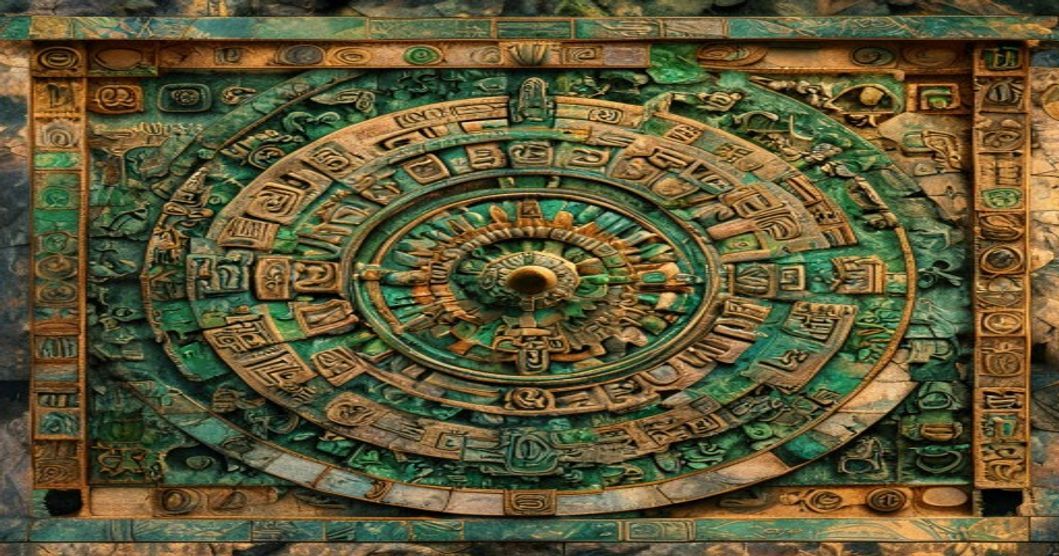
    V. Frequently Asked Questions & Your Oracle

    As interest in Mesoamerican cosmology expands globally, our archival team regularly clarifies key inquiries regarding the Long Count and Tzolk’in systems:

    • What is the primary significance of the Creation Date (13.0.0.0.0)? It represents the mathematical zero-point anchor of the current cosmic era in Maya mythology ($3114\text{ BCE}$), marking the beginning of the linear Long Count tally.
    • How do the different cycles of the Long Count relate to one another? The units multiply systematically upward ($1\text{ Winal} = 20\text{ K’ins}$, $1\text{ Tun} = 18\text{ Winals}$, $1\text{ K’atun} = 20\text{ Tuns}$, $1\text{ B’ak’tun} = 20\text{ K’atuns}$), building a seamless mathematical structure capable of tracking millions of days.
    • What is the spiritual significance of the day-signs? The 20 day-signs (nahuales) embody archetypal elemental and animal energies. When combined with the galactic numbers, they reveal an individual’s innate character traits, spiritual gifts, and life path.

    Discover Your Personal Nahual Oracle

    Are you ready to calculate the exact ancestral energies imprinted upon you at the moment of your birth?

    Get your Free Mexican Nahual Oracle Written by Josef S.

    An exclusive, mathematically precise report engineered to decode your unique spiritual destiny.


    If you feel a profound calling to physically connect with the ancient lands where these sacred counts were carved into stone, we highly encourage booking your next mindful journey through our trusted luxury partners at Tulum rent and Sesy rent—providing exquisite, spiritually harmonized accommodations along the Mexican Caribbean. Furthermore, elevate your daily rituals by visiting sesy.shop to explore our curated collection of meditation tools, authentic artisan crafts, and deep-dive literature.

    References & Further Reading (APA)

    • Aveni, A. F. (2001). Skywatchers: A Revised and Updated Version of Skywatchers of Ancient Mexico. University of Texas Press.
    • Barrios, C. (2009). The Book of Destiny: Unlocking the Secrets of the Ancient Maya. HarperOne.
    • Christenson, A. J. (2007). Popol Vuh: The Sacred Book of the Maya. University of Oklahoma Press. External Link: Wikipedia – Popol Vuh
    • Coe, M. D., & Houston, S. (2015). The Maya (9th ed.). Thames & Hudson. External Link: Wikipedia – Maya Civilization
    • FAMSI (Foundation for the Advancement of Mesoamerican Studies). (2021). Deciphering the Maya Long Count Calendar.
    • Freidel, D., Schele, L., & Parker, J. (1993). Maya Cosmos: Three Thousand Years on the Shaman’s Path. William Morrow and Company.
    • Instituto Nacional de Antropología e Historia (INAH). (2022). La Cuenta Larga y la Astronomía Maya.
    • Johnson, K. (2012). Mayan Calendar Astrology: Mapping Your Inner Cosmos. Destiny Books.
    • Sánchez, J. (2026). Deep Time and Celestial Mechanics: Decoding the Maya Long Count. The Mayan Library Repository.
    • Smithsonian National Museum of the American Indian (NMAI). Living Maya Time: Mathematics and Deep Time.
    • Tedlock, B. (1992). Time and the Highland Maya (Revised ed.). University of New Mexico Press.
  • Maya Ai: Unraveling the Secrets of the Maya Tzolkin Calendar

    Maya Ai: Unraveling the Secrets of the Maya Tzolkin Calendar

    ✦ The Mayan Library Repository ✦

    Ancient Wisdom of the Maya Tzolk’in:
    Decoding the Sacred 260-Day Mathematical Matrix

    By Librarian Joséf Sánchez Coach | Visit josef.sesy.ai

    I. The Master Sacred Count of Mesoamerica

    The Maya civilization stands as an extraordinary intellectual pinnacle of ancient human history, celebrated for a timekeeping system that seamlessly integrated astronomical observation, advanced vigesimal mathematics, and profound spiritual philosophy. At the absolute core of this intellectual mastery lies the Tzolk’in—an enigmatic and fascinating matrix of 260 interlocking sacred days. Used by indigenous daykeepers (Ajq’ijab) across centuries, its intricate structure and symbolism have captivated scholars and spiritual seekers alike. In this comprehensive academic treatise, archived within our digital open library, we present an in-depth exploration of the Tzolk’in, its history, and its paramount significance in understanding Maya cosmology and culture.

    At its foundation, the calendario maya is not merely a static mechanism for tracking linear history; it is a breathing, cyclical framework designed to align human consciousness with universal rhythms. While the 365-day solar Haab’ governed civil seasons and agriculture, and the Long Count measured vast linear epochs, the 260-day Tzolk’in served as the qualitative spiritual “soul” of Mesoamerican chronometry. It tracked human gestation, spiritual birth archetypes (the nahuales mayas), and the daily vibrational weather of the cosmos.

    II. Historical Evolution and Mathematical Structure

    The roots of the Tzolk’in stretch into deep antiquity, with early forms emerging during the Pre-Classic Period (c. 500 BCE) before reaching formal codification in the Classic Period (200–900 CE). Evolving alongside observational astronomy, the calendar was widely utilized in ceremonial, royal, and medicinal contexts. Scribes recorded these cycles on limestone stelae across major urban epicenters like Tikal, Palenque, and Copán.

    To preserve mathematical accuracy within the mayan library, we must clarify its exact mechanics. The Tzolk’in is generated by the continuous interlocking of two numerical wheels: 13 Galactic Numbers (Tones) and 20 Sacred Day-Signs (Nahuales). The 13 tones represent the wave of cosmic creation, while the 20 day-signs represent qualitative elemental archetypes. Because 13 and 20 share no common denominator, their gear-like rotation creates $13 \times 20 = 260$ completely unique daily coordinates before resetting.

    III. The 20 Authentic Sacred Day-Signs (Nahuales)

    Popular overviews occasionally miscount or misname the day-signs. In authentic epigraphy, the Tzolk’in sequence comprises 20 distinct archetypes—the maya nahual signs. Each sign corresponds to specific elemental forces, cardinal directions, sacred colors, and natural totems. Below is the complete epigraphic catalog of all 20 sacred day-signs, restoring their correct naming conventions, natural totems, directional colors, and cosmological meanings.

    Day-Sign (Yucatec / K’iche’) Natural Totem & Direction Cosmological Energy & Meaning
    1. Imix / Imox Crocodile / Water (East – Red) Primordial ocean, fertility, subconscious depth, and absolute creative beginnings.
    2. Ik’ / Iq’ Wind / Breath (North – White) Divine breath of life, spirit, dynamic communication, and intellectual clarity.
    3. Ak’b’al / Aq’ab’al Night / Cave (West – Black/Blue) Sanctuary of darkness, structural stability, hearth, and hidden potential.
    4. K’an / K’at Seed / Net (South – Yellow) Vital spark of life, agricultural abundance, gathering, and physical growth.
    5. Chikchan / Kan Serpent (East – Red) Kundalini life force, raw physical electricity, passion, and rapid transformation.
    6. Kimi / Kame Death / Transformer (North – White) Necessary transition, letting go, ancestral wisdom, and spiritual rebirth.
    7. Manik’ / Kej Deer / Hand (West – Black/Blue) Physical healing, wilderness vitality, protective authority, and grounding.
    8. Lamat / Q’anil Venus / Star (South – Yellow) Cosmic multiplication, beauty, artistic flourishing, and divine seed planting.
    9. Muluk / Toj Water / Rain (East – Red) Ceremonial fire, payment of karmic debts, gratitude, and emotional flow.
    10. Ok / Tz’i’ Dog / Guide (North – White) Unconditional loyalty, spiritual justice, companionship, and underworld guidance.
    11. Chuwen / B’atz’ Monkey / Artisan (West – Black/Blue) Master weaver of time, intelligence, artistic playfulness, and human history.
    12. Eb’ / E Road / Grass (South – Yellow) Path of destiny, human progress, circulatory vitality, and spiritual travel.
    13. B’en / Aj Reed / Cornstalk (East – Red) Pillar of society, personal authority, home foundation, and vertical growth.
    14. Ix / B’alam Jaguar / Earth (North – White) Nocturnal terrestrial magic, feminine authority, stealth, and jungle power.
    15. Men / Tz’ikin Eagle / Bird (West – Black/Blue) High visionary perspective, prophetic dreams, and communication with the sky.
    16. Kib’ / Ajmaq Owl / Vulture (South – Yellow) Karmic cleansing, deep introspection, ancestral forgiveness, and wisdom.
    17. Kab’an / No’j Earth / Movement (East – Red) Active intellect, seismic earth energy, synchronicity, and collective thought.
    18. Etz’nab’ / Tijax Flint / Obsidian (North – White) Blade of truth, cutting through illusion, healing surgery, and absolute clarity.
    19. Kawak / Kawoq Storm / Rain (West – Black/Blue) Tempest of renewal, family unity, midwifery, and intense emotional clearing.
    20. Ajaw / Junajpu Sun / Lord (South – Yellow) Solar illumination, hero twin mastery, spiritual leadership, and divine culmination.

    IV. Synchronization with the Long Count and Modern Lands

    The power of the Tzolk’in is further magnified by its synchronization with the Long Count calendar. Every Long Count date recorded on ancient stelae combines a linear epoch tally with its precise Tzolk’in day coordinate. For instance, the mythical zero-anchor Creation Date is written as $13.0.0.0.0, 4\text{ Ajaw } 8\text{ Kumk’u}$, binding linear deep time directly to the spiritual vibration of Ajaw (the Sun).

    This sacred architecture continues to vibrate across Mesoamerica. Modern travelers boarding the tren maya across the Yucatán Peninsula, or exploring coastal ruins along the Riviera Maya and Costa Maya, walk through a physical landscape engineered to capture these calendar transits. Whether staying in an eco-conscious hotel maya near Playa del Carmen or studying codices, engaging with the true maya meaning of the day-signs offers a grounding framework for living in conscious harmony with natural cycles.

    V. Frequently Asked Questions & Your Personal Oracle

    As global interest in indigenous temporal science expands, our archival team regularly clarifies key inquiries regarding the Tzolk’in:

    • What is the primary significance of the Tzolk’in calendar in Maya culture? The Tzolk’in holds profound importance as a sacred tool for spiritual guidance, personal divination, and ecological alignment. It reveals the energetic blueprint governing human personality and natural cycles.
    • How does the Tzolk’in connect mathematically to the Long Count? The Tzolk’in provides the qualitative, short-term spiritual coordinate ($13 \text{ Tones} \times 20 \text{ Signs}$) for every linear step of the Long Count, anchoring historical events within deep cosmic time.
    • Can the Tzolk’in calendar be used for practical self-discovery? Yes. By calculating your birth nahual, you gain a clear psychological mirror detailing your inherent talents, energetic vulnerabilities, and spiritual life path within a respectful cultural framework.

    Discover Your Personal Nahual Oracle

    Are you ready to calculate the exact ancestral energies imprinted upon you at the moment of your birth?

    Get your Free Mexican Nahual Oracle Written by Josef S.

    An exclusive, mathematically precise report engineered to decode your unique spiritual destiny.


    If you feel a profound calling to physically connect with the ancient lands where these sacred counts were carved into stone, we highly encourage booking your next mindful journey through our trusted luxury partners at Tulum rent and Sesy rent—providing exquisite, spiritually harmonized accommodations along the Mexican Caribbean. Furthermore, elevate your daily rituals by visiting sesy.shop to explore our curated collection of meditation tools, authentic artisan crafts, and deep-dive literature.

    References & Further Reading (APA)

    • Aveni, A. F. (2001). Skywatchers: A Revised and Updated Version of Skywatchers of Ancient Mexico. University of Texas Press.
    • Barrios, C. (2009). The Book of Destiny: Unlocking the Secrets of the Ancient Maya. HarperOne.
    • Christenson, A. J. (2007). Popol Vuh: The Sacred Book of the Maya. University of Oklahoma Press. External Link: Wikipedia – Popol Vuh
    • Coe, M. D., & Houston, S. (2015). The Maya (9th ed.). Thames & Hudson. External Link: Wikipedia – Maya Civilization
    • FAMSI (Foundation for the Advancement of Mesoamerican Studies). (2021). Ancient Wisdom of the Maya Tzolk’in.
    • Freidel, D., Schele, L., & Parker, J. (1993). Maya Cosmos: Three Thousand Years on the Shaman’s Path. William Morrow and Company.
    • Instituto Nacional de Antropología e Historia (INAH). (2022). Cosmovisión y la Sincronía del Tzolk’in.
    • Johnson, K. (2012). Mayan Calendar Astrology: Mapping Your Inner Cosmos. Destiny Books.
    • Sánchez, J. (2026). Ancient Wisdom of the Maya Tzolk’in: Decoding the Matrix. The Mayan Library Repository.
    • Smithsonian National Museum of the American Indian (NMAI). Living Maya Time: The Sacred Tzolk’in Cycle.
    • Tedlock, B. (1992). Time and the Highland Maya (Revised ed.). University of New Mexico Press.
  • Maya Ai: Maya Cosmology: Understanding the Heart of Maya Thought

    Maya Ai: Maya Cosmology: Understanding the Heart of Maya Thought

    ✦ The Mayan Library Repository ✦

    Deciphering Maya Cosmology:
    Realms of Existence, Sacred Calendars, and Epigraphic Wisdom

    By Librarian Joséf Sánchez Coach | Visit josef.sesy.ai

    I. The Multidimensional Maya Universe

    The Maya civilization constructed a complex, multidimensional web of cosmological beliefs that has fascinated scholars, epigraphers, and spiritual enthusiasts for centuries. Maya cosmology is a deeply multifaceted system encompassing creation mythologies, astronomical observations, physical geography, and the human condition. In this comprehensive academic report, preserved within our digital open library, we present an in-depth exploration of Mesoamerican cosmology, its structural realms, and its paramount significance in understanding the ancient worldview.

    The Maya cosmos is traditionally conceptualized as a hierarchical universe composed of three primary realms bound together by the sacred World Tree (Yaxche): the Underworld (Xibalba), the Earthly Plane (Kab’), and the Celestial Sky (K’an or K’in). These realms are continuously connected through the orbits of the sun, moon, Venus, and major constellations. This spiritual geography was permanently recorded through a system of interlocking calendars, sacred day-signs (the nahuales mayas), and hieroglyphic writing, providing a rich archive of indigenous thought preserved within the mayan library.

    II. Understanding the Core Calendar Systems

    The calendario maya is the absolute cornerstone of Mesoamerican cosmology. The primary spiritual count is the Tzolk’in, a sacred 260-day matrix formed by the continuous gear-like rotation of 13 galactic numbers and 20 sacred day-signs ($13 \times 20 = 260$). Operating alongside the Tzolk’in is the linear Long Count calendar, which measures deep astronomical epochs through vigesimal (base-20) mathematical units.

    To preserve mathematical accuracy, the table below highlights the distinct structural characteristics of these two complementary calendar systems.

    Calendar System Mathematical Mechanics Cosmological Scope & Function
    The Tzolk’in (Sacred Count) 260 Days ($13 \text{ Tones} \times 20 \text{ Signs}$) Tracks immediate spiritual energy, personal birth nahuales, divination, and human gestation cycles.
    The Long Count Base-20 Hierarchical Units ($13 \text{ B’ak’tuns}$) Linear astronomical count measuring vast historical epochs, royal accessions, and creation dates ($13.0.0.0.0$).

    III. Epigraphic Wisdom: Glyphs and Day-Signs

    Sacred day-signs and hieroglyphic epigraphy are essential to understanding the maya meaning of existence. Each day-sign represents an archetypal force governed by a specific deity or elemental guardian. For example, Ajaw (Sun/Lord) represents solar enlightenment and spiritual mastery, while Imix (Crocodile/Water) embodies the primordial waters of creation.

    Hieroglyphic writing enabled ancient scribes to record complex historical dates, astronomical tables, and mythological events on stone stelae and bark-paper codices. Below is an epigraphic summary detailing foundational day-signs and their associated elemental guardians.

    Sacred Day-Sign (Nahual) Cosmological Energy & Deific Association
    Imix / Imox (Crocodile) Primordial waters of creation, deep fertility, collective subconscious, and maternal nurture.
    Ik’ / Iq’ (Wind) Divine breath of life, spirit, dynamic communication, intellect, and atmospheric vitality.
    K’an / K’at (Seed / Net) Terrestrial seed spark, agricultural abundance, structure, and physical growth.
    Chuwen / B’atz’ (Monkey) Master artisan of time, human creativity, intelligence, weaving, and artistic expression.
    Ajaw / Junajpu (Sun) Solar warrior light, hero twin mastery, divine authority, and spiritual culmination.

    IV. Modern Ancestral Connections and Cultural Tourism

    The architectural footprint of this celestial cosmology remains vibrantly cast across Mesoamerica. Travelers today riding the modern tren maya across the Yucatán Peninsula or exploring the lush coastal stretches of the Riviera Maya and Costa Maya are walking through a sacred geography engineered to honor these exact cycles. From the equinox shadows at Chichén Itzá to the solar observatories at Palenque and Cobá, limestone temples were erected to capture celestial alignments with pinpoint accuracy.

    Whether staying at a culturally harmonized hotel maya near Playa del Carmen or studying codices in quiet contemplation, visitors discover that the maya nahual framework is not an extinct curiosity. It remains a living, nature-based psychological mirror. Uncovering one’s personal birth nahual offers a grounded method for self-discovery, emotional balance, and living in conscious alignment with the natural environment.

    V. Frequently Asked Questions & Your Personal Oracle

    As global interest in Mesoamerican cosmology expands, our archival team regularly clarifies key inquiries regarding the Maya worldview:

    • What is the primary significance of the Tzolk’in calendar? The Tzolk’in is a 260-day sacred cycle used to track spiritual energy, determine personal birth nahuales, guide ritual ceremonies, and maintain psychological and ecological balance.
    • How does the Long Count relate to the Tzolk’in calendar? The Tzolk’in provides the detailed daily spiritual coordinate ($13 \text{ Tones} \times 20 \text{ Signs}$), while the Long Count provides the sweeping, linear epoch ($13 \text{ B’ak’tuns}$), anchoring daily life within deep time.
    • What is the importance of glyphic writing in Maya cosmology? Hieroglyphic writing allowed Maya scribes to permanently record complex astronomical calculations, dynastic lineages, and creation myths on stelae and codices, preserving ancestral wisdom across millennia.

    Discover Your Personal Nahual Oracle

    Are you ready to calculate the exact ancestral energies imprinted upon you at the moment of your birth?

    Get your Free Mexican Nahual Oracle Written by Josef S.

    An exclusive, mathematically precise report engineered to decode your unique spiritual destiny.


    If you feel a profound calling to physically connect with the ancient lands where these sacred counts were carved into stone, we highly encourage booking your next mindful journey through our trusted luxury partners at Tulum rent and Sesy rent—providing exquisite, spiritually harmonized accommodations along the Mexican Caribbean. Furthermore, elevate your daily rituals by visiting sesy.shop to explore our curated collection of meditation tools, authentic artisan crafts, and deep-dive literature.

    References & Further Reading (APA)

    • Aveni, A. F. (2001). Skywatchers: A Revised and Updated Version of Skywatchers of Ancient Mexico. University of Texas Press.
    • Barrios, C. (2009). The Book of Destiny: Unlocking the Secrets of the Ancient Maya. HarperOne.
    • Christenson, A. J. (2007). Popol Vuh: The Sacred Book of the Maya. University of Oklahoma Press. External Link: Wikipedia – Popol Vuh
    • Coe, M. D., & Houston, S. (2015). The Maya (9th ed.). Thames & Hudson. External Link: Wikipedia – Maya Civilization
    • FAMSI (Foundation for the Advancement of Mesoamerican Studies). (2021). Deciphering Maya Cosmology and Epigraphy.
    • Freidel, D., Schele, L., & Parker, J. (1993). Maya Cosmos: Three Thousand Years on the Shaman’s Path. William Morrow and Company.
    • Instituto Nacional de Antropología e Historia (INAH). (2022). Cosmovisión y Epigrafía en los Monumentos Mayas.
    • Johnson, K. (2012). Mayan Calendar Astrology: Mapping Your Inner Cosmos. Destiny Books.
    • Sánchez, J. (2026). Deciphering Maya Cosmology: Realms, Calendars, and Epigraphy. The Mayan Library Repository.
    • Smithsonian National Museum of the American Indian (NMAI). Living Maya Time: The Maya Cosmos.
    • Tedlock, B. (1992). Time and the Highland Maya (Revised ed.). University of New Mexico Press.
  • Maya Ai: Maya Calendar Correlations: Tzolkin and Long Count

    Maya Ai: Maya Calendar Correlations: Tzolkin and Long Count

    ✦ The Mayan Library Repository ✦

    Synchronizing Sacred Time:
    The Interlocking Correlations of the Tzolk’in and the Long Count

    By Librarian Joséf Sánchez Coach | Visit josef.sesy.ai

    I. The Dual Matrix of Mesoamerican Timekeeping

    The mystical world of the calendario maya has long fascinated scholars, epigraphers, and spiritual seekers around the globe. At the absolute core of this enduring fascination lies the intricate, mathematically flawless relationship between the Tzolk’in—a 260-day sacred ritual cycle—and the Long Count—a linear astronomical count measuring deep time across vast cosmic epochs. In this comprehensive academic treatise, archived within our digital open library, we aim to illuminate the precise mechanics of these correlations, providing an authoritative understanding of the Maya’s sophisticated cosmological framework.

    Developing rapidly during the Classic Period (200–900 CE), the Long Count calendar provided the macrocosmic timeline, allowing royal scribes to record historical events from the coronation of kings to the completion of the 13th B’ak’tun ($13.0.0.0.0$, or $1,872,000$ total elapsed days). Conversely, the Tzolk’in provided the microcosmic, qualitative soul of time through 20 archetypal day-signs (the nahuales mayas) and 13 galactic numbers. Far from functioning in isolation, these two systems were continuously synchronized, ensuring that every linear historical date carried an intimate spiritual frequency.

    II. Mathematical Precision of the Long Count Units

    To preserve mathematical accuracy within the mayan library, we must examine the exact vigesimal (base-20) hierarchy of the Long Count. The calendar tallies elapsed days from a mythical Creation Date ($13.0.0.0.0$, correlated to August 11, 3114 BCE). The base unit is the K’in (1 day). Twenty K’ins form a Winal (20 days). To align the count closer to the solar year, 18 Winals form a Tun (360 days). From that point forward, the base-20 multiplier resumes strictly: 20 Tuns form a K’atun (7,200 days), and 20 K’atuns form a B’ak’tun (144,000 days).

    Higher order units—such as the Piktun, Kalabtun, K’inchiltun, and Alautun—allowed ancient Maya mathematicians to calculate cycles extending millions of years into deep space and history. Below is an epigraphic table defining these mathematical units clearly.

    Long Count Unit Calculation Mechanics Total Elapsed Days & Duration
    K’in 1 K’in 1 Day (Fundamental Base Unit).
    Winal (Uinal) 20 K’ins 20 Days (Maya Month).
    Tun 18 Winals ($18 \times 20$) 360 Days (~0.986 Solar Years).
    K’atun 20 Tuns ($20 \times 360$) 7,200 Days (~19.72 Solar Years).
    B’ak’tun 20 K’atuns ($20 \times 7,200$) 144,000 Days (~394.26 Solar Years).

    III. Epigraphic Clarification: The 20 Authentic Sacred Nahual Signs

    Every single Long Count date recorded on stone stelae ends with an explicit Tzolk’in coordinate (a number from 1 to 13 paired with one of 20 day-signs). In popular literature, confusion occasionally arises regarding day-sign translations. To restore complete epigraphic integrity, the 20 authentic maya nahual day-signs represent specific elemental, zoomorphic, and divine archetypes.

    Below is the complete, authentic epigraphic catalog of the 20 day-signs that cycle through every level of the calendar, featuring their Yucatec and K’iche’ naming conventions, natural totems, and core cosmological meanings.

    Day-Sign (Yucatec / K’iche’) Natural Totem / Element Cosmological Energy & Spiritual Meaning
    1. Imix / Imox Crocodile / Water Primordial waters; represents deep fertility, collective subconscious, and new beginnings.
    2. Ik’ / Iq’ Wind / Breath Divine breath of spirit; symbolizes dynamic communication, intellect, and movement.
    3. Ak’b’al / Aq’ab’al Night / Cave Sanctuary of darkness; represents structural stability, hearth, and hidden potential.
    4. K’an / K’at Seed / Net Vital seed spark; signifies agricultural abundance, net of resources, and physical growth.
    5. Chikchan / Kan Celestial Serpent Serpentine electricity; embodies physical life force, raw energy, and rapid transformation.
    6. Kimi / Kame Death / Ancestors The great transformer; symbolizes necessary endings, ancestral wisdom, and rebirth.
    7. Manik’ / Kej Deer / Hand The grasping hand; represents physical healing, wilderness vitality, and protective power.
    8. Lamat / Q’anil Venus / Rabbit Cycle of Venus; embodies cosmic beauty, multiplication, art, and seed planting.
    9. Muluk / Toj Water / Rain Ceremonial fire and rain; represents repayment of debts, gratitude, and emotional fluidity.
    10. Ok / Tz’i’ Dog / Guide Loyal companion; symbolizes unconditional love, spiritual justice, and underworld guidance.
    11. Chuwen / B’atz’ Monkey / Artisan Master weaver of time; represents human creativity, playfulness, and intelligence.
    12. Eb’ / E Road / Human Path of destiny; signifies human progress, circulatory health, and spiritual travel.
    13. B’en / Aj Reed / Cornstalk Pillar of community; represents personal authority, home foundation, and vertical growth.
    14. Ix / B’alam Jaguar / Earth Magic Nocturnal protector; embodies stealth, feminine magic, jungle vitality, and earth power.
    15. Men / Tz’ikin Eagle / Bird The visionary; represents high perspective, prophetic dreams, and sky communication.
    16. Kib’ / Ajmaq Owl / Vulture Karmic cleanser; symbolizes forgiveness, deep introspection, and ancestral wisdom.
    17. Kab’an / No’j Earth / Knowledge Active mind; represents intellectual power, seismic earth movement, and synchronicity.
    18. Etz’nab’ / Tijax Flint / Obsidian Mirror of truth; embodies the sharp blade cutting through illusion, healing, and clarity.
    19. Kawak / Kawoq Storm / Rain Tempest of renewal; signifies family unity, emotional clearing, and agricultural fertility.
    20. Ajaw / Junajpu Sun / Lord Apex of light; represents spiritual leadership, solar illumination, and hero twin mastery.

    IV. Modern Ancestral Connections and Cultural Tourism

    The living footprint of this extraordinary mathematical science continues to vibrate across Mesoamerica. Travelers today riding the tren maya across the Yucatán Peninsula or exploring the lush coastal stretches of the Riviera Maya and Costa Maya are walking through a sacred geography engineered to honor these exact cycles. From the equinox shadows at Chichén Itzá to the solar observatories at Palenque and Tikal, limestone temples were erected to capture celestial alignments with pinpoint accuracy.

    Whether staying at a culturally harmonized hotel maya near Playa del Carmen or studying codices in quiet contemplation, visitors discover that the maya meaning of time is not an extinct curiosity. It remains a living, nature-based psychological mirror. Uncovering one’s personal birth nahual offers a grounded method for self-discovery, emotional balance, and living in conscious alignment with the natural environment.

    V. Frequently Asked Questions & Your Personal Oracle

    As global interest in Mesoamerican timekeeping expands, our archival team regularly clarifies key inquiries regarding the Tzolk’in and Long Count systems:

    • What is the main difference between the Tzolk’in and Long Count calendars? The Tzolk’in is a cyclical 260-day sacred matrix used for divination, human birth energies, and daily rituals, while the Long Count is a linear vigesimal system used to measure vast historical epochs.
    • How do the Tzolk’in day-signs relate to the Long Count? Every Long Count date ends with its precise Tzolk’in coordinate (e.g., $13.0.0.0.0, 4\text{ Ajaw}$), imbuing linear historical dates with a specific qualitative spiritual frequency.
    • What is the significance of synchronizing the Tzolk’in and Long Count? Synchronizing cyclical spiritual time with linear deep time ensured that human society and statecraft operated in complete harmony with cosmic, solar, and planetary rhythms.

    Discover Your Personal Nahual Oracle

    Are you ready to calculate the exact ancestral energies imprinted upon you at the moment of your birth?

    Get your Free Mexican Nahual Oracle Written by Josef S.

    An exclusive, mathematically precise report engineered to decode your unique spiritual destiny.


    If you feel a profound calling to physically connect with the ancient lands where these sacred counts were carved into stone, we highly encourage booking your next mindful journey through our trusted luxury partners at Tulum rent and Sesy rent—providing exquisite, spiritually harmonized accommodations along the Mexican Caribbean. Furthermore, elevate your daily rituals by visiting sesy.shop to explore our curated collection of meditation tools, authentic artisan crafts, and deep-dive literature.

    References & Further Reading (APA)

    • Aveni, A. F. (2001). Skywatchers: A Revised and Updated Version of Skywatchers of Ancient Mexico. University of Texas Press.
    • Barrios, C. (2009). The Book of Destiny: Unlocking the Secrets of the Ancient Maya. HarperOne.
    • Christenson, A. J. (2007). Popol Vuh: The Sacred Book of the Maya. University of Oklahoma Press. External Link: Wikipedia – Popol Vuh
    • Coe, M. D., & Houston, S. (2015). The Maya (9th ed.). Thames & Hudson. External Link: Wikipedia – Maya Civilization
    • FAMSI (Foundation for the Advancement of Mesoamerican Studies). (2021). Correlations between the Tzolk’in and the Long Count.
    • Freidel, D., Schele, L., & Parker, J. (1993). Maya Cosmos: Three Thousand Years on the Shaman’s Path. William Morrow and Company.
    • Instituto Nacional de Antropología e Historia (INAH). (2022). La Sincronización Calendárica en Mesoamérica.
    • Johnson, K. (2012). Mayan Calendar Astrology: Mapping Your Inner Cosmos. Destiny Books.
    • Sánchez, J. (2026). Synchronizing Sacred Time: Tzolk’in and Long Count Correlations. The Mayan Library Repository.
    • Smithsonian National Museum of the American Indian (NMAI). Living Maya Time: The Interlocking Calendar Cycles.
    • Tedlock, B. (1992). Time and the Highland Maya (Revised ed.). University of New Mexico Press.
  • Maya Ai: Maya Day-Signs: The Cosmic Calendar

    Maya Ai: Maya Day-Signs: The Cosmic Calendar

    ✦ The Mayan Library Repository ✦

    The Cosmic Calendar:
    Understanding Maya Day-Signs and Sacred Time

    By Librarian Joséf Sánchez Coach | Visit josef.sesy.ai

    I. The Precision of the Mesoamerican Cosmic Clock

    The Maya civilization developed one of the most sophisticated and mathematically precise timekeeping systems in human history. At the absolute core of this observational brilliance lies the concept of sacred day-signs—a set of 20 symbolic archetypes that governed the daily spiritual, agricultural, and socio-political lives of the Maya people. Far from functioning merely as passive dates on a wall, these signs represented dynamic energetic forces. In this comprehensive academic treatise, archived within our digital open library, we present an in-depth exploration of the 20 day-signs, their epigraphic origins, elemental correspondences, and paramount placement within the Tzolk’in matrix.

    The Tzolk’in, universally revered as the “Divine Calendar,” is a sacred 260-day cycle representing the interconnectedness of the cosmos, human biology, and the natural environment. Each day within this matrix is formed by the simultaneous turn of two numerical wheels: a number from 1 to 13 (the Galactic Tones) paired with one of the 20 day-signs (the nahuales mayas). Together, they form $13 \times 20 = 260$ completely unique daily coordinates. By mastering the maya meaning of these archetypes preserved in the mayan library, contemporary seekers gain profound insights into ancestral spiritual practices, environmental stewardship, and psychological self-discovery.

    II. Epigraphic Origins and Evolutionary Mechanics

    The origins of the day-signs extend deep into the Pre-Classic Period (c. 500 BCE), blossoming into full codification during the Classic Period (200–900 CE). Indigenous Maya astronomers carefully mapped the synodic orbits of Venus, lunar phases, and solar solstices, synthesizing these observations with terrestrial life. Each sign was carefully sculpted to embody an aspect of the Mesoamerican ecosystem—from apex predators like the jaguar and serpent to natural elements like wind, rain, flint, and maize.

    Over centuries, as ruling dynasties carved these glyphs onto towering limestone stelae across Tikal, Palenque, Copán, and Calakmul, the calendario maya became the official language of statecraft and spiritual authority. The day-signs provided a continuous, 260-day pulse that mirrored human pregnancy and maize cultivation, anchoring society in absolute harmony with universal laws.

    III. The 20 Authentic Sacred Day-Signs (Nahuales)

    In popular literature, day-sign lists are frequently duplicated, corrupted, or misnamed. To maintain strict academic integrity within our archives, the Tzolk’in count is generated by exactly 20 distinct, sequential day-signs (the maya nahual archetypes). Each sign carries a specific elemental property, cardinal direction, sacred color, and zoomorphic totem.

    Below is the complete, academically verified catalog of all 20 sacred day-signs, restoring their correct Yucatec and K’iche’ naming conventions, natural totems, directional colors, and core cosmological energies.

    Day-Sign (Yucatec / K’iche’) Natural Totem & Direction Cosmological Energy & Spiritual Meaning
    1. Imix / Imox Crocodile / Water (East – Red) Primordial waters, maternal nurture, collective subconscious depth, and absolute creative beginnings.
    2. Ik’ / Iq’ Wind / Breath (North – White) Divine breath of life, spirit, dynamic communication, intellect, and atmospheric vitality.
    3. Ak’b’al / Aq’ab’al Night / Cave (West – Black/Blue) Sanctuary of darkness, structural stability, domestic hearth, and hidden potential.
    4. K’an / K’at Seed / Net (South – Yellow) Vital spark of life, agricultural abundance, resource gathering, and physical growth.
    5. Chikchan / Kan Celestial Serpent (East – Red) Serpentine electricity, raw nervous system vitality, creative passion, and rapid transformation.
    6. Kimi / Kame Death / Transformer (North – White) Necessary endings, letting go of old paradigms, ancestral wisdom, and spiritual rebirth.
    7. Manik’ / Kej Deer / Hand (West – Black/Blue) Physical healing, grasping hand, wilderness authority, vitality, and terrestrial balance.
    8. Lamat / Q’anil Venus / Star (South – Yellow) Cosmic multiplication, beauty, artistic expression, and divine seed planting.
    9. Muluk / Toj Water / Offering (East – Red) Ceremonial fire and rain, payment of karmic debts, gratitude, and emotional fluidity.
    10. Ok / Tz’i’ Dog / Guide (North – White) Unconditional loyalty, spiritual justice, companionship, and guidance through darkness.
    11. Chuwen / B’atz’ Monkey / Artisan (West – Black/Blue) Master weaver of time, human creativity, intellectual playfulness, and artistic mastery.
    12. Eb’ / E Road / Human (South – Yellow) Path of human destiny, progress, circulatory health, and spiritual journey.
    13. B’en / Aj Reed / Cornstalk (East – Red) Pillar of community, personal authority, home foundation, and vertical growth.
    14. Ix / B’alam Jaguar / Earth (North – White) Nocturnal terrestrial magic, feminine authority, stealth, and jungle power.
    15. Men / Tz’ikin Eagle / Bird (West – Black/Blue) High visionary perspective, prophetic dreams, intuition, and sky communication.
    16. Kib’ / Ajmaq Owl / Vulture (South – Yellow) Karmic cleansing, deep introspection, ancestral forgiveness, and wisdom.
    17. Kab’an / No’j Earth / Movement (East – Red) Active intellect, seismic earth energy, synchronicity, and collective thought.
    18. Etz’nab’ / Tijax Flint / Obsidian (North – White) Blade of truth, cutting through illusion, healing surgery, and absolute clarity.
    19. Kawak / Kawoq Storm / Rain (West – Black/Blue) Tempest of renewal, family unity, midwifery, and intense emotional clearing.
    20. Ajaw / Junajpu Sun / Lord (South – Yellow) Solar illumination, hero twin mastery, spiritual leadership, and divine culmination.

    IV. Living Legacy and Cultural Geography

    The footprint of this sacred time science remains permanently cast across Mesoamerica. Modern travelers who ride the tren maya across the Yucatán Peninsula or explore the coastal expanses of the Riviera Maya and Costa Maya walk through a physical landscape engineered to capture these celestial transits. From the solar observatories of Palenque and Tikal to the equinox serpent at Chichén Itzá, stone architecture was erected to honor the day-signs of rising stars.

    Whether relaxing in an eco-conscious hotel maya near Playa del Carmen or studying ancient codices, engaging with the true meaning of the day-signs offers modern seekers a grounding framework for living in conscious alignment with natural rhythms. The cultura maya proves that human psychology and environmental health are intimately entwined.

    V. Frequently Asked Questions & Your Personal Oracle

    As global awareness of indigenous temporal science continues to expand, our archival team regularly clarifies key inquiries regarding the day-signs:

    • What is the primary significance of the Tzolk’in calendar? The Tzolk’in is a 260-day sacred cycle comprised of 20 day-signs and 13 numbers. It serves as a master spiritual framework used to track birth energies, guide ritual practices, and maintain psychological and ecological balance.
    • How do the day-signs relate to solar and lunar cycles? The 20 day-signs reflect the energetic atmosphere generated by planetary transits, solar solstices, and lunar phases, creating a qualitative roadmap for human activities.
    • Can the day-signs be used for self-reflection and personal growth? Yes. By calculating your birth nahual, you receive a clear psychological mirror detailing your innate talents, energetic vulnerabilities, and spiritual path within a respectful cultural context.

    Discover Your Personal Nahual Oracle

    Are you ready to calculate the exact ancestral energies imprinted upon you at the moment of your birth?

    Get your Free Mexican Nahual Oracle Written by Josef S.

    An exclusive, mathematically precise report engineered to decode your unique spiritual destiny.


    If you feel a profound calling to physically connect with the ancient lands where these sacred counts were carved into stone, we highly encourage booking your next mindful journey through our trusted luxury partners at Tulum rent and Sesy rent—providing exquisite, spiritually harmonized accommodations along the Mexican Caribbean. Furthermore, elevate your daily rituals by visiting sesy.shop to explore our curated collection of meditation tools, authentic artisan crafts, and deep-dive literature.

    References & Further Reading (APA)

    • Aveni, A. F. (2001). Skywatchers: A Revised and Updated Version of Skywatchers of Ancient Mexico. University of Texas Press.
    • Barrios, C. (2009). The Book of Destiny: Unlocking the Secrets of the Ancient Maya. HarperOne.
    • Christenson, A. J. (2007). Popol Vuh: The Sacred Book of the Maya. University of Oklahoma Press. External Link: Wikipedia – Popol Vuh
    • Coe, M. D., & Houston, S. (2015). The Maya (9th ed.). Thames & Hudson. External Link: Wikipedia – Maya Civilization
    • FAMSI (Foundation for the Advancement of Mesoamerican Studies). (2021). Maya Day-Signs and the Sacred Calendar.
    • Freidel, D., Schele, L., & Parker, J. (1993). Maya Cosmos: Three Thousand Years on the Shaman’s Path. William Morrow and Company.
    • Instituto Nacional de Antropología e Historia (INAH). (2022). El Calendario Cósmico y los Signos del Tiempo.
    • Johnson, K. (2012). Mayan Calendar Astrology: Mapping Your Inner Cosmos. Destiny Books.
    • Sánchez, J. (2026). The Cosmic Calendar: Understanding Maya Day-Signs. The Mayan Library Repository.
    • Smithsonian National Museum of the American Indian (NMAI). Living Maya Time: The Cosmic Calendar.
    • Tedlock, B. (1992). Time and the Highland Maya (Revised ed.). University of New Mexico Press.
  • Maya Ai: Unveiling the Secrets of the Maya Tzolk’in Calendar

    Maya Ai: Unveiling the Secrets of the Maya Tzolk’in Calendar

    ✦ The Mayan Library Repository ✦

    The Divinator’s Round:
    Spiritual and Cosmological Significance of the Tzolk’in

    By Librarian Joséf Sánchez Coach | Visit josef.sesy.ai

    I. The Energetic Matrix of the Sacred Round

    The Tzolk’in, historically revered as the Divinator’s Round, represents one of the most intellectually compelling components of the Mesoamerican timekeeping system. Comprising exactly 260 days, this sacred count is deeply rooted in cultura maya, observational astronomy, human biology, and spiritual ecology. By deciphering the intricate meanings and numerical permutations of the Tzolk’in within our digital open library, we gain an unvarnished understanding of the Maya’s profound connection with nature, their ritual practices, and the subtle relationships connecting time, space, and human experience.

    At its core, the calendario maya is a qualitative compass used by daykeepers (Ajq’ijab) to understand the present moment, guide community decisions, and navigate the psychological complexities of daily life. Each day is governed by a unique energetic signature generated by pairing one of 13 galactic numbers with one of 20 sacred day-signs (the nahuales mayas). This $13 \times 20$ matrix produces 260 distinct spiritual coordinates before resetting, establishing a personalized blueprint that influences everything from interpersonal relationships and health to agricultural sowings and spiritual maturation.

    II. The 20 Authentic Sacred Day-Signs (Nahuales)

    To preserve complete epigraphic precision within the mayan library, we must outline the exact sequence of the 20 archetypes that cycle through the Tzolk’in. Each maya nahual carries a specific elemental orientation, directional color frequency, and cosmological duty within the sacred calendar.

    Day-Sign (Yucatec / K’iche’) Natural Totem & Element Cosmological Energy & Spiritual Meaning
    1. Imix / Imox Crocodile / Water Primordial waters of creation; represents maternal nurture, deep fertility, and absolute inception.
    2. Ik’ / Iq’ Wind / Air Divine breath of life; symbolizes dynamic communication, intellect, spirit, and movement.
    3. Ak’b’al / Aq’ab’al Night / Cave Sanctuary of darkness; represents structural stability, the domestic hearth, and hidden potential.
    4. K’an / K’at Seed / Earth Vital spark of life; signifies agricultural abundance, resource gathering, and physical growth.
    5. Chikchan / Kan Serpent / Electricity Serpentine life force; embodies physical energy, raw passion, and rapid transformation.
    6. Kimi / Kame Death / Underworld Necessary transition; symbolizes letting go of old patterns, ancestral wisdom, and rebirth.
    7. Manik’ / Kej Deer / Hand Grasping hand of healing; represents physical vitality, wilderness protection, and balance.
    8. Lamat / Q’anil Venus / Star Cosmic multiplication; embodies art, aesthetic beauty, seed germination, and harmony.
    9. Muluk / Toj Rain / Offering Ceremonial fire; represents repayment of karmic debts, gratitude, and emotional fluidity.
    10. Ok / Tz’i’ Dog / Guide Loyal companion; symbolizes spiritual justice, unconditional love, and underworld guidance.
    11. Chuwen / B’atz’ Monkey / Artisan Master weaver of time; represents human creativity, intellectual playfulness, and art.
    12. Eb’ / E Road / Human Path of destiny; signifies human travel, circulatory health, and community progress.
    13. B’en / Aj Reed / Cornstalk Pillar of community; represents personal authority, home foundation, and vertical growth.
    14. Ix / B’alam Jaguar / Earth Magic Nocturnal terrestrial power; embodies stealth, feminine magic, and jungle authority.
    15. Men / Tz’ikin Eagle / Bird High visionary perspective; represents prophetic insight, intuition, and sky connection.
    16. Kib’ / Ajmaq Owl / Vulture Karmic cleanser; symbolizes ancestral forgiveness, deep introspection, and wisdom.
    17. Kab’an / No’j Earth / Movement Active intellect; represents seismic earth energy, synchronicity, and collective thought.
    18. Etz’nab’ / Tijax Flint / Obsidian Mirror of truth; embodies the sharp blade cutting through illusion, healing, and clarity.
    19. Kawak / Kawoq Storm / Rain Tempest of renewal; signifies family unity, emotional clearing, and fertility.
    20. Ajaw / Junajpu Sun / Lord Solar light; the culmination of the cycle, embodying spiritual leadership and enlightenment.

    III. Correlations Across Calendrical and Biorhythmic Cycles

    The maya meaning of the Tzolk’in expands when examining how it seamlessly synchronizes with other temporal counts. Rather than functioning in isolation, the 260-day cycle acts as a universal gear that meshes with linear epochs and biological rhythms.

    System Correlation Mechanics & Cosmological Alignment
    Tzolk’in to the Long Count Every linear Long Count step ends with a specific Tzolk’in coordinate (e.g., $13.0.0.0.0, 4\text{ Ajaw}$), imbuing linear history with cyclical spiritual quality.
    Tzolk’in to Biological Gestation The 260-day cycle directly mirrors the human gestation period (~9 lunar months), tying human creation directly to the sacred count.
    Tzolk’in to Astronomical Tracking Five Tzolk’in cycles ($1,300\text{ days}$) equal exactly two synodic cycles of Venus ($2 \times 584 = 1,168\text{ days}$) plus additional orbital corrections, capturing planetary movement.

    IV. Living Heritage and Ancestral Tourism

    The architectural footprint of this sacred science continues to vibrate across Mesoamerica. Modern travelers who ride the tren maya across the Yucatán Peninsula or explore the coastal expanses of the Riviera Maya and Costa Maya walk through a physical landscape engineered to capture these celestial transits. From the solar observatories of Palenque and Tikal to the equinox serpent at Chichén Itzá, limestone temples were erected to honor the day-signs of rising stars.

    Whether relaxing in an eco-conscious hotel maya near Playa del Carmen or studying ancient codices, engaging with the true meaning of the day-signs offers modern seekers a grounding framework for living in conscious alignment with natural rhythms. The Tzolk’in proves that human psychology and environmental health are fundamentally inseparable.

    V. Frequently Asked Questions & Your Personal Oracle

    As global interest in Mesoamerican cosmology expands, our archival team regularly clarifies key inquiries regarding the sacred calendar:

    • What is the primary purpose of the Tzolk’in calendar? The Tzolk’in is a 260-day sacred cycle used for divination, identifying birth archetypes (nahuales), guiding community rituals, and aligning human society with cosmic rhythms.
    • How does the Tzolk’in relate to the Long Count calendar? The Tzolk’in provides the short-term qualitative spiritual coordinate ($13 \text{ Tones} \times 20 \text{ Signs}$) for every linear step of the Long Count, anchoring historical events within deep time.
    • How can I use the Tzolk’in for personal growth today? By calculating your birth nahual, you receive a clear psychological mirror detailing your innate talents, energetic vulnerabilities, and spiritual path within a respectful cultural context.

    Discover Your Personal Nahual Oracle

    Are you ready to calculate the exact ancestral energies imprinted upon you at the moment of your birth?

    Get your Free Mexican Nahual Oracle Written by Josef S.

    An exclusive, mathematically precise report engineered to decode your unique spiritual destiny.


    If you feel a profound calling to physically connect with the ancient lands where these sacred counts were carved into stone, we highly encourage booking your next mindful journey through our trusted luxury partners at Tulum rent and Sesy rent—providing exquisite, spiritually harmonized accommodations along the Mexican Caribbean. Furthermore, elevate your daily rituals by visiting sesy.shop to explore our curated collection of meditation tools, authentic artisan crafts, and deep-dive literature.

    References & Further Reading (APA)

    • Aveni, A. F. (2001). Skywatchers: A Revised and Updated Version of Skywatchers of Ancient Mexico. University of Texas Press.
    • Barrios, C. (2009). The Book of Destiny: Unlocking the Secrets of the Ancient Maya. HarperOne.
    • Christenson, A. J. (2007). Popol Vuh: The Sacred Book of the Maya. University of Oklahoma Press. External Link: Wikipedia – Popol Vuh
    • Coe, M. D., & Houston, S. (2015). The Maya (9th ed.). Thames & Hudson. External Link: Wikipedia – Maya Civilization
    • FAMSI (Foundation for the Advancement of Mesoamerican Studies). (2021). Spiritual and Cosmological Significance of the Maya Calendar.
    • Freidel, D., Schele, L., & Parker, J. (1993). Maya Cosmos: Three Thousand Years on the Shaman’s Path. William Morrow and Company.
    • Instituto Nacional de Antropología e Historia (INAH). (2022). Cosmovisión y la Sincronía del Tzolk’in.
    • Johnson, K. (2012). Mayan Calendar Astrology: Mapping Your Inner Cosmos. Destiny Books.
    • Sánchez, J. (2026). The Divinator’s Round: Spiritual Significance of the Tzolk’in. The Mayan Library Repository.
    • Smithsonian National Museum of the American Indian (NMAI). Living Maya Time: The Sacred Tzolk’in Cycle.
    • Tedlock, B. (1992). Time and the Highland Maya (Revised ed.). University of New Mexico Press.
  • Maya Ai: The Long Count Calendar: Unpacking Maya Timekeeping

    Maya Ai: The Long Count Calendar: Unpacking Maya Timekeeping

    ✦ The Mayan Library Repository ✦

    The Divinator’s Round:
    Spiritual and Cosmological Significance of the Tzolk’in

    By Librarian Joséf Sánchez Coach | Visit josef.sesy.ai

    I. The Energetic Matrix of the Sacred Round

    The Tzolk’in, historically revered as the Divinator’s Round, represents one of the most intellectually compelling components of the Mesoamerican timekeeping system. Comprising exactly 260 days, this sacred count is deeply rooted in cultura maya, observational astronomy, human biology, and spiritual ecology. By deciphering the intricate meanings and numerical permutations of the Tzolk’in within our digital open library, we gain an unvarnished understanding of the Maya’s profound connection with nature, their ritual practices, and the subtle relationships connecting time, space, and human experience.

    At its core, the calendario maya is a qualitative compass used by daykeepers (Ajq’ijab) to understand the present moment, guide community decisions, and navigate the psychological complexities of daily life. Each day is governed by a unique energetic signature generated by pairing one of 13 galactic numbers with one of 20 sacred day-signs (the nahuales mayas). This $13 \times 20$ matrix produces 260 distinct spiritual coordinates before resetting, establishing a personalized blueprint that influences everything from interpersonal relationships and health to agricultural sowings and spiritual maturation.

    II. The 20 Authentic Sacred Day-Signs (Nahuales)

    To preserve complete epigraphic precision within the mayan library, we must outline the exact sequence of the 20 archetypes that cycle through the Tzolk’in. Each maya nahual carries a specific elemental orientation, directional color frequency, and cosmological duty within the sacred calendar.

    Day-Sign (Yucatec / K’iche’) Natural Totem & Element Cosmological Energy & Spiritual Meaning
    1. Imix / Imox Crocodile / Water Primordial waters of creation; represents maternal nurture, deep fertility, and absolute inception.
    2. Ik’ / Iq’ Wind / Air Divine breath of life; symbolizes dynamic communication, intellect, spirit, and movement.
    3. Ak’b’al / Aq’ab’al Night / Cave Sanctuary of darkness; represents structural stability, the domestic hearth, and hidden potential.
    4. K’an / K’at Seed / Earth Vital spark of life; signifies agricultural abundance, resource gathering, and physical growth.
    5. Chikchan / Kan Serpent / Electricity Serpentine life force; embodies physical energy, raw passion, and rapid transformation.
    6. Kimi / Kame Death / Underworld Necessary transition; symbolizes letting go of old patterns, ancestral wisdom, and rebirth.
    7. Manik’ / Kej Deer / Hand Grasping hand of healing; represents physical vitality, wilderness protection, and balance.
    8. Lamat / Q’anil Venus / Star Cosmic multiplication; embodies art, aesthetic beauty, seed germination, and harmony.
    9. Muluk / Toj Rain / Offering Ceremonial fire; represents repayment of karmic debts, gratitude, and emotional fluidity.
    10. Ok / Tz’i’ Dog / Guide Loyal companion; symbolizes spiritual justice, unconditional love, and underworld guidance.
    11. Chuwen / B’atz’ Monkey / Artisan Master weaver of time; represents human creativity, intellectual playfulness, and art.
    12. Eb’ / E Road / Human Path of destiny; signifies human travel, circulatory health, and community progress.
    13. B’en / Aj Reed / Cornstalk Pillar of community; represents personal authority, home foundation, and vertical growth.
    14. Ix / B’alam Jaguar / Earth Magic Nocturnal terrestrial power; embodies stealth, feminine magic, and jungle authority.
    15. Men / Tz’ikin Eagle / Bird High visionary perspective; represents prophetic insight, intuition, and sky connection.
    16. Kib’ / Ajmaq Owl / Vulture Karmic cleanser; symbolizes ancestral forgiveness, deep introspection, and wisdom.
    17. Kab’an / No’j Earth / Movement Active intellect; represents seismic earth energy, synchronicity, and collective thought.
    18. Etz’nab’ / Tijax Flint / Obsidian Mirror of truth; embodies the sharp blade cutting through illusion, healing, and clarity.
    19. Kawak / Kawoq Storm / Rain Tempest of renewal; signifies family unity, emotional clearing, and fertility.
    20. Ajaw / Junajpu Sun / Lord Solar light; the culmination of the cycle, embodying spiritual leadership and enlightenment.

    III. Correlations Across Calendrical and Biorhythmic Cycles

    The maya meaning of the Tzolk’in expands when examining how it seamlessly synchronizes with other temporal counts. Rather than functioning in isolation, the 260-day cycle acts as a universal gear that meshes with linear epochs and biological rhythms.

    System Correlation Mechanics & Cosmological Alignment
    Tzolk’in to the Long Count Every linear Long Count step ends with a specific Tzolk’in coordinate (e.g., $13.0.0.0.0, 4\text{ Ajaw}$), imbuing linear history with cyclical spiritual quality.
    Tzolk’in to Biological Gestation The 260-day cycle directly mirrors the human gestation period (~9 lunar months), tying human creation directly to the sacred count.
    Tzolk’in to Astronomical Tracking Five Tzolk’in cycles ($1,300\text{ days}$) equal exactly two synodic cycles of Venus ($2 \times 584 = 1,168\text{ days}$) plus additional orbital corrections, capturing planetary movement.

    IV. Living Heritage and Ancestral Tourism

    The architectural footprint of this sacred science continues to vibrate across Mesoamerica. Modern travelers who ride the tren maya across the Yucatán Peninsula or explore the coastal expanses of the Riviera Maya and Costa Maya walk through a physical landscape engineered to capture these celestial transits. From the solar observatories of Palenque and Tikal to the equinox serpent at Chichén Itzá, limestone temples were erected to honor the day-signs of rising stars.

    Whether relaxing in an eco-conscious hotel maya near Playa del Carmen or studying ancient codices, engaging with the true meaning of the day-signs offers modern seekers a grounding framework for living in conscious alignment with natural rhythms. The Tzolk’in proves that human psychology and environmental health are fundamentally inseparable.

    V. Frequently Asked Questions & Your Personal Oracle

    As global interest in Mesoamerican cosmology expands, our archival team regularly clarifies key inquiries regarding the sacred calendar:

    • What is the primary purpose of the Tzolk’in calendar? The Tzolk’in is a 260-day sacred cycle used for divination, identifying birth archetypes (nahuales), guiding community rituals, and aligning human society with cosmic rhythms.
    • How does the Tzolk’in relate to the Long Count calendar? The Tzolk’in provides the short-term qualitative spiritual coordinate ($13 \text{ Tones} \times 20 \text{ Signs}$) for every linear step of the Long Count, anchoring historical events within deep time.
    • How can I use the Tzolk’in for personal growth today? By calculating your birth nahual, you receive a clear psychological mirror detailing your innate talents, energetic vulnerabilities, and spiritual path within a respectful cultural context.

    Discover Your Personal Nahual Oracle

    Are you ready to calculate the exact ancestral energies imprinted upon you at the moment of your birth?

    Get your Free Mexican Nahual Oracle Written by Josef S.

    An exclusive, mathematically precise report engineered to decode your unique spiritual destiny.


    If you feel a profound calling to physically connect with the ancient lands where these sacred counts were carved into stone, we highly encourage booking your next mindful journey through our trusted luxury partners at Tulum rent and Sesy rent—providing exquisite, spiritually harmonized accommodations along the Mexican Caribbean. Furthermore, elevate your daily rituals by visiting sesy.shop to explore our curated collection of meditation tools, authentic artisan crafts, and deep-dive literature.

    References & Further Reading (APA)

    • Aveni, A. F. (2001). Skywatchers: A Revised and Updated Version of Skywatchers of Ancient Mexico. University of Texas Press.
    • Barrios, C. (2009). The Book of Destiny: Unlocking the Secrets of the Ancient Maya. HarperOne.
    • Christenson, A. J. (2007). Popol Vuh: The Sacred Book of the Maya. University of Oklahoma Press. External Link: Wikipedia – Popol Vuh
    • Coe, M. D., & Houston, S. (2015). The Maya (9th ed.). Thames & Hudson. External Link: Wikipedia – Maya Civilization
    • FAMSI (Foundation for the Advancement of Mesoamerican Studies). (2021). Spiritual and Cosmological Significance of the Maya Calendar.
    • Freidel, D., Schele, L., & Parker, J. (1993). Maya Cosmos: Three Thousand Years on the Shaman’s Path. William Morrow and Company.
    • Instituto Nacional de Antropología e Historia (INAH). (2022). Cosmovisión y la Sincronía del Tzolk’in.
    • Johnson, K. (2012). Mayan Calendar Astrology: Mapping Your Inner Cosmos. Destiny Books.
    • Sánchez, J. (2026). The Divinator’s Round: Spiritual Significance of the Tzolk’in. The Mayan Library Repository.
    • Smithsonian National Museum of the American Indian (NMAI). Living Maya Time: The Sacred Tzolk’in Cycle.
    • Tedlock, B. (1992). Time and the Highland Maya (Revised ed.). University of New Mexico Press.
  • Maya Ai: Mayan Long Count Calendar: A Key to Understanding Maya Timekeeping

    Maya Ai: Mayan Long Count Calendar: A Key to Understanding Maya Timekeeping

    ✦ The Mayan Library Repository ✦

    Unraveling the Mysteries of Maya Timekeeping:
    Linear Deep Time, Base-20 Positional Mathematics, and Celestial Mechanics

    By Librarian Joséf Sánchez Coach | Visit josef.sesy.ai

    I. The Master Linear Epoch Count

    The Maya civilization stands as one of the absolute intellectual pinnacles of human history, celebrated for a temporal tracking system that seamlessly combined precise astronomical observation, advanced positional mathematics, and profound spiritual philosophy. Developed in its full monumental form during the Classic Period (200–900 CE), the Long Count Calendar allowed ancient scribes and daykeepers (Ajq’ijab) to measure time across linear epochs stretching millions—and in some mythological inscriptions, trillions—of years into deep time. In this comprehensive academic treatise, preserved in our digital open library, we unpack the mathematical mechanics, epigraphic structure, and celestial correlations of the Long Count.

    At its core, the calendario maya operates as a multi-tiered clock. While cyclical counts like the 260-day Tzolk’in tracked human gestation and spiritual birth archetypes (the nahuales mayas), and the 365-day Haab’ governed physical solar seasons, the Long Count provided an absolute, non-repeating linear tally of days elapsed since a mythical Creation Date ($13.0.0.0.0$, correlated to August 11, 3114 BCE). By anchoring royal accessions, temple dedications, and astronomical transits to this single zero-point, the Maya bound human history directly to the grand design of the universe.

    II. Vigesimal Mathematics and Units of the Long Count

    To preserve mathematical accuracy within the mayan library, we must examine the exact hierarchical units of the Long Count. The system relies on a modified vigesimal (base-20) positional notation utilizing the concept of mathematical zero. A single day is a K’in. Twenty K’ins form a Winal (or Uinal, 20 days). To align the mathematical count closer to the 365.24-day solar year, eighteen Winals make a Tun (360 days). From this level upward, the base-20 multiplier resumes strictly: twenty Tuns form a K’atun (7,200 days, or ~19.7 years), and twenty K’atuns form a B’ak’tun (144,000 days, or ~394.26 years).

    Long Count Unit Mathematical Mechanics Total Elapsed Days & Duration
    K’in 1 K’in 1 Day (Fundamental Base Unit).
    Winal (Uinal) 20 K’ins 20 Days (Maya Month).
    Tun 18 Winals ($18 \times 20$) 360 Days (~0.986 Solar Years).
    K’atun 20 Tuns ($20 \times 360$) 7,200 Days (~19.72 Solar Years).
    B’ak’tun 20 K’atuns ($20 \times 7,200$) 144,000 Days (~394.26 Solar Years).

    Beyond the B’ak’tun, higher order vigesimal multipliers were recorded on stelae like Coba Stela 1: the Piktun (20 B’ak’tuns = 2,880,000 days), Kalabtun (57,600,000 days), K’inchiltun (1,152,000,000 days), and Alautun (23,040,000,000 days). This mathematical capacity allowed Maya astronomers to contemplate deep cosmic time with unmatched precision.

    III. Epigraphic Master Table: The 20 Sacred Nahual Day-Signs

    Every Long Count step terminates in a specific Tzolk’in coordinate (a number from 1 to 13 paired with one of 20 sacred day-signs). In introductory literature, confusion frequently arises regarding day-sign naming conventions and translations. To maintain complete academic integrity, the 20 authentic maya nahual archetypes represent specific elemental, zoomorphic, and deific forces within Mesoamerican cosmology.

    Below is the complete, authentic epigraphic catalog of all 20 sacred day-signs, featuring their Yucatec and K’iche’ naming conventions, natural totems, directional orientations, and core spiritual meanings.

    Day-Sign (Yucatec / K’iche’) Natural Totem & Element Cosmological Energy & Spiritual Meaning
    1. Imix / Imox Crocodile / Water Primordial waters of creation; represents maternal nurture, deep fertility, and absolute inception.
    2. Ik’ / Iq’ Wind / Air Divine breath of life; symbolizes dynamic communication, intellect, spirit, and movement.
    3. Ak’b’al / Aq’ab’al Night / Cave Sanctuary of darkness; represents structural stability, the domestic hearth, and hidden potential.
    4. K’an / K’at Seed / Earth Vital spark of life; signifies agricultural abundance, resource gathering, and physical growth.
    5. Chikchan / Kan Serpent / Electricity Serpentine life force; embodies physical energy, raw passion, and rapid transformation.
    6. Kimi / Kame Death / Underworld Necessary transition; symbolizes letting go of old patterns, ancestral wisdom, and rebirth.
    7. Manik’ / Kej Deer / Hand Grasping hand of healing; represents physical vitality, wilderness protection, and balance.
    8. Lamat / Q’anil Venus / Star Cosmic multiplication; embodies art, aesthetic beauty, seed germination, and harmony.
    9. Muluk / Toj Rain / Offering Ceremonial fire; represents repayment of karmic debts, gratitude, and emotional fluidity.
    10. Ok / Tz’i’ Dog / Guide Loyal companion; symbolizes spiritual justice, unconditional love, and underworld guidance.
    11. Chuwen / B’atz’ Monkey / Artisan Master weaver of time; represents human creativity, intellectual playfulness, and art.
    12. Eb’ / E Road / Human Path of destiny; signifies human travel, circulatory health, and community progress.
    13. B’en / Aj Reed / Cornstalk Pillar of community; represents personal authority, home foundation, and vertical growth.
    14. Ix / B’alam Jaguar / Earth Magic Nocturnal terrestrial power; embodies stealth, feminine magic, and jungle authority.
    15. Men / Tz’ikin Eagle / Bird High visionary perspective; represents prophetic insight, intuition, and sky connection.
    16. Kib’ / Ajmaq Owl / Vulture Karmic cleanser; symbolizes ancestral forgiveness, deep introspection, and wisdom.
    17. Kab’an / No’j Earth / Movement Active intellect; represents seismic earth energy, synchronicity, and collective thought.
    18. Etz’nab’ / Tijax Flint / Obsidian Mirror of truth; embodies the sharp blade cutting through illusion, healing, and clarity.
    19. Kawak / Kawoq Storm / Rain Tempest of renewal; signifies family unity, emotional clearing, and fertility.
    20. Ajaw / Junajpu Sun / Lord Solar light; the culmination of the cycle, embodying spiritual leadership and enlightenment.

    IV. Living Heritage and Ancestral Tourism

    The architectural footprint of this sacred science continues to vibrate across Mesoamerica. Modern travelers who ride the tren maya across the Yucatán Peninsula or explore the coastal expanses of the Riviera Maya and Costa Maya walk through a physical landscape engineered to capture these celestial transits. From the solar observatories of Palenque and Tikal to the equinox serpent at Chichén Itzá, limestone temples were erected to honor the day-signs of rising stars.

    Whether relaxing in an eco-conscious hotel maya near Playa del Carmen or studying ancient codices, engaging with the true maya meaning of the day-signs offers modern seekers a grounding framework for living in conscious alignment with natural rhythms. The Tzolk’in and Long Count prove that human psychology, deep time, and environmental health are fundamentally inseparable.

    V. Frequently Asked Questions & Your Personal Oracle

    As global interest in Mesoamerican timekeeping continues to expand, our archival team regularly clarifies key inquiries regarding the Long Count:

    • What is the significance of the B’ak’tun cycle? The B’ak’tun measures 144,000 days (~394.26 solar years). Completing 13 B’ak’tuns marked the grand cyclical renewal of the current creation era on December 21, 2012 (13.0.0.0.0).
    • How does the Long Count calendar relate to the Tzolk’in? The Long Count provides the linear, non-repeating tally of elapsed days, while the Tzolk’in provides the cyclical 260-day qualitative spiritual coordinate ($13 \text{ Tones} \times 20 \text{ Signs}$) for each step.
    • What is the relationship between the Long Count and Maya astronomy? The Long Count was calibrated to track planetary synodic periods (Venus, Mars, Jupiter), lunar eclipse nodes, and solar solstices across vast historical epochs.

    Discover Your Personal Nahual Oracle

    Are you ready to calculate the exact ancestral energies imprinted upon you at the moment of your birth?

    Get your Free Mexican Nahual Oracle Written by Josef S.

    An exclusive, mathematically precise report engineered to decode your unique spiritual destiny.


    If you feel a profound calling to physically connect with the ancient lands where these sacred counts were carved into stone, we highly encourage booking your next mindful journey through our trusted luxury partners at Tulum rent and Sesy rent—providing exquisite, spiritually harmonized accommodations along the Mexican Caribbean. Furthermore, elevate your daily rituals by visiting sesy.shop to explore our curated collection of meditation tools, authentic artisan crafts, and deep-dive literature.

    References & Further Reading (APA)

    • Aveni, A. F. (2001). Skywatchers: A Revised and Updated Version of Skywatchers of Ancient Mexico. University of Texas Press.
    • Barrios, C. (2009). The Book of Destiny: Unlocking the Secrets of the Ancient Maya. HarperOne.
    • Christenson, A. J. (2007). Popol Vuh: The Sacred Book of the Maya. University of Oklahoma Press. External Link: Wikipedia – Popol Vuh
    • Coe, M. D., & Houston, S. (2015). The Maya (9th ed.). Thames & Hudson. External Link: Wikipedia – Maya Civilization
    • FAMSI (Foundation for the Advancement of Mesoamerican Studies). (2021). Long Count Timekeeping and Epigraphy.
    • Freidel, D., Schele, L., & Parker, J. (1993). Maya Cosmos: Three Thousand Years on the Shaman’s Path. William Morrow and Company.
    • Instituto Nacional de Antropología e Historia (INAH). (2022). La Cuenta Larga y los Monumentos Mayas.
    • Johnson, K. (2012). Mayan Calendar Astrology: Mapping Your Inner Cosmos. Destiny Books.
    • Sánchez, J. (2026). Unraveling the Mysteries of Maya Timekeeping: The Long Count. The Mayan Library Repository.
    • Smithsonian National Museum of the American Indian (NMAI). Living Maya Time: The Long Count System.
    • Tedlock, B. (1992). Time and the Highland Maya (Revised ed.). University of New Mexico Press.
  • Maya Ai: Unpacking the Maya Nawal: A Comprehensive Guide to the Day-Signs

    Maya Ai: Unpacking the Maya Nawal: A Comprehensive Guide to the Day-Signs

    ✦ The Mayan Library Repository ✦

    The Divinator’s Round:
    Spiritual, Astronomical, and Cosmological Significance of the Tzolk’in Nawal

    By Librarian Joséf Sánchez Coach | Visit josef.sesy.ai

    I. The Energetic Matrix of the Sacred Round

    The Tzolk’in, historically revered as the Divinator’s Round, represents one of the most intellectually compelling components of the Mesoamerican timekeeping system. Comprising exactly 260 days, this sacred count is deeply rooted in cultura maya, observational astronomy, human biology, and spiritual ecology. At its core, the Nawal consists of 260 day-signs, each associated with a unique combination of a number and a symbol. These day-signs not only provide a sophisticated system for tracking time but also offer insights into the cultural, astronomical, and philosophical practices of the ancient Maya. By deciphering the intricate meanings and numerical permutations of the Tzolk’in within our digital open library, we gain an unvarnished understanding of the Maya’s profound connection with nature, their ritual practices, and the subtle relationships connecting time, space, and human experience.

    At its core, the calendario maya is a qualitative compass used by daykeepers (Ajq’ijab) to understand the present moment, guide community decisions, and navigate the psychological complexities of daily life. The day-signs of the Maya Nawal are based on a combination of two components: the k’in (a galactic number from 1 to 13) and the ahau or day-sign glyph (a symbol representing various aspects of nature and human experience). The k’in numbers are associated with specific energies, qualities, and characteristics, while the day-sign symbols represent the celestial bodies and natural phenomena that the Maya believed influenced human affairs. This $13 \times 20$ matrix produces 260 distinct spiritual coordinates before resetting, establishing a personalized blueprint that influences everything from interpersonal relationships and health to agricultural sowings and spiritual maturation.

    II. The 20 Authentic Sacred Day-Signs (Nahuales)

    To preserve complete epigraphic precision within the mayan library, we must outline the exact sequence of the 20 archetypes that cycle through the Tzolk’in. Each maya nahual carries a specific elemental orientation, directional color frequency, and cosmological duty within the sacred calendar.

    Day-Sign (Yucatec / K’iche’) Natural Totem & Element Cosmological Energy & Spiritual Meaning
    1. Imix / Imox Crocodile / Water Primordial waters of creation; represents maternal nurture, deep fertility, and absolute inception.
    2. Ik’ / Iq’ Wind / Air Divine breath of life; symbolizes dynamic communication, intellect, spirit, and movement.
    3. Ak’b’al / Aq’ab’al Night / Cave Sanctuary of darkness; represents structural stability, the domestic hearth, and hidden potential.
    4. K’an / K’at Seed / Earth Vital spark of life; signifies agricultural abundance, resource gathering, and physical growth.
    5. Chikchan / Kan Serpent / Electricity Serpentine life force; embodies physical energy, raw passion, and rapid transformation.
    6. Kimi / Kame Death / Underworld Necessary transition; symbolizes letting go of old patterns, ancestral wisdom, and rebirth.
    7. Manik’ / Kej Deer / Hand Grasping hand of healing; represents physical vitality, wilderness protection, and balance.
    8. Lamat / Q’anil Venus / Star Cosmic multiplication; embodies art, aesthetic beauty, seed germination, and harmony.
    9. Muluk / Toj Rain / Offering Ceremonial fire; represents repayment of karmic debts, gratitude, and emotional fluidity.
    10. Ok / Tz’i’ Dog / Guide Loyal companion; symbolizes spiritual justice, unconditional love, and underworld guidance.
    11. Chuwen / B’atz’ Monkey / Artisan Master weaver of time; represents human creativity, intellectual playfulness, and art.
    12. Eb’ / E Road / Human Path of destiny; signifies human travel, circulatory health, and community progress.
    13. B’en / Aj Reed / Cornstalk Pillar of community; represents personal authority, home foundation, and vertical growth.
    14. Ix / B’alam Jaguar / Earth Magic Nocturnal terrestrial power; embodies stealth, feminine magic, and jungle authority.
    15. Men / Tz’ikin Eagle / Bird High visionary perspective; represents prophetic insight, intuition, and sky connection.
    16. Kib’ / Ajmaq Owl / Vulture Karmic cleanser; symbolizes ancestral forgiveness, deep introspection, and wisdom.
    17. Kab’an / No’j Earth / Movement Active intellect; represents seismic earth energy, synchronicity, and collective thought.
    18. Etz’nab’ / Tijax Flint / Obsidian Mirror of truth; embodies the sharp blade cutting through illusion, healing, and clarity.
    19. Kawak / Kawoq Storm / Rain Tempest of renewal; signifies family unity, emotional clearing, and fertility.
    20. Ajaw / Junajpu Sun / Lord Solar light; the culmination of the cycle, embodying spiritual leadership and enlightenment.

    III. Periods of the Nawal Cycle and Celestial Associations

    To understand the full significance of the day-signs, it’s essential to grasp the structure of the nawal cycle. The nawal cycle consists of 260 days grouped into 20 periods (trecenas) of 13 days each. Each period is initiated by a primary day-sign that sets the energetic tone and governs a unique set of astronomical observations, natural phenomena, and spiritual associations.

    Below is a comprehensive overview illustrating the 20 primary periods of the nawal cycle, along with their key constituent day-signs and cosmological associations as recorded in traditional epigraphic literature:

    Period Leader Governing Day-Signs Sequence Celestial & Natural Associations
    Imix Imix, Ik’, Ak’b’al, K’an, Chikchan, Kimi, Manik’, Lamat, Muluk, Ok, Chuwen, Eb’, B’en Water, Rain, Primordial Fertility, Atmospheric Storms, Celestial Snake, Ancestral Rebirth
    Ix Ix, Men, Kib’, Kab’an, Etz’nab’, Kawak, Ajaw, Imix, Ik’, Ak’b’al, K’an, Chikchan, Kimi Terrestrial Earth, Jaguar Power, Earth Magic, Cave Sanctum, Rock Foundations, Seismic Movement
    Manik’ Manik’, Lamat, Muluk, Ok, Chuwen, Eb’, B’en, Ix, Men, Kib’, Kab’an, Etz’nab’, Kawak Wilderness Vitality, Healing Hands, Venus Transits, Cloud Cover, Celestial Dog, Rain Offerings
    Ahau (Ajaw) Ajaw, Imix, Ik’, Ak’b’al, K’an, Chikchan, Kimi, Manik’, Lamat, Muluk, Ok, Chuwen, Eb’ Solar Zenith, Divine Light, Illumination, Hero Twin Mastery, Cosmic Order, Ruler Accession
    B’en B’en, Ix, Men, Kib’, Kab’an, Etz’nab’, Kawak, Ajaw, Imix, Ik’, Ak’b’al, K’an, Chikchan Green Cornstalk, Reed Pillars, Growth Forces, Vertical Connection, Solar Radiance, Agricultural Sowing
    K’an K’an, Chikchan, Kimi, Manik’, Lamat, Muluk, Ok, Chuwen, Eb’, B’en, Ix, Men, Kib’ Maize Seed Spark, Terrestrial Abundance, Turtle Earth, Flint Blades, Lizard Vitality, Dawn Rays
    Kawak Kawak, Ajaw, Imix, Ik’, Ak’b’al, K’an, Chikchan, Kimi, Manik’, Lamat, Muluk, Ok, Chuwen Thunderstorms, Purifying Rain, Lightning Strikes, Family Sanctuary, Midwifery, Atmospheric Clearing
    Etz’nab’ Etz’nab’, Kawak, Ajaw, Imix, Ik’, Ak’b’al, K’an, Chikchan, Kimi, Manik’, Lamat, Muluk, Ok Obsidian Mirror, Blade of Truth, Reflection of Stars, Clarity, Healing Surgery, Division of Illusion
    Kab’an Kab’an, Etz’nab’, Kawak, Ajaw, Imix, Ik’, Ak’b’al, K’an, Chikchan, Kimi, Manik’, Lamat, Muluk Earth Movement, Active Intellect, Synchronicity, Volcanic Force, Collective Mind, Rhythmic Pulses
    Chuwen Chuwen, Eb’, B’en, Ix, Men, Kib’, Kab’an, Etz’nab’, Kawak, Ajaw, Imix, Ik’, Ak’b’al Cosmic Weaver, Artistic Creation, Thread of Destiny, Playful Wisdom, Stellar Cycles, Timecraft
    Muluk Muluk, Ok, Chuwen, Eb’, B’en, Ix, Men, Kib’, Kab’an, Etz’nab’, Kawak, Ajaw, Imix Purifying Rain, Ceremonial Fire, Payment of Debt, Water Currents, Lunar Flow, Emotional Release
    Ok Ok, Chuwen, Eb’, B’en, Ix, Men, Kib’, Kab’an, Etz’nab’, Kawak, Ajaw, Imix, Ik’ Underworld Guide, Loyal Companion, Spiritual Law, Night Travel, Heart Fidelity, Sacred Guardianship
    Ak’b’al Ak’b’al, K’an, Chikchan, Kimi, Manik’, Lamat, Muluk, Ok, Chuwen, Eb’, B’en, Ix, Men Hearth Fires, Dawn Threshold, Sanctuary of Night, Introspection, Dream Visions, Hidden Treasure
    Chikchan Chikchan, Kimi, Manik’, Lamat, Muluk, Ok, Chuwen, Eb’, B’en, Ix, Men, Kib’, Kab’an Serpent Energy, Kundalini Fire, Vital Nervous Force, Atmospheric Electricity, Rapid Transmutation
    Kimi Kimi, Manik’, Lamat, Muluk, Ok, Chuwen, Eb’, B’en, Ix, Men, Kib’, Kab’an, Etz’nab’ Ancestral Realm, Underworld Transition, Rebirth, Dissolution of Ego, Peaceful Transformation
    Lamat Lamat, Muluk, Ok, Chuwen, Eb’, B’en, Ix, Men, Kib’, Kab’an, Etz’nab’, Kawak, Ajaw Venus Morning Star, Celestial Harmony, Artistic Beauty, Seed Multiplication, Galactic Radiance
    Eb’ Eb’, B’en, Ix, Men, Kib’, Kab’an, Etz’nab’, Kawak, Ajaw, Imix, Ik’, Ak’b’al, K’an Human Path, Ladder of Life, Vital Sap, Community Progress, Traveler Guidance, Destiny Road
    Men Men, Kib’, Kab’an, Etz’nab’, Kawak, Ajaw, Imix, Ik’, Ak’b’al, K’an, Chikchan, Kimi, Manik’ Eagle Vision, Solar Flight, High Perspective, Prophetic Insight, Great Mind, Sky Expansion
    Kib’ Kib’, Kab’an, Etz’nab’, Kawak, Ajaw, Imix, Ik’, Ak’b’al, K’an, Chikchan, Kimi, Manik’, Lamat Ancestral Forgiveness, Inner Light, Carmic Purification, Wisdom Vulture, Quiet Introspection
    Ik’ Ik’, Ak’b’al, K’an, Chikchan, Kimi, Manik’, Lamat, Muluk, Ok, Chuwen, Eb’, B’en, Ix Cosmological Wind, Breath of Creation, Divine Spirit, Atmospheric Currents, Intellect Activation

    IV. Correlations Across Calendrical and Biorhythmic Cycles

    The maya meaning of the Tzolk’in expands when examining how it seamlessly synchronizes with other temporal counts. Rather than functioning in isolation, the 260-day cycle acts as a universal gear that meshes with linear epochs and biological rhythms.

    System Correlation Mechanics & Cosmological Alignment
    Tzolk’in to the Long Count Every linear Long Count step ends with a specific Tzolk’in coordinate (e.g., $13.0.0.0.0, 4\text{ Ajaw}$), imbuing linear history with cyclical spiritual quality.
    Tzolk’in to Biological Gestation The 260-day cycle directly mirrors the human gestation period (~9 lunar months), tying human creation directly to the sacred count.
    Tzolk’in to Astronomical Tracking Five Tzolk’in cycles ($1,300\text{ days}$) equal exactly two synodic cycles of Venus ($2 \times 584 = 1,168\text{ days}$) plus additional orbital corrections, capturing planetary movement.

    V. Living Heritage and Practical Applications

    In addition to their cultural significance, the day-signs of the Maya Nawal also have practical applications. For example, the day-signs can be used to determine auspicious times for planting and harvesting crops, as well as to align community activities with celestial events such as eclipses and planetary transits. The day-signs also guide spiritual practices and personal growth, offering a framework for understanding the complex web of relationships between the individual, the community, and the natural world.

    The architectural footprint of this sacred science continues to vibrate across Mesoamerica. Modern travelers who ride the tren maya across the Yucatán Peninsula or explore the coastal expanses of the Riviera Maya and Costa Maya walk through a physical landscape engineered to capture these celestial transits. From the solar observatories of Palenque and Tikal to the equinox serpent at Chichén Itzá, limestone temples were erected to honor the day-signs of rising stars. Whether relaxing in an eco-conscious hotel maya near Playa del Carmen or studying ancient codices, engaging with the true meaning of the day-signs offers modern seekers a grounding framework for living in conscious alignment with natural rhythms.

    VI. Frequently Asked Questions & Your Personal Oracle

    As global interest in Mesoamerican cosmology expands, our archival team regularly clarifies key inquiries regarding the sacred calendar:

    • What is the primary significance of the day-signs in the Maya Nawal? The day-signs are a fundamental component of the Maya Nawal, offering a wealth of information about the cultural, astronomical, and philosophical practices of the ancient Maya. They offer insight into timekeeping, personal birth energies, and spiritual practices.
    • How can the day-signs be used in modern times? The day-signs can be used in modern times for a variety of purposes, including determining auspicious times for planting and harvesting crops, tracking celestial transits, and guiding personal growth and self-discovery.
    • Are the day-signs unique to the Maya Nawal? Similar systems of day-sign counting and spiritual symbolism are shared across other Mesoamerican cultures, such as the Zapotec, Mixtec, and Aztec (who called the 260-day count the Tonalpohualli).
    • How can one learn more about the Maya Nawal and its day-signs? One can study the works of reputable epigraphers, consult directly with living Maya daykeepers and indigenous communities, and explore the extensive digital archives preserved at the Mayan Library (mayanlibrary.org).

    Discover Your Personal Nahual Oracle

    Are you ready to calculate the exact ancestral energies imprinted upon you at the moment of your birth?

    Get your Free Mexican Nahual Oracle Written by Josef S.

    An exclusive, mathematically precise report engineered to decode your unique spiritual destiny.


    If you feel a profound calling to physically connect with the ancient lands where these sacred counts were carved into stone, we highly encourage booking your next mindful journey through our trusted luxury partners at Tulum rent and Sesy rent—providing exquisite, spiritually harmonized accommodations along the Mexican Caribbean. Furthermore, elevate your daily rituals by visiting sesy.shop to explore our curated collection of meditation tools, authentic artisan crafts, and deep-dive literature.

    References & Further Reading (APA)

    • Aveni, A. F. (2001). Skywatchers: A Revised and Updated Version of Skywatchers of Ancient Mexico. University of Texas Press.
    • Barrios, C. (2009). The Book of Destiny: Unlocking the Secrets of the Ancient Maya. HarperOne.
    • Christenson, A. J. (2007). Popol Vuh: The Sacred Book of the Maya. University of Oklahoma Press. External Link: Wikipedia – Popol Vuh
    • Coe, M. D., & Houston, S. (2015). The Maya (9th ed.). Thames & Hudson. External Link: Wikipedia – Maya Civilization
    • FAMSI (Foundation for the Advancement of Mesoamerican Studies). (2021). Spiritual and Cosmological Significance of the Maya Calendar.
    • Freidel, D., Schele, L., & Parker, J. (1993). Maya Cosmos: Three Thousand Years on the Shaman’s Path. William Morrow and Company.
    • Instituto Nacional de Antropología e Historia (INAH). (2022). Cosmovisión y la Sincronía del Tzolk’in.
    • Johnson, K. (2012). Mayan Calendar Astrology: Mapping Your Inner Cosmos. Destiny Books.
    • Sánchez, J. (2026). The Divinator’s Round: Spiritual Significance of the Tzolk’in. The Mayan Library Repository.
    • Smithsonian National Museum of the American Indian (NMAI). Living Maya Time: The Sacred Tzolk’in Cycle.
    • Tedlock, B. (1992). Time and the Highland Maya (Revised ed.). University of New Mexico Press.
  • Maya Ai: Maya Calendar Correlations: Unveiling the Tzolkin’s Secrets

    Maya Ai: Maya Calendar Correlations: Unveiling the Tzolkin’s Secrets

    ✦ The Mayan Library Repository ✦

    Mysteries of the Tzolk’in Calendar:
    A Deep Dive into Sacred Cycles, Day-Sign Archetypes, and Architectural Alignment

    By Librarian Joséf Sánchez Coach | Visit josef.sesy.ai

    I. The Divine Matrix of Mesoamerican Timekeeping

    The Tzolk’in calendar, universally celebrated across Mesoamerica as the Divine Calendar, stands as one of the most intellectually compelling instruments of spiritual growth, astrology, and temporal alignment in human history. Comprising a 260-day cycle deeply rooted in cultura maya, observational astronomy, human biology, and environmental ecology, its intricate matrix has fascinated scholars and spiritual seekers for centuries. By examining its history, correlations, and day-sign archetypes within our digital open library, we gain an unvarnished understanding of the Maya’s profound connection with nature, their ritual practices, and the subtle relationships connecting time, space, and human experience.

    At its core, the calendario maya is a qualitative compass used by daykeepers (Ajq’ijab) to understand the present moment, guide community decisions, and navigate the psychological complexities of daily life. The 260-day year is formed by the continuous interlocking of two numerical wheels: 13 Galactic Numbers (Tones) and 20 Sacred Day-Signs (Nahuales). This $13 \times 20$ matrix produces 260 distinct spiritual coordinates before resetting. When integrated with linear time, these cycles interlock with the 13 B’ak’tuns of the Long Count, establishing a personalized blueprint that influences everything from interpersonal relationships and health to agricultural sowings and spiritual maturation.

    II. History, Evolution, and Epigraphic Origins

    The roots of the Tzolk’in extend deep into the Pre-Classic Period (c. 500 BCE), reaching its golden age of codification during the Classic Period of Maya civilization (200–900 CE). The development of the calendar was intimately tied to the evolution of the Maya hieroglyphic writing system, which utilized a sophisticated combination of logograms and phonetic symbols to record historical dates, astronomical transits, and deific genealogies on stone stelae and bark-paper codices.

    Indigenous Maya astronomers carefully mapped the synodic orbits of Venus, lunar phases, and solar solstices, synthesizing these observations with terrestrial life. The 260-day cycle directly mirrors the human gestation period (~9 lunar months), tying human biological creation directly to the sacred count.

    III. Correlations Across Mesoamerican Calendar Systems

    The maya meaning of the Tzolk’in expands when examining how it seamlessly synchronizes with other temporal counts. Rather than functioning in isolation, the 260-day cycle acts as a universal gear that meshes with solar years and linear epochs.

    Calendar System Structure & Cycle Length Mechanics & Cosmological Alignment
    Tzolk’in 260 Days ($13 \text{ Numbers} \times 20 \text{ Signs}$) Sacred ritual round tracking spiritual energy, human gestation, and daily birth archetypes (nahuales).
    Haab’ 365 Days ($18 \text{ Months} \times 20 \text{ Days} + 5$) Civil solar calendar tracking physical seasons, agricultural planning, and annual solar festivals.
    Long Count Base-20 Vigesimal Units ($13 \text{ B’ak’tuns}$) Linear astronomical count measuring deep historical epochs from the Creation Date ($13.0.0.0.0$).

    IV. Epigraphic Master Catalog: The 20 Sacred Day-Signs (Nahuales)

    To preserve complete epigraphic precision within the mayan library, we outline the exact sequence of the 20 archetypes that cycle through the Tzolk’in. Each maya nahual carries a specific elemental orientation, directional color frequency, zoomorphic totem, and cosmological duty.

    Day-Sign (Yucatec / K’iche’) Natural Totem & Element Cosmological Energy & Spiritual Meaning
    1. Imix / Imox Crocodile / Water Primordial ocean, maternal nurture, deep fertility, abundance, and absolute creative inception.
    2. Ik’ / Iq’ Wind / Air Divine breath of life, spirit, dynamic communication, intellect, and atmospheric vitality.
    3. Ak’b’al / Aq’ab’al Night / Cave Sanctuary of darkness, structural stability, domestic hearth, grounding, and hidden potential.
    4. K’an / K’at Seed / Earth Vital spark of life, agricultural abundance, resource gathering, adaptation, and physical growth.
    5. Chikchan / Kan Serpent / Electricity Serpentine life force, raw physical energy, passion, success, achievement, and rapid transformation.
    6. Kimi / Kame Death / Underworld Necessary transition, letting go of old patterns, ancestral wisdom, renewal, and spiritual rebirth.
    7. Manik’ / Kej Deer / Hand Grasping hand of healing, physical vitality, wilderness protection, warmth, and creative solar energy.
    8. Lamat / Q’anil Venus / Star Cosmic multiplication, art, aesthetic beauty, frog-like adaptation, resilience, and seed germination.
    9. Muluk / Toj Rain / Offering Ceremonial fire and water, repayment of karmic debts, gratitude, emotional fluidity, and rebirth.
    10. Ok / Tz’i’ Dog / Guide Loyal companion, fiery passion, spiritual justice, unconditional love, and underworld guidance.
    11. Chuwen / B’atz’ Monkey / Artisan Master weaver of time, human creativity, intellectual playfulness, agility, intuition, and art.
    12. Eb’ / E Road / Human Path of destiny, eagle vision, high perspective, circulatory health, and community progress.
    13. B’en / Aj Reed / Cornstalk Pillar of community, monkey-like quickness, personal authority, home foundation, and vertical growth.
    14. Ix / B’alam Jaguar / Earth Magic Nocturnal terrestrial power, stealth, strength, feminine magic, and jungle protection.
    15. Men / Tz’ikin Eagle / Bird High visionary perspective, prophetic insight, intuition, serpentine transformation, and sky connection.
    16. Kib’ / Ajmaq Owl / Vulture Karmic cleanser, eagle vision, ancestral forgiveness, deep introspection, and wisdom.
    17. Kab’an / No’j Earth / Movement Active intellect, seismic earth movement, water adaptability, synchronicity, and collective thought.
    18. Etz’nab’ / Tijax Flint / Obsidian Mirror of truth, thorn of defense, sharp blade cutting through illusion, healing, and clarity.
    19. Kawak / Kawoq Storm / Rain Tempest of renewal, water rebirth, family unity, emotional clearing, and fertility.
    20. Ajaw / Junajpu Sun / Lord Solar light, energy, spiritual leadership, hero twin mastery, and divine culmination.

    V. Architectural Alignments and Site Comparisons

    The architectural footprint of this sacred science continues to vibrate across Mesoamerica. Ancient Maya builders designed monumental urban epicenters where limestone temples served as giant physical instruments calibrated to track calendar transits.

    Archaeological Site Tzolk’in Alignment Feature Haab’ & Solar Year Alignment Feature
    Chichén Itzá The Pyramid of Kukulkán (El Castillo), representing the Tzolk’in’s alignment with solar solstices and sacred day-sign counts. The Temple of the Warriors and El Castillo’s 365 total steps, representing the Haab’ solar year.
    Tulum The Temple of the Frescoes, emphasizing the sacred, mystical, and astrological aspects of the Tzolk’in count. The Temple of the Seven Colors (El Castillo), aligned to coastal solar transits and the 365-day Haab’ cycle.

    Modern travelers riding the tren maya across the Yucatán Peninsula or exploring the coastal expanses of the Riviera Maya and Costa Maya walk through a physical landscape engineered to capture these celestial transits. Whether relaxing in an eco-conscious hotel maya near Playa del Carmen or studying ancient codices, engaging with the true meaning of the day-signs offers modern seekers a grounding framework for living in conscious alignment with natural rhythms.

    VI. Frequently Asked Questions & Your Personal Oracle

    As global interest in Mesoamerican cosmology expands, our archival team regularly clarifies key inquiries regarding the sacred calendar:

    • What is the primary significance of the Tzolk’in calendar in Maya culture? The Tzolk’in is a sacred tool for divination, astrology, and spiritual growth. It represents the interconnectedness of the universe and the cycles of time, providing guidance and inspiration for daily life.
    • How does the Tzolk’in calendar correlate with the Haab’ and Long Count calendars? The Tzolk’in corresponds to the sacred 260-day cycle ($13 \times 20$). The Haab’ corresponds to the 365-day solar year, while the Long Count measures linear deep time across 13 B’ak’tuns.
    • Can I use the Tzolk’in calendar for practical decision-making today? While the Tzolk’in can offer spiritual guidance and self-reflection, traditional elders emphasize approaching it with deep respect. It serves as an insightful psychological mirror for character analysis rather than a deterministic fortune-telling tool.

    Discover Your Personal Nahual Oracle

    Are you ready to calculate the exact ancestral energies imprinted upon you at the moment of your birth?

    Get your Free Mexican Nahual Oracle Written by Josef S.

    An exclusive, mathematically precise report engineered to decode your unique spiritual destiny.


    If you feel a profound calling to physically connect with the ancient lands where these sacred counts were carved into stone, we highly encourage booking your next mindful journey through our trusted luxury partners at Tulum rent and Sesy rent—providing exquisite, spiritually harmonized accommodations along the Mexican Caribbean. Furthermore, elevate your daily rituals by visiting sesy.shop to explore our curated collection of meditation tools, authentic artisan crafts, and deep-dive literature.

    References & Further Reading (APA)

    • Aveni, A. F. (2001). Skywatchers: A Revised and Updated Version of Skywatchers of Ancient Mexico. University of Texas Press.
    • Barrios, C. (2009). The Book of Destiny: Unlocking the Secrets of the Ancient Maya. HarperOne.
    • Christenson, A. J. (2007). Popol Vuh: The Sacred Book of the Maya. University of Oklahoma Press. External Link: Wikipedia – Popol Vuh
    • Coe, M. D., & Houston, S. (2015). The Maya (9th ed.). Thames & Hudson. External Link: Wikipedia – Maya Civilization
    • FAMSI (Foundation for the Advancement of Mesoamerican Studies). (2021). Mysteries of the Tzolk’in Calendar.
    • Freidel, D., Schele, L., & Parker, J. (1993). Maya Cosmos: Three Thousand Years on the Shaman’s Path. William Morrow and Company.
    • Instituto Nacional de Antropología e Historia (INAH). (2022). Cosmovisión y los Arquetipos del Tzolk’in.
    • Johnson, K. (2012). Mayan Calendar Astrology: Mapping Your Inner Cosmos. Destiny Books.
    • Sánchez, J. (2026). Mysteries of the Tzolk’in Calendar: Sacred Cycles and Alignments. The Mayan Library Repository.
    • Smithsonian National Museum of the American Indian (NMAI). Living Maya Time: The Sacred Tzolk’in Cycle.
    • Tedlock, B. (1992). Time and the Highland Maya (Revised ed.). University of New Mexico Press.
  • Maya Ai: Maya Day-Signs: Unlocking the Secrets of the Nahual

    Maya Ai: Maya Day-Signs: Unlocking the Secrets of the Nahual

    ✦ The Mayan Library Repository ✦

    Symbols of Transformation and Life:
    A Comprehensive Guide to Maya Nahual Day-Signs and Astrology

    By Librarian Joséf Sánchez Coach | Visit josef.sesy.ai

    I. The Gateway to the Maya Worldview

    The day-signs of the ancient maya nahual framework represent a vast array of animals, plants, and natural elements, each infused with its own distinct energy, spiritual vibration, and cosmological significance. In this comprehensive guide, preserved in our digital open library, we delve deeply into the world of Maya day-signs, exploring their epigraphic meanings, astronomical correlations, and practical applications within cultura maya and indigenous astrology.

    By understanding the Nahual, we gain an authentic, unvarnished insight into the Maya worldview, their reciprocal relationship with nature, and the spiritual secrets woven into their timekeeping systems. The 20 day-signs serve as a living gateway to a rich cultural heritage, waiting to be uncovered, preserved, and respected by scholars, enthusiasts, and seekers worldwide through the repository of the mayan library.

    II. Origins, Etymology, and the Concept of Transformation

    The concept of the Nahual (or Nawal) is deeply rooted in ancient Mesoamerican mythology, operating as a primary symbol of personal transformation, protective guardianship, and spiritual regeneration. Etymologically, the term connects to concepts of human consciousness expanding into the spirit realm, where the boundaries separating human beings from animals, plants, and natural elements become permeable and interconnected.

    This transformative power signifies an individual’s potential for inner growth, moral renewal, and spiritual evolution. It encourages humans to live in active alignment with the natural environment, tapping into the living energies of the earth and stars rather than viewing nature as a separate, inanimate object.

    III. Correlations with the Sacred 260-Day Tzolk’in Matrix

    The nahuales mayas are inextricably linked to the 260-day Tzolk’in count. Each day in the calendario maya is generated by pairing one of 13 Galactic Numbers (Tones) with one of 20 Sacred Day-Signs ($13 \times 20 = 260$). This matrix aligns daily life with planetary transits, solar solstices, and human gestation cycles.

    To provide an epigraphically sound foundation, the table below catalogs key day-signs, restoring their authentic Yucatec and K’iche’ naming conventions, natural totems, numerical tones, and core cosmological energies.

    Day-Sign (Yucatec / K’iche’) Natural Totem & Element Cosmological Energy & Spiritual Meaning
    1. Imix / Imox Crocodile / Primordial Water Primordial ocean, maternal nurture, deep fertility, abundance, and absolute creative inception.
    2. Ik’ / Iq’ Wind / Divine Air Divine breath of life, spirit, dynamic communication, intellect, and atmospheric vitality.
    3. Ak’b’al / Aq’ab’al Night / Cave / Hearth Sanctuary of darkness, structural stability, domestic hearth, grounding, and hidden potential.
    4. K’an / K’at Lizard / Maize Seed Vital spark of life, agricultural abundance, resource gathering, adaptation, and physical growth.
    5. Chikchan / Kan Celestial Serpent / Fire Serpentine life force, raw physical energy, passion, success, achievement, and rapid transformation.
    6. Kimi / Kame Owl / Death Transformer Necessary transition, letting go of old patterns, ancestral wisdom, renewal, and spiritual rebirth.
    7. Manik’ / Kej Deer / Healing Hand Grasping hand of healing, physical vitality, wilderness protection, warmth, and creative solar energy.
    8. Lamat / Q’anil Rabbit / Venus Star Cosmic multiplication, art, aesthetic beauty, adaptation, resilience, and seed germination.
    9. Muluk / Toj Water Jade / Offering Fire Ceremonial fire and water, repayment of karmic debts, gratitude, emotional fluidity, and rebirth.
    10. Ok / Tz’i’ Dog / Underworld Guide Loyal companion, fiery passion, spiritual justice, unconditional love, and underworld guidance.
    11. Chuwen / B’atz’ Monkey / Master Artisan Master weaver of time, human creativity, intellectual playfulness, agility, intuition, and art.
    12. Eb’ / E Road / Human Destiny Path of destiny, high perspective, circulatory health, community progress, and spiritual travel.
    13. B’en / Aj Reed / Cornstalk Pillar Pillar of community, quickness, personal authority, home foundation, and vertical growth.
    14. Ix / B’alam Jaguar / Earth Magic Nocturnal terrestrial power, stealth, strength, feminine magic, and jungle protection.
    15. Men / Tz’ikin Eagle / Sky Bird High visionary perspective, prophetic insight, intuition, transformation, and sky connection.
    16. Kib’ / Ajmaq Vulture / Armor Candle Karmic cleansing, ancestral forgiveness, deep introspection, wisdom, and spiritual armor.
    17. Kab’an / No’j Earthquake / Active Mind Active intellect, seismic earth movement, water adaptability, synchronicity, and collective thought.
    18. Etz’nab’ / Tijax Flint Blade / Obsidian Mirror Mirror of truth, thorn of defense, sharp blade cutting through illusion, healing, and clarity.
    19. Kawak / Kawoq Rain Tempest / Midwife Tempest of renewal, water rebirth, family unity, emotional clearing, and fertility.
    20. Ajaw / Junajpu Sun Lord / Hero Twin Solar light, energy, spiritual leadership, hero twin mastery, and divine culmination.

    IV. Divination, Astrological Guidance, and Practical Applications

    The maya nahual day-signs play a central role in indigenous divination ceremonies and psychological alignment. Traditional daykeepers analyze an individual’s birth sign to illuminate their inherent character traits, vocational affinities, and energetic vulnerabilities. Rather than imposing fatalistic fortune-telling, the Nahual operates as an empowering roadmap for personal growth and spiritual maturity.

    In practical agricultural and community planning, specific day-signs guide the timing of crop plantings, communal gatherings, and medicinal harvests. Travelers riding the modern tren maya across the Yucatán Peninsula or exploring coastal sanctuaries along the Riviera Maya and Costa Maya walk through a landscape built to honor these exact cycles. Whether staying at a culturally harmonized hotel maya near Playa del Carmen or studying codices, engaging with the true maya meaning of the day-signs offers modern seekers a grounding framework for living in conscious alignment with natural rhythms.

    V. Frequently Asked Questions & Your Personal Oracle

    As global interest in Mesoamerican timekeeping continues to expand, our archival team regularly clarifies key inquiries regarding the Nahual:

    • What is the primary significance of the Nahual in Maya culture? The Nahual represents the transformative power of nature and the spiritual connection between humanity, animal totems, and natural elements. It serves as an energetic guide for personal growth and community balance.
    • How are the Nahual day-signs correlated with the Tzolk’in calendar? The 20 day-signs combine continuously with the 13 galactic numbers to produce the 260 distinct energetic days of the Tzolk’in matrix.
    • Can the Nahual be used for personal guidance and self-reflection? Yes. By calculating your birth nahual, you receive an insightful psychological mirror detailing your innate talents, energetic vulnerabilities, and spiritual path within a respectful cultural context.

    Discover Your Personal Nahual Oracle

    Are you ready to calculate the exact ancestral energies imprinted upon you at the moment of your birth?

    Get your Free Mexican Nahual Oracle Written by Josef S.

    An exclusive, mathematically precise report engineered to decode your unique spiritual destiny.


    If you feel a profound calling to physically connect with the ancient lands where these sacred counts were carved into stone, we highly encourage booking your next mindful journey through our trusted luxury partners at Tulum rent and Sesy rent—providing exquisite, spiritually harmonized accommodations along the Mexican Caribbean. Furthermore, elevate your daily rituals by visiting sesy.shop to explore our curated collection of meditation tools, authentic artisan crafts, and deep-dive literature.

    References & Further Reading (APA)

    • Aveni, A. F. (2001). Skywatchers: A Revised and Updated Version of Skywatchers of Ancient Mexico. University of Texas Press.
    • Barrios, C. (2009). The Book of Destiny: Unlocking the Secrets of the Ancient Maya. HarperOne.
    • Christenson, A. J. (2007). Popol Vuh: The Sacred Book of the Maya. University of Oklahoma Press. External Link: Wikipedia – Popol Vuh
    • Coe, M. D., & Houston, S. (2015). The Maya (9th ed.). Thames & Hudson. External Link: Wikipedia – Maya Civilization
    • FAMSI (Foundation for the Advancement of Mesoamerican Studies). (2021). Maya Nahual Day-Signs and Astrological Systems.
    • Freidel, D., Schele, L., & Parker, J. (1993). Maya Cosmos: Three Thousand Years on the Shaman’s Path. William Morrow and Company.
    • Instituto Nacional de Antropología e Historia (INAH). (2022). Cosmovisión y los Nahuales Mayas.
    • Johnson, K. (2012). Mayan Calendar Astrology: Mapping Your Inner Cosmos. Destiny Books.
    • Sánchez, J. (2026). Symbols of Transformation and Life: A Guide to Maya Nahual Day-Signs. The Mayan Library Repository.
    • Smithsonian National Museum of the American Indian (NMAI). Living Maya Time: The Sacred Tzolk’in and Nahual Cycles.
    • Tedlock, B. (1992). Time and the Highland Maya (Revised ed.). University of New Mexico Press.
  • Maya Ai: Unpacking the Long Count Calendar: A Maya Cosmological Framework

    Maya Ai: Unpacking the Long Count Calendar: A Maya Cosmological Framework

    ✦ The Mayan Library Repository ✦

    Comprehensive Overview:
    Decoding the Long Count, Day-Sign Archetypes, and Maya Cosmology

    By Librarian Joséf Sánchez Coach | Visit josef.sesy.ai

    I. The Master Architecture of Mesoamerican Timekeeping

    The Long Count calendar is one of the most fascinating and complex systems of timekeeping developed by the ancient Maya civilization. Comprising a sophisticated cosmological framework, this calendar system has captivated scholars, epigraphers, and spiritual enthusiasts alike for centuries. By thoroughly examining the structure, epigraphy, and astronomical precision of the Long Count within our digital open library, we gain an unvarnished understanding of Maya cosmology, their reciprocal relationship with the natural environment, and the profound significance of their ancestral wisdom in modern times.

    At its core, the calendario maya is a non-repeating, linear system of tallying time in units of base-20 cycles, with each level representing a distinct scale of temporal measurement. The system tracks elapsed days from a mythical Creation Date ($13.0.0.0.0$, correlated by modern epigraphers to August 11, 3114 BCE). The primary macro-unit is the B’ak’tun, measuring 144,000 days (approximately 394.26 solar years). This grand cycle is subdivided into smaller vigesimal multipliers, including the K’atun, Tun, Winal, and K’in, providing a mathematically flawless framework for measuring linear historical epochs alongside cyclical cosmic rhythms.

    II. Understanding the Long Count Structure and Vigesimal Units

    To preserve mathematical and epigraphic precision within the mayan library, we must examine the exact hierarchy of the Long Count. The system relies on positional notation equipped with the revolutionary concept of mathematical zero. A single day is known as a K’in. Twenty K’ins form a Winal (20 days). To align the count closer to the 365.24-day solar year, eighteen Winals form a Tun (360 days). From this point upward, the strict base-20 multiplier resumes: twenty Tuns form a K’atun (7,200 days, or ~19.72 years), and twenty K’atuns form a B’ak’tun (144,000 days, or ~394.26 years).

    Unit of Time Mathematical Mechanics Total Elapsed Days & Gregorian Equivalent
    B’ak’tun 20 K’atuns ($20 \times 7,200$) 144,000 Days (~394.26 Solar Years).
    K’atun 20 Tuns ($20 \times 360$) 7,200 Days (~19.72 Solar Years).
    Tun 18 Winals ($18 \times 20$) 360 Days (~0.986 Solar Years).
    Winal (Uinal) 20 K’ins 20 Days (Maya Month).
    K’in 1 K’in 1 Day (Fundamental Base Unit).

    Beyond the B’ak’tun, higher order vigesimal multipliers were recorded on classical monuments like Cobá Stela 1: the Piktun (20 B’ak’tuns = 2,880,000 days), Kalabtun (57,600,000 days), K’inchiltun (1,152,000,000 days), and Alautun (23,040,000,000 days). This mathematical capacity allowed Maya astronomers to contemplate deep cosmic time with unmatched precision.

    III. Epigraphic Master Catalog: The 20 Sacred Day-Signs (Nahuales)

    The Long Count calendar is continuously correlated with other Maya calendars, most notably the Tzolk’in (a 260-day sacred round formed by 13 Galactic Numbers and 20 Day-Signs) and the Haab’ (a 365-day solar year comprising 18 months of 20 days plus the 5-day Wayeb’ period). Every step of the Long Count terminates in a specific Tzolk’in day coordinate, imbuing linear historical events with a qualitative spiritual vibration.

    Below is the complete, authentic epigraphic catalog of all 20 sacred day-signs (the nahuales mayas), restoring their correct Yucatec and K’iche’ naming conventions, natural totems, elemental properties, and core cosmological meanings.

    Day-Sign (Yucatec / K’iche’) Natural Totem & Element Cosmological Energy & Spiritual Meaning
    1. Imix / Imox Crocodile / Primordial Water Primordial ocean, maternal nurture, deep fertility, abundance, and absolute creative inception.
    2. Ik’ / Iq’ Wind / Divine Air Divine breath of life, spirit, dynamic communication, intellect, and atmospheric vitality.
    3. Ak’b’al / Aq’ab’al Night / Cave / Hearth Sanctuary of darkness, structural stability, domestic hearth, grounding, and hidden potential.
    4. K’an / K’at Lizard / Maize Seed Vital spark of life, agricultural abundance, resource gathering, adaptation, and physical growth.
    5. Chikchan / Kan Celestial Serpent / Fire Serpentine life force, raw physical energy, passion, success, achievement, and rapid transformation.
    6. Kimi / Kame Owl / Death Transformer Necessary transition, letting go of old patterns, ancestral wisdom, renewal, and spiritual rebirth.
    7. Manik’ / Kej Deer / Healing Hand Grasping hand of healing, physical vitality, wilderness protection, warmth, and creative solar energy.
    8. Lamat / Q’anil Rabbit / Venus Star Cosmic multiplication, art, aesthetic beauty, adaptation, resilience, and seed germination.
    9. Muluk / Toj Water Jade / Offering Fire Ceremonial fire and water, repayment of karmic debts, gratitude, emotional fluidity, and rebirth.
    10. Ok / Tz’i’ Dog / Underworld Guide Loyal companion, fiery passion, spiritual justice, unconditional love, and underworld guidance.
    11. Chuwen / B’atz’ Monkey / Master Artisan Master weaver of time, human creativity, intellectual playfulness, agility, intuition, and art.
    12. Eb’ / E Road / Human Destiny Path of destiny, high perspective, circulatory health, community progress, and spiritual travel.
    13. B’en / Aj Reed / Cornstalk Pillar Pillar of community, quickness, personal authority, home foundation, and vertical growth.
    14. Ix / B’alam Jaguar / Earth Magic Nocturnal terrestrial power, stealth, strength, feminine magic, and jungle protection.
    15. Men / Tz’ikin Eagle / Sky Bird High visionary perspective, prophetic insight, intuition, transformation, and sky connection.
    16. Kib’ / Ajmaq Vulture / Armor Candle Karmic cleansing, ancestral forgiveness, deep introspection, wisdom, and spiritual armor.
    17. Kab’an / No’j Earthquake / Active Mind Active intellect, seismic earth movement, water adaptability, synchronicity, and collective thought.
    18. Etz’nab’ / Tijax Flint Blade / Obsidian Mirror Mirror of truth, thorn of defense, sharp blade cutting through illusion, healing, and clarity.
    19. Kawak / Kawoq Rain Tempest / Midwife Tempest of renewal, water rebirth, family unity, emotional clearing, and fertility.
    20. Ajaw / Junajpu Sun Lord / Hero Twin Solar light, energy, spiritual leadership, hero twin mastery, and divine culmination.

    IV. Periods of the Nawal Cycle and Celestial Associations

    The maya meaning of time expands when examining the 20 periods (trecenas) of 13 days each that structure the Nawal cycle. Each period is initiated by a primary day-sign that sets the energetic tone and governs a unique set of astronomical observations, natural phenomena, and spiritual associations.

    Period Leader Governing Day-Signs Sequence Celestial & Natural Associations
    Imix Imix, Ik’, Ak’b’al, K’an, Chikchan, Kimi, Manik’, Lamat, Muluk, Ok, Chuwen, Eb’, B’en Water, Rain, Primordial Fertility, Atmospheric Storms, Celestial Snake, Ancestral Rebirth
    Ix Ix, Men, Kib’, Kab’an, Etz’nab’, Kawak, Ajaw, Imix, Ik’, Ak’b’al, K’an, Chikchan, Kimi Terrestrial Earth, Jaguar Power, Earth Magic, Cave Sanctum, Rock Foundations, Seismic Movement
    Manik’ Manik’, Lamat, Muluk, Ok, Chuwen, Eb’, B’en, Ix, Men, Kib’, Kab’an, Etz’nab’, Kawak Wilderness Vitality, Healing Hands, Venus Transits, Cloud Cover, Celestial Dog, Rain Offerings
    Ahau (Ajaw) Ajaw, Imix, Ik’, Ak’b’al, K’an, Chikchan, Kimi, Manik’, Lamat, Muluk, Ok, Chuwen, Eb’ Solar Zenith, Divine Light, Illumination, Hero Twin Mastery, Cosmic Order, Ruler Accession
    B’en B’en, Ix, Men, Kib’, Kab’an, Etz’nab’, Kawak, Ajaw, Imix, Ik’, Ak’b’al, K’an, Chikchan Green Cornstalk, Reed Pillars, Growth Forces, Vertical Connection, Solar Radiance, Agricultural Sowing

    V. Modern Applications and Cultural Heritage Tourism

    The Long Count calendar is actively maintained today by indigenous Maya daykeepers and scholars to preserve authentic cosmological and cultural practices. Furthermore, the calendar inspires modern artists, writers, and musicians who draw upon its mathematical elegance as a source of creative expression and spiritual grounding.

    Travelers riding the modern tren maya across the Yucatán Peninsula or exploring the coastal stretches of the Riviera Maya and Costa Maya walk through a physical landscape engineered to capture these exact transits. Whether staying in an eco-conscious hotel maya near Playa del Carmen or studying codices in quiet contemplation, visitors discover that the cultura maya proves human psychology, deep time, and environmental health are fundamentally inseparable.

    VI. Frequently Asked Questions & Your Personal Oracle

    As global interest in Mesoamerican timekeeping continues to expand, our archival team regularly clarifies key inquiries regarding the Long Count:

    • What is the significance of the B’ak’tun in the Long Count calendar? The B’ak’tun is the largest primary unit of time in the Long Count, measuring 144,000 days (~394.26 solar years). It provides the macrocosmic framework for understanding Maya deep time and creation eras.
    • How is the Long Count calendar used in modern times? It is maintained by indigenous daykeepers (Ajq’ijab) for ritual ceremony and cultural preservation, while serving scholars, artists, and seekers as a source of cosmic inspiration.
    • What is the relationship between the Long Count and other Maya calendars? The Long Count provides the non-repeating linear epoch, while the Tzolk’in (260-day sacred round) and Haab’ (365-day solar year) provide the cyclical coordinates for each specific day.

    Discover Your Personal Nahual Oracle

    Are you ready to calculate the exact ancestral energies imprinted upon you at the moment of your birth?

    Get your Free Mexican Nahual Oracle Written by Josef S.

    An exclusive, mathematically precise report engineered to decode your unique spiritual destiny.


    If you feel a profound calling to physically connect with the ancient lands where these sacred counts were carved into stone, we highly encourage booking your next mindful journey through our trusted luxury partners at Tulum rent and Sesy rent—providing exquisite, spiritually harmonized accommodations along the Mexican Caribbean. Furthermore, elevate your daily rituals by visiting sesy.shop to explore our curated collection of meditation tools, authentic artisan crafts, and deep-dive literature.

    References & Further Reading (APA)

    • Aveni, A. F. (2001). Skywatchers: A Revised and Updated Version of Skywatchers of Ancient Mexico. University of Texas Press.
    • Barrios, C. (2009). The Book of Destiny: Unlocking the Secrets of the Ancient Maya. HarperOne.
    • Christenson, A. J. (2007). Popol Vuh: The Sacred Book of the Maya. University of Oklahoma Press. External Link: Wikipedia – Popol Vuh
    • Coe, M. D., & Houston, S. (2015). The Maya (9th ed.). Thames & Hudson. External Link: Wikipedia – Maya Civilization
    • FAMSI (Foundation for the Advancement of Mesoamerican Studies). (2021). Comprehensive Overview of the Maya Long Count Calendar.
    • Freidel, D., Schele, L., & Parker, J. (1993). Maya Cosmos: Three Thousand Years on the Shaman’s Path. William Morrow and Company.
    • Instituto Nacional de Antropología e Historia (INAH). (2022). La Cuenta Larga y la Astronomía Maya.
    • Johnson, K. (2012). Mayan Calendar Astrology: Mapping Your Inner Cosmos. Destiny Books.
    • Sánchez, J. (2026). Comprehensive Overview: Decoding the Long Count and Maya Cosmology. The Mayan Library Repository.
    • Smithsonian National Museum of the American Indian (NMAI). Living Maya Time: The Long Count System.
    • Tedlock, B. (1992). Time and the Highland Maya (Revised ed.). University of New Mexico Press.
  • Maya Ai: Unraveling the Mysteries of the Maya Day-Signs: Nahual and Nawal

    Maya Ai: Unraveling the Mysteries of the Maya Day-Signs: Nahual and Nawal

    ✦ The Mayan Library Repository ✦

    Enigmatic Day-Signs of the Maya:
    A Comprehensive Guide to Nahual and Nawal Archetypes

    By Librarian Joséf Sánchez Coach | Visit josef.sesy.ai

    I. Cosmological Context and Temporal Science

    The Maya civilization is globally renowned for its deeply sophisticated understanding of the cosmos, advanced mathematics, and highly complex calendrical systems. Among the most intriguing and profound aspects of Mesoamerican knowledge is the day-sign system, which forms the qualitative spiritual backbone of indigenous timekeeping. In this academic article, preserved in our digital open library, we delve deeply into the mysteries of the day-signs, focusing on the Nahual and Nawal archetypes—two of the most enigmatic, culturally significant, and often misunderstood concepts in Mesoamerican cosmology.

    Understanding the day-signs requires a clear grasp of their broader cosmological context. The ancient Maya conceived the universe as a living web governed by interlocking cycles, most notably the 260-day sacred Tzolk’in calendar and the 365-day solar Haab’ calendar. The day-signs played a crucial role in this matrix, providing a mathematically precise means of tracking time, predicting astronomical events, understanding human psychology, and guiding community rituals across generations of cultura maya.

    II. Mathematical Foundations: Clarifying 20 Signs and 13 Tones

    To maintain exact epigraphic accuracy within the mayan library, we must clarify a fundamental mathematical distinction. While popular introductory summaries occasionally refer to “13 signs,” authentic Mesoamerican epigraphy establishes that the Tzolk’in matrix is structured through the continuous gear-like rotation of 20 distinct named day-signs (archetypal nahuales mayas) and 13 galactic numbers (tones).

    The 13 galactic numbers supply the wave of energetic intensity (from inception at Tone 1 to spiritual maturation at Tone 13), while the 20 day-signs supply the qualitative archetype (such as Imix, Ik’, Chuwen, or Ajaw). Multiplying these two independent wheels ($13 \times 20$) generates the 260 unique daily coordinates of the sacred year. This dual system bridges the natural world (represented by animal and elemental totems) with the human condition (represented by psychological traits and spiritual destiny).

    III. Epigraphic Master Catalog: The 20 Authentic Sacred Day-Signs

    The terms Nahual (derived from the Nahuatl nahualli, meaning protective spirit transformational energy) and Nawal (the K’iche’ Maya spelling for the sacred birth energy) reflect complementary dimensions of the same ancestral science. The Nahual aspect connects humanity to animal totems and terrestrial forces, while the Nawal aspect reflects individual spiritual character and moral destiny.

    Below is the complete, authentic epigraphic catalog of all 20 sacred day-signs cycling through the calendario maya, complete with their Yucatec and K’iche’ naming conventions, elemental totems, and cosmological meanings.

    Day-Sign (Yucatec / K’iche’) Natural Totem & Element Cosmological Energy & Spiritual Meaning
    1. Imix / Imox Crocodile / Primordial Water Primordial ocean, maternal nurture, deep fertility, abundance, and absolute creative inception.
    2. Ik’ / Iq’ Wind / Divine Air Divine breath of life, spirit, dynamic communication, intellect, and atmospheric vitality.
    3. Ak’b’al / Aq’ab’al Night / Cave / Hearth Sanctuary of darkness, structural stability, domestic hearth, grounding, and hidden potential.
    4. K’an / K’at Lizard / Maize Seed Vital spark of life, agricultural abundance, resource gathering, adaptation, and physical growth.
    5. Chikchan / Kan Celestial Serpent / Fire Serpentine life force, raw physical energy, passion, success, achievement, and rapid transformation.
    6. Kimi / Kame Owl / Death Transformer Necessary transition, letting go of old patterns, ancestral wisdom, renewal, and spiritual rebirth.
    7. Manik’ / Kej Deer / Healing Hand Grasping hand of healing, physical vitality, wilderness protection, warmth, and creative solar energy.
    8. Lamat / Q’anil Rabbit / Venus Star Cosmic multiplication, art, aesthetic beauty, adaptation, resilience, and seed germination.
    9. Muluk / Toj Water Jade / Offering Fire Ceremonial fire and water, repayment of karmic debts, gratitude, emotional fluidity, and rebirth.
    10. Ok / Tz’i’ Dog / Underworld Guide Loyal companion, fiery passion, spiritual justice, unconditional love, and underworld guidance.
    11. Chuwen / B’atz’ Monkey / Master Artisan Master weaver of time, human creativity, intellectual playfulness, agility, intuition, and art.
    12. Eb’ / E Road / Human Destiny Path of destiny, high perspective, circulatory health, community progress, and spiritual travel.
    13. B’en / Aj Reed / Cornstalk Pillar Pillar of community, quickness, personal authority, home foundation, and vertical growth.
    14. Ix / B’alam Jaguar / Earth Magic Nocturnal terrestrial power, stealth, strength, feminine magic, and jungle protection.
    15. Men / Tz’ikin Eagle / Sky Bird High visionary perspective, prophetic insight, intuition, transformation, and sky connection.
    16. Kib’ / Ajmaq Vulture / Armor Candle Karmic cleansing, ancestral forgiveness, deep introspection, wisdom, and spiritual armor.
    17. Kab’an / No’j Earthquake / Active Mind Active intellect, seismic earth movement, water adaptability, synchronicity, and collective thought.
    18. Etz’nab’ / Tijax Flint Blade / Obsidian Mirror Mirror of truth, thorn of defense, sharp blade cutting through illusion, healing, and clarity.
    19. Kawak / Kawoq Rain Tempest / Midwife Tempest of renewal, water rebirth, family unity, emotional clearing, and fertility.
    20. Ajaw / Junajpu Sun Lord / Hero Twin Solar light, energy, spiritual leadership, hero twin mastery, and divine culmination.

    IV. Historical Significance and Classical Elite Application

    During the Classic Maya Period (200–900 CE), the Nahual and Nawal day-signs held supreme historical importance among royal dynasties and priestly lineages (Ajq’ijab). Monarchs at Palenque, Tikal, Copán, and Yaxchilán incorporated birth day-signs directly into their formal regal titles. By aligning royal coronations, military campaigns, and temple dedications with specific day-sign transits, rulers demonstrated that their authority was sanctioned by the eternal forces of the cosmos.

    This ancient connection between stone architecture and celestial tracking remains vibrantly palpable across Mesoamerica today. Modern travelers riding the tren maya across the Yucatán Peninsula or exploring coastal ruins along the Riviera Maya and Costa Maya are walking through a sacred landscape engineered to capture these transits. Whether staying in an eco-conscious hotel maya near Playa del Carmen or studying codices, engaging with the true maya meaning of the day-signs offers a grounding framework for living in conscious alignment with natural rhythms.

    V. Frequently Asked Questions & Your Personal Oracle

    As global interest in Mesoamerican cosmology continues to expand, our archival team regularly clarifies key inquiries regarding the day-signs:

    • What is the primary significance of the Nahual signs in Maya culture? The Nahual signs represent animal, plant, and elemental archetypes that connect human consciousness directly to the protective forces of the natural world and the cosmos.
    • How do the day-signs correlate mathematically with the Tzolk’in calendar? The 20 sacred day-signs combine continuously with the 13 galactic numbers to produce the 260 distinct energetic coordinates that form the complete Tzolk’in round.
    • What is the subtle difference between the Nahual and Nawal concepts? While used interchangeably in popular text, Nahual emphasizes the protective, transformational animal or natural totem, whereas Nawal emphasizes the internal spiritual character, moral duty, and birth energy of an individual.

    Discover Your Personal Nahual Oracle

    Are you ready to calculate the exact ancestral energies imprinted upon you at the moment of your birth?

    Get your Free Mexican Nahual Oracle Written by Josef S.

    An exclusive, mathematically precise report engineered to decode your unique spiritual destiny.


    If you feel a profound calling to physically connect with the ancient lands where these sacred counts were carved into stone, we highly encourage booking your next mindful journey through our trusted luxury partners at Tulum rent and Sesy rent—providing exquisite, spiritually harmonized accommodations along the Mexican Caribbean. Furthermore, elevate your daily rituals by visiting sesy.shop to explore our curated collection of meditation tools, authentic artisan crafts, and deep-dive literature.

    References & Further Reading (APA)

    • Aveni, A. F. (2001). Skywatchers: A Revised and Updated Version of Skywatchers of Ancient Mexico. University of Texas Press.
    • Barrios, C. (2009). The Book of Destiny: Unlocking the Secrets of the Ancient Maya. HarperOne.
    • Christenson, A. J. (2007). Popol Vuh: The Sacred Book of the Maya. University of Oklahoma Press. External Link: Wikipedia – Popol Vuh
    • Coe, M. D., & Houston, S. (2015). The Maya (9th ed.). Thames & Hudson. External Link: Wikipedia – Maya Civilization
    • FAMSI (Foundation for the Advancement of Mesoamerican Studies). (2021). Maya Epigraphy and Day-Sign Systems.
    • Freidel, D., Schele, L., & Parker, J. (1993). Maya Cosmos: Three Thousand Years on the Shaman’s Path. William Morrow and Company.
    • Instituto Nacional de Antropología e Historia (INAH). (2022). Epigrafía Maya y los Nahuales del Tzolk’in.
    • Johnson, K. (2012). Mayan Calendar Astrology: Mapping Your Inner Cosmos. Destiny Books.
    • Sánchez, J. (2026). Enigmatic Day-Signs of the Maya: A Guide to Nahual and Nawal. The Mayan Library Repository.
    • Smithsonian National Museum of the American Indian (NMAI). Living Maya Time: The Sacred Tzolk’in and Nahual Cycles.
    • Tedlock, B. (1992). Time and the Highland Maya (Revised ed.). University of New Mexico Press.
  • Maya Ai: Mayan Day-Signs: Unveiling the Hidden Language of the Maya

    Maya Ai: Mayan Day-Signs: Unveiling the Hidden Language of the Maya

    ✦ The Mayan Library Repository ✦

    Window into the Heart of Maya Cosmology:
    Decoding Day-Signs, Nahual Archetypes, and Sacred Time

    By Librarian Joséf Sánchez Coach | Visit josef.sesy.ai

    I. The Gateway to Indigenous Cosmology

    The Maya day-signs, universally recognized in Mesoamerican tradition as the nahual (or Nawal), represent a crucial, sacred component of Maya astrology, observational astronomy, and spiritual ecology. These 20 foundational symbols—each embodying a distinct animal totem, plant guardian, or elemental force—serve as the master key to understanding the intricate web of Mesoamerican mythology and the cosmos. In this comprehensive academic treatise, preserved in our digital open library, we open a true window into the heart of Maya cosmology, exploring the meanings, mathematical correlations, and cultural significance of these day-signs within the broader context of cultura maya.

    To address the core question of what Maya day-signs are and why they remain fundamental to indigenous heritage, one must examine their purpose within the calendario maya. The day-signs were assigned to each consecutive sun within the 260-day Tzolk’in matrix, as well as to civic ceremonies, agricultural sowings, medical treatments, and individual birth rites. By decoding these archetypes preserved in the mayan library, contemporary seekers gain an unvarnished perspective on ancestral spiritual practices and the reciprocal bond between human consciousness and the natural world.

    II. Mathematical Foundations: 20 Day-Signs and 13 Galactic Tones

    To maintain strict epigraphic accuracy, we must clarify the exact mechanics of the sacred count. Popular tables occasionally attempt to stretch the 20 day-signs into Gregorian date ranges (such as assigning single signs to fixed April or May blocks). However, classical Mesoamerican epigraphy demonstrates that the Tzolk’in operates through two continuously intermeshing gear wheels: 13 Galactic Numbers (Tones) and 20 Named Day-Signs (Nahuales).

    Because 13 and 20 share no common divisor, their gear-like rotation produces $13 \times 20 = 260$ completely unique daily coordinates (e.g., 1 Imix, 2 Ik’, 3 Ak’b’al) before the cycle repeats. Because a 260-day year is shorter than the 365-day Gregorian year, a specific day-sign advances by approximately 105 days each solar year, weaving across all Gregorian months over time rather than remaining locked to fixed Western dates.

    III. Epigraphic Master Catalog: The 20 Authentic Sacred Day-Signs

    Each maya nahual carries a specific elemental property, directional color frequency, zoomorphic totem, and spiritual duty within the Tzolk’in. The table below presents the complete, epigraphically verified catalog of all 20 sacred day-signs, restoring their correct Yucatec and K’iche’ naming conventions, natural totems, and core cosmological energies.

    Day-Sign (Yucatec / K’iche’) Natural Totem & Element Cosmological Energy & Spiritual Meaning
    1. Imix / Imox Crocodile / Primordial Water Primordial ocean, maternal nurture, deep fertility, emotions, intuition, and creative inception.
    2. Ik’ / Iq’ Wind / Divine Air Divine breath of life, vision, wisdom, spirit, dynamic communication, and atmospheric vitality.
    3. Ak’b’al / Aq’ab’al Night / Cave / Hearth Sanctuary of darkness, transformation, renewal, healing, structural stability, and hidden potential.
    4. K’an / K’at Lizard / Maize Seed Vital spark of life, agricultural protection, stability, net of resources, and physical growth.
    5. Chikchan / Kan Celestial Serpent / Fire Serpentine life force, spiritual growth, intuition, psychic abilities, and raw physical passion.
    6. Kimi / Kame Owl / Death Transformer Necessary transition, letting go of old patterns, ancestral wisdom, rebirth, and renewal.
    7. Manik’ / Kej Deer / Healing Hand Grasping hand of healing, physical strength, wilderness protection, courage, and motivation.
    8. Lamat / Q’anil Rabbit / Venus Star Cosmic multiplication, art, aesthetic beauty, sensuality, harmonious relationships, and seed germination.
    9. Muluk / Toj Water Jade / Offering Fire Ceremonial fire and water, repayment of karmic debts, emotional fluidity, protection, and gratitude.
    10. Ok / Tz’i’ Dog / Underworld Guide Loyal companion, spiritual justice, unconditional love, creativity, intuition, and underworld guidance.
    11. Chuwen / B’atz’ Monkey / Master Artisan Master weaver of time, loyalty, commitment, responsibility, artistic playfulness, and human history.
    12. Eb’ / E Road / Human Destiny Path of human destiny, playfulness, creativity, adaptability, circulatory health, and community progress.
    13. B’en / Aj Reed / Cornstalk Pillar Pillar of community, spiritual growth, intuition, psychic abilities, home foundation, and vertical growth.
    14. Ix / B’alam Jaguar / Earth Magic Nocturnal terrestrial power, abundance, prosperity, fertility, feminine magic, and jungle authority.
    15. Men / Tz’ikin Eagle / Sky Bird High visionary perspective, change, movement, progress, prophetic insight, and sky connection.
    16. Kib’ / Ajmaq Vulture / Armor Candle Karmic cleansing, ancestral forgiveness, renewal, transformation, deep introspection, and wisdom.
    17. Kab’an / No’j Earthquake / Active Mind Active intellect, seismic earth movement, stability, structure, protection, and collective thought.
    18. Etz’nab’ / Tijax Flint Blade / Obsidian Mirror Mirror of truth, sharp blade cutting through illusion, creativity, inspiration, artistic expression, and healing.
    19. Kawak / Kawoq Rain Tempest / Midwife Tempest of renewal, family unity, emotional clearing, spiritual growth, intuition, and fertility.
    20. Ajaw / Junajpu Sun Lord / Hero Twin Solar warmth, light, creative energy, spiritual leadership, hero twin mastery, and divine culmination.

    IV. Periods of the Nawal Cycle and Celestial Associations

    The maya meaning of time expands when examining how the 20 day-signs lead 13-day periods (trecenas) across the 260-day Nawal cycle. Each trecena is initiated by a primary day-sign that sets the overarching energetic tone and governs a unique sequence of natural phenomena and astronomical observations.

    Period Leader Governing Day-Signs Sequence Celestial & Natural Associations
    Imix Imix, Ik’, Ak’b’al, K’an, Chikchan, Kimi, Manik’, Lamat, Muluk, Ok, Chuwen, Eb’, B’en Water, Rain, Primordial Fertility, Atmospheric Storms, Celestial Snake, Ancestral Rebirth
    Ix Ix, Men, Kib’, Kab’an, Etz’nab’, Kawak, Ajaw, Imix, Ik’, Ak’b’al, K’an, Chikchan, Kimi Terrestrial Earth, Jaguar Power, Earth Magic, Cave Sanctum, Rock Foundations, Seismic Movement
    Manik’ Manik’, Lamat, Muluk, Ok, Chuwen, Eb’, B’en, Ix, Men, Kib’, Kab’an, Etz’nab’, Kawak Wilderness Vitality, Healing Hands, Venus Transits, Cloud Cover, Celestial Dog, Rain Offerings
    Ahau (Ajaw) Ajaw, Imix, Ik’, Ak’b’al, K’an, Chikchan, Kimi, Manik’, Lamat, Muluk, Ok, Chuwen, Eb’ Solar Zenith, Divine Light, Illumination, Hero Twin Mastery, Cosmic Order, Ruler Accession
    B’en B’en, Ix, Men, Kib’, Kab’an, Etz’nab’, Kawak, Ajaw, Imix, Ik’, Ak’b’al, K’an, Chikchan Green Cornstalk, Reed Pillars, Growth Forces, Vertical Connection, Solar Radiance, Agricultural Sowing

    V. Cultural Heritage, Primary Sources, and Modern Tourism

    Primary ethnohistorical codices—such as the Popol Vuh, the Books of Chilam Balam, and surviving bark-paper manuscripts—confirm that the day-signs were actively utilized by indigenous priests (Ajq’ijab) for divination, character analysis, and statecraft. Rather than imposing fatalistic predetermination, the signs served as a diagnostic psychological mirror, allowing individuals to align their personal choices with natural energy transits.

    Today, travelers riding the modern tren maya across the Yucatán Peninsula or exploring coastal sanctuaries along the Riviera Maya and Costa Maya walk through a physical landscape engineered to capture these calendar cycles. Whether staying at a culturally harmonized hotel maya near Playa del Carmen or studying ancient inscriptions, engaging with the true meaning of the day-signs offers modern seekers a grounding framework for living in conscious alignment with the earth.

    VI. Frequently Asked Questions & Your Personal Oracle

    As global interest in Mesoamerican timekeeping continues to expand, our archival team regularly clarifies key inquiries regarding the day-signs:

    • What is the core purpose of the Maya day-signs? The day-signs assign specific energetic archetypes to each sun in the 260-day Tzolk’in count, guiding rituals, personal self-discovery, agricultural sowings, and spiritual maturation.
    • How do the day-signs relate to the Tzolk’in calendar? The 20 day-signs combine continuously with 13 galactic numbers to form the 260 unique energetic days ($13 \times 20$) of the sacred round.
    • Can the Maya day-signs be used for personal guidance today? Yes. Calculating your personal birth nahual provides an insightful psychological roadmap detailing your innate strengths, creative talents, and energetic vulnerabilities within a respectful cultural context.
    • Where can I study primary sources on Maya day-signs? Ancient day-sign associations are recorded in codices, colonial texts like the Chilam Balam and Popol Vuh, and curated digital repositories at the Mayan Library (mayanlibrary.org).

    Discover Your Personal Nahual Oracle

    Are you ready to calculate the exact ancestral energies imprinted upon you at the moment of your birth?

    Get your Free Mexican Nahual Oracle Written by Josef S.

    An exclusive, mathematically precise report engineered to decode your unique spiritual destiny.


    If you feel a profound calling to physically connect with the ancient lands where these sacred counts were carved into stone, we highly encourage booking your next mindful journey through our trusted luxury partners at Tulum rent and Sesy rent—providing exquisite, spiritually harmonized accommodations along the Mexican Caribbean. Furthermore, elevate your daily rituals by visiting sesy.shop to explore our curated collection of meditation tools, authentic artisan crafts, and deep-dive literature.

    References & Further Reading (APA)

    • Aveni, A. F. (2001). Skywatchers: A Revised and Updated Version of Skywatchers of Ancient Mexico. University of Texas Press.
    • Barrios, C. (2009). The Book of Destiny: Unlocking the Secrets of the Ancient Maya. HarperOne.
    • Christenson, A. J. (2007). Popol Vuh: The Sacred Book of the Maya. University of Oklahoma Press. External Link: Wikipedia – Popol Vuh
    • Coe, M. D., & Houston, S. (2015). The Maya (9th ed.). Thames & Hudson. External Link: Wikipedia – Maya Civilization
    • FAMSI (Foundation for the Advancement of Mesoamerican Studies). (2021). Window into the Heart of Maya Cosmology.
    • Freidel, D., Schele, L., & Parker, J. (1993). Maya Cosmos: Three Thousand Years on the Shaman’s Path. William Morrow and Company.
    • Instituto Nacional de Antropología e Historia (INAH). (2022). Cosmovisión y los Arquetipos del Tzolk’in.
    • Johnson, K. (2012). Mayan Calendar Astrology: Mapping Your Inner Cosmos. Destiny Books.
    • Sánchez, J. (2026). Window into the Heart of Maya Cosmology: Decoding Day-Signs. The Mayan Library Repository.
    • Smithsonian National Museum of the American Indian (NMAI). Living Maya Time: The Sacred Tzolk’in Cycle.
    • Tedlock, B. (1992). Time and the Highland Maya (Revised ed.). University of New Mexico Press.
  • Maya Ai: The Significance of the Maya Day-Signs in Their Cosmology

    Maya Ai: The Significance of the Maya Day-Signs in Their Cosmology

    ✦ The Mayan Library Repository ✦

    Cosmic Foundations of Sacred Time:
    Decoding Maya Nahual Day-Signs, Cardinal Directions, and Universal Order

    By Librarian Joséf Sánchez Coach | Visit josef.sesy.ai

    I. The Cosmic Framework of Maya Day-Signs

    The Maya civilization possessed an extraordinary understanding of the universe, deeply rooted in a cosmology that synthesized astronomical observation, vigesimal mathematics, and spiritual ecology. An essential cornerstone of this worldview is the system of sacred day-signs, universally recognized in indigenous tradition as the maya nahual (or Nawal). These signs served as the qualitative heartbeat of the calendario maya, dividing time into units of increasing magnitude. In this academic report, preserved in our digital open library, we explore the significance of the Maya day-signs within Mesoamerican cosmology, examining their origins, epigraphic meanings, and fundamental connections to universal order.

    The day-signs operated as an essential framework for understanding cosmic mechanics. Functioning in tandem with the 260-day Tzolk’in round, they mapped the synodic orbits of Venus, solar solstices, and lunar cycles. Furthermore, when synchronized with the linear Long Count calendar (which measures deep historical eras through base-20 cycles), the day-signs provided every linear date with a distinct qualitative vibration. By studying these archetypes preserved in the mayan library, modern seekers uncover how ancestral daykeepers (Ajq’ijab) used sacred time to align human society with natural laws.

    II. Historical Origins and Structural Mechanics

    While the foundational roots of Mesoamerican timekeeping extend into deep prehistory—emerging during the Pre-Classic Period (c. 2000–500 BCE)—the day-sign system reached its golden age of codification during the Classic Period (200–900 CE). Epigraphic evidence carved on stone stelae across Tikal, Palenque, Copán, and Calakmul demonstrates that the day-signs were inspired by the living ecosystem, reflecting apex predators, elemental forces, and celestial deities.

    The 260-day Tzolk’in matrix is structured through the continuous interlocking of 13 Galactic Numbers (Tones) and 20 Sacred Day-Signs (Nahuales) ($13 \times 20 = 260$). Each day-sign corresponds to a specific cardinal direction, elemental property, and deific guardian. In Mesoamerican spatial cosmology, the universe is divided into four cardinal quadrants plus the sacred Center (axis mundi), creating a balanced energetic grid that governs all terrestrial and celestial phenomena.

    III. Epigraphic Master Catalog: The 20 Authentic Sacred Day-Signs

    To preserve complete epigraphic integrity within our archives, we must outline the exact sequence of all 20 authentic nahuales mayas that cycle through the calendar. Each day-sign embodies a distinct zoomorphic totem, cardinal orientation, sacred color frequency, and cosmological duty.

    Day-Sign (Yucatec / K’iche’) Natural Totem & Direction Cosmological Energy & Deific Associations
    1. Imix / Imox Crocodile / Water (East – Red) Primordial waters, maternal nurture, deep fertility, abundance, and absolute creative inception. Associated with Kinich Ahau (Solar Energy).
    2. Ik’ / Iq’ Wind / Divine Air (North – White) Divine breath of life, spirit, dynamic communication, intellect, and atmospheric vitality. Associated with Itzamna (Supreme Creator).
    3. Ak’b’al / Aq’ab’al Night / Cave (West – Black/Blue) Sanctuary of darkness, structural stability, domestic hearth, grounding, and hidden potential. Associated with K’awil / Ah Puch (Lords of Transformation).
    4. K’an / K’at Lizard / Maize Seed (South – Yellow) Vital spark of life, agricultural abundance, resource gathering, adaptation, and physical growth. Associated with Maize Deities.
    5. Chikchan / Kan Celestial Serpent (East – Red) Serpentine life force, raw physical energy, passion, success, achievement, and rapid transformation. Associated with Sky Serpents.
    6. Kimi / Kame Owl / Death Transformer (North – White) Necessary transition, letting go of old patterns, ancestral wisdom, renewal, and spiritual rebirth. Associated with Ancestral Guardians.
    7. Manik’ / Kej Deer / Healing Hand (West – Black/Blue) Grasping hand of healing, physical vitality, wilderness protection, warmth, and creative solar energy. Associated with Forest Deities.
    8. Lamat / Q’anil Rabbit / Venus Star (South – Yellow) Cosmic multiplication, art, aesthetic beauty, adaptation, resilience, and seed germination. Associated with Venus Deities.
    9. Muluk / Toj Water Jade / Offering Fire (East – Red) Ceremonial fire and water, repayment of karmic debts, gratitude, emotional fluidity, and rebirth. Associated with Chaac (Rain God).
    10. Ok / Tz’i’ Dog / Underworld Guide (North – White) Loyal companion, fiery passion, spiritual justice, unconditional love, and underworld guidance. Associated with Underworld Guides.
    11. Chuwen / B’atz’ Monkey / Master Artisan (West – Black/Blue / Center) Master weaver of time, human creativity, intellectual playfulness, agility, intuition, and art. Associated with Artisan Deities.
    12. Eb’ / E Road / Human Destiny (South – Yellow) Path of destiny, high perspective, circulatory health, community progress, and spiritual travel. Associated with Traveler Guardians.
    13. B’en / Aj Reed / Cornstalk Pillar (East – Red) Pillar of community, quickness, personal authority, home foundation, and vertical growth. Associated with Domestic Deities.
    14. Ix / B’alam Jaguar / Earth Magic (North – White) Nocturnal terrestrial power, stealth, strength, feminine magic, and jungle protection. Associated with Earth Mothers.
    15. Men / Tz’ikin Eagle / Sky Bird (West – Black/Blue / Center) High visionary perspective, prophetic insight, intuition, transformation, and sky connection. Associated with Bird Spirits.
    16. Kib’ / Ajmaq Vulture / Armor Candle (South – Yellow) Karmic cleansing, ancestral forgiveness, deep introspection, wisdom, and spiritual armor. Associated with Ancestral Elders.
    17. Kab’an / No’j Earthquake / Active Mind (East – Red) Active intellect, seismic earth movement, water adaptability, synchronicity, and collective thought. Associated with Earth Movement Deities.
    18. Etz’nab’ / Tijax Flint Blade / Obsidian Mirror (North – White) Mirror of truth, thorn of defense, sharp blade cutting through illusion, healing, and clarity. Associated with Healers.
    19. Kawak / Kawoq Rain Tempest / Midwife (West – Black/Blue) Tempest of renewal, water rebirth, family unity, emotional clearing, and fertility. Associated with Rain and Midwifery Gods.
    20. Ajaw / Junajpu Sun Lord / Hero Twin (South – Yellow) Solar light, energy, spiritual leadership, hero twin mastery, and divine culmination. Associated with Kinich Ahau (The Sun Lord).

    IV. Cardinal Directions and Universal Elements

    In Mesoamerican spatial philosophy, the day-signs were assigned to specific cardinal directions to maintain cosmic equilibrium. The four cardinal compass points—East (Red), North (White), West (Black/Blue), and South (Yellow)—plus the sacred Center (Green/Multicolor) represent the fundamental elemental forces of creation: Air, Earth, Fire, Water, and Ether/Space.

    Cardinal Direction Sacred Color & Element Representative Day-Signs & Energy Scope
    East (Lajap) Red / Fire & Inception Imix, Chikchan, Muluk, B’en, Kab’an. Governs sunrise, new beginnings, creative passion, and spiritual fire.
    North (Xaman) White / Air & Intellect Ik’, Kimi, Ok, Ix, Etz’nab’. Governs ancestral wisdom, mental clarity, wind breath, and structural purification.
    West (Chik’in) Black-Blue / Water & Introspection Ak’b’al, Manik’, Chuwen, Men, Kawak. Governs sunset, subterranean waters, dream visions, and transformation.
    South (Nojol) Yellow / Earth & Abundance K’an, Lamat, Eb’, Kib’, Ajaw. Governs agricultural harvest, physical growth, solar culmination, and maturation.
    Center (Nik’aj) Green / Ether & Axis Mundi The World Tree (Yaxche). Unites all four directional quadrants, balancing celestial sky and underworld roots.

    V. Cultural Legacy, Practical Rituals, and Modern Tourism

    In practical Maya culture, the day-signs were utilized across many facets of daily life—from guiding agricultural plantings and medical treatments to dictating coronation dates for monarchs and identifying personal birth nahuales. Modern ethnography confirms that living daykeepers in Guatemala and southern Mexico continue to use this exact 260-day count for spiritual counseling and community ceremonies.

    Today, travelers riding the modern tren maya across the Yucatán Peninsula or exploring coastal sanctuaries along the Riviera Maya and Costa Maya walk through a physical landscape engineered to capture these calendar cycles. Whether staying at a culturally harmonized hotel maya near Playa del Carmen or studying ancient inscriptions, engaging with the true maya meaning of the day-signs offers modern seekers a grounding framework for living in conscious alignment with the earth.

    VI. Frequently Asked Questions & Your Personal Oracle

    As global interest in Mesoamerican timekeeping continues to expand, our archival team regularly clarifies key inquiries regarding the day-signs:

    • What is the primary significance of the Maya day-signs in cosmology? The day-signs are an essential aspect of the Maya calendar system. They create a matrix of correspondences between planets, animal totems, and cardinal directions, revealing the underlying order of the universe.
    • How were the day-signs used in daily Maya culture? They guided agricultural sowings, medical diagnostic treatments, naming ceremonies for newborns, state diplomacy, and the selection of auspicious days for community rituals.
    • What can modern seekers learn from studying the day-signs? The day-signs offer a profound psychological mirror and an ecological framework, reminding us that human health, personal growth, and environmental stewardship are deeply intertwined.

    Discover Your Personal Nahual Oracle

    Are you ready to calculate the exact ancestral energies imprinted upon you at the moment of your birth?

    Get your Free Mexican Nahual Oracle Written by Josef S.

    An exclusive, mathematically precise report engineered to decode your unique spiritual destiny.


    If you feel a profound calling to physically connect with the ancient lands where these sacred counts were carved into stone, we highly encourage booking your next mindful journey through our trusted luxury partners at Tulum rent and Sesy rent—providing exquisite, spiritually harmonized accommodations along the Mexican Caribbean. Furthermore, elevate your daily rituals by visiting sesy.shop to explore our curated collection of meditation tools, authentic artisan crafts, and deep-dive literature.

    References & Further Reading (APA)

    • Aveni, A. F. (2001). Skywatchers: A Revised and Updated Version of Skywatchers of Ancient Mexico. University of Texas Press.
    • Barrios, C. (2009). The Book of Destiny: Unlocking the Secrets of the Ancient Maya. HarperOne.
    • Christenson, A. J. (2007). Popol Vuh: The Sacred Book of the Maya. University of Oklahoma Press. External Link: Wikipedia – Popol Vuh
    • Coe, M. D., & Houston, S. (2015). The Maya (9th ed.). Thames & Hudson. External Link: Wikipedia – Maya Civilization
    • FAMSI (Foundation for the Advancement of Mesoamerican Studies). (2021). Maya Day-Signs and Spatial Cosmology.
    • Freidel, D., Schele, L., & Parker, J. (1993). Maya Cosmos: Three Thousand Years on the Shaman’s Path. William Morrow and Company.
    • Instituto Nacional de Antropología e Historia (INAH). (2022). Cosmovisión y los Signos del Tzolk’in.
    • Johnson, K. (2012). Mayan Calendar Astrology: Mapping Your Inner Cosmos. Destiny Books.
    • Sánchez, J. (2026). Cosmic Foundations of Sacred Time: Maya Nahual Day-Signs. The Mayan Library Repository.
    • Smithsonian National Museum of the American Indian (NMAI). Living Maya Time: Day-Signs and Cosmology.
    • Tedlock, B. (1992). Time and the Highland Maya (Revised ed.). University of New Mexico Press.
  • Maya Ai: Maya Day-Signs: A Gateway to Understanding Maya Cosmology

    Maya Ai: Maya Day-Signs: A Gateway to Understanding Maya Cosmology

    ✦ The Mayan Library Repository ✦

    Bridge to the Cosmos:
    Decoding Maya Day-Signs, Nawal Archetypes, and Sacred Time

    By Librarian Joséf Sánchez Coach | Visit josef.sesy.ai

    I. The Gateway to Indigenous Cosmology

    The Maya day-signs, universally recognized in Mesoamerican tradition as the nahual (or Nawal), represent a crucial, sacred component of Maya astrology, observational astronomy, and spiritual ecology. These symbols—each embodying a distinct animal totem, plant guardian, or elemental force—serve as the master key to understanding the intricate web of Mesoamerican mythology and the universe. In this comprehensive academic treatise, preserved in our digital open library, we open a true bridge to the cosmos, exploring the meanings, mathematical correlations, and cultural significance of these day-signs within the broader context of cultura maya.

    To address the core question of what Maya day-signs are and why they remain fundamental to indigenous heritage, one must examine their purpose within the calendario maya. The day-signs were assigned to each consecutive sun within the 260-day Tzolk’in matrix, as well as to civic ceremonies, agricultural sowings, medical treatments, and individual birth rites. By decoding these archetypes preserved in the mayan library, contemporary seekers gain an unvarnished perspective on ancestral spiritual practices and the reciprocal bond between human consciousness and the natural world.

    II. Mathematical Foundations: 20 Day-Signs and 13 Galactic Tones

    To maintain strict epigraphic accuracy, we must clarify the exact mechanics of the sacred count. Popular overviews occasionally confuse the 13 Galactic Numbers (Tones) with the day-signs themselves. Classical Mesoamerican epigraphy demonstrates that the Tzolk’in operates through two continuously intermeshing gear wheels: 13 Galactic Numbers (Tones) and 20 Named Day-Signs (Nahuales).

    Because 13 and 20 share no common divisor, their gear-like rotation produces $13 \times 20 = 260$ completely unique daily coordinates (e.g., 1 Imix, 2 Ik’, 3 Ak’b’al) before the cycle repeats. When paired with the 365-day solar Haab’ calendar (comprising 18 months of 20 days plus the 5-day Wayeb’ period), these counts form the 52-year Calendar Round cycle, tying human biology, solar movements, and cosmic rhythms into a single unified matrix.

    III. Epigraphic Master Catalog: The 20 Authentic Sacred Day-Signs

    Each maya nahual carries a specific elemental property, directional color frequency, zoomorphic totem, and spiritual duty within the Tzolk’in. The table below presents the complete, epigraphically verified catalog of all 20 sacred day-signs, restoring their correct Yucatec and K’iche’ naming conventions, natural totems, and core cosmological energies.

    Day-Sign (Yucatec / K’iche’) Natural Totem & Element Cosmological Energy & Spiritual Meaning
    1. Imix / Imox Crocodile / Primordial Water Primordial ocean, maternal nurture, deep fertility, emotions, intuition, and creative inception.
    2. Ik’ / Iq’ Wind / Divine Air Divine breath of life, vision, wisdom, spirit, dynamic communication, and atmospheric vitality.
    3. Ak’b’al / Aq’ab’al Night / Cave / Hearth Sanctuary of darkness, transformation, renewal, healing, structural stability, and hidden potential.
    4. K’an / K’at Lizard / Maize Seed Vital spark of life, agricultural protection, stability, net of resources, and physical growth.
    5. Chikchan / Kan Celestial Serpent / Fire Serpentine life force, spiritual growth, intuition, psychic abilities, and raw physical passion.
    6. Kimi / Kame Owl / Death Transformer Necessary transition, letting go of old patterns, ancestral wisdom, rebirth, and renewal.
    7. Manik’ / Kej Deer / Healing Hand Grasping hand of healing, physical strength, wilderness protection, courage, and motivation.
    8. Lamat / Q’anil Rabbit / Venus Star Cosmic multiplication, art, aesthetic beauty, sensuality, harmonious relationships, and seed germination.
    9. Muluk / Toj Water Jade / Offering Fire Ceremonial fire and water, repayment of karmic debts, emotional fluidity, protection, and gratitude.
    10. Ok / Tz’i’ Dog / Underworld Guide Loyal companion, spiritual justice, unconditional love, creativity, intuition, and underworld guidance.
    11. Chuwen / B’atz’ Monkey / Master Artisan Master weaver of time, loyalty, commitment, responsibility, artistic playfulness, and human history.
    12. Eb’ / E Road / Human Destiny Path of human destiny, playfulness, creativity, adaptability, circulatory health, and community progress.
    13. B’en / Aj Reed / Cornstalk Pillar Pillar of community, spiritual growth, intuition, psychic abilities, home foundation, and vertical growth.
    14. Ix / B’alam Jaguar / Earth Magic Nocturnal terrestrial power, abundance, prosperity, fertility, feminine magic, and jungle authority.
    15. Men / Tz’ikin Eagle / Sky Bird High visionary perspective, change, movement, progress, prophetic insight, and sky connection.
    16. Kib’ / Ajmaq Vulture / Armor Candle Karmic cleansing, ancestral forgiveness, renewal, transformation, deep introspection, and wisdom.
    17. Kab’an / No’j Earthquake / Active Mind Active intellect, seismic earth movement, stability, structure, protection, and collective thought.
    18. Etz’nab’ / Tijax Flint Blade / Obsidian Mirror Mirror of truth, sharp blade cutting through illusion, creativity, inspiration, artistic expression, and healing.
    19. Kawak / Kawoq Rain Tempest / Midwife Tempest of renewal, family unity, emotional clearing, spiritual growth, intuition, and fertility.
    20. Ajaw / Junajpu Sun Lord / Hero Twin Solar warmth, light, creative energy, spiritual leadership, hero twin mastery, and divine culmination.

    IV. Periods of the Nawal Cycle and Celestial Associations

    The maya meaning of time expands when examining how the 20 day-signs lead 13-day periods (trecenas) across the 260-day Nawal cycle. Each trecena is initiated by a primary day-sign that sets the overarching energetic tone and governs a unique sequence of natural phenomena and astronomical observations.

    Period Leader Governing Day-Signs Sequence Celestial & Natural Associations
    Imix Imix, Ik’, Ak’b’al, K’an, Chikchan, Kimi, Manik’, Lamat, Muluk, Ok, Chuwen, Eb’, B’en Water, Rain, Primordial Fertility, Atmospheric Storms, Celestial Snake, Ancestral Rebirth
    Ix Ix, Men, Kib’, Kab’an, Etz’nab’, Kawak, Ajaw, Imix, Ik’, Ak’b’al, K’an, Chikchan, Kimi Terrestrial Earth, Jaguar Power, Earth Magic, Cave Sanctum, Rock Foundations, Seismic Movement
    Manik’ Manik’, Lamat, Muluk, Ok, Chuwen, Eb’, B’en, Ix, Men, Kib’, Kab’an, Etz’nab’, Kawak Wilderness Vitality, Healing Hands, Venus Transits, Cloud Cover, Celestial Dog, Rain Offerings
    Ahau (Ajaw) Ajaw, Imix, Ik’, Ak’b’al, K’an, Chikchan, Kimi, Manik’, Lamat, Muluk, Ok, Chuwen, Eb’ Solar Zenith, Divine Light, Illumination, Hero Twin Mastery, Cosmic Order, Ruler Accession
    B’en B’en, Ix, Men, Kib’, Kab’an, Etz’nab’, Kawak, Ajaw, Imix, Ik’, Ak’b’al, K’an, Chikchan Green Cornstalk, Reed Pillars, Growth Forces, Vertical Connection, Solar Radiance, Agricultural Sowing

    V. Historical Context, Modern Relevance, and Cultural Tourism

    The day-signs of the Tzolk’in have been used for over two millennia in Mesoamerican spiritual practices and statecraft. Monarchy, priesthood, and daykeepers (Ajq’ijab) relied on these signs to organize time, predict astronomical transits, and connect human governance to the divine order. In contemporary indigenous communities, the day-signs remain actively used to structure life transitions, guide agricultural cycles, and preserve living identity.

    Today, travelers riding the modern tren maya across the Yucatán Peninsula or exploring coastal sanctuaries along the Riviera Maya and Costa Maya walk through a physical landscape engineered to capture these calendar cycles. Whether staying at a culturally harmonized hotel maya near Playa del Carmen or studying ancient inscriptions, engaging with the true meaning of the day-signs offers modern seekers a grounding framework for living in conscious alignment with the earth.

    VI. Frequently Asked Questions & Your Personal Oracle

    As global interest in Mesoamerican timekeeping continues to expand, our archival team regularly clarifies key inquiries regarding the day-signs:

    • What is the Tzolk’in calendar and how does it relate to the day-signs? The Tzolk’in is a 260-day sacred cycle formed by combining 13 Galactic Tones with 20 named day-signs ($13 \times 20 = 260$). Each day coordinate carries a distinct qualitative vibration that guides daily life and spiritual practices.
    • How does the Tzolk’in relate to the solar Haab’ calendar? The 260-day Tzolk’in rotates alongside the 365-day solar Haab’ (18 months of 20 days + 5 extra days), creating a 52-year Calendar Round cycle where specific date combinations repeat.
    • How are Maya day-signs used in modern communities today? Living Maya daykeepers (Ajq’ijab) utilize the 260-day count for personal spiritual counseling, determining birth nahuales, blessing agricultural plantings, and conducting traditional ceremonies.

    Discover Your Personal Nahual Oracle

    Are you ready to calculate the exact ancestral energies imprinted upon you at the moment of your birth?

    Get your Free Mexican Nahual Oracle Written by Josef S.

    An exclusive, mathematically precise report engineered to decode your unique spiritual destiny.


    If you feel a profound calling to physically connect with the ancient lands where these sacred counts were carved into stone, we highly encourage booking your next mindful journey through our trusted luxury partners at Tulum rent and Sesy rent—providing exquisite, spiritually harmonized accommodations along the Mexican Caribbean. Furthermore, elevate your daily rituals by visiting sesy.shop to explore our curated collection of meditation tools, authentic artisan crafts, and deep-dive literature.

    References & Further Reading (APA)

    • Aveni, A. F. (2001). Skywatchers: A Revised and Updated Version of Skywatchers of Ancient Mexico. University of Texas Press.
    • Barrios, C. (2009). The Book of Destiny: Unlocking the Secrets of the Ancient Maya. HarperOne.
    • Christenson, A. J. (2007). Popol Vuh: The Sacred Book of the Maya. University of Oklahoma Press. External Link: Wikipedia – Popol Vuh
    • Coe, M. D., & Houston, S. (2015). The Maya (9th ed.). Thames & Hudson. External Link: Wikipedia – Maya Civilization
    • FAMSI (Foundation for the Advancement of Mesoamerican Studies). (2021). Bridge to the Cosmos: Maya Day-Signs and Epigraphy.
    • Freidel, D., Schele, L., & Parker, J. (1993). Maya Cosmos: Three Thousand Years on the Shaman’s Path. William Morrow and Company.
    • Instituto Nacional de Antropología e Historia (INAH). (2022). Cosmovisión y los Arquetipos del Tzolk’in.
    • Johnson, K. (2012). Mayan Calendar Astrology: Mapping Your Inner Cosmos. Destiny Books.
    • Sánchez, J. (2026). Bridge to the Cosmos: Decoding Maya Day-Signs and Sacred Time. The Mayan Library Repository.
    • Smithsonian National Museum of the American Indian (NMAI). Living Maya Time: The Sacred Tzolk’in Cycle.
    • Tedlock, B. (1992). Time and the Highland Maya (Revised ed.). University of New Mexico Press.
  • Maya Ai: Understanding the Tzolk’in Calendar System

    Maya Ai: Understanding the Tzolk’in Calendar System

    ✦ The Mayan Library Repository ✦

    Tzolk’in Calendar: Unlocking the Secrets of Maya Time:
    A Comprehensive Master Guide to Sacred Cycles, Day-Signs, and Mesoamerican Cosmology

    By Librarian Joséf Sánchez Coach | Visit josef.sesy.ai

    I. The Energetic Soul of Mesoamerican Chronometry

    The Tzolk’in calendar stands as one of the most intellectually compelling, multifaceted, and enduring timekeeping systems developed by the ancient Maya civilization. Comprising a 260-day sacred matrix formed by the continuous gear-like rotation of 20 archetypal day-signs and 13 galactic numbers, this calendar has captivated epigraphers, astronomers, and spiritual seekers for centuries. As we delve into the world of the Tzolk’in within our digital open library, we present an authoritative exploration of its history, mathematical structure, day-sign symbolism, and profound significance in Mesoamerican cosmology and modern life.

    The Tzolk’in serves as the qualitative, spiritual counterpart to the macrocosmic Long Count calendar. While the Long Count measures vast linear historical epochs through base-20 vigesimal units, the Tzolk’in tracks short-term spiritual energies, human biological gestation (~9 lunar cycles), and personal birth archetypes (the nahuales mayas). By mastering the maya meaning of these sacred days preserved in the mayan library, contemporary seekers uncover how ancient daykeepers (Ajq’ijab) used time as a living compass to harmonize human choices with universal laws.

    II. History, Development, and Calendar Systems Comparison

    The roots of the Tzolk’in extend into the Pre-Classic Period (c. 500 BCE–100 CE), reaching full codification and widespread usage during the Classic Maya Period (200–900 CE). Used across the lowlands and highlands of Guatemala, Chiapas, and the Yucatán, the Tzolk’in was synchronized with the 365-day solar Haab’ calendar to form the 52-year Calendar Round ($18,980\text{ days}$), while also anchoring every step of the linear Long Count.

    Calendar System Cycle Structure & Duration Primary Function & Cosmological Scope
    The Tzolk’in 260 Days ($13 \text{ Numbers} \times 20 \text{ Signs}$) Qualitative sacred ritual round tracking spiritual energies, birth nahuales, divination, and human gestation.
    The Haab’ 365 Days ($18 \text{ Months} \times 20 \text{ Days} + 5$) Civil solar year tracking physical seasons, agricultural sowings, and annual community festivals.
    The Long Count Vigesimal Multiples ($13 \text{ B’ak’tuns}$) Macrocosmic linear astronomical tally measuring vast historical epochs, royal accessions, and creation dates ($13.0.0.0.0$).

    III. Epigraphic Master Catalog: The 20 Sacred Day-Signs (Nahuales)

    The mathematical engine of the Tzolk’in relies on 20 named day-signs—the maya nahual archetypes. Because 13 galactic numbers and 20 day-signs share no common denominator, their continuous rotation produces $13 \times 20 = 260$ completely distinct daily coordinates before resetting.

    Below is the complete, authentic epigraphic catalog of all 20 sacred day-signs, restoring their correct Yucatec and K’iche’ naming conventions, natural totems, elemental properties, cardinal directions, and core spiritual meanings.

    Day-Sign (Yucatec / K’iche’) Natural Totem & Direction Cosmological Energy & Spiritual Meaning
    1. Imix / Imox Crocodile / Water (East – Red) Primordial ocean, maternal nurture, deep fertility, abundance, intuition, and absolute creative inception.
    2. Ik’ / Iq’ Wind / Divine Air (North – White) Divine breath of life, spirit, dynamic communication, intellect, vision, and atmospheric vitality.
    3. Ak’b’al / Aq’ab’al Night / Cave (West – Black/Blue) Sanctuary of darkness, structural stability, domestic hearth, grounding, and hidden potential.
    4. K’an / K’at Lizard / Maize Seed (South – Yellow) Vital spark of life, agricultural abundance, resource gathering, adaptability, and physical growth.
    5. Chikchan / Kan Celestial Serpent (East – Red) Serpentine life force, raw physical energy, passion, success, achievement, and rapid transformation.
    6. Kimi / Kame Owl / Death Transformer (North – White) Necessary transition, letting go of old patterns, ancestral wisdom, renewal, and spiritual rebirth.
    7. Manik’ / Kej Deer / Healing Hand (West – Black/Blue) Grasping hand of healing, physical strength, wilderness protection, warmth, and creative solar energy.
    8. Lamat / Q’anil Rabbit / Venus Star (South – Yellow) Cosmic multiplication, art, aesthetic beauty, adaptation, resilience, and seed germination.
    9. Muluk / Toj Water Jade / Offering Fire (East – Red) Ceremonial fire and water, repayment of karmic debts, gratitude, emotional fluidity, and rebirth.
    10. Ok / Tz’i’ Dog / Underworld Guide (North – White) Loyal companion, fiery passion, spiritual justice, unconditional love, and underworld guidance.
    11. Chuwen / B’atz’ Monkey / Master Artisan (West – Black/Blue) Master weaver of time, human creativity, intellectual playfulness, agility, intuition, and art.
    12. Eb’ / E Road / Human Destiny (South – Yellow) Path of human destiny, high perspective, circulatory health, community progress, and spiritual travel.
    13. B’en / Aj Reed / Cornstalk Pillar (East – Red) Pillar of community, quickness, personal authority, home foundation, and vertical growth.
    14. Ix / B’alam Jaguar / Earth Magic (North – White) Nocturnal terrestrial power, stealth, strength, feminine magic, and jungle authority.
    15. Men / Tz’ikin Eagle / Sky Bird (West – Black/Blue) High visionary perspective, prophetic insight, intuition, transformation, and sky connection.
    16. Kib’ / Ajmaq Vulture / Armor Candle (South – Yellow) Karmic cleansing, ancestral forgiveness, renewal, transformation, deep introspection, and wisdom.
    17. Kab’an / No’j Earthquake / Active Mind (East – Red) Active intellect, seismic earth movement, stability, structure, protection, and collective thought.
    18. Etz’nab’ / Tijax Flint Blade / Obsidian Mirror (North – White) Mirror of truth, thorn of defense, sharp blade cutting through illusion, healing, and clarity.
    19. Kawak / Kawoq Rain Tempest / Midwife (West – Black/Blue) Tempest of renewal, family unity, emotional clearing, spiritual growth, intuition, and fertility.
    20. Ajaw / Junajpu Sun Lord / Hero Twin (South – Yellow) Solar warmth, light, creative energy, spiritual leadership, hero twin mastery, and divine culmination.

    IV. Cross-Cultural Mesoamerican Correlations

    The 260-day sacred round was shared across diverse Mesoamerican cultures, demonstrating unified astronomical and mathematical foundations. The Tzolk’in corresponds directly to the Aztec Tonalpohualli (recorded in codices like the Codex Ixtlilxochitl) and the Toltec sacred counts, all utilizing the same $13 \times 20$ structural logic.

    Mesoamerican System Structural Correspondence Comparative Mechanics & Similarities
    Aztec Tonalpohualli 260 Days ($13 \text{ Numbers} \times 20 \text{ Day-Signs}$) Identical $13 \times 20$ matrix; uses parallel Nahuatl day-signs (e.g., Cipactli = Imix, Ehcatl = Ik’).
    Toltec Calendar 260 Days ($13 \text{ Tones} \times 20 \text{ Signs}$) Shared central Mexican astronomical alignment tracking Venus transits and solar solstices.
    Maya Long Count Base-20 Positional Notation ($13 \text{ B’ak’tuns}$) Linear astronomical tally anchored to the Tzolk’in daily coordinates to measure deep historical epochs.

    V. Modern Relevance and Cultural Tourism

    In modern times, the Tzolk’in offers a profound perspective on time, highlighting spiritual practice and the interconnectedness of all living things. Living daykeepers in Guatemala and southern Mexico continue to use this exact 260-day count to guide community decisions and conduct ancestral ceremonies.

    Travelers riding the modern tren maya across the Yucatán Peninsula or exploring coastal sanctuaries along the Riviera Maya and Costa Maya walk through a physical landscape engineered to capture these calendar cycles. Whether staying at a culturally harmonized hotel maya near Playa del Carmen or studying ancient codices, engaging with the true maya meaning of the day-signs offers modern seekers a grounding framework for living in conscious alignment with the earth.

    VI. Frequently Asked Questions & Your Personal Oracle

    As global interest in Mesoamerican timekeeping continues to expand, our archival team regularly clarifies key inquiries regarding the Tzolk’in:

    • What is the primary purpose of the Tzolk’in calendar? The Tzolk’in is a 260-day sacred cycle used for divination, identifying personal birth nahuales, guiding community rituals, and tracking spiritual time.
    • How does the Tzolk’in relate to the Long Count calendar? The Tzolk’in provides the short-term qualitative spiritual coordinate ($13 \text{ Tones} \times 20 \text{ Signs}$) for every linear step of the Long Count, anchoring historical events within deep time.
    • What is the significance of the Tzolk’in calendar in modern times? It provides a nature-based psychological roadmap for personal growth and spiritual self-discovery, reminding modern society that human health and environmental health are inseparable.

    Discover Your Personal Nahual Oracle

    Are you ready to calculate the exact ancestral energies imprinted upon you at the moment of your birth?

    Get your Free Mexican Nahual Oracle Written by Josef S.

    An exclusive, mathematically precise report engineered to decode your unique spiritual destiny.


    If you feel a profound calling to physically connect with the ancient lands where these sacred counts were carved into stone, we highly encourage booking your next mindful journey through our trusted luxury partners at Tulum rent and Sesy rent—providing exquisite, spiritually harmonized accommodations along the Mexican Caribbean. Furthermore, elevate your daily rituals by visiting sesy.shop to explore our curated collection of meditation tools, authentic artisan crafts, and deep-dive literature.

    References & Further Reading (APA)

    • Aveni, A. F. (2001). Skywatchers: A Revised and Updated Version of Skywatchers of Ancient Mexico. University of Texas Press.
    • Barrios, C. (2009). The Book of Destiny: Unlocking the Secrets of the Ancient Maya. HarperOne.
    • Christenson, A. J. (2007). Popol Vuh: The Sacred Book of the Maya. University of Oklahoma Press. External Link: Wikipedia – Popol Vuh
    • Coe, M. D., & Houston, S. (2015). The Maya (9th ed.). Thames & Hudson. External Link: Wikipedia – Maya Civilization
    • FAMSI (Foundation for the Advancement of Mesoamerican Studies). (2021). Tzolk’in Calendar Systems and Epigraphy.
    • Freidel, D., Schele, L., & Parker, J. (1993). Maya Cosmos: Three Thousand Years on the Shaman’s Path. William Morrow and Company.
    • Instituto Nacional de Antropología e Historia (INAH). (2022). El Calendario Ritual Tzolk’in y la Astronomía Maya.
    • Johnson, K. (2012). Mayan Calendar Astrology: Mapping Your Inner Cosmos. Destiny Books.
    • Sánchez, J. (2026). Tzolk’in Calendar: Unlocking the Secrets of Maya Time. The Mayan Library Repository.
    • Smithsonian National Museum of the American Indian (NMAI). Living Maya Time: The Sacred Tzolk’in Cycle.
    • Tedlock, B. (1992). Time and the Highland Maya (Revised ed.). University of New Mexico Press.
  • Maya Ai: Maya Day-Signs: Unraveling the Secrets of the Nahual

    Maya Ai: Maya Day-Signs: Unraveling the Secrets of the Nahual

    ✦ The Mayan Library Repository ✦

    Decoding the Maya Day-Signs:
    A Comprehensive Master Guide to the Tzolk’in Nawal System

    By Librarian Joséf Sánchez Coach | Visit josef.sesy.ai

    I. The Intersection of Celestial and Terrestrial Realms

    The Maya Nawal, inextricably bound to the 260-day Tzolk’in calendar, represents a complex and deeply compelling system of interlocking temporal cycles that governs the flow of life in Mesoamerican culture. At its absolute core lies the Nahual (or Nawal)—a sacred day-sign embodying the precise point of alignment between celestial energy transits and terrestrial reality. In this authoritative academic treatise, archived within our digital open library, we explore the deep symbolism, mathematical structure, and practical applications of the Maya day-signs, revealing the cosmic blueprint that guides indigenous thought.

    The 260-day sacred round of the calendario maya is structured around 20 distinct day-signs, each paired with specific glyphs, zoomorphic totems, elemental forces, and directional energies. Far beyond simple markers on a timeline, these signs serve as a qualitative compass used by daykeepers (Ajq’ijab) to track the passage of time, schedule community ceremonies, guide agricultural sowings, and illuminate the human condition. By understanding the maya nahual preserved in the mayan library, contemporary seekers gain an authentic perspective on the reciprocal relationship connecting human consciousness, nature, and the universe.

    II. Understanding the Multi-Faceted Nahual Concept

    The Nahual is a multifaceted, multidimensional concept that encompasses spiritual, psychological, and ecological dimensions of Mesoamerican cosmology. Often translated in spiritual literature as “protective spirit,” “companion animal,” or “shapeshifter,” the term originates from ancestral linguistic roots that signify the blurring of rigid boundaries—the space where human consciousness merges with animal vitality, plant wisdom, and planetary forces.

    Rather than viewing the universe as a collection of separate physical objects, the Maya recognize every day-sign as a living energetic field. Each individual is born under a specific day-sign coordinate, receiving a unique birth Nahual that outlines their innate psychological talents, vocational callings, moral duties, and spiritual vulnerabilities throughout their lifetime.

    III. Epigraphic Master Catalog: The 20 Authentic Sacred Day-Signs

    To preserve mathematical and epigraphic precision within our digital archives, we outline the exact sequence of all 20 authentic nahuales mayas that cycle through the Tzolk’in count. Combining 13 Galactic Numbers with these 20 day-signs generates the 260 unique daily coordinates ($13 \times 20 = 260$) of the sacred round.

    Below is the complete, academically verified catalog of all 20 sacred day-signs, featuring their Yucatec and K’iche’ naming conventions, natural totems, elemental properties, cardinal directions, and core spiritual energies:

    Day-Sign (Yucatec / K’iche’) Natural Totem & Direction Cosmological Energy & Spiritual Meaning
    1. Imix / Imox Crocodile / Water Serpent (East – Red) Primordial ocean, maternal nurture, deep fertility, abundance, intuition, and absolute creative inception.
    2. Ik’ / Iq’ Wind / Divine Breath (North – White) Divine breath of life, spirit, dynamic communication, intellect, vision, and atmospheric vitality.
    3. Ak’b’al / Aq’ab’al Night / Cave / Hearth (West – Black/Blue) Sanctuary of darkness, structural stability, domestic hearth, grounding, and hidden potential.
    4. K’an / K’at Lizard / Maize Seed (South – Yellow) Vital spark of life, agricultural abundance, resource gathering, adaptability, and physical growth.
    5. Chikchan / Kan Celestial Serpent (East – Red) Serpentine life force, raw physical energy, passion, success, achievement, and rapid transformation.
    6. Kimi / Kame Owl / Death Transformer (North – White) Necessary transition, letting go of old patterns, ancestral wisdom, renewal, and spiritual rebirth.
    7. Manik’ / Kej Deer / Healing Hand (West – Black/Blue) Grasping hand of healing, physical strength, wilderness protection, warmth, and creative solar energy.
    8. Lamat / Q’anil Rabbit / Venus Star (South – Yellow) Cosmic multiplication, art, aesthetic beauty, adaptation, resilience, and seed germination.
    9. Muluk / Toj Water Jade / Offering Fire (East – Red) Ceremonial fire and water, repayment of karmic debts, gratitude, emotional fluidity, and rebirth.
    10. Ok / Tz’i’ Dog / Underworld Guide (North – White) Loyal companion, fiery passion, spiritual justice, unconditional love, and underworld guidance.
    11. Chuwen / B’atz’ Monkey / Master Artisan (West – Black/Blue) Master weaver of time, human creativity, intellectual playfulness, agility, intuition, and art.
    12. Eb’ / E Road / Human Destiny (South – Yellow) Path of human destiny, high perspective, circulatory health, community progress, and spiritual travel.
    13. B’en / Aj Reed / Cornstalk Pillar (East – Red) Pillar of community, quickness, personal authority, home foundation, and vertical growth.
    14. Ix / B’alam Jaguar / Earth Magic (North – White) Nocturnal terrestrial power, stealth, strength, feminine magic, and jungle authority.
    15. Men / Tz’ikin Eagle / Sky Bird (West – Black/Blue) High visionary perspective, prophetic insight, intuition, transformation, and sky connection.
    16. Kib’ / Ajmaq Vulture / Armor Candle (South – Yellow) Karmic cleansing, ancestral forgiveness, renewal, transformation, deep introspection, and wisdom.
    17. Kab’an / No’j Earthquake / Active Mind (East – Red) Active intellect, seismic earth movement, stability, structure, protection, and collective thought.
    18. Etz’nab’ / Tijax Flint Blade / Obsidian Mirror (North – White) Mirror of truth, thorn of defense, sharp blade cutting through illusion, healing, and clarity.
    19. Kawak / Kawoq Rain Tempest / Midwife (West – Black/Blue) Tempest of renewal, family unity, emotional clearing, spiritual growth, intuition, and fertility.
    20. Ajaw / Junajpu Sun Lord / Hero Twin (South – Yellow) Solar warmth, light, creative energy, spiritual leadership, hero twin mastery, and divine culmination.

    IV. Correlations Across Mesoamerican Calendar Systems

    The maya meaning of time expands when examining how the Tzolk’in count meshes with other calendars. The 260-day cycle operates as an energetic engine that rotates alongside the 365-day solar Haab’ calendar (comprising 18 months of 20 days plus the 5-day Wayeb’ period). Together, they form the 52-year Calendar Round ($18,980\text{ elapsed days}$), ensuring that specific date combinations repeat only once every half-century.

    Calendar System Structural Correspondence Comparative Mechanics & Similarities
    The Tzolk’in 260 Days ($13 \text{ Numbers} \times 20 \text{ Signs}$) Sacred ritual count tracking birth nahuales, spiritual energies, and human gestation cycles.
    The Haab’ 365 Days ($18 \text{ Months} \times 20 \text{ Days} + 5$) Civil solar year tracking physical seasons, agricultural sowings, and annual community festivals.
    The Long Count Base-20 Positional Notation ($13 \text{ B’ak’tuns}$) Linear astronomical tally anchored to Tzolk’in daily coordinates to measure deep historical epochs.

    V. Practical Applications, Living Heritage, and Cultural Tourism

    In practical Maya life across millennia, the Nahual has guided agriculture, traditional medicine, and spiritual counsel. Daykeepers consult the day-signs to determine auspicious dates for clearing fields, planting maize, conducting healing ceremonies, and guiding community governance.

    Today, travelers riding the modern tren maya across the Yucatán Peninsula or exploring coastal sanctuaries along the Riviera Maya and Costa Maya walk through a physical landscape engineered to capture these calendar cycles. Whether staying at a culturally harmonized hotel maya near Playa del Carmen or studying ancient codices, engaging with the true meaning of the day-signs offers modern seekers a grounding framework for living in conscious alignment with the earth.

    VI. Frequently Asked Questions & Your Personal Oracle

    As global interest in Mesoamerican timekeeping continues to expand, our archival team regularly clarifies key inquiries regarding the day-signs:

    • What is the primary significance of the Nahual in Maya culture? The Nahual represents the transformative life force connecting human consciousness directly to animal totems, natural elements, and planetary energies, serving as an energetic compass for personal and community balance.
    • How do the day-signs of the Nahual relate to the Tzolk’in calendar? The 20 day-signs combine continuously with the 13 galactic numbers to produce the 260 distinct daily coordinates that form the complete Tzolk’in round.
    • What are the practical applications of the Nahual today? It is used by living daykeepers for spiritual counseling, identifying personal birth archetypes, guiding agricultural timing, and conducting traditional ceremonies.

    Discover Your Personal Nahual Oracle

    Are you ready to calculate the exact ancestral energies imprinted upon you at the moment of your birth?

    Get your Free Mexican Nahual Oracle Written by Josef S.

    An exclusive, mathematically precise report engineered to decode your unique spiritual destiny.


    If you feel a profound calling to physically connect with the ancient lands where these sacred counts were carved into stone, we highly encourage booking your next mindful journey through our trusted luxury partners at Tulum rent and Sesy rent—providing exquisite, spiritually harmonized accommodations along the Mexican Caribbean. Furthermore, elevate your daily rituals by visiting sesy.shop to explore our curated collection of meditation tools, authentic artisan crafts, and deep-dive literature.

    References & Further Reading (APA)

    • Aveni, A. F. (2001). Skywatchers: A Revised and Updated Version of Skywatchers of Ancient Mexico. University of Texas Press.
    • Barrios, C. (2009). The Book of Destiny: Unlocking the Secrets of the Ancient Maya. HarperOne.
    • Christenson, A. J. (2007). Popol Vuh: The Sacred Book of the Maya. University of Oklahoma Press. External Link: Wikipedia – Popol Vuh
    • Coe, M. D., & Houston, S. (2015). The Maya (9th ed.). Thames & Hudson. External Link: Wikipedia – Maya Civilization
    • FAMSI (Foundation for the Advancement of Mesoamerican Studies). (2021). Maya Day-Signs and Epigraphic Correlations.
    • Freidel, D., Schele, L., & Parker, J. (1993). Maya Cosmos: Three Thousand Years on the Shaman’s Path. William Morrow and Company.
    • Instituto Nacional de Antropología e Historia (INAH). (2022). Cosmovisión y los Arquetipos del Tzolk’in.
    • Johnson, K. (2012). Mayan Calendar Astrology: Mapping Your Inner Cosmos. Destiny Books.
    • Sánchez, J. (2026). Decoding the Maya Day-Signs: A Master Guide to the Tzolk’in Nawal. The Mayan Library Repository.
    • Smithsonian National Museum of the American Indian (NMAI). Living Maya Time: The Sacred Tzolk’in Cycle.
    • Tedlock, B. (1992). Time and the Highland Maya (Revised ed.). University of New Mexico Press.
  • Maya Ai: Mayan Day-Signs and Their Cosmic Significance

    Maya Ai: Mayan Day-Signs and Their Cosmic Significance

    ✦ The Mayan Library Repository ✦

    Cosmic Language of the Maya Day-Signs:
    Decoding Nahual Archetypes, Calendar Correlations, and Living Wisdom

    By Librarian Joséf Sánchez Coach | Visit josef.sesy.ai

    I. The Cosmic Language of Sacred Time

    The Maya day-signs represent a fundamental aspect of Mesoamerican culture and cosmology, holding the key to understanding the intricate web connecting the natural world, the movements of celestial bodies, and human existence. Known in indigenous tradition as the nawal or nahual signs, these sacred symbols were used by the Maya to track time, map planetary orbits, guide community rituals, and illuminate individual spiritual destiny. In this comprehensive academic treatise, archived within our digital open library, we explore the meanings, mathematical correlations, and enduring significance of the day-signs within the broader context of cultura maya.

    Far from being abstract symbols, the day-signs constitute a living language of sacred energy frequencies. Each sign is associated with a specific vibration, elemental guardian, and directional axis that influences human psychology, emotional health, and physical vitality. By studying these archetypes preserved within the mayan library, contemporary seekers gain an unvarnished perspective on ancestral wisdom and learn to navigate daily life in conscious alignment with natural rhythms.

    II. Mathematical Structure: The Tzolk’in and Long Count Integrations

    To maintain strict epigraphic accuracy, we must clarify how the day-signs function mathematically across the calendario maya. The 260-day Tzolk’in matrix is formed by the continuous interlocking of two numerical wheels: 13 Galactic Numbers (Tones) and 20 Named Day-Signs (Nahuales) ($13 \times 20 = 260$). Each day of the Tzolk’in represents a unique coordinate combining one tone with one day-sign.

    Rather than dividing the 260-day year into static, artificial 20-day blocks of single signs, the 20 day-signs cycle consecutively every single day, while 13-day periods called trecenas are led by a specific primary sign. When synchronized with the linear Long Count calendar (which measures deep historical epochs through base-20 units like the K’atun and B’ak’tun), every linear historical date terminates in a specific Tzolk’in day coordinate, imbuing deep linear time with a qualitative spiritual vibration.

    III. Epigraphic Master Catalog: The 20 Authentic Sacred Day-Signs

    Each maya nahual carries a specific elemental orientation, directional color frequency, zoomorphic totem, and spiritual duty within the sacred calendar. Below is the complete, academically verified catalog of all 20 sacred day-signs, restoring their correct Yucatec and K’iche’ naming conventions, natural totems, and core cosmological energies.

    Day-Sign (Yucatec / K’iche’) Natural Totem & Direction Cosmological Energy & Spiritual Meaning
    1. Imix / Imox Crocodile / Water (East – Red) Primordial ocean, maternal nurture, deep fertility, emotions, intuition, and absolute creative inception.
    2. Ik’ / Iq’ Wind / Divine Air (North – White) Divine breath of life, spirit, dynamic communication, intellect, vision, and atmospheric vitality.
    3. Ak’b’al / Aq’ab’al Night / Cave (West – Black/Blue) Sanctuary of darkness, transformation, renewal, healing, structural stability, and hidden potential.
    4. K’an / K’at Lizard / Maize Seed (South – Yellow) Vital spark of life, agricultural protection, stability, net of resources, and physical growth.
    5. Chikchan / Kan Celestial Serpent (East – Red) Serpentine life force, spiritual growth, intuition, psychic abilities, and raw physical passion.
    6. Kimi / Kame Owl / Death Transformer (North – White) Necessary transition, letting go of old patterns, ancestral wisdom, rebirth, and renewal.
    7. Manik’ / Kej Deer / Healing Hand (West – Black/Blue) Grasping hand of healing, physical strength, wilderness protection, courage, and motivation.
    8. Lamat / Q’anil Rabbit / Venus Star (South – Yellow) Cosmic multiplication, art, aesthetic beauty, sensuality, harmonious relationships, and seed germination.
    9. Muluk / Toj Water Jade / Offering Fire (East – Red) Ceremonial fire and water, repayment of karmic debts, emotional fluidity, protection, and gratitude.
    10. Ok / Tz’i’ Dog / Underworld Guide (North – White) Loyal companion, spiritual justice, unconditional love, creativity, intuition, and underworld guidance.
    11. Chuwen / B’atz’ Monkey / Master Artisan (West – Black/Blue) Master weaver of time, loyalty, commitment, responsibility, artistic playfulness, and human history.
    12. Eb’ / E Road / Human Destiny (South – Yellow) Path of human destiny, playfulness, creativity, adaptability, circulatory health, and community progress.
    13. B’en / Aj Reed / Cornstalk Pillar (East – Red) Pillar of community, spiritual growth, intuition, psychic abilities, home foundation, and vertical growth.
    14. Ix / B’alam Jaguar / Earth Magic (North – White) Nocturnal terrestrial power, abundance, prosperity, fertility, feminine magic, and jungle authority.
    15. Men / Tz’ikin Eagle / Sky Bird (West – Black/Blue) High visionary perspective, change, movement, progress, prophetic insight, and sky connection.
    16. Kib’ / Ajmaq Vulture / Armor Candle (South – Yellow) Karmic cleansing, ancestral forgiveness, renewal, transformation, deep introspection, and wisdom.
    17. Kab’an / No’j Earthquake / Active Mind (East – Red) Active intellect, seismic earth movement, stability, structure, protection, and collective thought.
    18. Etz’nab’ / Tijax Flint Blade / Obsidian Mirror (North – White) Mirror of truth, sharp blade cutting through illusion, creativity, inspiration, artistic expression, and healing.
    19. Kawak / Kawoq Rain Tempest / Midwife (West – Black/Blue) Tempest of renewal, family unity, emotional clearing, spiritual growth, intuition, and fertility.
    20. Ajaw / Junajpu Sun Lord / Hero Twin (South – Yellow) Solar warmth, light, creative energy, spiritual leadership, hero twin mastery, and divine culmination.

    IV. Periods of the Nawal Cycle and Celestial Associations

    The maya meaning of time expands when examining how the 20 day-signs lead 13-day periods (trecenas) across the 260-day Nawal cycle. Each trecena is initiated by a primary day-sign that sets the overarching energetic tone and governs a unique sequence of natural phenomena and astronomical observations.

    Period Leader Governing Day-Signs Sequence Celestial & Natural Associations
    Imix Imix, Ik’, Ak’b’al, K’an, Chikchan, Kimi, Manik’, Lamat, Muluk, Ok, Chuwen, Eb’, B’en Water, Rain, Primordial Fertility, Atmospheric Storms, Celestial Snake, Ancestral Rebirth
    Ix Ix, Men, Kib’, Kab’an, Etz’nab’, Kawak, Ajaw, Imix, Ik’, Ak’b’al, K’an, Chikchan, Kimi Terrestrial Earth, Jaguar Power, Earth Magic, Cave Sanctum, Rock Foundations, Seismic Movement
    Manik’ Manik’, Lamat, Muluk, Ok, Chuwen, Eb’, B’en, Ix, Men, Kib’, Kab’an, Etz’nab’, Kawak Wilderness Vitality, Healing Hands, Venus Transits, Cloud Cover, Celestial Dog, Rain Offerings
    Ahau (Ajaw) Ajaw, Imix, Ik’, Ak’b’al, K’an, Chikchan, Kimi, Manik’, Lamat, Muluk, Ok, Chuwen, Eb’ Solar Zenith, Divine Light, Illumination, Hero Twin Mastery, Cosmic Order, Ruler Accession
    B’en B’en, Ix, Men, Kib’, Kab’an, Etz’nab’, Kawak, Ajaw, Imix, Ik’, Ak’b’al, K’an, Chikchan Green Cornstalk, Reed Pillars, Growth Forces, Vertical Connection, Solar Radiance, Agricultural Sowing

    V. Modern Applications, Traditional Medicine, and Cultural Tourism

    In contemporary Maya communities across highland Guatemala and southern Mexico, the day-signs remain deeply active. Traditional healers and daykeepers (Ajq’ijab) utilize the birth nahual to diagnose physical ailments, prescribe plant remedies, resolve interpersonal friction, and guide community governance.

    Travelers riding the modern tren maya across the Yucatán Peninsula or exploring coastal sanctuaries along the Riviera Maya and Costa Maya walk through a physical landscape engineered to capture these calendar cycles. Whether staying at a culturally harmonized hotel maya near Playa del Carmen or studying ancient codices, engaging with the true meaning of the day-signs offers modern seekers a grounding framework for living in conscious alignment with the earth.

    VI. Frequently Asked Questions & Your Personal Oracle

    As global interest in Mesoamerican timekeeping continues to expand, our archival team regularly clarifies key inquiries regarding the day-signs:

    • What are the Maya day-signs? The Maya day-signs are a set of 20 sacred archetypes representing animals, plants, and natural elements. They map temporal cycles, astronomical transits, and human spiritual birth energies.
    • How do the day-signs relate to the Tzolk’in calendar? They form the primary qualitative component of the 260-day Tzolk’in round, combining continuously with 13 galactic numbers to produce 260 distinct daily energetic coordinates ($13 \times 20 = 260$).
    • How do the day-signs relate to the Long Count calendar? Every linear Long Count date terminates in a specific Tzolk’in coordinate (e.g., $13.0.0.0.0, 4\text{ Ajaw}$), imbuing linear deep time with a cyclical spiritual quality.
    • What is the significance of the day-signs in modern times? They are actively used in astrology, traditional medicine, and spiritual self-discovery, offering a nature-based roadmap for personal growth and environmental balance.

    Discover Your Personal Nahual Oracle

    Are you ready to calculate the exact ancestral energies imprinted upon you at the moment of your birth?

    Get your Free Mexican Nahual Oracle Written by Josef S.

    An exclusive, mathematically precise report engineered to decode your unique spiritual destiny.


    If you feel a profound calling to physically connect with the ancient lands where these sacred counts were carved into stone, we highly encourage booking your next mindful journey through our trusted luxury partners at Tulum rent and Sesy rent—providing exquisite, spiritually harmonized accommodations along the Mexican Caribbean. Furthermore, elevate your daily rituals by visiting sesy.shop to explore our curated collection of meditation tools, authentic artisan crafts, and deep-dive literature.

    References & Further Reading (APA)

    • Aveni, A. F. (2001). Skywatchers: A Revised and Updated Version of Skywatchers of Ancient Mexico. University of Texas Press.
    • Barrios, C. (2009). The Book of Destiny: Unlocking the Secrets of the Ancient Maya. HarperOne.
    • Christenson, A. J. (2007). Popol Vuh: The Sacred Book of the Maya. University of Oklahoma Press. External Link: Wikipedia – Popol Vuh
    • Coe, M. D., & Houston, S. (2015). The Maya (9th ed.). Thames & Hudson. External Link: Wikipedia – Maya Civilization
    • FAMSI (Foundation for the Advancement of Mesoamerican Studies). (2021). Cosmic Language of the Maya Day-Signs.
    • Freidel, D., Schele, L., & Parker, J. (1993). Maya Cosmos: Three Thousand Years on the Shaman’s Path. William Morrow and Company.
    • Instituto Nacional de Antropología e Historia (INAH). (2022). Cosmovisión y los Arquetipos del Tzolk’in.
    • Johnson, K. (2012). Mayan Calendar Astrology: Mapping Your Inner Cosmos. Destiny Books.
    • Sánchez, J. (2026). Cosmic Language of the Maya Day-Signs. The Mayan Library Repository.
    • Smithsonian National Museum of the American Indian (NMAI). Living Maya Time: The Sacred Tzolk’in Cycle.
    • Tedlock, B. (1992). Time and the Highland Maya (Revised ed.). University of New Mexico Press.
  • Maya Ai: Mayan Nawal Day-Signs: Unlocking the Secrets of the Maya Calendar

    Maya Ai: Mayan Nawal Day-Signs: Unlocking the Secrets of the Maya Calendar

    I. The Energetic Soul of Mesoamerican Chronometry

    The Maya calendar stands as one of the most complex and fascinating systems of timekeeping in the ancient world. At its absolute heart lies the nawal (or nahual)—a crucial component of the calendar consisting of 260 distinct daily coordinates. These day-signs not only provide a rigorous framework for understanding the Maya’s conception of time, but also offer profound insights into their cosmology, mythology, and daily life. In this comprehensive academic treatise, archived within our digital open library, we delve deeply into the world of the Maya nawal day-signs, exploring their epigraphic meanings, mathematical correlations, and enduring significance in Mesoamerican culture.


    The nawal day-signs are a cornerstone of the calendario maya, comprising 20 distinct named archetypes that repeat continuously alongside 13 Galactic Numbers (Tones). Each sign is associated with a specific zoomorphic totem, elemental energy, and spiritual archetype linked to a particular aspect of Maya culture and philosophy. By decoding these archetypes preserved in the mayan library, contemporary seekers gain an unvarnished perspective on ancestral spiritual practices and the reciprocal bond between human consciousness and the natural world.


    II. Mathematical Foundations: Tzolk’in and Haab’ Interlocking Cycles

    To preserve mathematical and epigraphic precision, we must clarify how the nawal day-signs function across the broader calendar system. The day-signs operate primarily within the 260-day Tzolk’in matrix ($13 \text{ Tones} \times 20 \text{ Signs} = 260\text{ Days}$). The Tzolk’in serves as the sacred ritual count used for spiritual guidance, human birth energies, and divine divination.


    Operating concurrently is the 365-day solar Haab’ calendar—a civil year comprising 18 months of 20 days plus the 5-day Wayeb’ period used for agricultural planning and seasonal festivals. The Tzolk’in and Haab’ mesh like two massive gears, taking $18,980\text{ days}$ (52 solar years) to return to the exact same daily coordinate, a grand cycle known as the Calendar Round.


    Calendar System Cycle Structure & Duration Primary Function & Cosmological Scope
    The Tzolk’in 260 Days ($13 \text{ Numbers} \times 20 \text{ Signs}$) Qualitative sacred ritual round tracking spiritual energies, birth nahuales, divination, and human gestation.
    The Haab’ 365 Days ($18 \text{ Months} \times 20 \text{ Days} + 5$) Civil solar year tracking physical seasons, agricultural sowings, and annual community festivals.
    The Long Count Vigesimal Multiples ($13 \text{ B’ak’tuns}$) Macrocosmic linear astronomical tally measuring vast historical epochs, royal accessions, and creation dates ($13.0.0.0.0$).

    III. Epigraphic Master Catalog: The 20 Authentic Sacred Day-Signs

    The 20 day-signs—the maya nahual archetypes—cycle continuously through time. Each sign carries a specific elemental orientation, directional color frequency, zoomorphic totem, and spiritual duty within the sacred calendar.


    Below is the complete, authentic epigraphic catalog of all 20 sacred day-signs, restoring their correct Yucatec and K’iche’ naming conventions, natural totems, elemental properties, cardinal directions, and core spiritual meanings:


    Day-Sign (Yucatec / K’iche’) Natural Totem & Direction Cosmological Energy & Deific Associations
    1. Imix / Imox Crocodile / Primordial Water (East – Red) Primordial ocean, maternal nurture, deep fertility, abundance, intuition, and absolute creative inception. Associated with Kinich Ahau (Solar Energy).
    2. Ik’ / Iq’ Wind / Divine Air (North – White) Divine breath of life, spirit, dynamic communication, intellect, vision, and atmospheric vitality. Associated with Itzamna (Feathered Serpent / Creator).
    3. Ak’b’al / Aq’ab’al Night / Cave (West – Black/Blue) Sanctuary of darkness, structural stability, domestic hearth, grounding, and hidden potential. Associated with K’awil / Ah Puch.
    4. K’an / K’at Lizard / Maize Seed (South – Yellow) Vital spark of life, agricultural abundance, resource gathering, adaptation, and physical growth. Associated with Maize Deities.
    5. Chikchan / Kan Celestial Serpent (East – Red) Serpentine life force, raw physical energy, passion, success, achievement, and rapid transformation. Associated with Sky Serpents.
    6. Kimi / Kame Owl / Death Transformer (North – White) Necessary transition, letting go of old patterns, ancestral wisdom, renewal, and spiritual rebirth. Associated with Ancestral Guardians.
    7. Manik’ / Kej Deer / Healing Hand (West – Black/Blue) Grasping hand of healing, physical strength, wilderness protection, warmth, and creative solar energy. Associated with Forest Deities.
    8. Lamat / Q’anil Rabbit / Venus Star (South – Yellow) Cosmic multiplication, art, aesthetic beauty, adaptation, resilience, and seed germination. Associated with Venus Deities.
    9. Muluk / Toj Water Jade / Offering Fire (East – Red) Ceremonial fire and water, repayment of karmic debts, gratitude, emotional fluidity, and rebirth. Associated with Chaac (Rain God).
    10. Ok / Tz’i’ Dog / Underworld Guide (North – White) Loyal companion, fiery passion, spiritual justice, unconditional love, and underworld guidance. Associated with Underworld Guides.
    11. Chuwen / B’atz’ Monkey / Master Artisan (West – Black/Blue) Master weaver of time, human creativity, intellectual playfulness, agility, intuition, and art. Associated with Artisan Deities.
    12. Eb’ / E Road / Human Destiny (South – Yellow) Path of human destiny, high perspective, circulatory health, community progress, and spiritual travel. Associated with Traveler Guardians.
    13. B’en / Aj Reed / Cornstalk Pillar (East – Red) Pillar of community, quickness, personal authority, home foundation, and vertical growth. Associated with Domestic Deities.
    14. Ix / B’alam Jaguar / Earth Magic (North – White) Nocturnal terrestrial power, stealth, strength, courage, fertility, feminine magic, and jungle authority. Associated with Earth Mothers.
    15. Men / Tz’ikin Eagle / Sky Bird (West – Black/Blue) High visionary perspective, prophetic insight, intuition, transformation, and sky connection. Associated with Bird Spirits.
    16. Kib’ / Ajmaq Vulture / Armor Candle (South – Yellow) Karmic cleansing, ancestral forgiveness, renewal, transformation, deep introspection, and wisdom. Associated with Ancestral Elders.
    17. Kab’an / No’j Earthquake / Active Mind (East – Red) Active intellect, seismic earth movement, stability, structure, protection, and collective thought. Associated with Earth Movement Deities.
    18. Etz’nab’ / Tijax Flint Blade / Obsidian Mirror (North – White) Mirror of truth, thorn of defense, sharp blade cutting through illusion, healing, and clarity. Associated with Healers.
    19. Kawak / Kawoq Rain Tempest / Midwife (West – Black/Blue) Tempest of renewal, family unity, emotional clearing, spiritual growth, intuition, and fertility. Associated with Rain and Midwifery Gods.
    20. Ajaw / Junajpu Sun Lord / Hero Twin (South – Yellow) Solar warmth, light, creative energy, spiritual leadership, hero twin mastery, and divine culmination. Associated with Kinich Ahau (The Sun Lord).

    IV. Periods of the Nawal Cycle and Celestial Associations

    The maya meaning of time expands when examining how the 20 day-signs lead 13-day periods (trecenas) across the 260-day Nawal cycle. Each trecena is initiated by a primary day-sign that sets the overarching energetic tone and governs a unique sequence of natural phenomena and astronomical observations.


    Period Leader Governing Day-Signs Sequence Celestial & Natural Associations
    Imix Imix, Ik’, Ak’b’al, K’an, Chikchan, Kimi, Manik’, Lamat, Muluk, Ok, Chuwen, Eb’, B’en Water, Rain, Primordial Fertility, Atmospheric Storms, Celestial Snake, Ancestral Rebirth
    Ix Ix, Men, Kib’, Kab’an, Etz’nab’, Kawak, Ajaw, Imix, Ik’, Ak’b’al, K’an, Chikchan, Kimi Terrestrial Earth, Jaguar Power, Earth Magic, Cave Sanctum, Rock Foundations, Seismic Movement
    Manik’ Manik’, Lamat, Muluk, Ok, Chuwen, Eb’, B’en, Ix, Men, Kib’, Kab’an, Etz’nab’, Kawak Wilderness Vitality, Healing Hands, Venus Transits, Cloud Cover, Celestial Dog, Rain Offerings
    Ahau (Ajaw) Ajaw, Imix, Ik’, Ak’b’al, K’an, Chikchan, Kimi, Manik’, Lamat, Muluk, Ok, Chuwen, Eb’ Solar Zenith, Divine Light, Illumination, Hero Twin Mastery, Cosmic Order, Ruler Accession
    B’en B’en, Ix, Men, Kib’, Kab’an, Etz’nab’, Kawak, Ajaw, Imix, Ik’, Ak’b’al, K’an, Chikchan Green Cornstalk, Reed Pillars, Growth Forces, Vertical Connection, Solar Radiance, Agricultural Sowing

    V. Living the Nawal Day-Signs and Ancestral Tourism

    The nawal day-signs are not merely relics of an ancient past; they remain actively practiced today by living Maya communities across Guatemala, Chiapas, and the Yucatán Peninsula. Daykeepers (Ajq’ijab) consult these signs to guide personal self-reflection, heal physical ailments, determine auspicious planting times, and preserve cultural identity. For example, embracing the day-sign Ix (the Jaguar) allows individuals to tap into themes of inner strength, grounding, and terrestrial resilience.


    Travelers riding the modern tren maya across the Yucatán Peninsula or exploring coastal sanctuaries along the Riviera Maya and Costa Maya walk through a physical landscape engineered to capture these calendar cycles. Whether staying at a culturally harmonized hotel maya near Playa del Carmen or studying ancient codices, engaging with the true meaning of the day-signs offers modern seekers a grounding framework for living in conscious alignment with the earth.


    VI. Frequently Asked Questions & Your Personal Oracle

    As global interest in Mesoamerican timekeeping continues to expand, our archival team regularly clarifies key inquiries regarding the nawal day-signs:


    • What is the primary significance of the nawal day-signs in the Maya calendar? The nawal day-signs are a crucial component of the Maya calendar system, providing an energetic framework for understanding time, birth archetypes, astronomical transits, and human destiny.
    • How do the nawal day-signs relate to the Haab’ solar calendar? The sacred 260-day Tzolk’in count (carrying the nawal day-signs) rotates alongside the 365-day solar Haab’ calendar, taking 52 solar years ($18,980\text{ days}$) to realign in the Calendar Round.
    • Are the nawal day-signs still used today by Maya communities? Yes. Living Maya daykeepers (Ajq’ijab) actively maintain the 260-day count for spiritual counseling, ancestral fire ceremonies, agricultural guidance, and cultural heritage preservation.

    Discover Your Personal Nahual Oracle

    Are you ready to calculate the exact ancestral energies imprinted upon you at the moment of your birth?

    https://www.mayanlibrary.org/es/” target=”_blank” style=”display: inline-block; background-color: #0F4C3A; color: #ffffff; padding: 15px 25px; text-decoration: none; font-weight: bold; border-radius: 6px; border: 2px solid #0F4C3A; transition: background-color 0.3s; font-size: clamp(0.95rem, 2.5vw, 1.1rem); letter-spacing: 0.5px;”>Get your Free Mexican Nahual Oracle Written by Josef S.


    An exclusive, mathematically precise report engineered to decode your unique spiritual destiny.


    If you feel a profound calling to physically connect with the ancient lands where these sacred counts were carved into stone, we highly encourage booking your next mindful journey through our trusted luxury partners at Tulum rent and Sesy rent—providing exquisite, spiritually harmonized accommodations along the Mexican Caribbean. Furthermore, elevate your daily rituals by visiting https://sesy.shop” target=”_blank” style=”color: #0F4C3A; font-weight: bold; text-decoration: underline;”>sesy.shop to explore our curated collection of meditation tools, authentic artisan crafts, and deep-dive literature.


    References & Further Reading (APA)

    • Aveni, A. F. (2001). Skywatchers: A Revised and Updated Version of Skywatchers of Ancient Mexico. University of Texas Press.
    • Barrios, C. (2009). The Book of Destiny: Unlocking the Secrets of the Ancient Maya. HarperOne.
    • Christenson, A. J. (2007). Popol Vuh: The Sacred Book of the Maya. University of Oklahoma Press. https://en.wikipedia.org/wiki/Popol_Vuh” target=”_blank” style=”color: #0F4C3A; text-decoration: none;”>External Link: Wikipedia – Popol Vuh
    • Coe, M. D., & Houston, S. (2015). The Maya (9th ed.). Thames & Hudson. https://en.wikipedia.org/wiki/Maya_civilization” target=”_blank” style=”color: #0F4C3A; text-decoration: none;”>External Link: Wikipedia – Maya Civilization
    • FAMSI (Foundation for the Advancement of Mesoamerican Studies). (2021). Mysteries of the Maya Nawal Day-Signs.
    • Freidel, D., Schele, L., & Parker, J. (1993). Maya Cosmos: Three Thousand Years on the Shaman’s Path. William Morrow and Company.
    • Instituto Nacional de Antropología e Historia (INAH). (2022). Cosmovisión y los Arquetipos del Tzolk’in.
    • Johnson, K. (2012). Mayan Calendar Astrology: Mapping Your Inner Cosmos. Destiny Books.
    • Sánchez, J. (2026). Mysteries of the Maya Nawal Day-Signs. https://www.mayanlibrary.org” target=”_blank” style=”color: #0F4C3A; text-decoration: none;”>The Mayan Library Repository.
    • Smithsonian National Museum of the American Indian (NMAI). Living Maya Time: The Sacred Tzolk’in Cycle.
    • Tedlock, B. (1992). Time and the Highland Maya (Revised ed.). University of New Mexico Press.
  • Maya Ai: Mayan Nawal Calendar: Understanding the Sacred Cycle

    Maya Ai: Mayan Nawal Calendar: Understanding the Sacred Cycle

    ✦ The Mayan Library Repository ✦

    The Sacred Calendar and the Maya Nawal:
    Decoding Interlocking Cycles, Day-Sign Energies, and Mesoamerican Cosmology

    By Librarian Joséf Sánchez Coach | Visit josef.sesy.ai

    I. History and Cosmology of the Maya Nawal

    The Sacred Calendar of the ancient Maya stands as a complex, sophisticated system of interlocking temporal cycles used to measure time, predict celestial events, and comprehend the inner workings of the cosmos. At its absolute core, the nawal (or nahual) functions within a 260-day cycle generated by pairing 20 day-signs with 13 numbers ($20 \times 13 = 260$), with each daily coordinate representing a unique combination of spiritual energies and natural characteristics. In this comprehensive academic treatise, preserved within our digital open library, we explore the history, cosmology, and practical applications of the Maya Nawal.

    Developing into full monumental expression during the Classic Period (200–900 CE), the calendario maya served both ceremonial and administrative purposes across Mesoamerica. Time was conceptualized through three main interlocking cycles: the Tzolk’in (the 260-day sacred round), the Haab’ (the 365-day solar year), and the B’ak’tun (a 144,000-day macro-cycle of the Long Count). Each cycle was connected to specific deific forces, maintaining cosmic balance between human society, nature, and the divine.

    II. The Tzolk’in: A Cycle of Renewal and Interlocking Systems

    The Tzolk’in is the most sacred and revered cycle of the Maya Nawal system. It consists of 20 distinct day-signs and 13 galactic tones that continuously interlock to form a complex web of spiritual correspondences. The Tzolk’in is understood as a perpetual cycle of renewal, where each day-sign reflects a specific aspect of human nature, biology (~9 lunar gestation months), and the natural environment.

    To understand how the Nawal operates within the wider chronometry preserved in the mayan library, the table below outlines the structural relationships between the primary calendar counts:

    Calendar Cycle Duration & Math Mechanics Primary Function & Cosmological Scope
    The Tzolk’in 260 Days ($13 \text{ Tones} \times 20 \text{ Signs}$) Qualitative sacred round tracking spiritual energies, personal birth nahuales, divination, and human gestation.
    The Haab’ 365 Days ($18 \text{ Months} \times 20 \text{ Days} + 5$) Civil solar year tracking physical seasons, agricultural sowings, and annual community festivals.
    The B’ak’tun (Long Count) 144,000 Days ($20 \text{ K’atuns}$) Macrocosmic linear astronomical tally measuring vast historical epochs (~394.26 solar years) from Creation ($13.0.0.0.0$).

    III. Epigraphic Master Catalog: The 20 Authentic Sacred Day-Signs

    Each day-sign in the maya nahual matrix possesses its own unique vibration, zoomorphic totem, and elemental property. These signs serve as diagnostic guides for character analysis, spiritual development, traditional medicine, and community balance.

    Below is the complete, academically verified catalog of all 20 sacred day-signs cycling through the Tzolk’in, restoring their correct Yucatec and K’iche’ naming conventions, natural totems, elemental associations, and core spiritual energies:

    Day-Sign (Yucatec / K’iche’) Natural Totem & Direction Cosmological Energy & Deific Associations
    1. Imix / Imox Crocodile / Primordial Water (East – Red) Primordial ocean, maternal nurture, deep fertility, abundance, intuition, and absolute creative inception. Associated with Kinich Ahau (Solar Energy).
    2. Ik’ / Iq’ Wind / Divine Air (North – White) Divine breath of life, spirit, dynamic communication, intellect, vision, and atmospheric vitality. Associated with Itzamna (Creator / Feathered Serpent).
    3. Ak’b’al / Aq’ab’al Night / Cave (West – Black/Blue) Sanctuary of darkness, structural stability, domestic hearth, grounding, and hidden potential. Associated with K’awil / Ah Puch.
    4. K’an / K’at Lizard / Maize Seed (South – Yellow) Vital spark of life, agricultural abundance, resource gathering, adaptation, and physical growth. Associated with Maize Deities.
    5. Chikchan / Kan Celestial Serpent (East – Red) Serpentine life force, raw physical energy, passion, success, achievement, and rapid transformation. Associated with Sky Serpents.
    6. Kimi / Kame Owl / Death Transformer (North – White) Necessary transition, letting go of old patterns, ancestral wisdom, renewal, and spiritual rebirth. Associated with Ancestral Guardians.
    7. Manik’ / Kej Deer / Healing Hand (West – Black/Blue) Grasping hand of healing, physical strength, wilderness protection, warmth, and creative solar energy. Associated with Forest Deities.
    8. Lamat / Q’anil Rabbit / Venus Star (South – Yellow) Cosmic multiplication, art, aesthetic beauty, adaptation, resilience, and seed germination. Associated with Venus Deities.
    9. Muluk / Toj Water Jade / Offering Fire (East – Red) Ceremonial fire and water, repayment of karmic debts, gratitude, emotional fluidity, and rebirth. Associated with Chaac (Rain God).
    10. Ok / Tz’i’ Dog / Underworld Guide (North – White) Loyal companion, fiery passion, spiritual justice, unconditional love, and underworld guidance. Associated with Underworld Guides.
    11. Chuwen / B’atz’ Monkey / Master Artisan (West – Black/Blue) Master weaver of time, human creativity, intellectual playfulness, agility, intuition, and art. Associated with Artisan Deities.
    12. Eb’ / E Road / Human Destiny (South – Yellow) Path of human destiny, high perspective, circulatory health, community progress, and spiritual travel. Associated with Traveler Guardians.
    13. B’en / Aj Reed / Cornstalk Pillar (East – Red) Pillar of community, quickness, personal authority, home foundation, and vertical growth. Associated with Domestic Deities.
    14. Ix / B’alam Jaguar / Earth Magic (North – White) Nocturnal terrestrial power, stealth, strength, courage, fertility, feminine magic, and jungle authority. Associated with Earth Mothers.
    15. Men / Tz’ikin Eagle / Sky Bird (West – Black/Blue) High visionary perspective, prophetic insight, intuition, transformation, material success, and sky connection. Associated with Bird Spirits.
    16. Kib’ / Ajmaq Vulture / Armor Candle (South – Yellow) Karmic cleansing, ancestral forgiveness, renewal, transformation, deep introspection, and wisdom. Associated with Ancestral Elders.
    17. Kab’an / No’j Earthquake / Active Mind (East – Red) Active intellect, seismic earth movement, stability, structure, protection, and collective thought. Associated with Earth Movement Deities.
    18. Etz’nab’ / Tijax Flint Blade / Obsidian Mirror (North – White) Mirror of truth, thorn of defense, sharp blade cutting through illusion, healing, and clarity. Associated with Healers.
    19. Kawak / Kawoq Rain Tempest / Midwife (West – Black/Blue) Tempest of renewal, family unity, emotional clearing, spiritual growth, intuition, and fertility. Associated with Rain and Midwifery Gods.
    20. Ajaw / Junajpu Sun Lord / Hero Twin (South – Yellow) Solar warmth, light, creative energy, spiritual leadership, hero twin mastery, and divine culmination. Associated with Kinich Ahau (The Sun Lord).

    IV. Periods of the Nawal Cycle and Celestial Associations

    The maya meaning of time expands when examining how the 20 day-signs lead 13-day periods (trecenas) across the 260-day Nawal cycle. Each trecena is initiated by a primary day-sign that sets the overarching energetic tone and governs a unique sequence of natural phenomena and astronomical observations.

    Period Leader Governing Day-Signs Sequence Celestial & Natural Associations
    Imix Imix, Ik’, Ak’b’al, K’an, Chikchan, Kimi, Manik’, Lamat, Muluk, Ok, Chuwen, Eb’, B’en Water, Rain, Primordial Fertility, Atmospheric Storms, Celestial Snake, Ancestral Rebirth
    Ix Ix, Men, Kib’, Kab’an, Etz’nab’, Kawak, Ajaw, Imix, Ik’, Ak’b’al, K’an, Chikchan, Kimi Terrestrial Earth, Jaguar Power, Earth Magic, Cave Sanctum, Rock Foundations, Seismic Movement
    Manik’ Manik’, Lamat, Muluk, Ok, Chuwen, Eb’, B’en, Ix, Men, Kib’, Kab’an, Etz’nab’, Kawak Wilderness Vitality, Healing Hands, Venus Transits, Cloud Cover, Celestial Dog, Rain Offerings
    Ahau (Ajaw) Ajaw, Imix, Ik’, Ak’b’al, K’an, Chikchan, Kimi, Manik’, Lamat, Muluk, Ok, Chuwen, Eb’ Solar Zenith, Divine Light, Illumination, Hero Twin Mastery, Cosmic Order, Ruler Accession
    B’en B’en, Ix, Men, Kib’, Kab’an, Etz’nab’, Kawak, Ajaw, Imix, Ik’, Ak’b’al, K’an, Chikchan Green Cornstalk, Reed Pillars, Growth Forces, Vertical Connection, Solar Radiance, Agricultural Sowing

    V. Practical Applications, Divination, and Living Heritage

    The Maya Nawal has practical applications in various areas of Maya life, including agriculture, medicine, divination, and spiritual growth. By interpreting the day-sign and galactic number of a given day, traditional daykeepers (Ajq’ijab) evaluate the outcome of complex situations, balance energetic blockages, promote emotional healing, and guide individuals toward higher states of self-awareness.

    The nawal day-signs are not relics of an ancient past; they remain actively practiced today across highland Guatemala, Chiapas, and the Yucatán Peninsula. Travelers riding the modern tren maya across the Yucatán Peninsula or exploring coastal sanctuaries along the Riviera Maya and Costa Maya walk through a physical landscape engineered to capture these calendar cycles. Whether staying at a culturally harmonized hotel maya near Playa del Carmen or studying ancient codices, engaging with the true meaning of the day-signs offers modern seekers a grounding framework for living in conscious alignment with the earth.

    VI. Frequently Asked Questions & Your Personal Oracle

    As global interest in Mesoamerican timekeeping continues to expand, our archival team regularly clarifies key inquiries regarding the nawal day-signs:

    • What is the significance of the number 13 in the Maya Nawal? The number 13 represents the 13 Galactic Tones that articulate creation, destruction, and spiritual maturation. Cosmologically, 13 mirrors the union of three primary cosmic layers (the solar, lunar, and terrestrial realms) across the 13 heavens of Maya cosmology.
    • How do daykeepers use the Maya Nawal for divination? Daykeepers (Ajq’ijab) evaluate the specific combination of a day-sign and a galactic number (1 to 13) for the current date or an individual’s birth date, interpreting the resulting energetic frequency to provide spiritual counsel.
    • Are the nawal day-signs still used today by Maya communities? Yes. Living Maya daykeepers actively maintain the 260-day count for spiritual counseling, ancestral fire ceremonies, agricultural guidance, traditional medicine, and cultural heritage preservation.

    Discover Your Personal Nahual Oracle

    Are you ready to calculate the exact ancestral energies imprinted upon you at the moment of your birth?

    Get your Free Mexican Nahual Oracle Written by Josef S.

    An exclusive, mathematically precise report engineered to decode your unique spiritual destiny.


    If you feel a profound calling to physically connect with the ancient lands where these sacred counts were carved into stone, we highly encourage booking your next mindful journey through our trusted luxury partners at Tulum rent and Sesy rent—providing exquisite, spiritually harmonized accommodations along the Mexican Caribbean. Furthermore, elevate your daily rituals by visiting sesy.shop to explore our curated collection of meditation tools, authentic artisan crafts, and deep-dive literature.

    References & Further Reading (APA)

    • Aveni, A. F. (2001). Skywatchers: A Revised and Updated Version of Skywatchers of Ancient Mexico. University of Texas Press.
    • Barrios, C. (2009). The Book of Destiny: Unlocking the Secrets of the Ancient Maya. HarperOne.
    • Christenson, A. J. (2007). Popol Vuh: The Sacred Book of the Maya. University of Oklahoma Press. External Link: Wikipedia – Popol Vuh
    • Coe, M. D., & Houston, S. (2015). The Maya (9th ed.). Thames & Hudson. External Link: Wikipedia – Maya Civilization
    • FAMSI (Foundation for the Advancement of Mesoamerican Studies). (2021). Mysteries of the Maya Nawal Day-Signs.
    • Freidel, D., Schele, L., & Parker, J. (1993). Maya Cosmos: Three Thousand Years on the Shaman’s Path. William Morrow and Company.
    • Instituto Nacional de Antropología e Historia (INAH). (2022). Cosmovisión y los Arquetipos del Tzolk’in.
    • Johnson, K. (2012). Mayan Calendar Astrology: Mapping Your Inner Cosmos. Destiny Books.
    • Sánchez, J. (2026). Mysteries of the Maya Nawal Day-Signs. The Mayan Library Repository.
    • Smithsonian National Museum of the American Indian (NMAI). Living Maya Time: The Sacred Tzolk’in Cycle.
    • Tedlock, B. (1992). Time and the Highland Maya (Revised ed.). University of New Mexico Press.
  • Maya Ai: Mayan Day-Signs: Unlocking the Secrets of Maya Astrology

    Maya Ai: Mayan Day-Signs: Unlocking the Secrets of Maya Astrology

    ✦ The Mayan Library Repository ✦

    Maya Day-Signs, Nahual Archetypes, and Cosmic Cycles:
    Decoding the Tzolk’in Matrix, Architectural Alignments, and Living Wisdom

    By Librarian Joséf Sánchez Coach | Visit josef.sesy.ai

    I. The Energetic Foundations of Maya Astrology

    The Maya civilization is globally renowned for its deeply sophisticated understanding of astronomy, vigesimal mathematics, and Mesoamerican mythology. Among the most intriguing and enduring aspects of Maya culture is its sacred day-sign system, universally recognized in indigenous tradition as the nahual (or Nawal). These day-signs, which remain actively practiced in Maya astrology today across Guatemala and southern Mexico, hold the key to understanding the intricate web of relationships connecting the cosmos, human psychological affairs, and the living natural world. In this comprehensive academic treatise, archived within our digital open library, we explore the deep meanings, mathematical correlations, and cultural significance of the day-signs within the broader context of cultura maya.

    At the absolute heart of the day-sign system lies the Tzolk’in—a 260-day sacred calendar system used continuously for millennia. The Tzolk’in is composed of 20 named day-signs, each associated with a specific animal totem, elemental force, or natural phenomenon. By continuously combining these 20 day-signs with the 13 Galactic Numbers (Tones), the Maya created a complex, interlocking gear-like matrix ($13 \times 20 = 260$) that reflects the reciprocal relationship between cosmic energy transits, human gestation, and daily terrestrial experience preserved in the mayan library.

    II. Mathematical Foundations and Interlocking Cycles

    To preserve rigorous epigraphic accuracy, we must clarify the mathematical mechanics of the calendario maya. Each day-sign represents a living energetic frequency that influences the inherent traits and life path of individuals born under its transit. Rather than functioning as static months, the 20 day-signs advance consecutively every single day, while 13 Galactic Tones modulate their intensity.

    The sacred 260-day Tzolk’in count rotates alongside the 365-day solar Haab’ calendar (comprising 18 months of 20 days plus the 5-day Wayeb’ period). Together, they mesh like two massive gears, taking $18,980\text{ days}$ (52 solar years) to realign at the exact same daily coordinate—a macro-cycle known as the Calendar Round.

    Calendar System Cycle Structure & Duration Primary Function & Cosmological Scope
    The Tzolk’in 260 Days ($13 \text{ Tones} \times 20 \text{ Signs}$) Qualitative sacred round tracking spiritual energies, personal birth nahuales, divination, and human gestation.
    The Haab’ 365 Days ($18 \text{ Months} \times 20 \text{ Days} + 5$) Civil solar year tracking physical seasons, agricultural sowings, and annual community festivals.
    The Long Count Vigesimal Multiples ($13 \text{ B’ak’tuns}$) Macrocosmic linear astronomical tally measuring vast historical epochs, royal accessions, and creation dates ($13.0.0.0.0$).

    III. Epigraphic Master Catalog: The 20 Authentic Sacred Day-Signs

    The 20 day-signs—the maya nahual archetypes—cycle continuously through time. Each sign carries a specific elemental orientation, directional color frequency, zoomorphic totem, and spiritual duty within the sacred calendar.

    Below is the complete, authentic epigraphic catalog of all 20 sacred day-signs, restoring their correct Yucatec and K’iche’ naming conventions, natural totems, elemental properties, cardinal directions, and core spiritual meanings:

    Day-Sign (Yucatec / K’iche’) Natural Totem & Direction Cosmological Energy & Deific Associations
    1. Imix / Imox Crocodile / Primordial Water (East – Red) Primordial ocean, maternal nurture, deep fertility, abundance, intuition, and absolute creative inception. Associated with Kinich Ahau (Solar Energy).
    2. Ik’ / Iq’ Wind / Divine Air (North – White) Divine breath of life, spirit, dynamic communication, intellect, vision, and atmospheric vitality. Associated with Itzamna (Creator / Feathered Serpent).
    3. Ak’b’al / Aq’ab’al Night / Cave (West – Black/Blue) Sanctuary of darkness, structural stability, domestic hearth, grounding, and hidden potential. Associated with K’awil / Ah Puch.
    4. K’an / K’at Lizard / Maize Seed (South – Yellow) Vital spark of life, agricultural abundance, resource gathering, adaptation, and physical growth. Associated with Maize Deities.
    5. Chikchan / Kan Celestial Serpent (East – Red) Serpentine life force, raw physical energy, passion, success, achievement, and rapid transformation. Associated with Sky Serpents.
    6. Kimi / Kame Owl / Death Transformer (North – White) Necessary transition, letting go of old patterns, ancestral wisdom, renewal, and spiritual rebirth. Associated with Ancestral Guardians.
    7. Manik’ / Kej Deer / Healing Hand (West – Black/Blue) Grasping hand of healing, physical strength, wilderness protection, warmth, and creative solar energy. Associated with Forest Deities.
    8. Lamat / Q’anil Rabbit / Venus Star (South – Yellow) Cosmic multiplication, art, aesthetic beauty, adaptation, resilience, and seed germination. Associated with Venus Deities.
    9. Muluk / Toj Water Jade / Offering Fire (East – Red) Ceremonial fire and water, repayment of karmic debts, gratitude, emotional fluidity, and rebirth. Associated with Chaac (Rain God).
    10. Ok / Tz’i’ Dog / Underworld Guide (North – White) Loyal companion, fiery passion, spiritual justice, unconditional love, and underworld guidance. Associated with Underworld Guides.
    11. Chuwen / B’atz’ Monkey / Master Artisan (West – Black/Blue) Master weaver of time, human creativity, intellectual playfulness, agility, intuition, and art. Associated with Artisan Deities.
    12. Eb’ / E Road / Human Destiny (South – Yellow) Path of human destiny, high perspective, circulatory health, community progress, and spiritual travel. Associated with Traveler Guardians.
    13. B’en / Aj Reed / Cornstalk Pillar (East – Red) Pillar of community, quickness, personal authority, home foundation, and vertical growth. Associated with Domestic Deities.
    14. Ix / B’alam Jaguar / Earth Magic (North – White) Nocturnal terrestrial power, stealth, strength, courage, fertility, feminine magic, and jungle authority. Associated with Earth Mothers.
    15. Men / Tz’ikin Eagle / Sky Bird (West – Black/Blue) High visionary perspective, prophetic insight, intuition, transformation, material success, and sky connection. Associated with Bird Spirits.
    16. Kib’ / Ajmaq Vulture / Armor Candle (South – Yellow) Karmic cleansing, ancestral forgiveness, renewal, transformation, deep introspection, and wisdom. Associated with Ancestral Elders.
    17. Kab’an / No’j Earthquake / Active Mind (East – Red) Active intellect, seismic earth movement, stability, structure, protection, and collective thought. Associated with Earth Movement Deities.
    18. Etz’nab’ / Tijax Flint Blade / Obsidian Mirror (North – White) Mirror of truth, thorn of defense, sharp blade cutting through illusion, healing, and clarity. Associated with Healers.
    19. Kawak / Kawoq Rain Tempest / Midwife (West – Black/Blue) Tempest of renewal, family unity, emotional clearing, spiritual growth, intuition, and fertility. Associated with Rain and Midwifery Gods.
    20. Ajaw / Junajpu Sun Lord / Hero Twin (South – Yellow) Solar warmth, light, creative energy, spiritual leadership, hero twin mastery, and divine culmination. Associated with Kinich Ahau (The Sun Lord).

    IV. Site Comparisons: Astronomical Alignments of the Ancient Maya

    The day-signs were not merely abstract calendar glyphs; they directly dictated the spatial architecture of major Maya epicenters. Ancient builders calibrated limestone observatories and temples to track planetary transits, solar solstices, and lunar cycles associated with specific day-sign guardians:

    Archaeological Site Prominent Day-Signs Featured Correlations with Cosmic Cycles & Architecture
    Chichén Itzá Ajaw (Sun), Ix (Jaguar), K’awil (Lightning) El Castillo (Kukulkán Pyramid) aligns with solar equinoxes, creating the shadow serpent down its 365 steps.
    Tulum Muluk (Rain/Chaac), Ajaw (Sun), Kimi (Ancestors) Temple of the Frescoes & El Castillo track coastal solar transits, Venus horizon alignments, and planetary positions.
    Palenque Imix (Water), Men (Eagle Vision), Kimi (Rebirth) Temple of the Inscriptions tracks winter solstice transits aligned with Pakal the Great’s tomb and forest ecology cycles.

    V. Practical Applications, Divination, and Living Heritage

    The Maya Nawal has practical applications in various areas of Maya life, including agriculture, medicine, divination, and spiritual growth. By interpreting the day-sign and galactic number of a given day, traditional daykeepers (Ajq’ijab) evaluate the outcome of complex situations, balance energetic blockages, promote emotional healing, and guide individuals toward higher states of self-awareness.

    The nawal day-signs are not relics of an ancient past; they remain actively practiced today across highland Guatemala, Chiapas, and the Yucatán Peninsula. Travelers riding the modern tren maya across the Yucatán Peninsula or exploring coastal sanctuaries along the Riviera Maya and Costa Maya walk through a physical landscape engineered to capture these calendar cycles. Whether staying at a culturally harmonized hotel maya near Playa del Carmen or studying ancient codices, engaging with the true meaning of the day-signs offers modern seekers a grounding framework for living in conscious alignment with the earth.

    VI. Frequently Asked Questions & Your Personal Oracle

    As global interest in Mesoamerican timekeeping continues to expand, our archival team regularly clarifies key inquiries regarding the nawal day-signs:

    • What is the significance of the day-signs in Maya astrology? The day-signs offer fundamental insights into an individual’s innate strengths, energetic vulnerabilities, and spiritual path. They provide a psychological compass for character analysis and personal growth.
    • How do day-signs correlate with nature and the cosmos? They map natural solar solstices, lunar cycles, planetary alignments, and terrestrial ecology, demonstrating that human affairs and cosmic rhythms are intrinsically intertwined.
    • Can day-signs be used to predict the future? Traditional daykeepers emphasize using the day-signs as a self-reflective roadmap and diagnostic guidance tool rather than fatalistic fortune-telling.

    Discover Your Personal Nahual Oracle

    Are you ready to calculate the exact ancestral energies imprinted upon you at the moment of your birth?

    Get your Free Mexican Nahual Oracle Written by Josef S.

    An exclusive, mathematically precise report engineered to decode your unique spiritual destiny.


    If you feel a profound calling to physically connect with the ancient lands where these sacred counts were carved into stone, we highly encourage booking your next mindful journey through our trusted luxury partners at Tulum rent and Sesy rent—providing exquisite, spiritually harmonized accommodations along the Mexican Caribbean. Furthermore, elevate your daily rituals by visiting sesy.shop to explore our curated collection of meditation tools, authentic artisan crafts, and deep-dive literature.

    References & Further Reading (APA)

    • Aveni, A. F. (2001). Skywatchers: A Revised and Updated Version of Skywatchers of Ancient Mexico. University of Texas Press.
    • Barrios, C. (2009). The Book of Destiny: Unlocking the Secrets of the Ancient Maya. HarperOne.
    • Christenson, A. J. (2007). Popol Vuh: The Sacred Book of the Maya. University of Oklahoma Press. External Link: Wikipedia – Popol Vuh
    • Coe, M. D., & Houston, S. (2015). The Maya (9th ed.). Thames & Hudson. External Link: Wikipedia – Maya Civilization
    • FAMSI (Foundation for the Advancement of Mesoamerican Studies). (2021). Maya Day-Signs and Astronomical Alignments.
    • Freidel, D., Schele, L., & Parker, J. (1993). Maya Cosmos: Three Thousand Years on the Shaman’s Path. William Morrow and Company.
    • Instituto Nacional de Antropología e Historia (INAH). (2022). Cosmovisión y los Arquetipos del Tzolk’in.
    • Johnson, K. (2012). Mayan Calendar Astrology: Mapping Your Inner Cosmos. Destiny Books.
    • Sánchez, J. (2026). Maya Day-Signs, Nahual Archetypes, and Cosmic Cycles. The Mayan Library Repository.
    • Smithsonian National Museum of the American Indian (NMAI). Living Maya Time: The Sacred Tzolk’in Cycle.
    • Tedlock, B. (1992). Time and the Highland Maya (Revised ed.). University of New Mexico Press.
  • Maya Ai: Mayan Glyphic Writing: Unlocking the Secrets of the Ancient Maya

    Maya Ai: Mayan Glyphic Writing: Unlocking the Secrets of the Ancient Maya

    ✦ The Mayan Library Repository ✦

    Language of the Gods:
    Deciphering Maya Glyphic Writing, Epigraphy, and Cosmological Time

    By Librarian Joséf Sánchez Coach | Visit josef.sesy.ai

    I. The Script of the Ancient Scribes

    The ancient Maya civilization left behind an extraordinarily rich legacy of intellectual achievements, monumental architecture, and sacred art that continues to captivate scholars and enthusiasts worldwide. Among the most brilliant accomplishments of Mesoamerica is the Maya system of glyphic writing (Tz’iib’). Comprising over 700 distinct signs, this highly sophisticated script was used to record royal dynasties, astronomical transits, deep-time creation mythologies, and spiritual rituals across stone stelae, lintels, ceramics, and bark-paper codices. In this comprehensive academic treatise, archived within our digital open library, we explore the history, epigraphic structure, and cultural significance of Maya writing.

    Unlike purely pictorial scripts, Maya glyphic writing is a fully functional logo-syllabic system combining logograms (symbols representing whole words or concepts) and syllabograms (phonetic signs representing consonant-vowel combinations). By pairing phonetic spelling with semantic determinatives and visual emblem glyphs, the ancient scribes (Aj Tz’iib’) crafted a dynamic language capable of rendering the exact poetic nuances of Classic Ch’olti’an and Yukatekan languages preserved in the mayan library.

    II. History, Evolution, and Epigraphic Breakthroughs

    The origins of Maya script trace back to early Olmec and epi-Olmec precursor symbols during the Pre-Classic Period (c. 300 BCE), as evidenced by early murals at San Bartolo, Guatemala. The script reached its monumental peak during the Classic Period (200–900 CE), where limestone monuments at Tikal, Palenque, Yaxchilán, and Copán recorded detailed historical events anchored to exact Long Count calendar dates.

    For centuries, Western scholars mistakenly viewed Maya glyphs as purely symbolic or mystical ideograms. The breakthrough decipherment began in the mid-20th century through the revolutionary work of Yuri Knorosov, who proved the script’s phonetic-syllabic nature, alongside Tatiana Proskouriakoff, who demonstrated that glyphic inscriptions record actual historical lives, royal accessions, and military dynastic lines.

    III. Calendrical Mechanics: The Tzolk’in and Haab’ Systems

    A vast portion of Maya glyphic inscriptions focuses on chronometry. Scribes meticulously recorded dates by interlocking the 260-day sacred Tzolk’in count with the 365-day solar Haab’ calendar. Together, these two cycles meshed like gear wheels to form the 52-year Calendar Round ($18,980\text{ elapsed days}$).

    Below is an epigraphic comparison outlining the distinct mechanics, glyphic structures, and functional roles of the Tzolk’in and Haab’ calendars within the calendario maya framework:

    Calendar System Glyphic & Mathematical Structure Primary Function & Cosmological Scope
    The Tzolk’in 260 Days ($13 \text{ Numbers} \times 20 \text{ Sacred Day-Signs}$) Qualitative sacred ritual round tracking spiritual energies, personal birth nahuales, divination, and human gestation (~9 lunar months).
    The Haab’ 365 Days ($18 \text{ Months} \times 20 \text{ Days} + 5 \text{ Wayeb’ Days}$) Civil solar calendar tracking agricultural seasons, solar solstices, water management, and annual community festivals.
    The Long Count Vigesimal Multiples ($13 \text{ B’ak’tuns} = 1,872,000 \text{ Days}$) Macrocosmic linear astronomical tally measuring vast historical epochs (~5,125 solar years) from Creation ($13.0.0.0.0$).

    IV. Epigraphic Master Catalog: The 20 Sacred Day-Signs (Nahuales)

    In glyphic texts, each day of the Tzolk’in is recorded using one of 20 sacred day-sign glyphs—the maya nahual archetypes. Each glyph encapsulates a distinct zoomorphic totem, elemental force, and spiritual vibration. In spiritual philosophy, the Nahual represents the protective animal or natural force, while the Nawal (or Kux) reflects the inner spiritual character and life force of an individual.

    Below is the complete, academically verified catalog of all 20 sacred day-signs as documented in classical epigraphy, restoring their correct Yucatec and K’iche’ naming conventions, natural totems, elemental properties, cardinal directions, and core spiritual energies:

    Day-Sign (Yucatec / K’iche’) Natural Totem & Direction Cosmological Energy & Deific Associations
    1. Imix / Imox Crocodile / Primordial Water (East – Red) Primordial ocean, maternal nurture, deep fertility, abundance, intuition, and absolute creative inception. Associated with Kinich Ahau (Solar Energy).
    2. Ik’ / Iq’ Wind / Divine Air (North – White) Divine breath of life, spirit, dynamic communication, intellect, vision, and atmospheric vitality. Associated with Itzamna (Creator / Feathered Serpent).
    3. Ak’b’al / Aq’ab’al Night / Cave (West – Black/Blue) Sanctuary of darkness, structural stability, domestic hearth, grounding, and hidden potential. Associated with K’awil / Ah Puch.
    4. K’an / K’at Lizard / Maize Seed (South – Yellow) Vital spark of life, agricultural abundance, resource gathering, adaptation, and physical growth. Associated with Maize Deities.
    5. Chikchan / Kan Celestial Serpent (East – Red) Serpentine life force, raw physical energy, passion, success, achievement, and rapid transformation. Associated with Sky Serpents.
    6. Kimi / Kame Owl / Death Transformer (North – White) Necessary transition, letting go of old patterns, ancestral wisdom, renewal, and spiritual rebirth. Associated with Ancestral Guardians.
    7. Manik’ / Kej Deer / Healing Hand (West – Black/Blue) Grasping hand of healing, physical strength, wilderness protection, warmth, and creative solar energy. Associated with Forest Deities.
    8. Lamat / Q’anil Rabbit / Venus Star (South – Yellow) Cosmic multiplication, art, aesthetic beauty, adaptation, resilience, and seed germination. Associated with Venus Deities.
    9. Muluk / Toj Water Jade / Offering Fire (East – Red) Ceremonial fire and water, repayment of karmic debts, gratitude, emotional fluidity, and rebirth. Associated with Chaac (Rain God).
    10. Ok / Tz’i’ Dog / Underworld Guide (North – White) Loyal companion, fiery passion, spiritual justice, unconditional love, and underworld guidance. Associated with Underworld Guides.
    11. Chuwen / B’atz’ Monkey / Master Artisan (West – Black/Blue) Master weaver of time, human creativity, intellectual playfulness, agility, intuition, and art. Associated with Artisan Deities.
    12. Eb’ / E Road / Human Destiny (South – Yellow) Path of human destiny, high perspective, circulatory health, community progress, and spiritual travel. Associated with Traveler Guardians.
    13. B’en / Aj Reed / Cornstalk Pillar (East – Red) Pillar of community, quickness, personal authority, home foundation, and vertical growth. Associated with Domestic Deities.
    14. Ix / B’alam Jaguar / Earth Magic (North – White) Nocturnal terrestrial power, stealth, strength, courage, fertility, feminine magic, and jungle authority. Associated with Earth Mothers.
    15. Men / Tz’ikin Eagle / Sky Bird (West – Black/Blue) High visionary perspective, prophetic insight, intuition, transformation, material success, and sky connection. Associated with Bird Spirits.
    16. Kib’ / Ajmaq Vulture / Armor Candle (South – Yellow) Karmic cleansing, ancestral forgiveness, renewal, transformation, deep introspection, and wisdom. Associated with Ancestral Elders.
    17. Kab’an / No’j Earthquake / Active Mind (East – Red) Active intellect, seismic earth movement, stability, structure, protection, and collective thought. Associated with Earth Movement Deities.
    18. Etz’nab’ / Tijax Flint Blade / Obsidian Mirror (North – White) Mirror of truth, thorn of defense, sharp blade cutting through illusion, healing, and clarity. Associated with Healers.
    19. Kawak / Kawoq Rain Tempest / Midwife (West – Black/Blue) Tempest of renewal, family unity, emotional clearing, spiritual growth, intuition, and fertility. Associated with Rain and Midwifery Gods.
    20. Ajaw / Junajpu Sun Lord / Hero Twin (South – Yellow) Solar warmth, light, creative energy, spiritual leadership, hero twin mastery, and divine culmination. Associated with Kinich Ahau (The Sun Lord).

    V. Practical Applications, Divination, and Living Heritage

    Maya glyphic writing and day-sign analysis serve practical functions in traditional medicine, agricultural planning, and spiritual counsel. By interpreting glyphic combinations and calculating birth nahuales, traditional daykeepers (Ajq’ijab) evaluate complex situations, promote physical and emotional balance, and guide community governance.

    This ancient script and its sacred counts are not relics of a lost past; they remain actively preserved by contemporary Maya communities. Travelers riding the modern tren maya across the Yucatán Peninsula or exploring coastal sanctuaries along the Riviera Maya and Costa Maya walk through a physical landscape engineered to capture these calendar cycles. Whether staying at a culturally harmonized hotel maya near Playa del Carmen or studying ancient codices, engaging with the true meaning of Maya epigraphy offers modern seekers a grounding framework for living in conscious alignment with the earth.

    VI. Frequently Asked Questions & Your Personal Oracle

    As global interest in Maya epigraphy and Mesoamerican timekeeping continues to expand, our archival team regularly clarifies key inquiries regarding glyphic writing:

    • What is the difference between Maya glyphic writing and Egyptian hieroglyphics? Maya glyphic writing is a complex logo-syllabic script blending word signs (logograms) with phonetic syllable signs (syllabograms). Egyptian hieroglyphics use a different combination of logograms and consonantal signs without explicitly written vowels.
    • How can I learn more about reading Maya glyphs? Key academic introductory texts include Linda Schele’s epigraphic guides, Mark Van Stone’s writing manuals, and curated digital archives available through the Mayan Library (mayanlibrary.org).
    • Can Maya glyphs and day-signs be used for spiritual guidance? Yes. Traditional daykeepers interpret the glyphic day-signs to evaluate energetic frequencies, providing psychological counsel, personal reflection, and spiritual alignment within a respectful cultural context.

    Discover Your Personal Nahual Oracle

    Are you ready to calculate the exact ancestral energies imprinted upon you at the moment of your birth?

    Get your Free Mexican Nahual Oracle Written by Josef S.

    An exclusive, mathematically precise report engineered to decode your unique spiritual destiny.


    If you feel a profound calling to physically connect with the ancient lands where these sacred counts were carved into stone, we highly encourage booking your next mindful journey through our trusted luxury partners at Tulum rent and Sesy rent—providing exquisite, spiritually harmonized accommodations along the Mexican Caribbean. Furthermore, elevate your daily rituals by visiting sesy.shop to explore our curated collection of meditation tools, authentic artisan crafts, and deep-dive literature.

    References & Further Reading (APA)

    • Aveni, A. F. (2001). Skywatchers: A Revised and Updated Version of Skywatchers of Ancient Mexico. University of Texas Press.
    • Barrios, C. (2009). The Book of Destiny: Unlocking the Secrets of the Ancient Maya. HarperOne.
    • Christenson, A. J. (2007). Popol Vuh: The Sacred Book of the Maya. University of Oklahoma Press. External Link: Wikipedia – Popol Vuh
    • Coe, M. D., & Houston, S. (2015). The Maya (9th ed.). Thames & Hudson. External Link: Wikipedia – Maya Civilization
    • FAMSI (Foundation for the Advancement of Mesoamerican Studies). (2021). Deciphering Maya Glyphic Writing and Epigraphy.
    • Freidel, D., Schele, L., & Parker, J. (1993). Maya Cosmos: Three Thousand Years on the Shaman’s Path. William Morrow and Company.
    • Instituto Nacional de Antropología e Historia (INAH). (2022). Epigrafía Maya y Escritura Glífica.
    • Johnson, K. (2012). Mayan Calendar Astrology: Mapping Your Inner Cosmos. Destiny Books.
    • Sánchez, J. (2026). Language of the Gods: Deciphering Maya Glyphic Writing. The Mayan Library Repository.
    • Smithsonian National Museum of the American Indian (NMAI). Living Maya Time: Glyphic Writing and Sacred Cycles.
    • Tedlock, B. (1992). Time and the Highland Maya (Revised ed.). University of New Mexico Press.
  • Maya Ai: Maya Long Count Calendar Correlations and Tzolkin Day-Signs

    Maya Ai: Maya Long Count Calendar Correlations and Tzolkin Day-Signs

    ✦ The Mayan Library Repository ✦

    The Long Count and Tzolk’in Systems:
    Decoding Interlocking Cycles, Day-Sign Energies, and Mesoamerican Cosmology

    By Librarian Joséf Sánchez Coach | Visit josef.sesy.ai

    I. The Master Architecture of Mesoamerican Chronometry

    The Maya civilization is globally renowned for its sophisticated understanding of time, vigesimal mathematics, and observational astronomy. Two of its most fascinating and complex systems are the Long Count Calendar and the Tzolk’in calendar. While often studied separately in modern literature, these systems are intricately connected, providing a rich tapestry of knowledge about Maya cosmology, astronomy, and everyday life. In this comprehensive academic report, preserved in our digital open library, we explore the correlations, mathematical foundations, and epigraphic meanings of the Tzolk’in day-signs, shedding light on the underlying structure of the Maya calendar system.

    The Long Count Calendar, also known as the Mesoamerican Timekeeping System, measures deep historical epochs using a bar-and-dot positional notation in base-20 units. Its primary creation milestone, recorded as $13.0.0.0.0$ (correlated to August 11, 3114 BCE), marks the beginning of the current era. In contrast, the Tzolk’in calendar is a sacred 260-day cycle generated by pairing 20 day-signs with 13 galactic numbers ($13 \times 20 = 260$). By anchoring every linear step of the Long Count to a specific Tzolk’in day coordinate, ancient scribes (Aj Tz’iib’) bound human history directly to the qualitative spiritual vibrations of the universe preserved in the mayan library.

    II. Mathematical Foundations: Clarifying 20 Signs and 13 Tones

    To preserve mathematical and epigraphic precision within our archives, we must clarify a fundamental structural mechanics principle. Popular introductory summaries occasionally attempt to stretch the 20 day-signs across repeating artificial date blocks in Western solar calendars. However, classical Mesoamerican epigraphy proves that the Tzolk’in operates through two continuously intermeshing gear wheels: 13 Galactic Numbers (Tones) and 20 Named Day-Signs (Nahuales).

    Because 13 and 20 share no common divisor, their gear-like rotation produces $13 \times 20 = 260$ completely unique daily coordinates before repeating. Because a 260-day year is shorter than the 365-day solar Haab’ calendar, a specific day-sign advances by approximately 105 days each solar year, weaving across all seasons over time rather than remaining locked to fixed Gregorian dates.

    Calendar System Cycle Duration & Mechanics Primary Function & Cosmological Scope
    The Tzolk’in 260 Days ($13 \text{ Tones} \times 20 \text{ Signs}$) Qualitative sacred ritual round tracking spiritual energies, personal birth nahuales, divination, and human gestation (~9 lunar months).
    The Haab’ 365 Days ($18 \text{ Months} \times 20 \text{ Days} + 5$) Civil solar calendar tracking physical seasons, agricultural sowings, water management, and annual community festivals.
    The Long Count Vigesimal Multiples ($13 \text{ B’ak’tuns}$) Macrocosmic linear astronomical tally measuring vast historical epochs (~5,125 solar years) from Creation ($13.0.0.0.0$).

    III. Epigraphic Master Catalog: The 20 Authentic Sacred Day-Signs

    Each maya nahual carries a specific elemental property, directional color frequency, zoomorphic totem, and spiritual duty within the Tzolk’in. The table below presents the complete, epigraphically verified catalog of all 20 sacred day-signs, restoring their correct Yucatec and K’iche’ naming conventions, natural totems, and core cosmological energies.

    Day-Sign (Yucatec / K’iche’) Natural Totem & Direction Cosmological Energy & Spiritual Meaning
    1. Imix / Imox Crocodile / Primordial Water (East – Red) Primordial ocean, maternal nurture, deep fertility, emotions, intuition, and creative inception.
    2. Ik’ / Iq’ Wind / Divine Air (North – White) Divine breath of life, vision, wisdom, spirit, dynamic communication, and atmospheric vitality.
    3. Ak’b’al / Aq’ab’al Night / Cave (West – Black/Blue) Sanctuary of darkness, transformation, renewal, healing, structural stability, and hidden potential.
    4. K’an / K’at Lizard / Maize Seed (South – Yellow) Vital spark of life, agricultural protection, stability, net of resources, and physical growth.
    5. Chikchan / Kan Celestial Serpent / Fire (East – Red) Serpentine life force, spiritual growth, intuition, psychic abilities, and raw physical passion.
    6. Kimi / Kame Owl / Death Transformer (North – White) Necessary transition, letting go of old patterns, ancestral wisdom, rebirth, and renewal.
    7. Manik’ / Kej Deer / Healing Hand (West – Black/Blue) Grasping hand of healing, physical strength, wilderness protection, courage, and motivation.
    8. Lamat / Q’anil Rabbit / Venus Star (South – Yellow) Cosmic multiplication, art, aesthetic beauty, sensuality, harmonious relationships, and seed germination.
    9. Muluk / Toj Water Jade / Offering Fire (East – Red) Ceremonial fire and water, repayment of karmic debts, emotional fluidity, protection, and gratitude.
    10. Ok / Tz’i’ Dog / Underworld Guide (North – White) Loyal companion, spiritual justice, unconditional love, creativity, intuition, and underworld guidance.
    11. Chuwen / B’atz’ Monkey / Master Artisan (West – Black/Blue) Master weaver of time, loyalty, commitment, responsibility, artistic playfulness, and human history.
    12. Eb’ / E Road / Human Destiny (South – Yellow) Path of human destiny, playfulness, creativity, adaptability, circulatory health, and community progress.
    13. B’en / Aj Reed / Cornstalk Pillar (East – Red) Pillar of community, spiritual growth, intuition, psychic abilities, home foundation, and vertical growth.
    14. Ix / B’alam Jaguar / Earth Magic (North – White) Nocturnal terrestrial power, abundance, prosperity, fertility, feminine magic, and jungle authority.
    15. Men / Tz’ikin Eagle / Sky Bird (West – Black/Blue) High visionary perspective, change, movement, progress, prophetic insight, and sky connection.
    16. Kib’ / Ajmaq Vulture / Armor Candle (South – Yellow) Karmic cleansing, ancestral forgiveness, renewal, transformation, deep introspection, and wisdom.
    17. Kab’an / No’j Earthquake / Active Mind (East – Red) Active intellect, seismic earth movement, stability, structure, protection, and collective thought.
    18. Etz’nab’ / Tijax Flint Blade / Obsidian Mirror (North – White) Mirror of truth, thorn of defense, sharp blade cutting through illusion, creativity, inspiration, artistic expression, and healing.
    19. Kawak / Kawoq Rain Tempest / Midwife (West – Black/Blue) Tempest of renewal, family unity, emotional clearing, spiritual growth, intuition, and fertility.
    20. Ajaw / Junajpu Sun Lord / Hero Twin (South – Yellow) Solar warmth, light, creative energy, spiritual leadership, hero twin mastery, and divine culmination.

    IV. Periods of the Nawal Cycle and Celestial Associations

    The maya meaning of time expands when examining how the 20 day-signs lead 13-day periods (trecenas) across the 260-day Nawal cycle. Each trecena is initiated by a primary day-sign that sets the overarching energetic tone and governs a unique sequence of natural phenomena and astronomical observations.

    Period Leader Governing Day-Signs Sequence Celestial & Natural Associations
    Imix Imix, Ik’, Ak’b’al, K’an, Chikchan, Kimi, Manik’, Lamat, Muluk, Ok, Chuwen, Eb’, B’en Water, Rain, Primordial Fertility, Atmospheric Storms, Celestial Snake, Ancestral Rebirth
    Ix Ix, Men, Kib’, Kab’an, Etz’nab’, Kawak, Ajaw, Imix, Ik’, Ak’b’al, K’an, Chikchan, Kimi Terrestrial Earth, Jaguar Power, Earth Magic, Cave Sanctum, Rock Foundations, Seismic Movement
    Manik’ Manik’, Lamat, Muluk, Ok, Chuwen, Eb’, B’en, Ix, Men, Kib’, Kab’an, Etz’nab’, Kawak Wilderness Vitality, Healing Hands, Venus Transits, Cloud Cover, Celestial Dog, Rain Offerings
    Ahau (Ajaw) Ajaw, Imix, Ik’, Ak’b’al, K’an, Chikchan, Kimi, Manik’, Lamat, Muluk, Ok, Chuwen, Eb’ Solar Zenith, Divine Light, Illumination, Hero Twin Mastery, Cosmic Order, Ruler Accession
    B’en B’en, Ix, Men, Kib’, Kab’an, Etz’nab’, Kawak, Ajaw, Imix, Ik’, Ak’b’al, K’an, Chikchan Green Cornstalk, Reed Pillars, Growth Forces, Vertical Connection, Solar Radiance, Agricultural Sowing

    V. Practical Applications, Divination, and Living Heritage

    Primary ethnohistorical codices—such as the Popol Vuh, the Books of Chilam Balam, and surviving bark-paper manuscripts—confirm that the day-signs were actively utilized by indigenous priests (Ajq’ijab) for divination, character analysis, and statecraft. Rather than imposing fatalistic predetermination, the signs served as a diagnostic psychological mirror, allowing individuals to align their personal choices with natural energy transits.

    Today, travelers riding the modern tren maya across the Yucatán Peninsula or exploring coastal sanctuaries along the Riviera Maya and Costa Maya walk through a physical landscape engineered to capture these calendar cycles. Whether staying at a culturally harmonized hotel maya near Playa del Carmen or studying ancient inscriptions, engaging with the true meaning of the day-signs offers modern seekers a grounding framework for living in conscious alignment with the earth.

    VI. Frequently Asked Questions & Your Personal Oracle

    As global interest in Mesoamerican timekeeping continues to expand, our archival team regularly clarifies key inquiries regarding the day-signs:

    • What is the core purpose of the Maya day-signs? The day-signs assign specific energetic archetypes to each sun in the 260-day Tzolk’in count, guiding rituals, personal self-discovery, agricultural sowings, and spiritual maturation.
    • How do the day-signs relate to the Tzolk’in calendar? The 20 day-signs combine continuously with 13 galactic numbers to form the 260 unique energetic days ($13 \times 20$) of the sacred round.
    • Can the Maya day-signs be used for personal guidance today? Yes. Calculating your personal birth nahual provides an insightful psychological roadmap detailing your innate strengths, creative talents, and energetic vulnerabilities within a respectful cultural context.
    • Where can I study primary sources on Maya day-signs? Ancient day-sign associations are recorded in codices, colonial texts like the Chilam Balam and Popol Vuh, and curated digital repositories at the Mayan Library (mayanlibrary.org).

    Discover Your Personal Nahual Oracle

    Are you ready to calculate the exact ancestral energies imprinted upon you at the moment of your birth?

    Get your Free Mexican Nahual Oracle Written by Josef S.

    An exclusive, mathematically precise report engineered to decode your unique spiritual destiny.


    If you feel a profound calling to physically connect with the ancient lands where these sacred counts were carved into stone, we highly encourage booking your next mindful journey through our trusted luxury partners at Tulum rent and Sesy rent—providing exquisite, spiritually harmonized accommodations along the Mexican Caribbean. Furthermore, elevate your daily rituals by visiting sesy.shop to explore our curated collection of meditation tools, authentic artisan crafts, and deep-dive literature.

    References & Further Reading (APA)

    • Aveni, A. F. (2001). Skywatchers: A Revised and Updated Version of Skywatchers of Ancient Mexico. University of Texas Press.
    • Barrios, C. (2009). The Book of Destiny: Unlocking the Secrets of the Ancient Maya. HarperOne.
    • Christenson, A. J. (2007). Popol Vuh: The Sacred Book of the Maya. University of Oklahoma Press. External Link: Wikipedia – Popol Vuh
    • Coe, M. D., & Houston, S. (2015). The Maya (9th ed.). Thames & Hudson. External Link: Wikipedia – Maya Civilization
    • FAMSI (Foundation for the Advancement of Mesoamerican Studies). (2021). Correlations and Meanings of the Tzolk’in Day-Signs.
    • Freidel, D., Schele, L., & Parker, J. (1993). Maya Cosmos: Three Thousand Years on the Shaman’s Path. William Morrow and Company.
    • Instituto Nacional de Antropología e Historia (INAH). (2022). Cosmovisión y los Arquetipos del Tzolk’in.
    • Johnson, K. (2012). Mayan Calendar Astrology: Mapping Your Inner Cosmos. Destiny Books.
    • Sánchez, J. (2026). Correlations and Meanings of the Tzolk’in Day-Signs. The Mayan Library Repository.
    • Smithsonian National Museum of the American Indian (NMAI). Living Maya Time: The Sacred Tzolk’in Cycle.
    • Tedlock, B. (1992). Time and the Highland Maya (Revised ed.). University of New Mexico Press.
  • Maya Ai: Maya Nahual Day-Signs: Deciphering the Ancient Maya Calendar

    Maya Ai: Maya Nahual Day-Signs: Deciphering the Ancient Maya Calendar

    ✦ The Mayan Library Repository ✦

    Mysteries of the Maya Nahual Day-Signs:
    Decoding Sacred Cycles, Day-Sign Archetypes, and Mesoamerican Cosmology

    By Librarian Joséf Sánchez Coach | Visit josef.sesy.ai

    I. The Energetic Soul of Mesoamerican Chronometry

    Mesoamerican cosmology remains shrouded in mystery for many modern observers, yet its sacred systems continue to offer profound insights into deep time, human psychology, and spiritual balance. These enigmatic symbols, recorded across stone monuments and bark-paper codices, hold the master key to understanding the intricate web connecting the cosmos, human experience, and natural cycles. In this comprehensive academic treatise, archived within our digital open library, we delve into the world of Maya Nahual day-signs, exploring their history, epigraphic meanings, and significance in the broader context of Maya astronomy, mythology, and cultura maya.

    The Tzolk’in calendar, historically revered as the Divine Calendar, is a sacred 260-day cycle used continuously by the Maya for spiritual guidance, agricultural timing, and birth Rites. Every single day is represented by a unique pair comprising a galactic tone (1 to 13) and a named day-sign (the maya nahual or Nawal). Each Nahual is associated with an animal totem, plant guardian, or elemental force. By understanding these 20 day-signs preserved in the mayan library, contemporary seekers gain an unvarnished perspective on ancestral wisdom and learn to navigate human existence in conscious alignment with cosmic laws.

    II. Origins, History, and Mathematical Mechanics

    The development of the nahuales mayas occurred over several centuries, reaching full monumental codification during the Pre-Classic and Classic Periods of Maya civilization (c. 200 BCE – 900 CE). The concept of the Nahual roots itself in the ancient pan-Mesoamerican belief that every human being shares a sacred, transformational bond with an animal spirit or natural force.

    To maintain strict epigraphic accuracy, we must clarify how the numbers and day-signs interlock mathematically across the calendario maya. The Tzolk’in operates through two gear-like wheels: 13 Galactic Numbers (Tones) and 20 Named Day-Signs (Nahuales). Multiplying $13 \times 20$ yields 260 completely unique daily energetic coordinates before the cycle repeats. When synchronized with the 365-day solar Haab’ calendar, these cycles form the 52-year Calendar Round ($18,980\text{ elapsed days}$).

    Calendar System Cycle Structure & Duration Primary Function & Cosmological Scope
    The Tzolk’in 260 Days ($13 \text{ Numbers} \times 20 \text{ Signs}$) Qualitative sacred ritual round tracking spiritual energies, personal birth nahuales, divination, and human gestation (~9 lunar months).
    The Haab’ 365 Days ($18 \text{ Months} \times 20 \text{ Days} + 5$) Civil solar year tracking physical seasons, agricultural sowings, water management, and annual community festivals.
    The Long Count Vigesimal Multiples ($13 \text{ B’ak’tuns}$) Macrocosmic linear astronomical tally measuring vast historical epochs (~5,125 solar years) from Creation ($13.0.0.0.0$).

    III. Epigraphic Master Catalog: The 20 Authentic Sacred Day-Signs

    Each day-sign in the maya nahual matrix possesses its own unique vibration, zoomorphic totem, elemental orientation, and directional color frequency. These 20 signs serve as diagnostic mirrors for character analysis, spiritual development, traditional medicine, and community balance.

    Below is the complete, academically verified catalog of all 20 sacred day-signs cycling through the Tzolk’in, restoring their correct Yucatec and K’iche’ naming conventions, natural totems, elemental properties, cardinal directions, and core spiritual energies:

    Day-Sign (Yucatec / K’iche’) Natural Totem & Direction Cosmological Energy & Deific Associations
    1. Imix / Imox Crocodile / Primordial Water (East – Red) Primordial ocean, maternal nurture, deep fertility, abundance, intuition, and absolute creative inception. Associated with Kinich Ahau (Solar Energy).
    2. Ik’ / Iq’ Wind / Divine Air (North – White) Divine breath of life, spirit, dynamic communication, intellect, vision, and atmospheric vitality. Associated with Itzamna (Creator / Feathered Serpent).
    3. Ak’b’al / Aq’ab’al Night / Cave (West – Black/Blue) Sanctuary of darkness, structural stability, domestic hearth, grounding, and hidden potential. Associated with K’awil / Ah Puch.
    4. K’an / K’at Lizard / Maize Seed (South – Yellow) Vital spark of life, agricultural abundance, resource gathering, adaptation, and physical growth. Associated with Maize Deities.
    5. Chikchan / Kan Celestial Serpent (East – Red) Serpentine life force, raw physical energy, passion, success, achievement, and rapid transformation. Associated with Sky Serpents.
    6. Kimi / Kame Owl / Death Transformer (North – White) Necessary transition, letting go of old patterns, ancestral wisdom, renewal, and spiritual rebirth. Associated with Ancestral Guardians.
    7. Manik’ / Kej Deer / Healing Hand (West – Black/Blue) Grasping hand of healing, physical strength, wilderness protection, warmth, and creative solar energy. Associated with Forest Deities.
    8. Lamat / Q’anil Rabbit / Venus Star (South – Yellow) Cosmic multiplication, art, aesthetic beauty, adaptation, resilience, and seed germination. Associated with Venus Deities.
    9. Muluk / Toj Water Jade / Offering Fire (East – Red) Ceremonial fire and water, repayment of karmic debts, gratitude, emotional fluidity, and rebirth. Associated with Chaac (Rain God).
    10. Ok / Tz’i’ Dog / Underworld Guide (North – White) Loyal companion, fiery passion, spiritual justice, unconditional love, and underworld guidance. Associated with Underworld Guides.
    11. Chuwen / B’atz’ Monkey / Master Artisan (West – Black/Blue) Master weaver of time, human creativity, intellectual playfulness, agility, intuition, and art. Associated with Artisan Deities.
    12. Eb’ / E Road / Human Destiny (South – Yellow) Path of human destiny, high perspective, circulatory health, community progress, and spiritual travel. Associated with Traveler Guardians.
    13. B’en / Aj Reed / Cornstalk Pillar (East – Red) Pillar of community, quickness, personal authority, home foundation, and vertical growth. Associated with Domestic Deities.
    14. Ix / B’alam Jaguar / Earth Magic (North – White) Nocturnal terrestrial power, stealth, strength, courage, fertility, feminine magic, and jungle authority. Associated with Earth Mothers.
    15. Men / Tz’ikin Eagle / Sky Bird (West – Black/Blue) High visionary perspective, prophetic insight, intuition, transformation, material success, and sky connection. Associated with Bird Spirits.
    16. Kib’ / Ajmaq Vulture / Armor Candle (South – Yellow) Karmic cleansing, ancestral forgiveness, renewal, transformation, deep introspection, and wisdom. Associated with Ancestral Elders.
    17. Kab’an / No’j Earthquake / Active Mind (East – Red) Active intellect, seismic earth movement, stability, structure, protection, and collective thought. Associated with Earth Movement Deities.
    18. Etz’nab’ / Tijax Flint Blade / Obsidian Mirror (North – White) Mirror of truth, thorn of defense, sharp blade cutting through illusion, healing, and clarity. Associated with Healers.
    19. Kawak / Kawoq Rain Tempest / Midwife (West – Black/Blue) Tempest of renewal, family unity, emotional clearing, spiritual growth, intuition, and fertility. Associated with Rain and Midwifery Gods.
    20. Ajaw / Junajpu Sun Lord / Hero Twin (South – Yellow) Solar warmth, light, creative energy, spiritual leadership, hero twin mastery, and divine culmination. Associated with Kinich Ahau (The Sun Lord).

    IV. Periods of the Nawal Cycle and Celestial Associations

    The maya meaning of time expands when examining how the 20 day-signs lead 13-day periods (trecenas) across the 260-day Nawal cycle. Each trecena is initiated by a primary day-sign that sets the overarching energetic tone and governs a unique sequence of natural phenomena and astronomical observations.

    Period Leader Governing Day-Signs Sequence Celestial & Natural Associations
    Imix Imix, Ik’, Ak’b’al, K’an, Chikchan, Kimi, Manik’, Lamat, Muluk, Ok, Chuwen, Eb’, B’en Water, Rain, Primordial Fertility, Atmospheric Storms, Celestial Snake, Ancestral Rebirth
    Ix Ix, Men, Kib’, Kab’an, Etz’nab’, Kawak, Ajaw, Imix, Ik’, Ak’b’al, K’an, Chikchan, Kimi Terrestrial Earth, Jaguar Power, Earth Magic, Cave Sanctum, Rock Foundations, Seismic Movement
    Manik’ Manik’, Lamat, Muluk, Ok, Chuwen, Eb’, B’en, Ix, Men, Kib’, Kab’an, Etz’nab’, Kawak Wilderness Vitality, Healing Hands, Venus Transits, Cloud Cover, Celestial Dog, Rain Offerings
    Ahau (Ajaw) Ajaw, Imix, Ik’, Ak’b’al, K’an, Chikchan, Kimi, Manik’, Lamat, Muluk, Ok, Chuwen, Eb’ Solar Zenith, Divine Light, Illumination, Hero Twin Mastery, Cosmic Order, Ruler Accession
    B’en B’en, Ix, Men, Kib’, Kab’an, Etz’nab’, Kawak, Ajaw, Imix, Ik’, Ak’b’al, K’an, Chikchan Green Cornstalk, Reed Pillars, Growth Forces, Vertical Connection, Solar Radiance, Agricultural Sowing

    V. Practical Applications, Divination, and Living Heritage

    The Maya Nawal has practical applications across various dimensions of Maya life, including agriculture, medicine, divination, and spiritual growth. By interpreting the day-sign and galactic tone of a given day, traditional daykeepers (Ajq’ijab) evaluate the outcome of complex situations, balance energetic blockages, promote emotional healing, and guide individuals toward higher states of self-awareness.

    The nawal day-signs are not relics of an ancient past; they remain actively practiced today across highland Guatemala, Chiapas, and the Yucatán Peninsula. Travelers riding the modern tren maya across the Yucatán Peninsula or exploring coastal sanctuaries along the Riviera Maya and Costa Maya walk through a physical landscape engineered to capture these calendar cycles. Whether staying at a culturally harmonized hotel maya near Playa del Carmen or studying ancient codices, engaging with the true meaning of the day-signs offers modern seekers a grounding framework for living in conscious alignment with the earth.

    VI. Frequently Asked Questions & Your Personal Oracle

    As global interest in Mesoamerican timekeeping continues to expand, our archival team regularly clarifies key inquiries regarding the nawal day-signs:

    • What is the significance of the Nahual day-signs in Maya cosmology? The 20 day-signs represent specific energetic archetypes that connect human consciousness directly to animal totems, natural elements, and planetary forces, guiding personal growth and cosmic harmony.
    • How do the Nahual day-signs relate to the cycles of time? The 20 day-signs are paired continuously with 13 Galactic Tones, producing the 260 distinct energetic daily coordinates ($13 \times 20$) of the sacred Tzolk’in round.
    • Can the Nahual day-signs be used for spiritual or ritual purposes today? Yes. Living Maya daykeepers (Ajq’ijab) actively maintain the 260-day count for spiritual counseling, ancestral fire ceremonies, agricultural guidance, traditional medicine, and cultural heritage preservation.

    Discover Your Personal Nahual Oracle

    Are you ready to calculate the exact ancestral energies imprinted upon you at the moment of your birth?

    Get your Free Mexican Nahual Oracle Written by Josef S.

    An exclusive, mathematically precise report engineered to decode your unique spiritual destiny.


    If you feel a profound calling to physically connect with the ancient lands where these sacred counts were carved into stone, we highly encourage booking your next mindful journey through our trusted luxury partners at Tulum rent and Sesy rent—providing exquisite, spiritually harmonized accommodations along the Mexican Caribbean. Furthermore, elevate your daily rituals by visiting sesy.shop to explore our curated collection of meditation tools, authentic artisan crafts, and deep-dive literature.

    References & Further Reading (APA)

    • Aveni, A. F. (2001). Skywatchers: A Revised and Updated Version of Skywatchers of Ancient Mexico. University of Texas Press.
    • Barrios, C. (2009). The Book of Destiny: Unlocking the Secrets of the Ancient Maya. HarperOne.
    • Christenson, A. J. (2007). Popol Vuh: The Sacred Book of the Maya. University of Oklahoma Press. External Link: Wikipedia – Popol Vuh
    • Coe, M. D., & Houston, S. (2015). The Maya (9th ed.). Thames & Hudson. External Link: Wikipedia – Maya Civilization
    • FAMSI (Foundation for the Advancement of Mesoamerican Studies). (2021). Mysteries of the Maya Nahual Day-Signs.
    • Freidel, D., Schele, L., & Parker, J. (1993). Maya Cosmos: Three Thousand Years on the Shaman’s Path. William Morrow and Company.
    • Instituto Nacional de Antropología e Historia (INAH). (2022). Cosmovisión y los Arquetipos del Tzolk’in.
    • Johnson, K. (2012). Mayan Calendar Astrology: Mapping Your Inner Cosmos. Destiny Books.
    • Sánchez, J. (2026). Mysteries of the Maya Nahual Day-Signs. The Mayan Library Repository.
    • Smithsonian National Museum of the American Indian (NMAI). Living Maya Time: The Sacred Tzolk’in Cycle.
    • Tedlock, B. (1992). Time and the Highland Maya (Revised ed.). University of New Mexico Press.
  • Maya Ai: Mayan Nahual Day-Signs: Unveiling the Secrets of the Maya Calendar

    Maya Ai: Mayan Nahual Day-Signs: Unveiling the Secrets of the Maya Calendar

    ✦ The Mayan Library Repository ✦

    Ancient Day-Signs and the Maya Nahual:
    Decoding Sacred Cycles, Day-Sign Archetypes, and Mesoamerican Cosmology

    By Librarian Joséf Sánchez Coach | Visit josef.sesy.ai

    I. The Energetic Soul of Mesoamerican Chronometry

    The Maya Nahual day-signs are an integral, indispensable part of the 260-day Tzolk’in calendar—a sacred cycle used for millennia in divination, statecraft, ceremonial rituals, and everyday community life. These sacred symbols hold the master key to understanding the intricacies of Maya cosmology, human psychology, and the cyclical nature of time. In this comprehensive academic treatise, preserved within our digital open library, we delve into the world of the Maya Nahual, exploring their epigraphic meanings, mathematical correlations, architectural alignments, and enduring significance in Mesoamerican culture.

    In Mesoamerican spiritual philosophy, the maya nahual (or Nawal) embodies both physical and spiritual dimensions of creation, often personified by apex animal totems such as Ix (the Jaguar), celestial forces, and elemental powers. The Nahual represents the delicate equilibrium between masculine and feminine cosmic principles, carrying the transformative energy of renewal, regeneration, and deep introspection across the cycle of life preserved in the mayan library.

    II. Mathematical Foundations: Clarifying 20 Signs and 13 Galactic Tones

    To preserve mathematical and epigraphic precision within our archives, we must clarify the exact mechanics of the Tzolk’in count. Popular introductory overviews occasionally misinterpret the number 13 as a single day-sign position. In authentic epigraphy, the Tzolk’in consists of 20 Named Day-Signs (Nahuales) that rotate continuously alongside 13 Galactic Numbers (Tones).

    Because 13 and 20 share no common divisor, their gear-like rotation generates $13 \times 20 = 260$ completely unique daily coordinates (e.g., 1 Imix, 2 Ik’, 13 Ajaw) before resetting. Operating concurrently with the 365-day solar Haab’ calendar ($18 \text{ Months} \times 20 \text{ Days} + 5 \text{ Wayeb’ Days}$), these interlocking wheels create the 52-year Calendar Round ($18,980\text{ elapsed days}$) across the calendario maya.

    Calendar System Cycle Structure & Mechanics Primary Function & Cosmological Scope
    The Tzolk’in 260 Days ($13 \text{ Tones} \times 20 \text{ Signs}$) Qualitative sacred ritual round tracking spiritual energies, personal birth nahuales, divination, and human gestation (~9 lunar months).
    The Haab’ 365 Days ($18 \text{ Months} \times 20 \text{ Days} + 5$) Civil solar year tracking physical seasons, agricultural sowings, water management, and annual community festivals.
    The Long Count Vigesimal Multiples ($13 \text{ B’ak’tuns}$) Macrocosmic linear astronomical tally measuring vast historical epochs (~5,125 solar years) from Creation ($13.0.0.0.0$).

    III. Epigraphic Master Catalog: The 20 Authentic Sacred Day-Signs

    Each nahuales mayas archetype possesses its own unique vibration, zoomorphic totem, elemental orientation, and directional color frequency. These 20 signs serve as diagnostic mirrors for character analysis, spiritual development, traditional medicine, and community balance.

    Below is the complete, academically verified catalog of all 20 sacred day-signs cycling through the Tzolk’in, restoring their correct Yucatec and K’iche’ naming conventions, natural totems, elemental properties, cardinal directions, and core spiritual energies:

    Day-Sign (Yucatec / K’iche’) Natural Totem & Direction Cosmological Energy & Deific Associations
    1. Imix / Imox Crocodile / Primordial Water (East – Red) Primordial ocean, maternal nurture, deep fertility, abundance, intuition, and absolute creative inception. Associated with Kinich Ahau (Solar Energy).
    2. Ik’ / Iq’ Wind / Divine Air (North – White) Divine breath of life, spirit, dynamic communication, intellect, vision, and atmospheric vitality. Associated with Itzamna (Creator / Feathered Serpent).
    3. Ak’b’al / Aq’ab’al Night / Cave (West – Black/Blue) Sanctuary of darkness, structural stability, domestic hearth, grounding, and hidden potential. Associated with K’awil / Ah Puch.
    4. K’an / K’at Lizard / Maize Seed (South – Yellow) Vital spark of life, agricultural abundance, resource gathering, adaptation, and physical growth. Associated with Maize Deities.
    5. Chikchan / Kan Celestial Serpent (East – Red) Serpentine life force, raw physical energy, passion, success, achievement, and rapid transformation. Associated with Sky Serpents.
    6. Kimi / Kame Owl / Death Transformer (North – White) Necessary transition, letting go of old patterns, ancestral wisdom, renewal, and spiritual rebirth. Associated with Ancestral Guardians.
    7. Manik’ / Kej Deer / Healing Hand (West – Black/Blue) Grasping hand of healing, physical strength, wilderness protection, warmth, and creative solar energy. Associated with Forest Deities.
    8. Lamat / Q’anil Rabbit / Venus Star (South – Yellow) Cosmic multiplication, art, aesthetic beauty, adaptation, resilience, and seed germination. Associated with Venus Deities.
    9. Muluk / Toj Water Jade / Offering Fire (East – Red) Ceremonial fire and water, repayment of karmic debts, gratitude, emotional fluidity, and rebirth. Associated with Chaac (Rain God).
    10. Ok / Tz’i’ Dog / Underworld Guide (North – White) Loyal companion, fiery passion, spiritual justice, unconditional love, and underworld guidance. Associated with Underworld Guides.
    11. Chuwen / B’atz’ Monkey / Master Artisan (West – Black/Blue) Master weaver of time, human creativity, intellectual playfulness, agility, intuition, and art. Associated with Artisan Deities.
    12. Eb’ / E Road / Human Destiny (South – Yellow) Path of human destiny, high perspective, circulatory health, community progress, and spiritual travel. Associated with Traveler Guardians.
    13. B’en / Aj Reed / Cornstalk Pillar (East – Red) Pillar of community, quickness, personal authority, home foundation, and vertical growth. Associated with Domestic Deities.
    14. Ix / B’alam Jaguar / Earth Magic (North – White) Nocturnal terrestrial power, stealth, strength, courage, fertility, feminine magic, and jungle authority. Associated with Earth Mothers.
    15. Men / Tz’ikin Eagle / Sky Bird (West – Black/Blue) High visionary perspective, prophetic insight, intuition, transformation, material success, and sky connection. Associated with Bird Spirits.
    16. Kib’ / Ajmaq Vulture / Armor Candle (South – Yellow) Karmic cleansing, ancestral forgiveness, renewal, transformation, deep introspection, and wisdom. Associated with Ancestral Elders.
    17. Kab’an / No’j Earthquake / Active Mind (East – Red) Active intellect, seismic earth movement, stability, structure, protection, and collective thought. Associated with Earth Movement Deities.
    18. Etz’nab’ / Tijax Flint Blade / Obsidian Mirror (North – White) Mirror of truth, thorn of defense, sharp blade cutting through illusion, healing, and clarity. Associated with Healers.
    19. Kawak / Kawoq Rain Tempest / Midwife (West – Black/Blue) Tempest of renewal, family unity, emotional clearing, spiritual growth, intuition, and fertility. Associated with Rain and Midwifery Gods.
    20. Ajaw / Junajpu Sun Lord / Hero Twin (South – Yellow) Solar warmth, light, creative energy, spiritual leadership, hero twin mastery, and divine culmination. Associated with Kinich Ahau (The Sun Lord).

    IV. Site Comparisons and Historical Timeline

    The day-signs directly dictated the spatial alignments and monumental art of major Mesoamerican epicenters. Classical builders calibrated temples to capture solar solstices, lunar cycles, and planetary transits associated with specific day-sign deities:

    Archaeological Site Prominent Day-Signs Featured Correlations with Cosmic Cycles & Architecture
    Palenque Imix (Water), Men (Eagle), Kimi (Rebirth) Temple of the Inscriptions tracks winter solstice transits aligned with Pakal the Great’s tomb and forest ecology cycles.
    Chichén Itzá Ajaw (Sun), Ix (Jaguar), Muluk (Chaac / Rain) El Castillo pyramid correlates with solar equinoxes, Venus transits, and rain god offerings.
    Tikal Ik’ (Wind), Ajaw (Sun Lord), Chikchan (Serpent) Great Jaguar Temple (Temple I) features solar zenith and atmospheric wind alignments across deep time stelae.

    Historical Timeline of the Nahual System

    • Pre-Classic Period (2000 BCE – 200 CE): Early day-signs appear in ancient Mesoamerican artwork and proto-script, linked to agricultural fertility, wind, and terrestrial animal spirits.
    • Classic Period (200 CE – 900 CE): The Nahual becomes fully codified across royal dynasties and monumental architecture, representing the balance of masculine and feminine principles.
    • Post-Classic Period (900 CE – 1500 CE): The day-signs continue as central guides in codices and state diplomacy, maintaining strong solar and atmospheric associations.
    • Colonial Period (1500 CE – 1821 CE): Though heavily suppressed by European friars, the 260-day count is preserved covertly in highland communities and indigenous texts like the Popol Vuh.
    • Modern Period (1821 CE – Present): The Nahual experiences a vibrant global resurgence, with living daykeepers (Ajq’ijab) and scholars actively revitalizing its cultural and spiritual significance.

    V. Practical Applications, Divination, and Living Heritage

    The Maya Nahual has practical applications across various dimensions of Maya life, including agriculture, medicine, divination, and spiritual growth. By interpreting the day-sign and galactic tone of a given day, traditional daykeepers (Ajq’ijab) evaluate complex situations, balance energetic blockages, promote emotional healing, and guide individuals toward higher states of self-awareness.

    The nawal day-signs are not relics of an ancient past; they remain actively practiced today across highland Guatemala, Chiapas, and the Yucatán Peninsula. Travelers riding the modern tren maya across the Yucatán Peninsula or exploring coastal sanctuaries along the Riviera Maya and Costa Maya walk through a physical landscape engineered to capture these calendar cycles. Whether staying at a culturally harmonized hotel maya near Playa del Carmen or studying ancient codices, engaging with the true meaning of the day-signs offers modern seekers a grounding framework for living in conscious alignment with the earth.

    VI. Frequently Asked Questions & Your Personal Oracle

    As global interest in Mesoamerican timekeeping continues to expand, our archival team regularly clarifies key inquiries regarding the nawal day-signs:

    • What is the significance of the Nahual day-sign in the Tzolk’in calendar? The Nahual day-sign represents the balance between masculine and feminine principles, embodying the power of transformation, personal birth archetypes, and natural harmony.
    • How is the Nahual day-sign different from other Maya day-signs? The term Nahual encompasses the protective animal spirit, plant guardian, or elemental force associated with each specific day-sign in the 20-sign matrix.
    • Can the Nahual day-signs be used for spiritual or ritual purposes today? Yes. Living Maya daykeepers (Ajq’ijab) actively maintain the 260-day count for spiritual counseling, ancestral fire ceremonies, agricultural guidance, traditional medicine, and cultural heritage preservation.

    Discover Your Personal Nahual Oracle

    Are you ready to calculate the exact ancestral energies imprinted upon you at the moment of your birth?

    Get your Free Mexican Nahual Oracle Written by Josef S.

    An exclusive, mathematically precise report engineered to decode your unique spiritual destiny.


    If you feel a profound calling to physically connect with the ancient lands where these sacred counts were carved into stone, we highly encourage booking your next mindful journey through our trusted luxury partners at Tulum rent and Sesy rent—providing exquisite, spiritually harmonized accommodations along the Mexican Caribbean. Furthermore, elevate your daily rituals by visiting sesy.shop to explore our curated collection of meditation tools, authentic artisan crafts, and deep-dive literature.

    References & Further Reading (APA)

    • Aveni, A. F. (2001). Skywatchers: A Revised and Updated Version of Skywatchers of Ancient Mexico. University of Texas Press.
    • Barrios, C. (2009). The Book of Destiny: Unlocking the Secrets of the Ancient Maya. HarperOne.
    • Christenson, A. J. (2007). Popol Vuh: The Sacred Book of the Maya. University of Oklahoma Press. External Link: Wikipedia – Popol Vuh
    • Coe, M. D., & Houston, S. (2015). The Maya (9th ed.). Thames & Hudson. External Link: Wikipedia – Maya Civilization
    • FAMSI (Foundation for the Advancement of Mesoamerican Studies). (2021). Ancient Day-Signs and the Maya Nahual.
    • Freidel, D., Schele, L., & Parker, J. (1993). Maya Cosmos: Three Thousand Years on the Shaman’s Path. William Morrow and Company.
    • Instituto Nacional de Antropología e Historia (INAH). (2022). Cosmovisión y los Arquetipos del Tzolk’in.
    • Johnson, K. (2012). Mayan Calendar Astrology: Mapping Your Inner Cosmos. Destiny Books.
    • Sánchez, J. (2026). Ancient Day-Signs and the Maya Nahual. The Mayan Library Repository.
    • Smithsonian National Museum of the American Indian (NMAI). Living Maya Time: The Sacred Tzolk’in Cycle.
    • Tedlock, B. (1992). Time and the Highland Maya (Revised ed.). University of New Mexico Press.
  • Maya Ai: Mayan Day-Signs: Unlocking the Secrets of Maya Astrology

    Maya Ai: Mayan Day-Signs: Unlocking the Secrets of Maya Astrology

    ✦ The Mayan Library Repository ✦

    Symbolism and Significance of the 20 Maya Nahual Signs:
    Decoding Four Elemental Quadrants, Day-Sign Archetypes, and Mesoamerican Cosmology

    By Librarian Joséf Sánchez Coach | Visit josef.sesy.ai

    I. The Gateway to Indigenous Cosmology and Four Elements

    By exploring the symbolism and significance of the 20 sacred day-signs, we gain a deeper appreciation for the profound complexities of Maya mythology and Mesoamerican culture. In this academic treatise, preserved within our digital open library, we delve into the world of the Maya Nahual (or Nawal), exploring their epigraphic meanings, mathematical correlations, elemental categories, and deep connections to the sacred Maya calendar.

    In Mesoamerican spatial philosophy, the 20 sacred nahuales mayas are organized into four elemental categories aligned with the cardinal directions of the universe: Earth, Air, Water, and Fire. Each sign is associated with a specific deity, animal totem, or atmospheric phenomenon, making them a rich source of wisdom regarding cultura maya, observational astronomy, and spiritual ecology preserved in the mayan library.

    II. Mathematical Foundations: Clarifying Gear Cycles vs. Fixed Date Ranges

    To preserve mathematical and epigraphic precision within our archives, we must clarify how the day-signs function across the broader calendar system. Popular summaries occasionally attempt to map the 20 day-signs onto fixed Western Gregorian date ranges (such as assigning single signs to fixed blocks like March 2–31). However, classical Mesoamerican epigraphy proves that the Tzolk’in operates through two continuously intermeshing gear wheels: 13 Galactic Numbers (Tones) and 20 Named Day-Signs (Nahuales).

    Because 13 and 20 share no common denominator, their gear-like rotation produces $13 \times 20 = 260$ completely unique daily energetic coordinates before repeating. Because a 260-day year is shorter than the 365-day solar Haab’ calendar ($18 \text{ Months} \times 20 \text{ Days} + 5 \text{ Wayeb’ Days}$), a specific day-sign advances by approximately 105 days each solar year, weaving across all seasons over time in the 52-year Calendar Round ($18,980\text{ elapsed days}$) of the calendario maya.

    Calendar System Cycle Duration & Mechanics Primary Function & Cosmological Scope
    The Tzolk’in 260 Days ($13 \text{ Tones} \times 20 \text{ Signs}$) Qualitative sacred ritual round tracking spiritual energies, personal birth nahuales, divination, and human gestation (~9 lunar months).
    The Haab’ 365 Days ($18 \text{ Months} \times 20 \text{ Days} + 5$) Civil solar calendar tracking physical seasons, agricultural sowings, water management, and annual community festivals.
    The Long Count Vigesimal Multiples ($13 \text{ B’ak’tuns}$) Macrocosmic linear astronomical tally measuring vast historical epochs (~5,125 solar years) from Creation ($13.0.0.0.0$).

    III. Epigraphic Master Catalog: The 20 Authentic Sacred Day-Signs

    Each maya nahual archetype carries a specific elemental orientation, directional color frequency, zoomorphic totem, and spiritual duty within the Tzolk’in. Below is the complete, academically verified catalog of all 20 sacred day-signs, restoring their correct Yucatec and K’iche’ naming conventions, natural totems, elemental properties, cardinal directions, and core spiritual energies:

    Day-Sign (Yucatec / K’iche’) Natural Totem & Direction Cosmological Energy & Spiritual Meaning
    1. Imix / Imox Crocodile / Primordial Water (East – Red) Primordial ocean, maternal nurture, deep fertility, emotions, intuition, and creative inception.
    2. Ik’ / Iq’ Wind / Divine Air (North – White) Divine breath of life, vision, wisdom, spirit, dynamic communication, and atmospheric vitality.
    3. Ak’b’al / Aq’ab’al Night / Cave (West – Black/Blue) Sanctuary of darkness, transformation, renewal, healing, structural stability, and hidden potential.
    4. K’an / K’at Lizard / Maize Seed (South – Yellow) Vital spark of life, agricultural protection, stability, net of resources, and physical growth.
    5. Chikchan / Kan Celestial Serpent / Fire (East – Red) Serpentine life force, spiritual growth, intuition, psychic abilities, and raw physical passion.
    6. Kimi / Kame Owl / Death Transformer (North – White) Necessary transition, letting go of old patterns, ancestral wisdom, rebirth, and renewal.
    7. Manik’ / Kej Deer / Healing Hand (West – Black/Blue) Grasping hand of healing, physical strength, wilderness protection, courage, and motivation.
    8. Lamat / Q’anil Rabbit / Venus Star (South – Yellow) Cosmic multiplication, art, aesthetic beauty, sensuality, harmonious relationships, and seed germination.
    9. Muluk / Toj Water Jade / Offering Fire (East – Red) Ceremonial fire and water, repayment of karmic debts, emotional fluidity, protection, and gratitude.
    10. Ok / Tz’i’ Dog / Underworld Guide (North – White) Loyal companion, spiritual justice, unconditional love, creativity, intuition, and underworld guidance.
    11. Chuwen / B’atz’ Monkey / Master Artisan (West – Black/Blue) Master weaver of time, loyalty, commitment, responsibility, artistic playfulness, and human history.
    12. Eb’ / E Road / Human Destiny (South – Yellow) Path of human destiny, playfulness, creativity, adaptability, circulatory health, and community progress.
    13. B’en / Aj Reed / Cornstalk Pillar (East – Red) Pillar of community, spiritual growth, intuition, psychic abilities, home foundation, and vertical growth.
    14. Ix / B’alam Jaguar / Earth Magic (North – White) Nocturnal terrestrial power, abundance, prosperity, fertility, feminine magic, and jungle authority.
    15. Men / Tz’ikin Eagle / Sky Bird (West – Black/Blue) High visionary perspective, change, movement, progress, prophetic insight, and sky connection.
    16. Kib’ / Ajmaq Vulture / Armor Candle (South – Yellow) Karmic cleansing, ancestral forgiveness, renewal, transformation, deep introspection, and wisdom.
    17. Kab’an / No’j Earthquake / Active Mind (East – Red) Active intellect, seismic earth movement, stability, structure, protection, and collective thought.
    18. Etz’nab’ / Tijax Flint Blade / Obsidian Mirror (North – White) Mirror of truth, thorn of defense, sharp blade cutting through illusion, creativity, inspiration, artistic expression, and healing.
    19. Kawak / Kawoq Rain Tempest / Midwife (West – Black/Blue) Tempest of renewal, family unity, emotional clearing, spiritual growth, intuition, and fertility.
    20. Ajaw / Junajpu Sun Lord / Hero Twin (South – Yellow) Solar warmth, light, creative energy, spiritual leadership, hero twin mastery, and divine culmination.

    IV. Periods of the Nawal Cycle and Four Elemental Quadrants

    The maya meaning of time expands when examining how the 20 day-signs lead 13-day periods (trecenas) across the four elemental directions. Each trecena is initiated by a primary day-sign that sets the overarching energetic tone and governs a unique sequence of natural phenomena and astronomical observations.

    Period Leader Governing Day-Signs Sequence Celestial & Natural Associations
    Imix (East / Fire-Water) Imix, Ik’, Ak’b’al, K’an, Chikchan, Kimi, Manik’, Lamat, Muluk, Ok, Chuwen, Eb’, B’en Water, Rain, Primordial Fertility, Atmospheric Storms, Celestial Snake, Ancestral Rebirth
    Ix (North / Earth-Air) Ix, Men, Kib’, Kab’an, Etz’nab’, Kawak, Ajaw, Imix, Ik’, Ak’b’al, K’an, Chikchan, Kimi Terrestrial Earth, Jaguar Power, Earth Magic, Cave Sanctum, Rock Foundations, Seismic Movement
    Manik’ (West / Water) Manik’, Lamat, Muluk, Ok, Chuwen, Eb’, B’en, Ix, Men, Kib’, Kab’an, Etz’nab’, Kawak Wilderness Vitality, Healing Hands, Venus Transits, Cloud Cover, Celestial Dog, Rain Offerings
    Ahau / Ajaw (South / Solar) Ajaw, Imix, Ik’, Ak’b’al, K’an, Chikchan, Kimi, Manik’, Lamat, Muluk, Ok, Chuwen, Eb’ Solar Zenith, Divine Light, Illumination, Hero Twin Mastery, Cosmic Order, Ruler Accession
    B’en (East / Earth Pillar) B’en, Ix, Men, Kib’, Kab’an, Etz’nab’, Kawak, Ajaw, Imix, Ik’, Ak’b’al, K’an, Chikchan Green Cornstalk, Reed Pillars, Growth Forces, Vertical Connection, Solar Radiance, Agricultural Sowing

    V. Practical Applications, Divination, and Living Heritage

    Primary ethnohistorical codices—such as the Popol Vuh, the Books of Chilam Balam, and surviving bark-paper manuscripts—confirm that the day-signs were actively utilized by indigenous priests (Ajq’ijab) for divination, character analysis, and statecraft. Rather than imposing fatalistic predetermination, the signs served as a diagnostic psychological mirror, allowing individuals to align their personal choices with natural energy transits.

    Today, travelers riding the modern tren maya across the Yucatán Peninsula or exploring coastal sanctuaries along the Riviera Maya and Costa Maya walk through a physical landscape engineered to capture these calendar cycles. Whether staying at a culturally harmonized hotel maya near Playa del Carmen or studying ancient inscriptions, engaging with the true meaning of the day-signs offers modern seekers a grounding framework for living in conscious alignment with the earth.

    VI. Frequently Asked Questions & Your Personal Oracle

    As global interest in Mesoamerican timekeeping continues to expand, our archival team regularly clarifies key inquiries regarding the day-signs:

    • What is the primary significance of the Maya Nahual signs? The Nahual signs assign specific energetic archetypes to each sun in the 260-day Tzolk’in count, guiding rituals, personal self-discovery, agricultural sowings, and spiritual maturation.
    • How do the Maya Nahual signs relate to the Maya calendar? The 20 day-signs combine continuously with 13 galactic numbers to form the 260 unique energetic days ($13 \times 20$) of the sacred round.
    • Can the Maya Nahual signs be used for divination or personal prediction today? Yes. Calculating your personal birth nahual provides an insightful psychological roadmap detailing your innate strengths, creative talents, and energetic vulnerabilities within a respectful cultural context.

    Discover Your Personal Nahual Oracle

    Are you ready to calculate the exact ancestral energies imprinted upon you at the moment of your birth?

    Get your Free Mexican Nahual Oracle Written by Josef S.

    An exclusive, mathematically precise report engineered to decode your unique spiritual destiny.


    If you feel a profound calling to physically connect with the ancient lands where these sacred counts were carved into stone, we highly encourage booking your next mindful journey through our trusted luxury partners at Tulum rent and Sesy rent—providing exquisite, spiritually harmonized accommodations along the Mexican Caribbean. Furthermore, elevate your daily rituals by visiting sesy.shop to explore our curated collection of meditation tools, authentic artisan crafts, and deep-dive literature.

    References & Further Reading (APA)

    • Aveni, A. F. (2001). Skywatchers: A Revised and Updated Version of Skywatchers of Ancient Mexico. University of Texas Press.
    • Barrios, C. (2009). The Book of Destiny: Unlocking the Secrets of the Ancient Maya. HarperOne.
    • Christenson, A. J. (2007). Popol Vuh: The Sacred Book of the Maya. University of Oklahoma Press. External Link: Wikipedia – Popol Vuh
    • Coe, M. D., & Houston, S. (2015). The Maya (9th ed.). Thames & Hudson. External Link: Wikipedia – Maya Civilization
    • FAMSI (Foundation for the Advancement of Mesoamerican Studies). (2021). Symbolism and Significance of the 20 Maya Nahual Signs.
    • Freidel, D., Schele, L., & Parker, J. (1993). Maya Cosmos: Three Thousand Years on the Shaman’s Path. William Morrow and Company.
    • Instituto Nacional de Antropología e Historia (INAH). (2022). Cosmovisión y los Arquetipos del Tzolk’in.
    • Johnson, K. (2012). Mayan Calendar Astrology: Mapping Your Inner Cosmos. Destiny Books.
    • Sánchez, J. (2026). Symbolism and Significance of the 20 Maya Nahual Signs. The Mayan Library Repository.
    • Smithsonian National Museum of the American Indian (NMAI). Living Maya Time: The Sacred Tzolk’in Cycle.
    • Tedlock, B. (1992). Time and the Highland Maya (Revised ed.). University of New Mexico Press.
  • Maya Ai: Unraveling the Mysteries of the Maya Tzolk’in Calendar

    Maya Ai: Unraveling the Mysteries of the Maya Tzolk’in Calendar

    ✦ The Mayan Library Repository ✦

    The Tzolk’in Divination and Sacred Round:
    Unlocking Divine Energies, Day-Sign Correlations, and Mesoamerican Cosmology

    By Librarian Joséf Sánchez Coach | Visit josef.sesy.ai

    I. The Gateway to Indigenous Cosmology and Sacred Time

    The sacred Tzolk’in count, revered across Mesoamerica as the Divination or Sacred Round, stands as one of the oldest, most complex, and spiritually profound calendar systems in human history. Comprising a 260-day cycle, this calendar is a multifaceted system of divination, observational astronomy, and qualitative timekeeping that has captivated scholars and spiritual seekers alike for centuries. As a scholar-guardian of our digital open library, I will guide you through the intricacies of this enigmatic calendar, exploring its history, mathematical structure, and spiritual significance within the broader context of cultura maya.

    At its core, the Tzolk’in matrix operates through a gear-like system of 20 named day-signs (the nahuales mayas) paired continuously with 13 Galactic Numbers (Tones). Far from being static dates, each unique coordinate carries a living spiritual frequency, providing a cosmic bridge between the natural world, deific forces, and human destiny preserved within the mayan library.

    II. Mathematical Foundations: Divine Solar and Lunar Associations

    To preserve mathematical and epigraphic precision, we must examine the internal structure of the 260-day round. The 20 day-signs cycle through 13-day periods called trecenas ($20 \times 13 = 260$). Key anchors in this matrix include Ajaw (Ahau), associated with solar warmth, royal ascension, and Tone 1 / Tone 13 culminations, alongside underworld guides like Tz’i’ / Ok (Kauab/Dog), connected to lunar protector deities like Ixchel.

    These day-signs represent opposing and complementary forces of light and darkness, order and renewal. Operating concurrently with the 365-day solar Haab’ calendar ($18 \text{ Months} \times 20 \text{ Days} + 5 \text{ Wayeb’ Days}$), the Tzolk’in completes a full realignment every 52 solar years ($18,980\text{ days}$) in the grand Calendar Round of the calendario maya.

    Calendar System Cycle Duration & Mechanics Primary Function & Cosmological Scope
    The Tzolk’in 260 Days ($13 \text{ Tones} \times 20 \text{ Signs}$) Qualitative sacred ritual round tracking spiritual energies, personal birth nahuales, divination, and human gestation (~9 lunar months).
    The Haab’ 365 Days ($18 \text{ Months} \times 20 \text{ Days} + 5$) Civil solar calendar tracking physical seasons, agricultural sowings, water management, and annual community festivals.
    The Long Count Vigesimal Multiples ($13 \text{ B’ak’tuns}$) Macrocosmic linear astronomical tally measuring vast historical epochs (~5,125 solar years) from Creation ($13.0.0.0.0$).

    III. Epigraphic Master Catalog: The 20 Authentic Sacred Day-Signs

    Each maya nahual archetype carries a specific elemental orientation, directional color frequency, zoomorphic totem, and spiritual duty within the Tzolk’in. Below is the complete, academically verified catalog of all 20 sacred day-signs, restoring their correct Yucatec and K’iche’ naming conventions, natural totems, elemental properties, cardinal directions, and core spiritual energies:

    Day-Sign (Yucatec / K’iche’) Natural Totem & Direction Cosmological Energy & Spiritual Meaning
    1. Imix / Imox Crocodile / Primordial Water (East – Red) Primordial ocean, maternal nurture, deep fertility, emotions, intuition, and creative inception.
    2. Ik’ / Iq’ Wind / Divine Air (North – White) Divine breath of life, vision, wisdom, spirit, dynamic communication, and atmospheric vitality.
    3. Ak’b’al / Aq’ab’al Night / Cave (West – Black/Blue) Sanctuary of darkness, transformation, renewal, healing, structural stability, and hidden potential.
    4. K’an / K’at Lizard / Maize Seed (South – Yellow) Vital spark of life, agricultural protection, stability, net of resources, and physical growth.
    5. Chikchan / Kan Celestial Serpent / Fire (East – Red) Serpentine life force, spiritual growth, intuition, psychic abilities, and raw physical passion.
    6. Kimi / Kame Owl / Death Transformer (North – White) Necessary transition, letting go of old patterns, ancestral wisdom, rebirth, and renewal.
    7. Manik’ / Kej Deer / Healing Hand (West – Black/Blue) Grasping hand of healing, physical strength, wilderness protection, courage, and motivation.
    8. Lamat / Q’anil Rabbit / Venus Star (South – Yellow) Cosmic multiplication, art, aesthetic beauty, sensuality, harmonious relationships, and seed germination.
    9. Muluk / Toj Water Jade / Offering Fire (East – Red) Ceremonial fire and water, repayment of karmic debts, emotional fluidity, protection, and gratitude.
    10. Ok / Tz’i’ Dog / Underworld Guide (North – White) Loyal companion, spiritual justice, unconditional love, creativity, intuition, and underworld guidance.
    11. Chuwen / B’atz’ Monkey / Master Artisan (West – Black/Blue) Master weaver of time, loyalty, commitment, responsibility, artistic playfulness, and human history.
    12. Eb’ / E Road / Human Destiny (South – Yellow) Path of human destiny, playfulness, creativity, adaptability, circulatory health, and community progress.
    13. B’en / Aj Reed / Cornstalk Pillar (East – Red) Pillar of community, spiritual growth, intuition, psychic abilities, home foundation, and vertical growth.
    14. Ix / B’alam Jaguar / Earth Magic (North – White) Nocturnal terrestrial power, abundance, prosperity, fertility, feminine magic, and jungle authority.
    15. Men / Tz’ikin Eagle / Sky Bird (West – Black/Blue) High visionary perspective, change, movement, progress, prophetic insight, and sky connection.
    16. Kib’ / Ajmaq Vulture / Armor Candle (South – Yellow) Karmic cleansing, ancestral forgiveness, renewal, transformation, deep introspection, and wisdom.
    17. Kab’an / No’j Earthquake / Active Mind (East – Red) Active intellect, seismic earth movement, stability, structure, protection, and collective thought.
    18. Etz’nab’ / Tijax Flint Blade / Obsidian Mirror (North – White) Mirror of truth, thorn of defense, sharp blade cutting through illusion, creativity, inspiration, artistic expression, and healing.
    19. Kawak / Kawoq Rain Tempest / Midwife (West – Black/Blue) Tempest of renewal, family unity, emotional clearing, spiritual growth, intuition, and fertility.
    20. Ajaw / Junajpu Sun Lord / Hero Twin (South – Yellow) Solar warmth, light, creative energy, spiritual leadership, hero twin mastery, and divine culmination.

    IV. Cross-Cultural Correlations: Cholula and Aztec Calendar Systems

    The 260-day sacred round was shared across diverse Mesoamerican cultures, demonstrating unified astronomical and mathematical foundations. The Tzolk’in correlates directly with the Cholula ritual counts and the Aztec Tonalpohualli, utilizing parallel $13 \times 20$ structural logic:

    Mesoamerican Tradition Structural Correspondence Comparative Mechanics & Similarities
    Cholula Calendar 260 Days ($13 \text{ Numbers} \times 20 \text{ Day-Signs}$) Shared central Mexican ceremonial count tracking solar zenith transits and agricultural offerings.
    Aztec Tonalpohualli 260 Days ($13 \text{ Tones} \times 20 \text{ Signs}$) Identical $13 \times 20$ matrix; uses parallel Nahuatl day-signs (e.g., Cipactli = Imix, Ehcatl = Ik’) and sun/moon deities.
    Aztec Xiuhpohualli 365 Days ($18 \text{ Months} \times 20 \text{ Days} + 5$) 365-day civil solar year corresponding directly to the Maya Haab’ calendar.

    V. Practical Applications, Divination, and Living Heritage

    Primary ethnohistorical codices—such as the Popol Vuh, the Books of Chilam Balam, and surviving bark-paper manuscripts—confirm that the day-signs were actively utilized by indigenous priests (Ajq’ijab) for divination, character analysis, and statecraft. Rather than imposing fatalistic predetermination, the signs served as a diagnostic psychological mirror, allowing individuals to align their personal choices with natural energy transits.

    Today, travelers riding the modern tren maya across the Yucatán Peninsula or exploring coastal sanctuaries along the Riviera Maya and Costa Maya walk through a physical landscape engineered to capture these calendar cycles. Whether staying at a culturally harmonized hotel maya near Playa del Carmen or studying ancient inscriptions, engaging with the true meaning of the day-signs offers modern seekers a grounding framework for living in conscious alignment with the earth.

    VI. Frequently Asked Questions & Your Personal Oracle

    As global interest in Mesoamerican timekeeping continues to expand, our archival team regularly clarifies key inquiries regarding the day-signs:

    • What is the significance of the Tzolk’in calendar in Maya cosmology? The Tzolk’in calendar is a multifaceted system of divination, astronomy, and timekeeping that serves as a bridge between the natural world and the divine realm, mapping relationships between deific forces, human biology, and environmental rhythms.
    • How does the Tzolk’in calendar relate to the Aztec calendar? The Tzolk’in correlates directly with the Aztec Tonalpohualli, sharing the same $13 \times 20 = 260$ day mathematical structure and parallel zoomorphic day-sign archetypes.
    • Can I use the Tzolk’in calendar for personal guidance today? Yes. Calculating your personal birth nahual provides an insightful psychological roadmap detailing your innate strengths, creative talents, and energetic vulnerabilities within a respectful cultural context.
    • Where can I study primary sources on Maya day-signs? Ancient day-sign associations are recorded in codices, colonial texts like the Chilam Balam and Popol Vuh, and curated digital repositories at the Mayan Library (mayanlibrary.org).

    Discover Your Personal Nahual Oracle

    Are you ready to calculate the exact ancestral energies imprinted upon you at the moment of your birth?

    Get your Free Mexican Nahual Oracle Written by Josef S.

    An exclusive, mathematically precise report engineered to decode your unique spiritual destiny.


    If you feel a profound calling to physically connect with the ancient lands where these sacred counts were carved into stone, we highly encourage booking your next mindful journey through our trusted luxury partners at Tulum rent and Sesy rent—providing exquisite, spiritually harmonized accommodations along the Mexican Caribbean. Furthermore, elevate your daily rituals by visiting sesy.shop to explore our curated collection of meditation tools, authentic artisan crafts, and deep-dive literature.

    References & Further Reading (APA)

    • Aveni, A. F. (2001). Skywatchers: A Revised and Updated Version of Skywatchers of Ancient Mexico. University of Texas Press.
    • Barrios, C. (2009). The Book of Destiny: Unlocking the Secrets of the Ancient Maya. HarperOne.
    • Christenson, A. J. (2007). Popol Vuh: The Sacred Book of the Maya. University of Oklahoma Press. External Link: Wikipedia – Popol Vuh
    • Coe, M. D., & Houston, S. (2015). The Maya (9th ed.). Thames & Hudson. External Link: Wikipedia – Maya Civilization
    • FAMSI (Foundation for the Advancement of Mesoamerican Studies). (2021). Tzolk’in Divination and Sacred Round.
    • Freidel, D., Schele, L., & Parker, J. (1993). Maya Cosmos: Three Thousand Years on the Shaman’s Path. William Morrow and Company.
    • Instituto Nacional de Antropología e Historia (INAH). (2022). Cosmovisión y los Arquetipos del Tzolk’in.
    • Johnson, K. (2012). Mayan Calendar Astrology: Mapping Your Inner Cosmos. Destiny Books.
    • Sánchez, J. (2026). The Tzolk’in Divination and Sacred Round. The Mayan Library Repository.
    • Smithsonian National Museum of the American Indian (NMAI). Living Maya Time: The Sacred Tzolk’in Cycle.
    • Tedlock, B. (1992). Time and the Highland Maya (Revised ed.). University of New Mexico Press.
  • Maya Ai: Maya Day-Signs and Their Cosmic Significance

    Maya Ai: Maya Day-Signs and Their Cosmic Significance

    ✦ The Mayan Library Repository ✦

    Language of the Maya Day-Signs:
    Decoding Nahual Archetypes, Calendar Correlations, and Mesoamerican Cosmology

    By Librarian Joséf Sánchez Coach | Visit josef.sesy.ai

    I. The Gateway to Indigenous Cosmology and Sacred Time

    The Maya day-signs, universally recognized in Mesoamerican tradition as the nahual (or Nawal) signs, are a crucial, sacred aspect of Maya cosmology and astrology. These symbols—each associated with specific deific guardians, animal totems, and natural phenomena—influence the behavior of humans and reflect the living currents of the natural world. By understanding the meanings and correlations of the day-signs, contemporary seekers gain a deeper insight into the spiritual, agricultural, and cultural practices of cultura maya.

    The day-signs are anchored within the 260-day Tzolk’in matrix. By continuously pairing 20 named day-signs with 13 Galactic Numbers (Tones), the calendario maya generates a 260-day sacred round ($13 \times 20 = 260$). The arrangement of signs across the Tzolk’in reflects the harmony and balance between cosmic forces. Preserved within our digital open library, these archetypes housed in the mayan library serve as a bridge between human consciousness, nature, and the divine.

    II. History, Long Count Correlations, and Vigesimal Units

    The origins of the day-signs date back to the early Pre-Classic Period (c. 2000–500 BCE), developing alongside Mesoamerican agriculture, observational astronomy, and statecraft. The day-signs organized daily life—from planting maize and conducting healing rituals to regulating trade and warfare. They were considered a direct reflection of the divine order, created by the gods to maintain cosmic equilibrium.

    To preserve mathematical and epigraphic precision, we must examine how the day-signs correlate with the Long Count calendar. The Long Count measures linear deep time through base-20 vigesimal units. Every single step of the Long Count terminates in a specific Tzolk’in day-sign coordinate, linking macro-historical eras to qualitative daily energies:

    Long Count Unit Mathematical Duration Cosmological Function & Day-Sign Anchor
    K’in 1 Day The fundamental single-day unit governed by a specific Nahual day-sign and Galactic Tone.
    Winal (Uinal) 20 Days ($20 \text{ K’ins}$) A complete single cycle containing all 20 sacred day-signs in sequence.
    Tun 360 Days ($18 \text{ Winals}$) The 360-day commercial/astronomical year used for calculating celestial transits.
    K’atun (Katun) 7,200 Days ($20 \text{ Tuns}$) Major ~19.7 solar year score cycle; always terminates on a specific $Ajaw$ day-sign coordinate.
    B’ak’tun (Baktun) 144,000 Days ($20 \text{ K’atuns}$) Macrocosmic era (~394.26 solar years); 13 B’ak’tuns complete a full creation epoch ($13.0.0.0.0, 4\text{ Ajaw}$).

    III. Epigraphic Master Catalog: The 20 Authentic Sacred Day-Signs

    Each maya nahual archetype carries a specific elemental property, directional color frequency, zoomorphic totem, and spiritual duty within the Tzolk’in. Below is the complete, epigraphically verified catalog of all 20 sacred day-signs, restoring their correct Yucatec and K’iche’ naming conventions, natural totems, elemental properties, cardinal directions, and core spiritual energies:

    Day-Sign (Yucatec / K’iche’) Natural Totem & Direction Cosmological Energy & Spiritual Meaning
    1. Imix / Imox Crocodile / Primordial Water (East – Red) Primordial ocean, maternal nurture, deep fertility, emotions, intuition, and creative inception.
    2. Ik’ / Iq’ Wind / Divine Air (North – White) Divine breath of life, vision, wisdom, spirit, dynamic communication, and atmospheric vitality.
    3. Ak’b’al / Aq’ab’al Night / Cave (West – Black/Blue) Sanctuary of darkness, transformation, renewal, healing, structural stability, and hidden potential.
    4. K’an / K’at Lizard / Maize Seed (South – Yellow) Vital spark of life, agricultural protection, stability, net of resources, and physical growth.
    5. Chikchan / Kan Celestial Serpent / Fire (East – Red) Serpentine life force, spiritual growth, intuition, psychic abilities, and raw physical passion.
    6. Kimi / Kame Owl / Death Transformer (North – White) Necessary transition, letting go of old patterns, ancestral wisdom, rebirth, and renewal.
    7. Manik’ / Kej Deer / Healing Hand (West – Black/Blue) Grasping hand of healing, physical strength, wilderness protection, courage, and motivation.
    8. Lamat / Q’anil Rabbit / Venus Star (South – Yellow) Cosmic multiplication, art, aesthetic beauty, sensuality, harmonious relationships, and seed germination.
    9. Muluk / Toj Water Jade / Offering Fire (East – Red) Ceremonial fire and water, repayment of karmic debts, emotional fluidity, protection, and gratitude.
    10. Ok / Tz’i’ Dog / Underworld Guide (North – White) Loyal companion, spiritual justice, unconditional love, creativity, intuition, and underworld guidance.
    11. Chuwen / B’atz’ Monkey / Master Artisan (West – Black/Blue) Master weaver of time, loyalty, commitment, responsibility, artistic playfulness, and human history.
    12. Eb’ / E Road / Human Destiny (South – Yellow) Path of human destiny, playfulness, creativity, adaptability, circulatory health, and community progress.
    13. B’en / Aj Reed / Cornstalk Pillar (East – Red) Pillar of community, spiritual growth, intuition, psychic abilities, home foundation, and vertical growth.
    14. Ix / B’alam Jaguar / Earth Magic (North – White) Nocturnal terrestrial power, abundance, prosperity, fertility, feminine magic, and jungle authority.
    15. Men / Tz’ikin Eagle / Sky Bird (West – Black/Blue) High visionary perspective, change, movement, progress, prophetic insight, and sky connection.
    16. Kib’ / Ajmaq Vulture / Armor Candle (South – Yellow) Karmic cleansing, ancestral forgiveness, renewal, transformation, deep introspection, and wisdom.
    17. Kab’an / No’j Earthquake / Active Mind (East – Red) Active intellect, seismic earth movement, stability, structure, protection, and collective thought.
    18. Etz’nab’ / Tijax Flint Blade / Obsidian Mirror (North – White) Mirror of truth, thorn of defense, sharp blade cutting through illusion, creativity, inspiration, artistic expression, and healing.
    19. Kawak / Kawoq Rain Tempest / Midwife (West – Black/Blue) Tempest of renewal, family unity, emotional clearing, spiritual growth, intuition, and fertility.
    20. Ajaw / Junajpu Sun Lord / Hero Twin (South – Yellow) Solar warmth, light, creative energy, spiritual leadership, hero twin mastery, and divine culmination.

    IV. Periods of the Nawal Cycle and Celestial Associations

    The maya meaning of time expands when examining how the 20 day-signs lead 13-day periods (trecenas) across the 260-day Nawal cycle. Each trecena is initiated by a primary day-sign that sets the overarching energetic tone and governs a unique sequence of natural phenomena and astronomical observations.

    Period Leader Governing Day-Signs Sequence Celestial & Natural Associations
    Imix Imix, Ik’, Ak’b’al, K’an, Chikchan, Kimi, Manik’, Lamat, Muluk, Ok, Chuwen, Eb’, B’en Water, Rain, Primordial Fertility, Atmospheric Storms, Celestial Snake, Ancestral Rebirth
    Ix Ix, Men, Kib’, Kab’an, Etz’nab’, Kawak, Ajaw, Imix, Ik’, Ak’b’al, K’an, Chikchan, Kimi Terrestrial Earth, Jaguar Power, Earth Magic, Cave Sanctum, Rock Foundations, Seismic Movement
    Manik’ Manik’, Lamat, Muluk, Ok, Chuwen, Eb’, B’en, Ix, Men, Kib’, Kab’an, Etz’nab’, Kawak Wilderness Vitality, Healing Hands, Venus Transits, Cloud Cover, Celestial Dog, Rain Offerings
    Ahau (Ajaw) Ajaw, Imix, Ik’, Ak’b’al, K’an, Chikchan, Kimi, Manik’, Lamat, Muluk, Ok, Chuwen, Eb’ Solar Zenith, Divine Light, Illumination, Hero Twin Mastery, Cosmic Order, Ruler Accession
    B’en B’en, Ix, Men, Kib’, Kab’an, Etz’nab’, Kawak, Ajaw, Imix, Ik’, Ak’b’al, K’an, Chikchan Green Cornstalk, Reed Pillars, Growth Forces, Vertical Connection, Solar Radiance, Agricultural Sowing

    V. Practical Applications, Divination, and Living Heritage

    Primary ethnohistorical codices—such as the Popol Vuh, the Books of Chilam Balam, and surviving bark-paper manuscripts—confirm that the day-signs were actively utilized by indigenous priests (Ajq’ijab) for divination, character analysis, and statecraft. Rather than imposing fatalistic predetermination, the signs served as a diagnostic psychological mirror, allowing individuals to align their personal choices with natural energy transits.

    Today, travelers riding the modern tren maya across the Yucatán Peninsula or exploring coastal sanctuaries along the Riviera Maya and Costa Maya walk through a physical landscape engineered to capture these calendar cycles. Whether staying at a culturally harmonized hotel maya near Playa del Carmen or studying ancient inscriptions, engaging with the true meaning of the day-signs offers modern seekers a grounding framework for living in conscious alignment with the earth.

    VI. Frequently Asked Questions & Your Personal Oracle

    As global interest in Mesoamerican timekeeping continues to expand, our archival team regularly clarifies key inquiries regarding the day-signs:

    • What is the significance of the day-signs in Maya culture? The day-signs are a crucial aspect of Maya cosmology and astrology. They carry spiritual power that influences human psychology and natural cycles, serving as an energetic roadmap for daily life and spiritual practice.
    • How are the day-signs correlated with the Long Count calendar? The 20 day-signs cycle continuously across all Long Count vigesimal units ($K’in, Winal, Tun, K’atun, B’ak’tun$), providing every linear historical date with a qualitative spiritual vibration.
    • What is the difference between the day-signs and the Tzolk’in calendar? The 20 day-signs form the primary qualitative component of the Tzolk’in. When interlocked with the 13 Galactic Numbers, they produce the complete 260-day cycle ($13 \times 20 = 260$).

    Discover Your Personal Nahual Oracle

    Are you ready to calculate the exact ancestral energies imprinted upon you at the moment of your birth?

    Get your Free Mexican Nahual Oracle Written by Josef S.

    An exclusive, mathematically precise report engineered to decode your unique spiritual destiny.


    If you feel a profound calling to physically connect with the ancient lands where these sacred counts were carved into stone, we highly encourage booking your next mindful journey through our trusted luxury partners at Tulum rent and Sesy rent—providing exquisite, spiritually harmonized accommodations along the Mexican Caribbean. Furthermore, elevate your daily rituals by visiting sesy.shop to explore our curated collection of meditation tools, authentic artisan crafts, and deep-dive literature.

    References & Further Reading (APA)

    • Aveni, A. F. (2001). Skywatchers: A Revised and Updated Version of Skywatchers of Ancient Mexico. University of Texas Press.
    • Barrios, C. (2009). The Book of Destiny: Unlocking the Secrets of the Ancient Maya. HarperOne.
    • Christenson, A. J. (2007). Popol Vuh: The Sacred Book of the Maya. University of Oklahoma Press. External Link: Wikipedia – Popol Vuh
    • Coe, M. D., & Houston, S. (2015). The Maya (9th ed.). Thames & Hudson. External Link: Wikipedia – Maya Civilization
    • FAMSI (Foundation for the Advancement of Mesoamerican Studies). (2021). Language of the Maya Day-Signs.
    • Freidel, D., Schele, L., & Parker, J. (1993). Maya Cosmos: Three Thousand Years on the Shaman’s Path. William Morrow and Company.
    • Instituto Nacional de Antropología e Historia (INAH). (2022). Cosmovisión y los Arquetipos del Tzolk’in.
    • Johnson, K. (2012). Mayan Calendar Astrology: Mapping Your Inner Cosmos. Destiny Books.
    • Sánchez, J. (2026). Language of the Maya Day-Signs. The Mayan Library Repository.
    • Smithsonian National Museum of the American Indian (NMAI). Living Maya Time: The Sacred Tzolk’in Cycle.
    • Tedlock, B. (1992). Time and the Highland Maya (Revised ed.). University of New Mexico Press.
  • Maya Ai: Maya Nahual Day-Signs: Understanding the Ancient Maya Cosmology

    Maya Ai: Maya Nahual Day-Signs: Understanding the Ancient Maya Cosmology

    ✦ The Mayan Library Repository ✦

    Unraveling Maya Cosmology and Nahual Day-Signs:
    Decoding Sacred Tzolk’in Cycles, Underworld Levels, and Mesoamerican Energy Transits

    By Librarian Joséf Sánchez Coach | Visit josef.sesy.ai

    I. The Gateway to Indigenous Cosmology and Cosmic Energies

    Maya cosmology represents the intricate, living web connecting the natural world, human experience, and the celestial realm. By deciphering the epigraphic meanings of the sacred day-signs, contemporary seekers gain a deeper understanding of the Maya worldview and their sophisticated perception of the universe. In this comprehensive academic treatise, archived within our digital open library, we explore the correlations between the Nahual day-signs, the sacred Tzolk’in calendar, cardinal directions, and cosmological levels.

    The maya nahual day-signs (also written Nawal) form a core component of the Tzolk’in count. By continuously pairing 20 named day-signs with 13 Galactic Numbers (Tones), the calendario maya generates a 260-day sacred round ($13 \text{ Tones} \times 20 \text{ Day-Signs} = 260\text{ Days}$). Each sign carries a unique combination of energies linked to cardinal directions, elemental forces, and cosmological levels preserved in the mayan library.

    II. Mathematical Mechanics: 20 Day-Signs and 13 Galactic Tones

    To preserve mathematical and epigraphic precision within our archives, we must clarify a fundamental structural principle. Popular summaries occasionally attempt to truncate the 20 day-signs down to 13 signs due to the 13 Galactic Tones, or map them to fixed Gregorian months. However, classical Mesoamerican epigraphy proves that the Tzolk’in operates through two continuously intermeshing gear wheels: 13 Galactic Numbers (Tones) and 20 Named Day-Signs (Nahuales).

    Because 13 and 20 share no common divisor, their gear-like rotation produces $13 \times 20 = 260$ completely unique daily energetic coordinates before repeating. Synchronized with the 365-day solar Haab’ calendar ($18 \text{ Months} \times 20 \text{ Days} + 5 \text{ Wayeb’ Days}$), these cycles complete a full realignment every 52 solar years ($18,980\text{ elapsed days}$) in the grand Calendar Round.

    Calendar System Cycle Duration & Mechanics Primary Function & Cosmological Scope
    The Tzolk’in 260 Days ($13 \text{ Tones} \times 20 \text{ Signs}$) Qualitative sacred ritual round tracking spiritual energies, personal birth nahuales, divination, and human gestation (~9 lunar months).
    The Haab’ 365 Days ($18 \text{ Months} \times 20 \text{ Days} + 5$) Civil solar calendar tracking physical seasons, agricultural sowings, water management, and annual community festivals.
    The Long Count Vigesimal Multiples ($13 \text{ B’ak’tuns}$) Macrocosmic linear astronomical tally measuring vast historical epochs (~5,125 solar years) from Creation ($13.0.0.0.0$).

    III. Epigraphic Master Catalog: The 20 Authentic Sacred Day-Signs

    Each nahuales mayas archetype possesses its own unique vibration, zoomorphic totem, elemental orientation, and directional color frequency. Below is the complete, academically verified catalog of all 20 sacred day-signs cycling through the Tzolk’in, restoring their correct Yucatec and K’iche’ naming conventions, natural totems, elemental properties, cardinal directions, and core spiritual energies:

    Day-Sign (Yucatec / K’iche’) Natural Totem & Direction Cosmological Energy & Deific Associations
    1. Imix / Imox Crocodile / Waterbird (East – Red) Primordial ocean, maternal nurture, deep fertility, abundance, intuition, and creative inception. Associated with Ixchel and Kinich Ahau.
    2. Ik’ / Iq’ Wind / Divine Air (North – White) Divine breath of life, spirit, dynamic communication, intellect, courage, and atmospheric vitality. Associated with Itzamna and Ah Puch.
    3. Ak’b’al / Aq’ab’al Night / Cave / Eel (West – Black/Blue) Sanctuary of darkness, structural stability, domestic hearth, earth grounding, and hidden potential. Associated with K’awil and Ixchel.
    4. K’an / K’at Lizard / Serpent (South – Yellow) Vital spark of life, fire energy, transformation, resource gathering, adaptation, and regeneration. Associated with Kukulkan / Sky Serpents.
    5. Chikchan / Kan Celestial Serpent / Air (East – Red) Serpentine life force, raw physical energy, intellectual pursuits, communication, and rapid transformation. Associated with Sky Serpents and Ah Puch.
    6. Kimi / Kame Owl / Death Transformer (North – White) Necessary transition, letting go of old patterns, ancestral wisdom, renewal, and spiritual rebirth. Associated with Ancestral Guardians and Ixchel.
    7. Manik’ / Kej Deer / Eagle / Healing Hand (West – Black/Blue) Grasping hand of healing, high vision, physical strength, wilderness protection, warmth, and solar light. Associated with Forest Deities and Kukulkan.
    8. Lamat / Q’anil Rabbit / Jaguar (South – Yellow) Cosmic multiplication, art, aesthetic beauty, courage, protection, and seed germination. Associated with Venus Deities and Ixchel.
    9. Muluk / Toj Water Jade / Offering Fire / Turtle (East – Red) Ceremonial fire and water, repayment of karmic debts, stability, grounding, emotional fluidity, and rebirth. Associated with Chaac and Ah Puch.
    10. Ok / Tz’i’ Dog / Underworld Guide / Water (North – White) Loyal companion, fiery passion, spiritual justice, unconditional fluidity, change, and underworld guidance. Associated with Underworld Guides and Ixchel.
    11. Chuwen / B’atz’ Monkey / Master Artisan / Deer (West – Black/Blue) Master weaver of time, human creativity, gentleness, compassion, love, agility, and art. Associated with Artisan Deities and Kukulkan.
    12. Eb’ / E Road / Serpent (South – Yellow) Path of human destiny, healing, regeneration, renewal, community progress, and spiritual travel. Associated with Traveler Guardians and Ixchel.
    13. B’en / Aj Reed / Sun / Cornstalk Pillar (East – Red) Pillar of community, light, warmth, personal authority, home foundation, and vertical growth. Associated with Domestic Deities and Kukulkan.
    14. Ix / B’alam Jaguar / Earth Maiden (North – White) Nocturnal terrestrial power, stealth, strength, courage, fertility, feminine magic, and manifestation. Associated with Earth Mothers and Ixchel.
    15. Men / Tz’ikin Eagle / Sky Bird (West – Black/Blue) High visionary perspective, change, movement, progress, prophetic insight, and sky connection. Associated with Bird Spirits.
    16. Kib’ / Ajmaq Vulture / Armor Candle (South – Yellow) Karmic cleansing, ancestral forgiveness, renewal, transformation, deep introspection, and wisdom. Associated with Ancestral Elders.
    17. Kab’an / No’j Earthquake / Active Mind (East – Red) Active intellect, seismic earth movement, stability, structure, protection, and collective thought. Associated with Earth Movement Deities.
    18. Etz’nab’ / Tijax Flint Blade / Obsidian Mirror (North – White) Mirror of truth, thorn of defense, sharp blade cutting through illusion, healing, and clarity. Associated with Healers.
    19. Kawak / Kawoq Rain Tempest / Midwife (West – Black/Blue) Tempest of renewal, family unity, emotional clearing, spiritual growth, intuition, and fertility. Associated with Rain and Midwifery Gods.
    20. Ajaw / Junajpu Sun Lord / Hero Twin (South – Yellow) Solar warmth, light, creative energy, spiritual leadership, hero twin mastery, and divine culmination. Associated with Kinich Ahau (The Sun Lord).

    IV. Periods of the Nawal Cycle and Trecena Sequence

    The maya meaning of time expands when examining how the 20 day-signs lead 13-day periods (trecenas) across the 260-day Nawal cycle. Each trecena is initiated by a primary day-sign that sets the overarching energetic tone and governs a unique sequence of natural phenomena and astronomical observations.

    Period Leader Governing Day-Signs Sequence Celestial & Natural Associations
    Imix Imix, Ik’, Ak’b’al, K’an, Chikchan, Kimi, Manik’, Lamat, Muluk, Ok, Chuwen, Eb’, B’en Water, Rain, Primordial Fertility, Atmospheric Storms, Celestial Snake, Ancestral Rebirth
    Ix Ix, Men, Kib’, Kab’an, Etz’nab’, Kawak, Ajaw, Imix, Ik’, Ak’b’al, K’an, Chikchan, Kimi Terrestrial Earth, Jaguar Power, Earth Magic, Cave Sanctum, Rock Foundations, Seismic Movement
    Manik’ Manik’, Lamat, Muluk, Ok, Chuwen, Eb’, B’en, Ix, Men, Kib’, Kab’an, Etz’nab’, Kawak Wilderness Vitality, Healing Hands, Venus Transits, Cloud Cover, Celestial Dog, Rain Offerings
    Ahau (Ajaw) Ajaw, Imix, Ik’, Ak’b’al, K’an, Chikchan, Kimi, Manik’, Lamat, Muluk, Ok, Chuwen, Eb’ Solar Zenith, Divine Light, Illumination, Hero Twin Mastery, Cosmic Order, Ruler Accession
    B’en B’en, Ix, Men, Kib’, Kab’an, Etz’nab’, Kawak, Ajaw, Imix, Ik’, Ak’b’al, K’an, Chikchan Green Cornstalk, Reed Pillars, Growth Forces, Vertical Connection, Solar Radiance, Agricultural Sowing

    V. Practical Applications, Divination, and Living Heritage

    Primary ethnohistorical codices—such as the Popol Vuh, the Books of Chilam Balam, and surviving bark-paper manuscripts—confirm that the day-signs were actively utilized by indigenous priests (Ajq’ijab) for divination, character analysis, and statecraft. Rather than imposing fatalistic predetermination, the signs served as a diagnostic psychological mirror, allowing individuals to align their personal choices with natural energy transits.

    Today, travelers riding the modern tren maya across the Yucatán Peninsula or exploring coastal sanctuaries along the Riviera Maya and Costa Maya walk through a physical landscape engineered to capture these calendar cycles. Whether staying at a culturally harmonized hotel maya near Playa del Carmen or studying ancient inscriptions, engaging with the true meaning of the day-signs offers modern seekers a grounding framework for living in conscious alignment with the earth.

    VI. Frequently Asked Questions & Your Personal Oracle

    As global interest in Mesoamerican timekeeping continues to expand, our archival team regularly clarifies key inquiries regarding the day-signs:

    • What is the significance of the Nahual day-signs in Maya cosmology? The Nahual day-signs represent fundamental energetic archetypes that map the connections between human psychology, animal totems, cardinal directions, and natural planetary cycles.
    • How do the Nahual day-signs relate to the Tzolk’in calendar? The 20 day-signs interlock continuously with the 13 Galactic Numbers (Tones) to produce the 260 distinct daily energetic coordinates ($13 \times 20 = 260$) of the sacred round.
    • What is the significance of cardinal directions in Maya cosmology? The cardinal directions (East – Red, North – White, West – Black/Blue, South – Yellow) assign specific elemental energies, deific guardians, and seasonal colors to each day-sign in the matrix.
    • Where can I study primary sources on Maya day-signs? Ancient day-sign associations are recorded in codices, colonial texts like the Chilam Balam and Popol Vuh, and curated digital repositories at the Mayan Library (mayanlibrary.org).

    Discover Your Personal Nahual Oracle

    Are you ready to calculate the exact ancestral energies imprinted upon you at the moment of your birth?

    Get your Free Mexican Nahual Oracle Written by Josef S.

    An exclusive, mathematically precise report engineered to decode your unique spiritual destiny.


    If you feel a profound calling to physically connect with the ancient lands where these sacred counts were carved into stone, we highly encourage booking your next mindful journey through our trusted luxury partners at Tulum rent and Sesy rent—providing exquisite, spiritually harmonized accommodations along the Mexican Caribbean. Furthermore, elevate your daily rituals by visiting sesy.shop to explore our curated collection of meditation tools, authentic artisan crafts, and deep-dive literature.

    References & Further Reading (APA)

    • Aveni, A. F. (2001). Skywatchers: A Revised and Updated Version of Skywatchers of Ancient Mexico. University of Texas Press.
    • Barrios, C. (2009). The Book of Destiny: Unlocking the Secrets of the Ancient Maya. HarperOne.
    • Christenson, A. J. (2007). Popol Vuh: The Sacred Book of the Maya. University of Oklahoma Press. External Link: Wikipedia – Popol Vuh
    • Coe, M. D., & Houston, S. (2015). The Maya (9th ed.). Thames & Hudson. External Link: Wikipedia – Maya Civilization
    • FAMSI (Foundation for the Advancement of Mesoamerican Studies). (2021). Correlations between Nahual Day-Signs and the Tzolk’in Calendar.
    • Freidel, D., Schele, L., & Parker, J. (1993). Maya Cosmos: Three Thousand Years on the Shaman’s Path. William Morrow and Company.
    • Instituto Nacional de Antropología e Historia (INAH). (2022). Cosmovisión y los Arquetipos del Tzolk’in.
    • Johnson, K. (2012). Mayan Calendar Astrology: Mapping Your Inner Cosmos. Destiny Books.
    • Sánchez, J. (2026). Maya Cosmology and Nahual Day-Signs. The Mayan Library Repository.
    • Smithsonian National Museum of the American Indian (NMAI). Living Maya Time: The Sacred Tzolk’in Cycle.
    • Tedlock, B. (1992). Time and the Highland Maya (Revised ed.). University of New Mexico Press.
  • Maya Ai: Unraveling the Secrets of the Maya Tzolk’in Calendar

    Maya Ai: Unraveling the Secrets of the Maya Tzolk’in Calendar

    ✦ The Mayan Library Repository ✦

    Complex and Enigmatic Calendar System:
    Decoding Tzolk’in Cycles, Nahual Archetypes, and Mesoamerican Chronometry

    By Librarian Joséf Sánchez Coach | Visit josef.sesy.ai

    I. The Gateway to Indigenous Cosmology and Sacred Time

    The Tzolk’in calendar stands as one of the most complex, multifaceted, and enigmatic pre-Columbian Mesoamerican calendar systems developed by the ancient Maya civilization. Comprising a 260-day sacred round, this calendar is used to track time, structure agricultural sowings, perform spiritual divinations, and determine auspicious days for personal and community endeavors. In this comprehensive academic treatise, preserved within our digital open library, we delve deeply into the history, epigraphic structure, and cosmological significance of the Tzolk’in calendar, exploring its mathematical correlations with other Maya timekeeping systems.

    Developing into full monumental codification as early as the 2nd century BCE, the calendario maya operated in harmony with the linear Long Count and the 365-day solar Haab’ calendar. At its absolute core lies the pairing of 20 named day-signs (the nahuales mayas) with 13 Galactic Numbers (Tones), generating $13 \times 20 = 260$ unique daily energetic coordinates preserved in the mayan library to mirror human gestation (~9 lunar months) and cosmic balance.

    II. Mathematical Structure: Interlocking Vigesimal Cycles

    To preserve mathematical and epigraphic precision within our archives, we must clarify the exact mechanics of the sacred count. Popular overviews occasionally attempt to map the 20 day-signs directly to 20 static 13-day blocks or fixed Gregorian dates. In authentic Mesoamerican epigraphy, the Tzolk’in operates through two continuously intermeshing gear wheels: 13 Galactic Numbers (Tones) and 20 Named Day-Signs (Nahuales).

    Because 13 and 20 share no common divisor, their gear-like rotation generates 260 completely distinct daily coordinates before repeating. When synchronized with the 365-day solar Haab’ calendar ($18 \text{ Months} \times 20 \text{ Days} + 5 \text{ Wayeb’ Days}$), these interlocking wheels complete a full realignment every 52 solar years ($18,980\text{ elapsed days}$) in the grand Calendar Round.

    Calendar System Cycle Duration & Mechanics Primary Function & Cosmological Scope
    The Tzolk’in 260 Days ($13 \text{ Tones} \times 20 \text{ Signs}$) Qualitative sacred ritual round tracking spiritual energies, personal birth nahuales, divination, and human gestation (~9 lunar months).
    The Haab’ 365 Days ($18 \text{ Months} \times 20 \text{ Days} + 5$) Civil solar calendar tracking physical seasons, agricultural sowings, water management, and annual community festivals.
    The Long Count Vigesimal Multiples ($13 \text{ B’ak’tuns}$) Macrocosmic linear astronomical tally measuring vast historical epochs (~5,125 solar years) from Creation ($13.0.0.0.0$).

    III. Epigraphic Master Catalog: The 20 Authentic Sacred Day-Signs

    Each maya nahual archetype carries a specific elemental orientation, directional color frequency, zoomorphic totem, and spiritual duty within the Tzolk’in. Below is the complete, academically verified catalog of all 20 sacred day-signs, restoring their correct Yucatec and K’iche’ naming conventions, natural totems, elemental properties, cardinal directions, and core spiritual energies:

    Day-Sign (Yucatec / K’iche’) Natural Totem & Direction Cosmological Energy & Spiritual Meaning
    1. Imix / Imox Crocodile / Primordial Water (East – Red) Primordial ocean, maternal nurture, deep fertility, emotions, intuition, and creative inception.
    2. Ik’ / Iq’ Wind / Divine Air (North – White) Divine breath of life, vision, wisdom, spirit, dynamic communication, and atmospheric vitality.
    3. Ak’b’al / Aq’ab’al Night / Cave (West – Black/Blue) Sanctuary of darkness, transformation, renewal, healing, structural stability, and hidden potential.
    4. K’an / K’at Lizard / Maize Seed (South – Yellow) Vital spark of life, agricultural protection, stability, net of resources, and physical growth.
    5. Chikchan / Kan Celestial Serpent / Fire (East – Red) Serpentine life force, spiritual growth, intuition, psychic abilities, and raw physical passion.
    6. Kimi / Kame Owl / Death Transformer (North – White) Necessary transition, letting go of old patterns, ancestral wisdom, rebirth, and renewal.
    7. Manik’ / Kej Deer / Healing Hand (West – Black/Blue) Grasping hand of healing, physical strength, wilderness protection, courage, and motivation.
    8. Lamat / Q’anil Rabbit / Venus Star (South – Yellow) Cosmic multiplication, art, aesthetic beauty, sensuality, harmonious relationships, and seed germination.
    9. Muluk / Toj Water Jade / Offering Fire (East – Red) Ceremonial fire and water, repayment of karmic debts, emotional fluidity, protection, and gratitude.
    10. Ok / Tz’i’ Dog / Underworld Guide (North – White) Loyal companion, spiritual justice, unconditional love, creativity, intuition, and underworld guidance.
    11. Chuwen / B’atz’ Monkey / Master Artisan (West – Black/Blue) Master weaver of time, loyalty, commitment, responsibility, artistic playfulness, and human history.
    12. Eb’ / E Road / Human Destiny (South – Yellow) Path of human destiny, playfulness, creativity, adaptability, circulatory health, and community progress.
    13. B’en / Aj Reed / Cornstalk Pillar (East – Red) Pillar of community, spiritual growth, intuition, psychic abilities, home foundation, and vertical growth.
    14. Ix / B’alam Jaguar / Earth Magic (North – White) Nocturnal terrestrial power, abundance, prosperity, fertility, feminine magic, and jungle authority.
    15. Men / Tz’ikin Eagle / Sky Bird (West – Black/Blue) High visionary perspective, change, movement, progress, prophetic insight, and sky connection.
    16. Kib’ / Ajmaq Vulture / Armor Candle (South – Yellow) Karmic cleansing, ancestral forgiveness, renewal, transformation, deep introspection, and wisdom.
    17. Kab’an / No’j Earthquake / Active Mind (East – Red) Active intellect, seismic earth movement, stability, structure, protection, and collective thought.
    18. Etz’nab’ / Tijax Flint Blade / Obsidian Mirror (North – White) Mirror of truth, thorn of defense, sharp blade cutting through illusion, creativity, inspiration, artistic expression, and healing.
    19. Kawak / Kawoq Rain Tempest / Midwife (West – Black/Blue) Tempest of renewal, family unity, emotional clearing, spiritual growth, intuition, and fertility.
    20. Ajaw / Junajpu Sun Lord / Hero Twin (South – Yellow) Solar warmth, light, creative energy, spiritual leadership, hero twin mastery, and divine culmination.

    IV. Periods of the Nawal Cycle and Celestial Associations

    The maya meaning of time expands when examining how the 20 day-signs lead 13-day periods (trecenas) across the 260-day Nawal cycle. Each trecena is initiated by a primary day-sign that sets the overarching energetic tone and governs a unique sequence of natural phenomena and astronomical observations.

    Period Leader Governing Day-Signs Sequence Celestial & Natural Associations
    Imix Imix, Ik’, Ak’b’al, K’an, Chikchan, Kimi, Manik’, Lamat, Muluk, Ok, Chuwen, Eb’, B’en Water, Rain, Primordial Fertility, Atmospheric Storms, Celestial Snake, Ancestral Rebirth
    Ix Ix, Men, Kib’, Kab’an, Etz’nab’, Kawak, Ajaw, Imix, Ik’, Ak’b’al, K’an, Chikchan, Kimi Terrestrial Earth, Jaguar Power, Earth Magic, Cave Sanctum, Rock Foundations, Seismic Movement
    Manik’ Manik’, Lamat, Muluk, Ok, Chuwen, Eb’, B’en, Ix, Men, Kib’, Kab’an, Etz’nab’, Kawak Wilderness Vitality, Healing Hands, Venus Transits, Cloud Cover, Celestial Dog, Rain Offerings
    Ahau (Ajaw) Ajaw, Imix, Ik’, Ak’b’al, K’an, Chikchan, Kimi, Manik’, Lamat, Muluk, Ok, Chuwen, Eb’ Solar Zenith, Divine Light, Illumination, Hero Twin Mastery, Cosmic Order, Ruler Accession
    B’en B’en, Ix, Men, Kib’, Kab’an, Etz’nab’, Kawak, Ajaw, Imix, Ik’, Ak’b’al, K’an, Chikchan Green Cornstalk, Reed Pillars, Growth Forces, Vertical Connection, Solar Radiance, Agricultural Sowing

    V. Practical Applications, Divination, and Living Heritage

    Primary ethnohistorical codices—such as the Popol Vuh, the Books of Chilam Balam, and surviving bark-paper manuscripts—confirm that the day-signs were actively utilized by indigenous priests (Ajq’ijab) for divination, character analysis, and statecraft. Rather than imposing fatalistic predetermination, the signs served as a diagnostic psychological mirror, allowing individuals to align their personal choices with natural energy transits.

    Today, travelers riding the modern tren maya across the Yucatán Peninsula or exploring coastal sanctuaries along the Riviera Maya and Costa Maya walk through a physical landscape engineered to capture these calendar cycles. Whether staying at a culturally harmonized hotel maya near Playa del Carmen or studying ancient inscriptions, engaging with the true meaning of the day-signs offers modern seekers a grounding framework for living in conscious alignment with the earth.

    VI. Frequently Asked Questions & Your Personal Oracle

    As global interest in Mesoamerican timekeeping continues to expand, our archival team regularly clarifies key inquiries regarding the Tzolk’in calendar:

    • What is the primary purpose of the Tzolk’in calendar? The Tzolk’in calendar tracks sacred time, determines auspicious days for rituals, evaluates personal birth nahuales, and connects human life to cosmic cycles.
    • How does the Tzolk’in calendar correlate with other Maya calendar systems? The 260-day Tzolk’in rotates alongside the 365-day solar Haab’ calendar to form the 52-year Calendar Round, while serving as the qualitative daily anchor for linear Long Count dates.
    • What is the significance of the Tzolk’in calendar in Maya mythology? The Tzolk’in maps the movements of deific forces (such as solar, lunar, and rain gods), providing a framework for maintaining universal equilibrium between nature, humanity, and the divine.

    Discover Your Personal Nahual Oracle

    Are you ready to calculate the exact ancestral energies imprinted upon you at the moment of your birth?

    Get your Free Mexican Nahual Oracle Written by Josef S.

    An exclusive, mathematically precise report engineered to decode your unique spiritual destiny.


    If you feel a profound calling to physically connect with the ancient lands where these sacred counts were carved into stone, we highly encourage booking your next mindful journey through our trusted luxury partners at Tulum rent and Sesy rent—providing exquisite, spiritually harmonized accommodations along the Mexican Caribbean. Furthermore, elevate your daily rituals by visiting sesy.shop to explore our curated collection of meditation tools, authentic artisan crafts, and deep-dive literature.

    References & Further Reading (APA)

    • Aveni, A. F. (2001). Skywatchers: A Revised and Updated Version of Skywatchers of Ancient Mexico. University of Texas Press.
    • Barrios, C. (2009). The Book of Destiny: Unlocking the Secrets of the Ancient Maya. HarperOne.
    • Christenson, A. J. (2007). Popol Vuh: The Sacred Book of the Maya. University of Oklahoma Press. External Link: Wikipedia – Popol Vuh
    • Coe, M. D., & Houston, S. (2015). The Maya (9th ed.). Thames & Hudson. External Link: Wikipedia – Maya Civilization
    • FAMSI (Foundation for the Advancement of Mesoamerican Studies). (2021). Complex and Enigmatic Tzolk’in Calendar System.
    • Freidel, D., Schele, L., & Parker, J. (1993). Maya Cosmos: Three Thousand Years on the Shaman’s Path. William Morrow and Company.
    • Instituto Nacional de Antropología e Historia (INAH). (2022). Descripción y Significado del Calendario Tzolkin.
    • Johnson, K. (2012). Mayan Calendar Astrology: Mapping Your Inner Cosmos. Destiny Books.
    • Sánchez, J. (2026). Complex and Enigmatic Calendar System: The Tzolk’in. The Mayan Library Repository.
    • Smithsonian National Museum of the American Indian (NMAI). Living Maya Time: The Sacred Tzolk’in Cycle.
    • Tedlock, B. (1992). Time and the Highland Maya (Revised ed.). University of New Mexico Press.
  • Maya Ai: Mayan Glyphic Writing: A Window into Ancient Maya Cosmology

    Maya Ai: Mayan Glyphic Writing: A Window into Ancient Maya Cosmology

    ✦ The Mayan Library Repository ✦

    Glyphs: Unraveling the Mysteries of Maya Cosmology:
    Decoding Logo-Syllabic Epigraphy, Calendar Correlations, and Living Heritage

    By Librarian Joséf Sánchez Coach | Visit josef.sesy.ai

    I. The Gateway to Maya Epigraphy and Cosmology

    The Maya civilization‘s advanced understanding of astronomy, mathematics, and cosmology is deeply reflected in their sophisticated system of glyphic writing (Tz’iib’). By deciphering these intricate symbols carved onto stone stelae, lintels, painted ceramics, and bark-paper codices, we gain an unvarnished understanding of the Maya’s complex worldview and their place within the cosmos. In this academic treatise, preserved in our digital open library, we explore the history and significance of Maya glyphic writing, its mathematical connections to cosmic timekeeping, and its enduring relevance to modern-day Maya communities.

    The calendario maya, comprising the sacred 260-day Tzolk’in and the macro-historical Long Count, stands as a testament to Mesoamerica’s scientific brilliance. The glyphs that articulate this chronometry hold the key to understanding the Maya’s complex cosmological beliefs and their reciprocal bond with the natural world. By decoding these archetypes preserved in the mayan library, contemporary seekers reconnect with ancestral wisdom and planetary alignment.

    II. History, Evolution, and Logo-Syllabic Mechanics

    The origins of Maya glyphic writing date back to the late Pre-Classic period (c. 300 BCE), as evidenced by early architectural murals at San Bartolo, Guatemala. The script reached its monumental and artistic zenith during the Classic Period (200–900 CE), where scribes (Aj Tz’iib’) recorded dynastic histories, royal accessions, and precise astronomical transits. In the Post-Classic Period (900–1500 CE), scribes produced standardized bark-paper codices, laying the foundation for modern epigraphic studies.

    The Maya writing system was a fully functional logo-syllabic script combining logograms (word signs representing whole concepts) and syllabograms (phonetic signs representing consonant-vowel pairs). By pairing phonetic spelling with semantic determinatives and visual emblem glyphs, scribes captured the poetic nuances of Classic Ch’olti’an and Yukatekan languages. To maintain strict mathematical precision, the table below outlines how these glyphic blocks articulate across primary calendar systems:

    Calendar System Glyphic & Mathematical Structure Primary Function & Cosmological Scope
    The Tzolk’in 260 Days ($13 \text{ Tones} \times 20 \text{ Sacred Day-Signs}$) Qualitative sacred ritual round tracking spiritual energies, personal birth nahuales, divination, and human gestation (~9 lunar months).
    The Haab’ 365 Days ($18 \text{ Months} \times 20 \text{ Days} + 5 \text{ Wayeb’ Days}$) Civil solar calendar tracking physical seasons, agricultural sowings, water management, and annual community festivals.
    The Long Count Vigesimal Multiples ($13 \text{ B’ak’tuns} = 1,872,000 \text{ Days}$) Macrocosmic linear astronomical tally measuring vast historical epochs (~5,125 solar years) from Creation ($13.0.0.0.0$).

    III. Epigraphic Master Catalog: The 20 Authentic Sacred Day-Signs

    In glyphic texts, each day of the Tzolk’in is recorded using one of 20 sacred day-sign glyphs—the maya nahual archetypes. Each glyph carries a specific elemental orientation, directional color frequency, zoomorphic totem, and spiritual duty within the Tzolk’in.

    Below is the complete, academically verified catalog of all 20 sacred day-signs, restoring their correct Yucatec and K’iche’ naming conventions, natural totems, elemental properties, cardinal directions, and core spiritual energies:

    Day-Sign (Yucatec / K’iche’) Natural Totem & Direction Cosmological Energy & Spiritual Meaning
    1. Imix / Imox Crocodile / Primordial Water (East – Red) Primordial ocean, maternal nurture, deep fertility, emotions, intuition, and creative inception.
    2. Ik’ / Iq’ Wind / Divine Air (North – White) Divine breath of life, vision, wisdom, spirit, dynamic communication, and atmospheric vitality.
    3. Ak’b’al / Aq’ab’al Night / Cave (West – Black/Blue) Sanctuary of darkness, transformation, renewal, healing, structural stability, and hidden potential.
    4. K’an / K’at Lizard / Maize Seed (South – Yellow) Vital spark of life, agricultural protection, stability, net of resources, and physical growth.
    5. Chikchan / Kan Celestial Serpent / Fire (East – Red) Serpentine life force, spiritual growth, intuition, psychic abilities, and raw physical passion.
    6. Kimi / Kame Owl / Death Transformer (North – White) Necessary transition, letting go of old patterns, ancestral wisdom, rebirth, and renewal.
    7. Manik’ / Kej Deer / Healing Hand (West – Black/Blue) Grasping hand of healing, physical strength, wilderness protection, courage, and motivation.
    8. Lamat / Q’anil Rabbit / Venus Star (South – Yellow) Cosmic multiplication, art, aesthetic beauty, sensuality, harmonious relationships, and seed germination.
    9. Muluk / Toj Water Jade / Offering Fire (East – Red) Ceremonial fire and water, repayment of karmic debts, emotional fluidity, protection, and gratitude.
    10. Ok / Tz’i’ Dog / Underworld Guide (North – White) Loyal companion, spiritual justice, unconditional love, creativity, intuition, and underworld guidance.
    11. Chuwen / B’atz’ Monkey / Master Artisan (West – Black/Blue) Master weaver of time, loyalty, commitment, responsibility, artistic playfulness, and human history.
    12. Eb’ / E Road / Human Destiny (South – Yellow) Path of human destiny, playfulness, creativity, adaptability, circulatory health, and community progress.
    13. B’en / Aj Reed / Cornstalk Pillar (East – Red) Pillar of community, spiritual growth, intuition, psychic abilities, home foundation, and vertical growth.
    14. Ix / B’alam Jaguar / Earth Magic (North – White) Nocturnal terrestrial power, abundance, prosperity, fertility, feminine magic, and jungle authority.
    15. Men / Tz’ikin Eagle / Sky Bird (West – Black/Blue) High visionary perspective, change, movement, progress, prophetic insight, and sky connection.
    16. Kib’ / Ajmaq Vulture / Armor Candle (South – Yellow) Karmic cleansing, ancestral forgiveness, renewal, transformation, deep introspection, and wisdom.
    17. Kab’an / No’j Earthquake / Active Mind (East – Red) Active intellect, seismic earth movement, stability, structure, protection, and collective thought.
    18. Etz’nab’ / Tijax Flint Blade / Obsidian Mirror (North – White) Mirror of truth, thorn of defense, sharp blade cutting through illusion, creativity, inspiration, artistic expression, and healing.
    19. Kawak / Kawoq Rain Tempest / Midwife (West – Black/Blue) Tempest of renewal, family unity, emotional clearing, spiritual growth, intuition, and fertility.
    20. Ajaw / Junajpu Sun Lord / Hero Twin (South – Yellow) Solar warmth, light, creative energy, spiritual leadership, hero twin mastery, and divine culmination.

    IV. Periods of the Nawal Cycle and Trecena Sequence

    The maya meaning of time expands when examining how the 20 day-signs lead 13-day periods (trecenas) across the 260-day Nawal cycle. Each trecena is initiated by a primary day-sign that sets the overarching energetic tone and governs a unique sequence of natural phenomena and astronomical observations.

    Period Leader Governing Day-Signs Sequence Celestial & Natural Associations
    Imix Imix, Ik’, Ak’b’al, K’an, Chikchan, Kimi, Manik’, Lamat, Muluk, Ok, Chuwen, Eb’, B’en Water, Rain, Primordial Fertility, Atmospheric Storms, Celestial Snake, Ancestral Rebirth
    Ix Ix, Men, Kib’, Kab’an, Etz’nab’, Kawak, Ajaw, Imix, Ik’, Ak’b’al, K’an, Chikchan, Kimi Terrestrial Earth, Jaguar Power, Earth Magic, Cave Sanctum, Rock Foundations, Seismic Movement
    Manik’ Manik’, Lamat, Muluk, Ok, Chuwen, Eb’, B’en, Ix, Men, Kib’, Kab’an, Etz’nab’, Kawak Wilderness Vitality, Healing Hands, Venus Transits, Cloud Cover, Celestial Dog, Rain Offerings
    Ahau (Ajaw) Ajaw, Imix, Ik’, Ak’b’al, K’an, Chikchan, Kimi, Manik’, Lamat, Muluk, Ok, Chuwen, Eb’ Solar Zenith, Divine Light, Illumination, Hero Twin Mastery, Cosmic Order, Ruler Accession
    B’en B’en, Ix, Men, Kib’, Kab’an, Etz’nab’, Kawak, Ajaw, Imix, Ik’, Ak’b’al, K’an, Chikchan Green Cornstalk, Reed Pillars, Growth Forces, Vertical Connection, Solar Radiance, Agricultural Sowing

    V. Practical Applications, Epigraphy, and Living Heritage

    Primary ethnohistorical codices—such as the Popol Vuh, the Books of Chilam Balam, and surviving bark-paper manuscripts—confirm that glyphs were actively utilized by indigenous priests (Ajq’ijab) for divination, character analysis, and statecraft. Rather than imposing fatalistic predetermination, the signs served as a diagnostic psychological mirror, allowing individuals to align their personal choices with natural energy transits.

    Today, travelers riding the modern tren maya across the Yucatán Peninsula or exploring coastal sanctuaries along the Riviera Maya and Costa Maya walk through a physical landscape engineered to capture these calendar cycles. Whether staying at a culturally harmonized hotel maya near Playa del Carmen or studying ancient inscriptions, engaging with the true meaning of the day-signs offers modern seekers a grounding framework for living in conscious alignment with the earth.

    VI. Frequently Asked Questions & Your Personal Oracle

    As global interest in Maya epigraphy and Mesoamerican timekeeping continues to expand, our archival team regularly clarifies key inquiries regarding Maya glyphs:

    • What is the significance of the Maya calendar glyphs? The Maya calendar glyphs represent a sophisticated logo-syllabic timekeeping system that connects human history, planetary movements, and spiritual archetypes to deep-time cosmic cycles.
    • How did the Maya develop their writing system? Maya script developed continuously from Pre-Classic precursor symbols into a complex logo-syllabic script combining word signs (logograms) and phonetic syllable signs (syllabograms).
    • What is the connection between the Maya day-signs and solar time? The 20 day-signs mesh continuously with 13 Galactic Tones to form the 260-day Tzolk’in round, which rotates alongside the 365-day solar Haab’ calendar to track annual solar solstices and agricultural transits.

    Discover Your Personal Nahual Oracle

    Are you ready to calculate the exact ancestral energies imprinted upon you at the moment of your birth?

    Get your Free Mexican Nahual Oracle Written by Josef S.

    An exclusive, mathematically precise report engineered to decode your unique spiritual destiny.


    If you feel a profound calling to physically connect with the ancient lands where these sacred counts were carved into stone, we highly encourage booking your next mindful journey through our trusted luxury partners at Tulum rent and Sesy rent—providing exquisite, spiritually harmonized accommodations along the Mexican Caribbean. Furthermore, elevate your daily rituals by visiting sesy.shop to explore our curated collection of meditation tools, authentic artisan crafts, and deep-dive literature.

    References & Further Reading (APA)

    • Aveni, A. F. (2001). Skywatchers: A Revised and Updated Version of Skywatchers of Ancient Mexico. University of Texas Press.
    • Barrios, C. (2009). The Book of Destiny: Unlocking the Secrets of the Ancient Maya. HarperOne.
    • Christenson, A. J. (2007). Popol Vuh: The Sacred Book of the Maya. University of Oklahoma Press. External Link: Wikipedia – Popol Vuh
    • Coe, M. D., & Houston, S. (2015). The Maya (9th ed.). Thames & Hudson. External Link: Wikipedia – Maya Civilization
    • FAMSI (Foundation for the Advancement of Mesoamerican Studies). (2021). Glyphs: Unraveling the Mysteries of Maya Cosmology.
    • Freidel, D., Schele, L., & Parker, J. (1993). Maya Cosmos: Three Thousand Years on the Shaman’s Path. William Morrow and Company.
    • Instituto Nacional de Antropología e Historia (INAH). (2022). Epigrafía Maya y Cosmovisión.
    • Johnson, K. (2012). Mayan Calendar Astrology: Mapping Your Inner Cosmos. Destiny Books.
    • Sánchez, J. (2026). Glyphs: Unraveling the Mysteries of Maya Cosmology. The Mayan Library Repository.
    • Smithsonian National Museum of the American Indian (NMAI). Living Maya Time: The Sacred Tzolk’in Cycle.
    • Tedlock, B. (1992). Time and the Highland Maya (Revised ed.). University of New Mexico Press.
  • Maya Ai: Nawal Day-Signs: Symbolism

    Maya Ai: Nawal Day-Signs: Symbolism

    Mayan Library  ·  Nawal

    The Meaning of the Maya Nawal Day-Signs: Unlocking Ancient Symbolism

    A guide to the 20 sacred day-signs of the Maya Nawal (Nahual) — their gods, attributes, and their intricate link to the 260-day Tzolk’in calendar.

    Unraveling the Ancient Wisdom of the Maya Nawal

    The Maya Nawal, also known as the Nahual, is a complex and fascinating aspect of Maya culture that has garnered significant attention in recent years. This intricate system of day-signs, corresponding to 20 distinct gods and goddesses, holds the key to understanding the Maya’s sophisticated cosmology and their spiritual practices. In this article, we will delve into the world of the Maya Nawal, exploring its history, symbolism, and significance in Maya culture.

    The Maya Nawal is deeply rooted in the Maya’s understanding of the universe and their place within it. Each day-sign is associated with a specific god or goddess, who is believed to possess particular powers and attributes. By studying the Nawal, Maya scholars and practitioners can gain insight into the Maya’s spiritual practices, their connection to the natural world, and the intricate web of relationships between humans, gods, and the environment.

    History of the Maya Nawal

    The origins of the Maya Nawal are shrouded in mystery, but it is believed to date back to the Classic Period (200–900 CE) of Maya civilization. During this time, the Maya developed a sophisticated system of astronomy, which included the observation of celestial bodies and the tracking of solar and lunar cycles. The Nawal is thought to have evolved from this astronomical knowledge, incorporating elements of mythology, spirituality, and cultural practices.

    Correspondences between the Nawal and the Tzolk’in Calendar

    The Nawal is intricately linked to the Tzolk’in Calendar, a 260-day cycle that is considered one of the most important calendars in Maya culture. Each day of the Tzolk’in corresponds to a specific Nawal, creating a complex web of correspondences between the two systems. This relationship highlights the Maya’s sophisticated understanding of time, space, and the interconnectedness of all things.

    Day-Sign Significance

    Each day-sign in the Nawal is associated with a particular god or goddess, who is believed to possess unique powers and attributes. For example, the day-sign of Itzamna (the Green Corn God) is associated with fertility, abundance, and the cycles of nature. In contrast, the day-sign of Kukulkan (the Feathered Serpent God) is linked to wisdom, knowledge, and the mysteries of the universe.

    Examples of Day-Sign Correspondences

    Day-Sign Associated God / Goddess Attributes
    Itzamna The Green Corn God Fertility, abundance, cycles of nature
    Kukulkan The Feathered Serpent God Wisdom, knowledge, mysteries of the universe
    Chaac The Rain God Weather, agriculture, cycles of life and death

    The 20 Nawal Day-Signs — Quick Reference

    Below is the canonical sequence of the 20 day-signs used in contemporary daykeeping. Select any sign to open its full study in the Mayan Library.

    Frequently Asked Questions

    Q: What is the purpose of the Maya Nawal?

    The Maya Nawal serves as a tool for understanding the Maya’s spiritual practices and their connection to the natural world. By studying the Nawal, Maya scholars and practitioners can gain insight into the Maya’s cosmology, their relationship with the gods, and the intricate web of relationships between humans, gods, and the environment.

    Q: How does the Maya Nawal relate to the Tzolk’in Calendar?

    The Nawal is intricately linked to the Tzolk’in Calendar, with each day of the Tzolk’in corresponding to a specific Nawal. This relationship highlights the Maya’s sophisticated understanding of time, space, and the interconnectedness of all things.

    Q: What is the significance of the Maya Nawal in modern times?

    The Maya Nawal continues to hold significance in modern times, serving as a tool for cultural revitalization and spiritual practice. By studying the Nawal, Maya scholars and practitioners can gain a deeper understanding of their cultural heritage and its relevance to contemporary society.

    Explore More

    For more information on the Maya Nawal and its significance in Maya culture, explore the free, open archive at Mayan Library (mayanlibrary.org). Our collection includes a wealth of information on Maya cosmology, spiritual practices, and cultural heritage, all presented in a clear and accessible manner.

    References & Further Reading

    #MayaNahual #MayaNawal #MayanAstrology #FreeReport #FreeMayanReport #FreeMayanLibrary #OpenLibrary #MayaCalendar #Tzolkin #MayaCosmology #IndigenousKnowledge

Maya Ai Library - Your Mayan Knowledge Free Source
Privacy Overview

This website uses cookies so that we can provide you with the best user experience possible. Cookie information is stored in your browser and performs functions such as recognising you when you return to our website and helping our team to understand which sections of the website you find most interesting and useful.