The Mayan Library · NEO Encyclopedia · Culture: Maya
The Great Mayan Library.
The Maya world's geography, its nature, peoples, counts of time and art, ordered with library science and open to every person and every intelligent agent.
- 324,000 km²Area
- ≈ 8 millionMaya people
- 30Languages
- 5.7 M haForest
- 7+World Heritage
- 260 · 365Time
Mayan Oracle reading · free · by the librarian
Your day, read by the librarian.
Your day-sign and your tone in the sacred 260-day Tzolkʼin, prepared for you by the librarian from your date, time and city of birth.
- 1Fill in your date, time and city of birth.
- 2Your sign appears at once; the librarian studies it in the Tzolkʼin.
- 3Your reading arrives by email within a few days, written for you.
One form for every NEO library (Sesy WpForm) · we never sell your data · privacy
Loading the reading form… or ask for it on WhatsApp
01Atlas
The Mayan world, on one map.
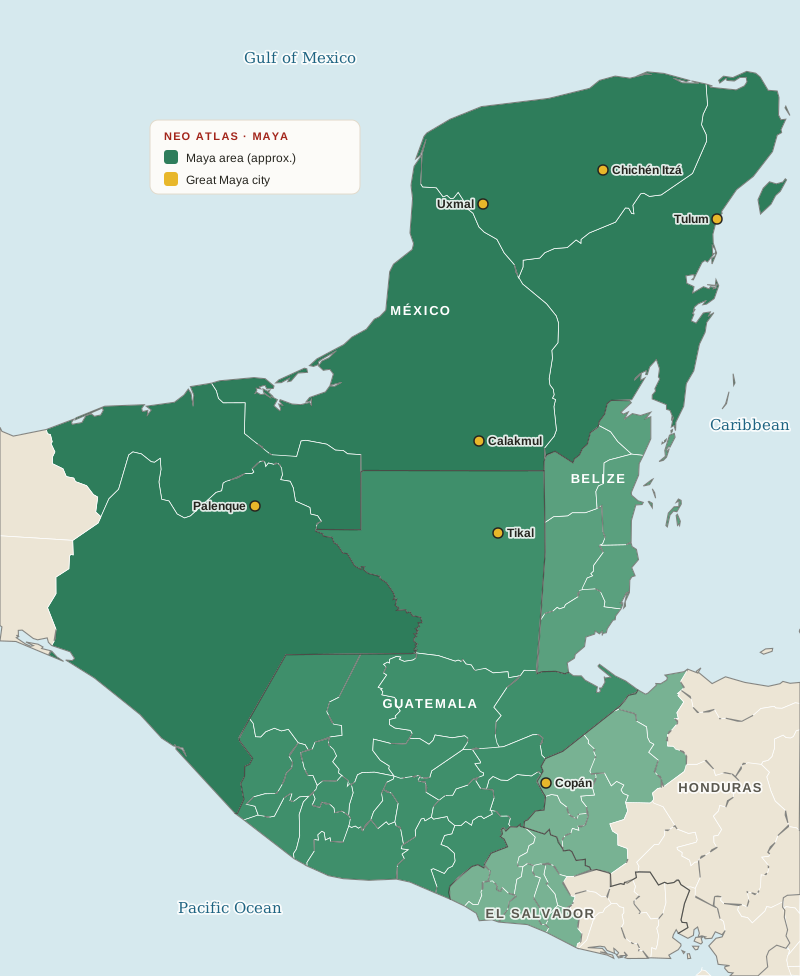
The Maya Bioregion by land and sea: the Maya area by country, its area of influence over the coast and the Caribbean, and the great cities. Plus the 72 places of the map of The Mysterious Maya (1977), found at the UNAM Central Library. Search, switch the layers, or press ▶ to fly from city to city.
Layer “Map of The Mysterious Maya”: Stuart, George E. & Stuart, Gene S. (1977). The Mysterious Maya. Washington: National Geographic Society. Map of the Maya lowlands and highlands. UNAM Central Library, F1435 S87. ▲ archaeological site · ◯ populated place of archaeological importance · ● city or town · ✚ volcano, as in the printed legend. Coordinates set by NEO.
Base maps © Esri and OpenStreetMap contributors · language regions: schematic, after Natural Earth (public domain) · Cartography by Librarian Joséf Sánchez Coach · © 2026.
02Archive
The Maya world in brief.
The Mayan Bioregional Library covers the Maya area of Mesoamerica: about 324,000 square kilometres (32,400,000 hectares / 80,060,000 acres) across south-east Mexico, Guatemala, Belize and the western edges of Honduras and El Salvador. It runs from the limestone plain of the Yucatán Peninsula to the volcanic highlands of Chiapas and Guatemala, with the Caribbean coast and the Mesoamerican Reef to the east (area as commonly given for the Maya area in Britannica and archaeological atlases).

- Area
- ≈ 324,000 km² · 32.4 million ha · 80 million acres
- Countries
- Mexico (Yucatán, Campeche, Quintana Roo, Chiapas, Tabasco), Guatemala, Belize, western Honduras and El Salvador
- Maya people today
- About 8 million (estimate): 6.2 million in Guatemala (census 2018) and about 2.4 million speakers of Mayan languages in Mexico (census 2020)
- Languages
- About 30 Mayan languages, among them Yucatec, K'iche', Q'eqchi', Kaqchikel, Mam, Tseltal, Tsotsil and Ch'ol
- Protected forest
- Gran Selva Maya biocultural corridor: about 5.7 million ha in Mexico, Guatemala and Belize (2025)
- World Heritage
- Tikal, Calakmul, Palenque, Chichén Itzá, Uxmal, Copán and Joya de Cerén, among others
- Time
- Tzolk'in (260 days), Haab' (365 days) and the Long Count
- Writing
- A logosyllabic script of hundreds of signs; four codices survive
- Economy
- Milpa farming, coffee, honey, textiles and crafts, tourism
- Arts
- Backstrap-loom weaving and huipiles, murals, ceramics, the marimba
- Symbols
- The ceiba (world tree), the jaguar, the quetzal, the colors of the four directions
Sources: INE Guatemala (Censo 2018), INEGI (Censo 2020), Britannica, UNESCO World Heritage Centre, Gran Selva Maya.
Codices & Books
The memory of the Mayan world.
Bark paper and deerskin folded like a screen, and the books written after: astronomy, calendars, history and sacred words.
Nothing here matches yet. Ask the librarian.
Dresden Codex
Saxon State Library, Dresden
Venus tables, eclipses and Tzolk'in almanacs: the finest of the four surviving Maya books.
Madrid Codex
Museo de América, Madrid
Almanacs for farming, hunting, beekeeping and the rituals of the days.
Paris Codex
Bibliothèque nationale de France
Katun prophecies and a zodiac of thirteen constellations.
Maya Codex of Mexico
Museo Nacional de Antropología
A Venus almanac on bark paper, authenticated by INAH in 2018: among the oldest books of the Americas.
Popol Vuh
Newberry Library, Chicago
The K'iche' book of creation: the Hero Twins and the dawn of the people of maize.
Chilam Balam of Chumayel
Princeton University Library
Books of the jaguar prophet in Yucatec Maya: history, prophecy, calendar and medicine.
Rabinal Achí
Rabinal, Guatemala
Dance-drama of a K'iche' warrior, proclaimed a Masterpiece of the Intangible Heritage by UNESCO in 2005.
Annals of the Kaqchikels
University of Pennsylvania
The Memorial de Sololá: the Kaqchikel people from their origin to the Spanish invasion.
Ritual of the Bacabs
Princeton University Library
Yucatec healing chants and incantations, written in the colonial era.
Relación de las cosas de Yucatán
Real Academia de la Historia, Madrid
Diego de Landa's account (c. 1566), whose 'alphabet' later helped decipher Maya writing.
Bibliography · UNAM Central Library
154 books on the Maya, from the shelf.
Read on 22 October 2026 from the spines of class F1435 (the Maya) at the Biblioteca Central, Universidad Nacional Autónoma de México (DGBSDI), Ciudad Universitaria: 154 titles, 268 copies, with their call numbers. Every title opens a search in WorldCat; ask for them at the library with the call number. Entries marked “(spine)” or “partly legible” give only what the spine shows.
F1435 · The Maya, general works 44 titles
- Mundo maya: viajes(magazine)
F1435 (label not visible)3 copies - Mesoamerican ArchaeologyHendon, Julia A. & Joyce, Rosemary A. (eds.)
F1435 M471 copy - Memoria del Congreso Interno 1979INAH
F1435 M49 19791 copy - Los moluscos arqueológicos: una visión del mundo mayaVelázquez Castro, Adrián & Lowe, Lynneth S. (eds.)
F1435 M662 copies - LacandoniaMontañés, Pablo
F1435 M694 copies - Ocupación y sobrevivencia campesina en la zona citrícola de YucatánMorales Valderrama, Carmen
F1435 M733 copies - The Ancient MayaMorley, Sylvanus G.
F1435 M74 19563 copies - El mundo maya: miradas japonesas(UNAM)
F1435 M862 copies - The Ancient Maya: New PerspectivesMcKillop, Heather
F1435 M4252 copies - Los legítimos hombres(spine)
F1435 M4862 copies - La civilización mayaMorley, Sylvanus G.
F1435 M7418 19723 copies - Estudios preliminares sobre los mayas de las tierras bajas noroccidentalesOchoa, Lorenzo
F1435 O232 copies - Usos, costumbres, religión i supersticiones de los mayasPacheco Cruz, Santiago
F1435 P33 19601 copy - Breve historia de los mayasPallán Gayol, Carlos
F1435 P362 copies - Journey to XibalbaPatterson
F1435 P371 copy - El PuucPiña Chan, Román
F1435 P5532 copies - Historia mayaProskouriakoff, Tatiana (comp. Rosemary A. Joyce)
F1435 P76182 copies - University of Chicago Publications in Anthropology (spine)Redfield, Robert
F1435 R431 copy - Mundo mayaReston, George (as read on the spine)
F1435 R482 copies - Ritual of the BacabsRoys, Ralph L.
F1435 R572 copies - El murciélago en la cultura mayaRomero Sandoval, Roberto
F1435 R652 copies - La civilización de los antiguos mayasRuz Lhuillier, Alberto
F1435 R82 19931 copy - Frente al pasado de los mayasRuz Lhuillier, Alberto
F1435 R841 copy - El pueblo mayaRuz Lhuillier, Alberto
F1435 R88 19933 copies - Los mayas: una breve introducciónRestall, Matthew & Solari, Amara
F1435 R5831 copy - Les hauts lieux de l'histoireChampdor (spine)
F1435 R586 19541 copy - Los antiguos mayasRuz Lhuillier, Alberto
F1435 R8153 copies - The MayasRuz Lhuillier, Alberto
F1435 R82131 copy - Los mayas y las incógnitas del imperio antiguoSantos
F1435 S352 copies - Collected Works in Mesoamerican Linguistics and Archaeology, I–IIISeler, Eduard
F1435 S36 19907 copies - The Mysterious MayaStuart, George E. & Stuart, Gene S.
F1435 S871 copy - Escondido en la selvaPrem, Hanns J. (ed.)
F1435 S556 20002 copies - Los mayasSoustelle, Jacques
F1435 S68181 copy - Los mayasStuart, George E. & Stuart, Gene S.
F1435 S87182 copies - La civilización mayaSharer, Robert J.
F1435 S42818 19983 copies - Los reinos perdidos de los mayasStuart, Gene S. & Stuart, George E.
F1435 S869182 copies - Técnicas analíticas aplicadas a la caracterización y producción de materiales arqueológicos en el área mayaVelázquez Castro, Adrián & Lowe, Lynneth S. (eds.)
F1435 T382 copies - Maya ArchaeologistThompson, J. Eric S.
F1435 T451 copy - Maya History and ReligionThompson, J. Eric S.
F1435 T561 copy - Aires de progresoThompson, Richard A.
F1435 T4643 copies - The Rise and Fall of Maya CivilizationThompson, J. Eric S.
F1435 T4962 copies - Grandeza y decadencia de los mayasThompson, J. Eric S.
F1435 T498 19843 copies - Arqueología mayaThompson, J. Eric S.
F1435 T5223 copies - Historia y religión de los mayasThompson, J. Eric S.
F1435 T4615 19861 copy
F1435.1 · Sites and regions 35 titles
- Contribución al estudio de los asentamientos de San Gervasio, Isla de CozumelSierra Sosa, Thelma Noemí
F1435.1 (label not visible)1 copy - Palenque (partly legible)(spine)
F1435.1 P21 copy - Pomoná: un sitio del Clásico maya en las colinas tabasqueñasGarcía Moll, Roberto
F1435.1 P3 copies - … los mayas contemporáneos (partly legible)(spine)
F1435.1 Q7 M391 copy - Lightning Warrior: Maya Art and Kingship at QuiriguaLooper, Matthew G.
F1435.1 Q8 L652 copies - Cultiv… territorio maya (partly legible)Bello Baltazar, Eduardo et al. (as read on the spine)
F1435.1 Q78 C852 copies - El bulto ritual de Mundo Perdido, TikalAyala Falcón, Maricela
F1435.1 T5 A933 copies - El dintel 3 del Templo IV de TikalMorselli Barbieri, Simonetta
F1435.1 T5 M671 copy - Tikal y Uaxactún en el PreclásicoLaporte, Juan Pedro & Fialko, Vilma
F1435.1 T5 T572 copies - La almena de TlahuizcalpantecuhtliSánchez, Jesús E.
F1435.1 T27 S361 copy - … prehispánica de la Huasteca (partly legible)Zaragoza Ocaña, Diana Minerva
F1435.1 T35 Z371 copy - TortugueroArellano Hernández, Alfonso
F1435.1 T67 A742 copies - Uaxactún: extinción de una culturaSchmidt
F1435.1 U2 S344 copies - Una comunidad maya en YucatánRivera
F1435.1 X6 R52 copies - Xamanhá: un sitio arqueológico de la costa central de Quintana RooGoñi, Guillermo
F1435.1 X35 G651 copy - Mayas del Puuc: arqueología de la región de Xculoc, CampecheMichelet, Dominique et al.
F1435.1 X38 M532 copies - Xkipché I: El asentamientoPrem, Hanns J.
F1435.1 X73 P743 copies - Tipología y análisis de la obsidiana de Yaxchilán, ChiapasBrokmann, Carlos
F1435.1 Y3 B762 copies - La arquitectura de YaxchilánGarcía Moll, Roberto
F1435.1 Y3 G371 copy - Yaxchilan: The Design of a Maya Ceremonial CityTate, Carolyn E.
F1435.1 Y3 T371 copy - Caribe mayaGómez, Arturo
F1435.1 Y8 G652 copies - Aproximaciones a la antropología jurídica de los mayas peninsularesKrotz, Esteban (coord.)
F1435.1 Y9 A671 copy - Espacios mayas: representaciones, usos, creenciasBreton, Alain; Monod Becquelin, Aurore & Ruz, Mario Humberto (eds.)
F1435.1 Y9 E765 copies - Mayas, gobierno y tierras frente a la acometida liberal en Yucatán, 1812–1847Güémez Pineda, Arturo
F1435.1 Y9 G842 copies - Buscando el centroBarona Cockerell, Miguel (as read on the spine)
F1435.1 Y89 B37 20131 copy - Una deuda históricaBracamonte y Sosa, Pedro
F1435.1 Y89 B741 copy - Crónicas de Yucatán: tres experiencias etnográficas en el sur de MéxicoCuevas Ávila, Rafael
F1435.1 Y89 C842 copies - Tiempos aciagos(spine)
F1435.1 Y89 P451 copy - El mundo colonial · vol. IIRuz, Mario Humberto
F1435.1 Y89 R891 copy - Vol. I (title partly legible)Ruz, Mario Humberto
F1435.1 Y89 R891 copy - Vol. III (title partly legible)Torras Conangla, Rosa
F1435.1 Y89 R892 copies - «Ruinas de Yucatán»: … fotográfico del siglo XIX (partly legible)Sellen, Adam T. & Lowe, Lynneth S.
F1435.1 Y89 S422 copies - White Roads of the YucatánShaw, Justine M.
F1435.1 Y89 S431 copy - Before Kukulkán: Maya Life, Death, and Identity at Classic Period YaxunáTiesler, Vera; Cucina, Andrea; Stanton, Travis W. & Freidel, David A.
F1435.1 Y89 T541 copy - An Inconstant Landscape: The Maya Kingdom of El Zotz, GuatemalaGarrison, Thomas G. & Houston, Stephen (eds.)
F1435.1 Z68 I531 copy
F1435.3 · Architecture and art 28 titles
- La arquitectura de BonampakArai, Alberto T.
F1435.3 A6 A732 copies - Arquitectura y arqueologíaAndrews, George F.
F1435.3 A6 A764 copies - Architecture and the Origins of Preclassic Maya PoliticsDoyle, James A.
F1435.3 A6 D691 copy - Espacios sagrados(spine)
F1435.3 A6 E762 copies - Los estilos Río Bec, Chenes y Puuc en la arquitectura mayaGendrop, Paul
F1435.3 A6 G452 copies - Maya MonumentsHughes, Nigel
F1435.3 A6 H841 copy - Mayas: guía de arquitectura y paisaje / The Maya: An Architectural and Landscape Guide(Junta de Andalucía)
F1435.3 A6 M3961 copy - Segunda Mesa Redonda de Palenque: arquitectura e ideología de los antiguos mayasTrejo, Silvia (ed.)
F1435.3 A6 M468 19973 copies - Nah, otochPierrebourg, Fabienne de & Ruz, Mario Humberto (eds.)
F1435.3 A6 N342 copies - An Album of Maya ArchitectureProskouriakoff, Tatiana
F1435.3 A6 P7 20021 copy - La ciudad maya: un escenario sagradoRivera Dorado, Miguel
F1435.3 A6 R582 copies - Orientaciones astronómicas en la arquitectura maya de las tierras bajasSánchez Nava, Pedro Francisco & Šprajc, Ivan
F1435.3 A6 S3351 copy - Maya Architecture(spine)
F1435.3 A6 T741 copy - Fiery Pool: The Maya and the Mythic SeaFinamore, Daniel & Houston, Stephen D. (eds.)
F1435.3 A7 F541 copy - Vasijas pintadas mayas en contexto arqueológicoFoncerrada de Molina, Marta & Lombardo de Ruiz, Sonia
F1435.3 A7 F662 copies - The Beast Between: Deer in Maya Art and CultureLooper, Matthew G.
F1435.3 A7 L661 copy - Los mayas del modernismo (partly legible)Lerner, Jesse
F1435.3 A7 L47181 copy - Courtly Art of the Ancient MayaMiller, Mary & Martin, Simon
F1435.3 A7 M531 copy - Mayas: el lenguaje de la belleza(INAH)
F1435.3 A7 M38641 copy - Mayas: revelación de un tiempo sin fin(INAH)
F1435.3 A7 M39071 copy - Maya Art and CivilizationSpinden, Herbert J.
F1435.3 A7 S6362 copies - Imágenes de animales en los manuscritos mexicanos y mayasSeler, Eduard
F1435.3 A7 S45181 copy - El libro del destinoSquirru
F1435.3 A8 S682 copies - La astronomía en el mundo mayaBeverido Pereau, Francisco
F1435.3 A81 copy - México rural y la serpiente emplumadaFaust, Betty Bernice
F1435.3 A37 F38181 copy - Sugarcane & Rum(spine)
F1435.3 A37 G871 copy - La cestería maya de tierras bajasRodríguez
F1435.3 B37 R633 copies - Antologías de la revista Ciencias 3: calendario, astronomía y cosmovisión(revista Ciencias, UNAM)
F1435.3 C14 C3542 copies
F1435.3 · Thought, writing and politics 19 titles
- Tiempo cíclico y vaticinios: ensayos indígenas de la historiaBracamonte y Sosa, Pedro
F1435.3 P5 B731 copy - Filosofía maya: antes de la invasiónHerrera Salazar, Gabriel
F1435.3 P5 H471 copy - Philosophy of the Ancient MayaMcLeod, Alexus
F1435.3 P5 M331 copy - Textos coloniales del libro de Chilam Balam de ChumayelÁlvarez, María Cristina
F1435.3 P6 A483 copies - Codex Dresdensis: Maya-Handschrift der Sächsischen Landesbibliothek DresdenDeckert, Helmut & Anders, Ferdinand
F1435.3 P6 D422 copies - Los códices mayasGarcés
F1435.3 P6 G362 copies - An Introduction to the Study of the Maya HieroglyphsMorley, Sylvanus G.
F1435.3 P6 M66 19751 copy - La … de los mayas (partly legible)(spine)
F1435.3 P6 O741 copy - El orden organiza… (partly legible)(spine)
F1435.3 P6 S361 copy - Maya Hieroglyphic WritingThompson, J. Eric S.
F1435.3 P6 T47 19711 copy - Crítica lingüística sobre los jeroglíficos y signos mayas (partly legible)Whorf, Benjamin Lee
F1435.3 P61 copy - Maya GlyphsHouston, Stephen D.
F1435.3 P61 copy - El despliegue del poder entre los mayas: nuevos estudios sobre la organización políticaIzquierdo y de la Cueva, Ana Luisa (ed.)
F1435.3 P7 A532 copies - Ancient Maya PoliticsMartin, Simon
F1435.3 P7 M381 copy - El movimiento maya en la década después de la paz (1997–2007)Bastos, Santiago & Brett, Roddy (eds.)
F1435.3 P7 M681 copy - Multiculturalismo y futuro en GuatemalaBastos, Santiago
F1435.3 P7 M851 copy - Nuevas perspectivas sobre la geografía política de los mayasOkoshi Harada, Tsubasa; Williams-Beck, Lorraine A. & Izquierdo, Ana Luisa (eds.)
F1435.3 P7 N842 copies - Conversaciones inconclusas: mayas y extranjeros entre dos guerrasSullivan, Paul
F1435.3 P7 S85183 copies - El …nado y la cuestión étnico nacional en Guatemala (partly legible)(spine)
F1435.3 P7 V551 copy
F1435.3 · Religion, myth and ritual 28 titles
- Introducción al estudio del Rabinal AchíAcuña, René
F1435.3 R3 A673 copies - Leyendas de los mayasAyala
F1435.3 R3 A931 copy - Mitos y leyendas de los mayasAyala
F1435.3 R3 A931 copy - Humor ritual en la altiplanicie de ChiapasBricker, Victoria R.
F1435.3 R3 B731 copy - Art and Myth of the Ancient MayaChinchilla Mazariegos, Oswaldo
F1435.3 R3 C451 copy - Con… cambios y rupturas en l… maya (partly legible)Garza, Mercedes de la & Valverde Valdés, María del Carmen (coords.)
F1435.3 R3 C653 copies - Las señoras de la lunaCruz Cortés, Noemí
F1435.3 R3 C782 copies - De la mano de lo sacro: santos y demonios en el mundo mayaRuz, Mario Humberto (ed.)
F1435.3 R3 D452 copies - … descubrimiento del culto crotálico (partly legible)Díaz Bolio, José
F1435.3 R3 D531 copy - Maya CosmosFreidel, David; Schele, Linda & Parker, Joy
F1435.3 R3 F741 copy - El hombre en el pensamiento religioso náhuatl y mayaGarza, Mercedes de la
F1435.3 R3 G373 copies - Rostros de lo sagrado en el mundo mayaGarza, Mercedes de la
F1435.3 R3 G381 copy - … la construcción humana y no humana del sentido del mundo … ante el dios Pochó de la muerte (partly legible)(spine)
F1435.3 R3 L491 copy - Los mayas: vida, mitología y arteLaughton, Timothy
F1435.3 R3 L38182 copies - La Reina RojaMalvido, Adriana
F1435.3 R3 M353 copies - La cosmovisión mayaMatul, Daniel
F1435.3 R3 M38 20072 copies - La noche de la Reina RojaMalvido, Adriana
F1435.3 R3 M3481 copy - Dioses y seres del viento entre los antiguos mayasNájera Coronado, Martha Ilia
F1435.3 R3 N342 copies - El don de la sangre en el equilibrio cósmicoNájera Coronado, Martha Ilia
F1435.3 R3 N352 copies - Psicotrónica de los mayas(spine)
F1435.3 R3 P761 copy - La imagen de ChaacQuezada García, Octavio
F1435.3 R3 Q842 copies - Religión maya(spine)
F1435.3 R3 R461 copy - El ritual de los bacabesArzápalo Marín, Ramón
F1435.3 R3 R572 copies - Las bocas del infiernoRivera Dorado, Miguel
F1435.3 R3 R5761 copy - Dragones y diosesRivera Dorado, Miguel
F1435.3 R3 R5783 copies - Maya Creation MythsKnowlton, Timothy W.
F1435.3 R31 copy - Protestantismo en el mundo maya contemporáneoGarma Navarro, Carlos & Ruz, Mario Humberto (eds.)
F1435.3 R32 copies - The Maya: Life, Myth, and ArtLaughton, Timothy
F1435.3 R31 copy
03Culture Library
Many Maya peoples.
The Maya are not one people but many related peoples who share a language family and a long history. Their cosmology shares common threads: a world of three levels (the sky, the earth and Xibalba, the underworld) joined by the ceiba tree; four directions with their colors; and time counted in interlocking cycles kept by daykeepers.
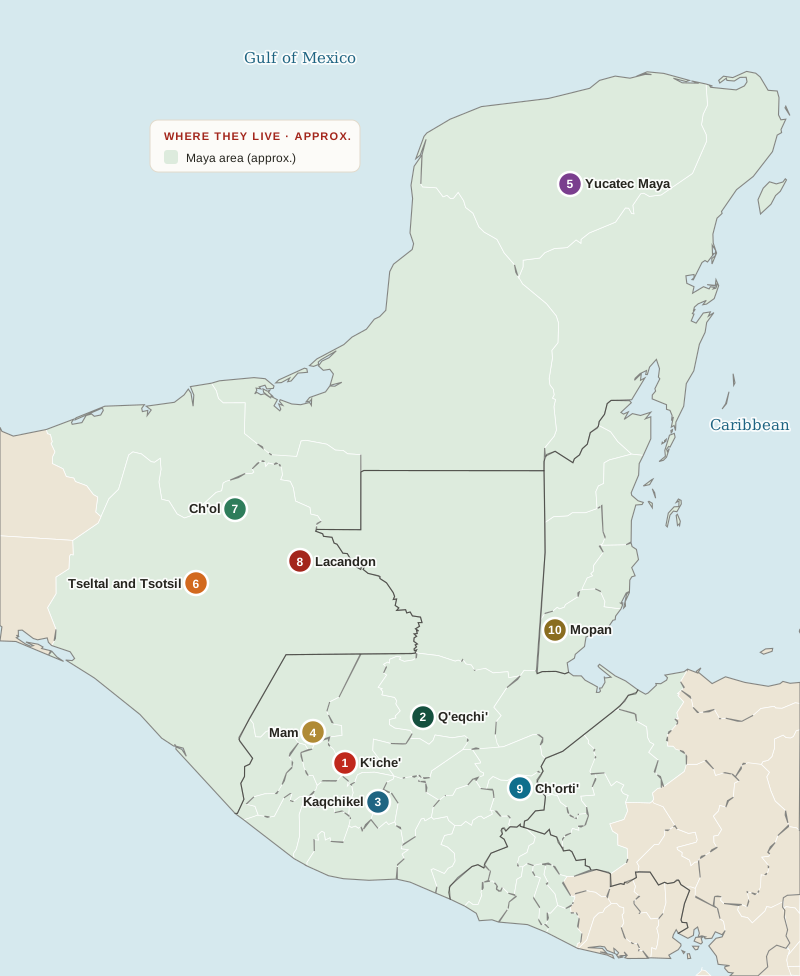
K'iche'
Western highlands of Guatemala; the Popol Vuh is their book
Q'eqchi'
Alta Verapaz, Petén and southern Belize
Kaqchikel
Central highlands of Guatemala
Mam
Western Guatemala and the Soconusco of Chiapas
Yucatec Maya
The Yucatán Peninsula
Tseltal and Tsotsil
Highlands of Chiapas
Ch'ol
Northern Chiapas and Tabasco
Lacandon
The Lacandon forest of Chiapas
Ch'orti'
The Guatemala–Honduras border, near Copán
Mopan
Southern Belize and Petén
K'iche'an10
Q'anjob'alan6
Mamean4
Yucatecan4
Ch'olan3
Tseltalan2
Huastecan1
Gastronomy
The Mayan table.
Dishes, drinks and ingredients of the milpa and the forest. The map of the table of every library ↗
Nothing here matches yet. Ask the librarian.
Cochinita pibil
Yucatán
Pork in achiote and sour orange, wrapped in banana leaves and cooked in the pib, the earth oven.
Sikil p'aak
Yucatán
A dip of toasted squash seeds, tomato and chile, an ancient Maya recipe.
Kak'ik
Alta Verapaz, Guatemala
Q'eqchi' turkey soup with chiles and spices, Intangible Cultural Heritage of Guatemala.
Pib (mucbipollo)
Yucatán
The great tamal baked underground for Hanal Pixán, the feast of the souls.
Pozol
Chiapas and Tabasco
Fermented maize dough, often with cacao, dissolved in water: food for the road and the field.
Maize
The milpa
The sacred grain from which the gods made the first people.
Cacao
Lowland forests
Drink of the lords, offering to the gods and coin of the markets.
Melipona honey
Xunan kab bee
Honey of the stingless bee, medicine and offering.
Chaya
Maya gardens
The 'tree spinach', rich in protein and iron.
Habanero chile
Yucatán Peninsula
The fiery chile of Yucatán, with designation of origin.
Philosophy and cosmovision
Ways to understand the world.
Creation, duality, time and the sacred, in the words of the peoples of this library.
Popol Vuh
The K'iche' book of creation
The gods made the first people from maize after failing with mud and wood.
The four directions
East · North · West · South
Each direction has a colour, a bearer of the year and a tree that holds the sky.
Yaxche'
The world tree
The ceiba joins the thirteen heavens, the earth and the nine levels of Xibalba.
Xibalba
The place of fear
The underworld, entered through caves and cenotes, where the Hero Twins won.
Nawal
Spirit companion
Every person is born with a day-sign and a companion that guides their path.
The Hero Twins
Junajpu and Xb'alanke
They defeat the lords of Xibalba and rise as the Sun and the Moon.
People of maize
Origin of humanity
Humans and maize share one body: to care for the milpa is to care for life.
Time as cycles
Tzolk'in · Haab' · Long Count
Time returns in great wheels; each day has its own face and energy.
Ajq'ij
The daykeeper
The spiritual guide who keeps the count of days and leads ceremonies.
In Lak'ech
'You are my other me'
A modern formulation (1960s, Domingo Martínez Paredez) of Maya reciprocity, widely taught today.
04Nature Library
Animals, plants and remedies.
The Maya forest is the largest tropical forest in the Americas after the Amazon. These are some of the species the Maya world lives with and has named for centuries. Traditional knowledge of living communities, shared for culture and study. It is not medical advice.
Nothing here matches yet. Ask the librarian.
Jaguar
Panthera onca
Near threatened (IUCN)
Baird's tapir
Tapirus bairdii
Endangered (IUCN)
Keel-billed toucan
Ramphastos sulfuratus
Native to the Maya forest
Geoffroy's spider monkey
Ateles geoffroyi
Endangered (IUCN)
Resplendent quetzal
Pharomachrus mocinno
Near threatened (IUCN)
Yucatán black howler
Alouatta pigra
Endangered (IUCN)
Ocellated turkey
Meleagris ocellata
Near threatened (IUCN)
Melipona bee
Melipona beecheii
Kept by Maya families for millennia
Ceiba
Ceiba pentandra
Yaxche', the world tree
Maize
Zea mays
The grain from which people were made
Cacao
Theobroma cacao
Drink of the gods and currency
Chicozapote
Manilkara zapota
Source of chicle
Ramón (breadnut)
Brosimum alicastrum
A food tree of the forest
Mahogany
Swietenia macrophylla
Great timber tree of the Petén
Copal
Protium copal
Resin burned in ceremonies
Chaya
Cnidoscolus aconitifolius
Leafy green of the milpa
Melipona honey
Melipona beecheii
Traditionally used on the eyes and on wounds
Guava leaf
Psidium guajava
Traditionally used as a tea for the stomach
Epazote
Dysphania ambrosioides
Traditionally used for digestion
Muicle
Justicia spicigera
Traditionally used as a tonic tea
Copal smoke
Protium copal
Used to cleanse spaces in healing ceremonies
Chaya
Cnidoscolus aconitifolius
Valued as a nourishing cooked green
Species
The species of the Mayan world.
Land, sea, sky and forest: the living neighbours of the peoples of this library, each with its scientific name.
Nothing here matches yet. Ask the librarian.
Jaguar
Panthera onca
Lord of the forest and the night; near threatened (IUCN).
Resplendent quetzal
Pharomachrus mocinno
Its green plumes crowned the lords; near threatened (IUCN).
Baird's tapir
Tapirus bairdii
The largest land mammal of the Maya forest; endangered (IUCN).
Xunan kab bee
Melipona beecheii
The sacred stingless bee kept by Maya families for millennia.
Black howler monkey
Alouatta pigra
Its voice fills the forest at dawn; endangered (IUCN).
Whale shark
Rhincodon typus
Gathers every summer off Holbox and Isla Mujeres; endangered (IUCN).
Hawksbill turtle
Eretmochelys imbricata
Nests on the Yucatán beaches; critically endangered (IUCN).
West Indian manatee
Trichechus manatus
Grazes the lagoons and bays of the Caribbean; vulnerable (IUCN).
Elkhorn coral
Acropora palmata
Builder of the Mesoamerican Reef; critically endangered (IUCN).
Queen conch
Aliger gigas
Its shell was blown as a trumpet in ceremonies; protected trade (CITES II).
Ceiba
Ceiba pentandra
Yaxche', the world tree that joins the heavens, the earth and Xibalba.
Cacao
Theobroma cacao
Drink of the lords and coin of the markets.
Maize
Zea mays
The flesh of the first people in the Popol Vuh.
Sapodilla
Manilkara zapota
Its sap is chicle; its hard wood framed temple doorways.
Ramón
Brosimum alicastrum
Breadnut tree whose seeds fed the forest people in lean years.
Huitlacoche
Ustilago maydis
The maize fungus, a delicacy of the milpa.
Indigo milk cap
Lactarius indigo
A blue mushroom of pine and oak forests.
Pink oyster mushroom
Pleurotus djamor
Grows on fallen trunks of the humid tropics.
Sacred mushrooms
Psilocybe spp.
Honored in the mushroom stones of the Maya highlands.
Wood ear
Auricularia spp.
Jelly fungus of the rainforest, gathered as food.
05Science Library
The day in its three counts.
The Tzolkʼin counts 260 days with 13 numbers and 20 signs; the Mexica Tonalpohualli is its sister count, and the NEO day follows the Earth on its orbit and the Moon in its phase. Choose any day: the wheels turn until its sign stands on top.
Maya day · Tzolkʼin
The twenty signs ↓…
Read on the Mayan LibraryMexica day · Tonalpohualli
Mexican Library ↗…
The Mexican LibraryNEO day · the sky of the day
13 counts ↗…
The same day in 13 counts- Maya Tzolkʼin · Haabʼ…260 days · 365 days
- Maya Long Count…Days since the creation, 13.0.0.0.0
- Mexica Tonalpohualli…260 days: 13 numbers × 20 signs
- Gregorian…Solar · the civil calendar of the world
- The Moon…Phase of the day
- Hijri…Lunar · Islamic calendar
- Hebrew…Lunisolar · Jewish calendar
- Chinese…Lunisolar · year of the cycle of sixty
The four directions
The twenty days, in the four directions.
Read in groups of five, each day-sign belongs to one direction and its colour. Today’s sign shines in its place.


The four directions and their colours in Yucatec Maya tradition, as in the books of Chilam Balam: east red, north white, west black, south yellow, and the green ceiba at the centre. The day-signs follow one another east, north, west, south.
The twenty day-signs
The signs of the days.
Each day-sign is a nawal: a guide and a way of being. With the thirteen numbers it makes the 260 days of the sacred count. Today’s sign shines in the list.

Imix
Crocodile
Primordial waters and the earth crocodile: the beginning of the count, nourishment and new starts.

Ikʼ
Wind
Wind and the breath of life: spirit, communication and the spoken word.

Akʼbʼal
Night
Night before the dawn: the house, dreams and the inner world.

Kʼan
Maize
The maize seed: abundance, growth and the net that gathers the harvest.

Chikchan
Serpent
The serpent: vital force, instinct and the energy of the body.

Kimi
Death
Death and the ancestors: transformation, rest and renewal.

Manikʼ
Deer
The deer and the hand: healing, work and the four pillars of the world.

Lamat
Star
The star Venus and the rabbit: harmony, fertility and plenty.

Muluk
Water
Water and offering: purification, feelings and the payment to the earth.

Ok
Dog
The dog: loyalty, guidance and the law of the community.

Chuwen
Monkey
The monkey and the thread of time: the arts, play and the artisan.

Ebʼ
Road
The road: destiny, travel and the path of each life.

Bʼen
Reed
The reed and the maize stalk: growth, the home and the hearth.

Ix
Jaguar
The jaguar: the strength of the earth, the night and the sacred altars.

Men
Eagle
The eagle: vision, the wise elders and the heights.

Kibʼ
Waxing
The vulture and the owl: forgiveness, conscience and the wisdom of the ancestors.

Kabʼan
Earth
The earth in movement: thought, knowledge and the earthquake.

Etzʼnabʼ
Flint
Flint: the mirror of truth, clear decisions and the healing of the body.

Kawak
Storm
Storm and rain: family, community and the cleansing of the sky.

Ajaw
Sun
The sun and the lord: light, wholeness and the ancestors at the close of the count.
Numbers
Dots, bars and the shell.
A dot is one, a bar is five, a shell is zero: the Maya counted in twenties and knew zero centuries before Europe. Names in Yucatec Maya.
06Art Library
The art of the Mayan world.
Murals, pigments, sculpture, ceramics, textiles and music. The map of art of every library ↗
Nothing here matches yet. Ask the librarian.
Bonampak murals
Chiapas
Painted about 790 CE: court, battle and celebration in vivid Maya blue.
Maya blue
Pigment of the Maya
Indigo bound to palygorskite clay: a colour that has resisted centuries of rain.
Calakmul murals
Chiik Nahb, Campeche
Scenes of a market and everyday life painted on a pyramid.
Mask of Pakal
Museo Nacional de Antropología
Jade mosaic funerary mask of K'inich Janaab' Pakal of Palenque (died 683 CE).
Yaxchilán lintels
British Museum and Yaxchilán
Lady K'abal Xook's vision ritual carved in stone.
Hieroglyphic Stairway
Copán, Honduras
The longest known Maya inscription, with more than 2,000 glyphs.
Jaina figurines
Isla de Jaina, Campeche
Small clay portraits of Maya men and women from an island burial ground.
Codex-style vases
Petén and Calakmul
Painted vessels with gods, lords and myths, in the style of the books.
Huipil
Backstrap loom
The woven blouse whose designs name the wearer's town and cosmos.
Marimba
Guatemala and Chiapas
The wooden xylophone, national instrument of Guatemala.
The first circle of libraries
Three libraries, one NEO.
Every library talks to the others: one design, one catalogue, one reading form, three traditions.
NEO Library
The New Encyclopedia Online: the five libraries of the whole Earth, the NEO Atlas and the NEO reading.
Your NEO reading You are hereMayan Library
The Maya world: the Tzolkʼin, the codices, the cities and the peoples of the Maya bioregion.
Your Mayan readingMexican Library
Mexico: the Tonalpohualli, the 68 original peoples, the codices and the table of Mexico.
Your Tonalli readingNEO Glossary
The words of this library.
The key terms, defined in plain words.
- Tzolk'in
- The sacred count of 260 days: 20 day-signs combined with 13 numbers.
- Haab'
- The solar year of 18 months of 20 days plus the 5 days of Wayeb'.
- Long Count
- A count of days in a modified base 20 (a tun of 18 × 20 days) from the era date 13.0.0.0.0, 11 August 3114 BCE, used for historical dates.
- Wayeb'
- The five closing days of the Haab', a time of caution.
- Nawal (Nahual)
- The day-sign and spirit companion that guides a person from birth.
- Ajq'ij
- A K'iche' daykeeper who keeps the count of days and leads ceremonies.
- Ajaw
- Lord; also the twentieth day-sign, the Sun.
- K'atun
- A period of 20 years of 360 days in the Long Count.
- Xibalba
- The underworld, entered through caves and cenotes.
- Ceiba (Yaxche')
- The world tree that joins sky, earth and underworld.
- Milpa
- The field of maize, beans and squash grown together.
- Cenote
- A natural well in the limestone of the Yucatán Peninsula.
- Sakbe
- A raised white road joining Maya cities.
- Huipil
- A woven blouse whose designs identify each community.
- Popol Vuh
- The K'iche' book of creation, the Hero Twins and the people of maize.
References and sources
Every fact has its source.
Official and academic sources behind the figures and facts of this library. Cite this page: Sánchez González, José Fernando (2026). The Mayan Library. NEO library.org. https://mayanlibrary.org/
- Instituto Nacional de Estadística, Guatemala · Censo 2018
- INEGI · Censo de Población y Vivienda 2020
- INALI · Catálogo de las Lenguas Indígenas Nacionales
- Instituto Nacional de Antropología e Historia (INAH)
- UNESCO World Heritage Centre · Mexico, Guatemala, Belize, Honduras, El Salvador
- Smithsonian National Museum of the American Indian · Living Maya Time
- Encyclopaedia Britannica · Maya
- Gran Selva Maya biocultural corridor
- Sánchez González, José Fernando · UNAM thesis (method of NEO Library)
- Stuart, George E. & Stuart, Gene S. (1977). The Mysterious Maya. Washington: National Geographic Society. Map of the Maya lowlands and highlands. UNAM Central Library, F1435 S87.
Sánchez González, José Fernando · NEO library science method · AI tools were used; the author is Librarian Joséf Sánchez Coach. AI engine by SESY.AI · Semantic Systems & AI.
Colophon
The Mayan Library, part of NEO.
The library pages, the circle of libraries, where to follow, languages and legal.
Authorship. Research, writing and cartography by Librarian Joséf Sánchez Coach. Made with the help of the artificial intelligences of the world, Claude among them, as research and drafting tools; every text, figure and map was selected, verified and signed by the author. NEO Atlas maps are a Sesy Maps product (SESY.AI).
Set in Fraunces, Instrument Sans and Space Mono (SIL Open Font License). Day-sign glyphs from Maya glyphs of days, Wikimedia Commons; see each file for its author and license. Numerals and calendar wheels drawn for NEO Library. Map tiles © Esri and OpenStreetMap contributors, rendered with Leaflet. Editor and librarian: Joséf Sánchez Coach, Colegio de Bibliotecología, UNAM.