Synchronizing Sacred Time:
The Interlocking Correlations of the Tzolk’in and the Long Count
By Librarian Joséf Sánchez Coach | Visit josef.sesy.ai
I. The Dual Matrix of Mesoamerican Timekeeping
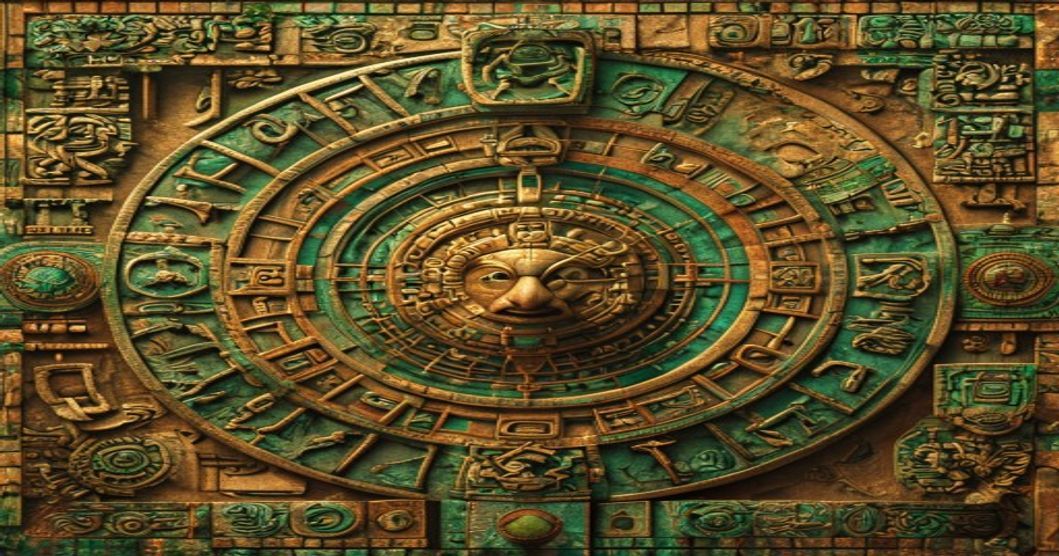
The mystical world of the calendario maya has long fascinated scholars, epigraphers, and spiritual seekers around the globe. At the absolute core of this enduring fascination lies the intricate, mathematically flawless relationship between the Tzolk’in—a 260-day sacred ritual cycle—and the Long Count—a linear astronomical count measuring deep time across vast cosmic epochs. In this comprehensive academic treatise, archived within our digital open library, we aim to illuminate the precise mechanics of these correlations, providing an authoritative understanding of the Maya’s sophisticated cosmological framework.
Developing rapidly during the Classic Period (200–900 CE), the Long Count calendar provided the macrocosmic timeline, allowing royal scribes to record historical events from the coronation of kings to the completion of the 13th B’ak’tun ($13.0.0.0.0$, or $1,872,000$ total elapsed days). Conversely, the Tzolk’in provided the microcosmic, qualitative soul of time through 20 archetypal day-signs (the nahuales mayas) and 13 galactic numbers. Far from functioning in isolation, these two systems were continuously synchronized, ensuring that every linear historical date carried an intimate spiritual frequency.
II. Mathematical Precision of the Long Count Units
To preserve mathematical accuracy within the mayan library, we must examine the exact vigesimal (base-20) hierarchy of the Long Count. The calendar tallies elapsed days from a mythical Creation Date ($13.0.0.0.0$, correlated to August 11, 3114 BCE). The base unit is the K’in (1 day). Twenty K’ins form a Winal (20 days). To align the count closer to the solar year, 18 Winals form a Tun (360 days). From that point forward, the base-20 multiplier resumes strictly: 20 Tuns form a K’atun (7,200 days), and 20 K’atuns form a B’ak’tun (144,000 days).
Higher order units—such as the Piktun, Kalabtun, K’inchiltun, and Alautun—allowed ancient Maya mathematicians to calculate cycles extending millions of years into deep space and history. Below is an epigraphic table defining these mathematical units clearly.
| Long Count Unit | Calculation Mechanics | Total Elapsed Days & Duration |
|---|---|---|
| K’in | 1 K’in | 1 Day (Fundamental Base Unit). |
| Winal (Uinal) | 20 K’ins | 20 Days (Maya Month). |
| Tun | 18 Winals ($18 \times 20$) | 360 Days (~0.986 Solar Years). |
| K’atun | 20 Tuns ($20 \times 360$) | 7,200 Days (~19.72 Solar Years). |
| B’ak’tun | 20 K’atuns ($20 \times 7,200$) | 144,000 Days (~394.26 Solar Years). |
III. Epigraphic Clarification: The 20 Authentic Sacred Nahual Signs
Every single Long Count date recorded on stone stelae ends with an explicit Tzolk’in coordinate (a number from 1 to 13 paired with one of 20 day-signs). In popular literature, confusion occasionally arises regarding day-sign translations. To restore complete epigraphic integrity, the 20 authentic maya nahual day-signs represent specific elemental, zoomorphic, and divine archetypes.
Below is the complete, authentic epigraphic catalog of the 20 day-signs that cycle through every level of the calendar, featuring their Yucatec and K’iche’ naming conventions, natural totems, and core cosmological meanings.
| Day-Sign (Yucatec / K’iche’) | Natural Totem / Element | Cosmological Energy & Spiritual Meaning |
|---|---|---|
| 1. Imix / Imox | Crocodile / Water | Primordial waters; represents deep fertility, collective subconscious, and new beginnings. |
| 2. Ik’ / Iq’ | Wind / Breath | Divine breath of spirit; symbolizes dynamic communication, intellect, and movement. |
| 3. Ak’b’al / Aq’ab’al | Night / Cave | Sanctuary of darkness; represents structural stability, hearth, and hidden potential. |
| 4. K’an / K’at | Seed / Net | Vital seed spark; signifies agricultural abundance, net of resources, and physical growth. |
| 5. Chikchan / Kan | Celestial Serpent | Serpentine electricity; embodies physical life force, raw energy, and rapid transformation. |
| 6. Kimi / Kame | Death / Ancestors | The great transformer; symbolizes necessary endings, ancestral wisdom, and rebirth. |
| 7. Manik’ / Kej | Deer / Hand | The grasping hand; represents physical healing, wilderness vitality, and protective power. |
| 8. Lamat / Q’anil | Venus / Rabbit | Cycle of Venus; embodies cosmic beauty, multiplication, art, and seed planting. |
| 9. Muluk / Toj | Water / Rain | Ceremonial fire and rain; represents repayment of debts, gratitude, and emotional fluidity. |
| 10. Ok / Tz’i’ | Dog / Guide | Loyal companion; symbolizes unconditional love, spiritual justice, and underworld guidance. |
| 11. Chuwen / B’atz’ | Monkey / Artisan | Master weaver of time; represents human creativity, playfulness, and intelligence. |
| 12. Eb’ / E | Road / Human | Path of destiny; signifies human progress, circulatory health, and spiritual travel. |
| 13. B’en / Aj | Reed / Cornstalk | Pillar of community; represents personal authority, home foundation, and vertical growth. |
| 14. Ix / B’alam | Jaguar / Earth Magic | Nocturnal protector; embodies stealth, feminine magic, jungle vitality, and earth power. |
| 15. Men / Tz’ikin | Eagle / Bird | The visionary; represents high perspective, prophetic dreams, and sky communication. |
| 16. Kib’ / Ajmaq | Owl / Vulture | Karmic cleanser; symbolizes forgiveness, deep introspection, and ancestral wisdom. |
| 17. Kab’an / No’j | Earth / Knowledge | Active mind; represents intellectual power, seismic earth movement, and synchronicity. |
| 18. Etz’nab’ / Tijax | Flint / Obsidian | Mirror of truth; embodies the sharp blade cutting through illusion, healing, and clarity. |
| 19. Kawak / Kawoq | Storm / Rain | Tempest of renewal; signifies family unity, emotional clearing, and agricultural fertility. |
| 20. Ajaw / Junajpu | Sun / Lord | Apex of light; represents spiritual leadership, solar illumination, and hero twin mastery. |
IV. Modern Ancestral Connections and Cultural Tourism
The living footprint of this extraordinary mathematical science continues to vibrate across Mesoamerica. Travelers today riding the tren maya across the Yucatán Peninsula or exploring the lush coastal stretches of the Riviera Maya and Costa Maya are walking through a sacred geography engineered to honor these exact cycles. From the equinox shadows at Chichén Itzá to the solar observatories at Palenque and Tikal, limestone temples were erected to capture celestial alignments with pinpoint accuracy.
Whether staying at a culturally harmonized hotel maya near Playa del Carmen or studying codices in quiet contemplation, visitors discover that the maya meaning of time is not an extinct curiosity. It remains a living, nature-based psychological mirror. Uncovering one’s personal birth nahual offers a grounded method for self-discovery, emotional balance, and living in conscious alignment with the natural environment.
V. Frequently Asked Questions & Your Personal Oracle
As global interest in Mesoamerican timekeeping expands, our archival team regularly clarifies key inquiries regarding the Tzolk’in and Long Count systems:
- What is the main difference between the Tzolk’in and Long Count calendars? The Tzolk’in is a cyclical 260-day sacred matrix used for divination, human birth energies, and daily rituals, while the Long Count is a linear vigesimal system used to measure vast historical epochs.
- How do the Tzolk’in day-signs relate to the Long Count? Every Long Count date ends with its precise Tzolk’in coordinate (e.g., $13.0.0.0.0, 4\text{ Ajaw}$), imbuing linear historical dates with a specific qualitative spiritual frequency.
- What is the significance of synchronizing the Tzolk’in and Long Count? Synchronizing cyclical spiritual time with linear deep time ensured that human society and statecraft operated in complete harmony with cosmic, solar, and planetary rhythms.
Discover Your Personal Nahual Oracle
Are you ready to calculate the exact ancestral energies imprinted upon you at the moment of your birth?
Get your Free Mexican Nahual Oracle Written by Josef S.
An exclusive, mathematically precise report engineered to decode your unique spiritual destiny.
If you feel a profound calling to physically connect with the ancient lands where these sacred counts were carved into stone, we highly encourage booking your next mindful journey through our trusted luxury partners at Tulum rent and Sesy rent—providing exquisite, spiritually harmonized accommodations along the Mexican Caribbean. Furthermore, elevate your daily rituals by visiting sesy.shop to explore our curated collection of meditation tools, authentic artisan crafts, and deep-dive literature.
References & Further Reading (APA)
- Aveni, A. F. (2001). Skywatchers: A Revised and Updated Version of Skywatchers of Ancient Mexico. University of Texas Press.
- Barrios, C. (2009). The Book of Destiny: Unlocking the Secrets of the Ancient Maya. HarperOne.
- Christenson, A. J. (2007). Popol Vuh: The Sacred Book of the Maya. University of Oklahoma Press. External Link: Wikipedia – Popol Vuh
- Coe, M. D., & Houston, S. (2015). The Maya (9th ed.). Thames & Hudson. External Link: Wikipedia – Maya Civilization
- FAMSI (Foundation for the Advancement of Mesoamerican Studies). (2021). Correlations between the Tzolk’in and the Long Count.
- Freidel, D., Schele, L., & Parker, J. (1993). Maya Cosmos: Three Thousand Years on the Shaman’s Path. William Morrow and Company.
- Instituto Nacional de Antropología e Historia (INAH). (2022). La Sincronización Calendárica en Mesoamérica.
- Johnson, K. (2012). Mayan Calendar Astrology: Mapping Your Inner Cosmos. Destiny Books.
- Sánchez, J. (2026). Synchronizing Sacred Time: Tzolk’in and Long Count Correlations. The Mayan Library Repository.
- Smithsonian National Museum of the American Indian (NMAI). Living Maya Time: The Interlocking Calendar Cycles.
- Tedlock, B. (1992). Time and the Highland Maya (Revised ed.). University of New Mexico Press.